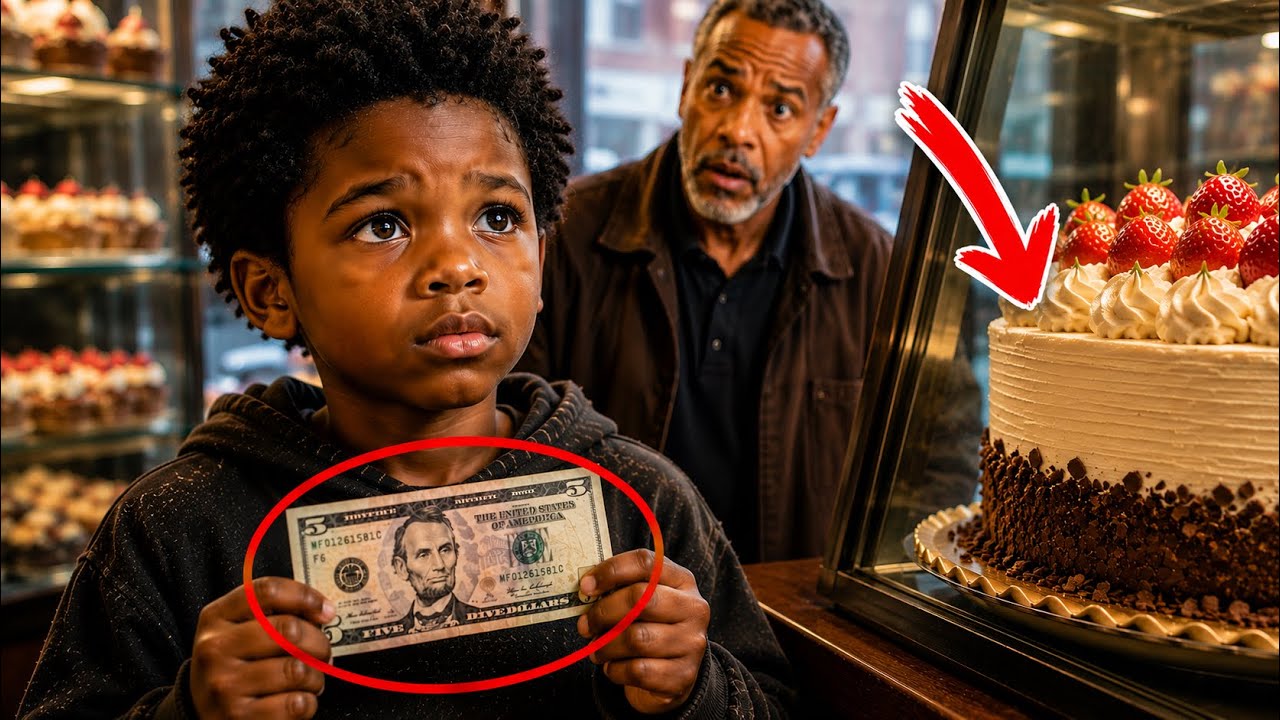
“That isn’t even enough to buy one slice.”
The cashier’s voice carried across the crowded bakery.
She did not shout.
She did not need to.
Everyone standing in line behind the boy heard her.
A few customers laughed.
A man in a gray suit checked his watch and sighed dramatically.
A woman pulled her young daughter closer, as though the boy standing at the counter might be dangerous.
The boy remained still.
He looked about twelve years old.
His oversized gray coat hung from his thin shoulders, and both sleeves were frayed badly enough to expose the lining. His sneakers were covered in dust, and the front of the left shoe had been held together with black tape.
On the counter in front of him lay a crumpled five-dollar bill.
It was all the money he had.
“I don’t need a big cake,” the boy said quietly. “Just the smallest one you have.”
The cashier picked up the bill with two fingers as if it were something dirty.
“The smallest cake here is eighteen dollars.”
She pointed toward the glass display.
Inside were rows of cakes covered in white frosting, pink frosting, strawberries, chocolate curls, and glossy sugar decorations.
The boy’s eyes stopped on a small round cake with a single yellow flower on top.
“Could you cut me a smaller piece from that one?”
Someone behind him laughed.
“This is a bakery, not a charity.”
Another voice called out:
“Kid, can you move? Some of us have jobs to get to.”
The boy lowered his head.
His name was Noah Whitmore.
Noah was used to being hungry.
He was used to cold nights when he had to curl into a tight ball beneath a thin blanket.
He was used to washing his clothes in a plastic basin with cold water. He was used to dinners made of watery soup. He was used to pretending he was not tired after walking for miles.
But there was one thing he had never learned to get used to.
The way people looked at him as though poverty meant he did not belong in the same world as them.
He tightened his fingers around the edge of the counter.
“It’s my grandmother’s birthday,” Noah said. “She has never had a birthday cake.”
No one answered.
The cashier slid the money back toward him.
“Then you should save more.”
The five-dollar bill slipped off the counter and fell to the floor.
Noah bent down immediately to pick it up.
Behind him, the sighs and complaints grew louder.
He tried not to cry.
He had promised Grandma Evelyn that he would be home early that afternoon.
He had also made a promise to himself.
Somehow, this year, she would have a cake.
Not because she had asked for one.
Evelyn never asked for anything for herself.
But she had saved Noah from the streets.
She had given him a mattress when he had nowhere to sleep.
She had shared the last bowl of soup with him when he was shaking from hunger.
She had stayed beside him for three nights when he was sick with fever, even though she had been coughing so badly she could barely stand.
If anyone in the world deserved to blow out a birthday candle, Noah believed it was her.
He picked up the five-dollar bill.
“I’m sorry for wasting everyone’s time.”
He turned toward the door.
“Wait.”
A man’s voice came from the back of the line.
No one laughed this time.
The man stepped forward.
He was around fifty, wearing a dark blue coat over an open-collar shirt. His hair was silver at the temples. He did not have the irritated expression of the other customers, but his face had gone pale, as if he had just witnessed something deeply painful.
His name was James Fisher.
James had been standing in line for several minutes.
He had heard every word.
He heard the laughter.
He heard the way the cashier emphasized the words “not enough.”
And for one moment, the bakery disappeared.
He was no longer a successful businessman who managed a real-estate company with hundreds of employees.
He was fourteen years old again.
Thirty-five years earlier, James had walked into a bakery with three dollars in coins.
He wanted to buy a small cake for Emily, the only girl in his class who had ever sat beside him at lunch while the other children mocked his old clothes.
The owner had picked up James’s coins, laughed, and asked:
“Are you trying to buy a cake or just the box?”
The customers had laughed with him.
James remembered the feeling perfectly.
It was not simply the disappointment of leaving without a cake.
It was the feeling that, for those few minutes, everyone in the room had treated poverty like a crime.
James had walked out with empty hands.
That night, he sat alone behind a bus station and made himself a promise.
If he ever had money, he would never allow another child to feel ashamed just because they could not afford something.
Thirty-five years had passed.
He had forgotten that promise.
Until now.
James stepped up to the counter.
“Which cake was he pointing to?”
The cashier’s expression changed immediately.
“The small one on the left, sir. But if you’d prefer something better, we have a larger premium—”
“No.”
James took a card from his wallet.
“I want that exact cake.”
“Of course, sir.”
The cashier removed the cake from the display, placed it carefully into a box, tied a yellow ribbon around it, and handed it to James with both hands.
The way she treated him was entirely different from the way she had treated Noah.
James looked at her for several seconds.
He said nothing.
That silence made her smile disappear.
He took the cake and turned to Noah.
“This is yours.”
Noah did not take it immediately.
He looked at the box.
Then at James.
“I can’t pay you back.”
“You don’t have to.”
“I don’t want charity.”
“I know.”
James lowered himself so they were at eye level.
“This isn’t charity. It’s a birthday gift for your grandmother.”
Noah studied his face for a long time.
Then he accepted the cake with both hands.
“Thank you.”
The customers behind them stood in silence.
The man who had complained about being late now stared at the floor.
The woman who had pulled her daughter away pretended to check her phone.
Noah held the cake against his chest and walked toward the door.
After a few steps, he stopped.
Then he turned around.
“Would you come with me?”
James looked surprised.
“Where?”
“To meet my grandmother.”
Noah glanced down at the cake.
“If you just buy this and leave, you’ll think you helped one poor kid.”
He looked back up.
“But when you meet her, you’ll understand why she deserves this cake.”
James checked his watch.
He had an investor meeting in forty minutes.
His phone had already vibrated twice.
His driver was waiting outside.
He had dozens of reasons to say no.
Then he looked at Noah.
This child had just been humiliated in front of an entire bakery, yet the only thing he cared about was making someone else’s birthday special.
James pulled out his phone and silenced it.
“All right.”
Noah smiled for the first time.
“Let’s go.”
They left the bakery beneath the uncomfortable stares of everyone inside.
None of them knew that the eighteen-dollar cake was about to lead James to a place that would change his life.
And not only his.
Noah walked quickly.
He held the cake tightly and carefully stepped around every crack and pothole in the sidewalk.
James followed beside him, his polished leather shoes looking increasingly out of place as they left the clean shopping district and entered an older part of the city.
The stores became smaller.
Glass office buildings gave way to faded brick apartment blocks.
Some windows were boarded up. Old signs swayed above the street. Tangled power lines stretched overhead.
But the neighborhood was not what surprised James most.
It was Noah.
Almost everyone seemed to know him.
“Noah!”
A woman sweeping outside a laundromat called to him.
“Is Evelyn feeling better today?”
“Her cough is better.”
“Tell her not to work too hard.”
Noah nodded.
Farther down the street, an elderly fruit vendor waved him over.
“Hold on.”
He picked two apples from a wooden crate, wiped them on his apron, and pushed them into Noah’s coat pocket.
“Take those to Evelyn.”
“I don’t have money to pay you.”
“Did I ask for money?”
The vendor looked at James, then at the cake in Noah’s hands.
“Something to celebrate?”
“It’s her birthday.”
The man’s face brightened.
“Then tell her Marco says she should live another hundred years.”
Noah laughed.
James noticed that Marco did not ask where Noah lived or who Evelyn was.
He already knew.
They kept walking.
A woman holding a baby waved to Noah from a bus stop.
A young mechanic called out to thank him for bringing medicine to his mother the week before.
An old man sitting outside a small house gave Noah a thumbs-up when he saw the cake.
James began to understand something.
Noah was not invisible in this neighborhood.
He was part of it.
“You know a lot of people,” James said.
Noah shrugged.
“Grandma knew them first. I just go with her.”
“What kind of work does your grandmother do?”
Noah thought for a moment.
“I don’t know what to call it.”
“Does she get paid?”
“No.”
“Then what does she do?”
Noah looked ahead.
“She finds people who have nowhere else to go.”
James did not ask anything else.
They turned into a narrow road behind an abandoned factory.
Weeds grew through cracks in the pavement. At the end of the road stood a rusted iron gate, one side hanging loosely from its hinges.
Beyond the gate was a large warehouse.
The metal roof was stained and patched.
The brick walls were cracked.
Several windows were broken and covered with cardboard.
There was no sign on the building.
Only a small bell hanging from a string beside the door.
Noah pushed open the gate.
James stopped.
“You live here?”
Noah turned.
“Yes.”
He said it as naturally as though the warehouse were an ordinary house.
“Two years ago, I lived outside.”
James looked at him.
“What happened to your parents?”
Noah’s smile disappeared.
“My father died in a construction accident. My mother got sick not long after that.”
He looked down at his taped shoes.
“After she died, I was sent to a foster home. There were too many people there. I ran away.”
“How old were you?”
“Ten.”
James had no answer.
Noah kept walking.
“I slept behind a convenience store. Grandma Evelyn found me one night when it was raining.”
“Did she know you?”
“No.”
“Then why did she bring you here?”
Noah looked at him as though the question made no sense.
“Because I was cold.”
The warehouse door opened before Noah could ring the bell.
An elderly woman stepped outside.
She was small, with silver hair tied neatly into a bun. She wore a faded blue sweater and an apron dusted with flour. Her face was lined with age, but her eyes were bright and alert.
When she saw Noah, she opened her arms.
“Where have you been?”
Noah ran to hug her, still holding the cake carefully to one side.
“I have a surprise.”
Evelyn looked at the cake box.
Then at James.
“You didn’t trouble someone, did you?”
“No. He offered.”
James stepped forward.
“Happy birthday.”
She looked embarrassed.
“You did not have to do that.”
“Maybe I did.”
She studied him for a second, then smiled.
“Then come inside. Anyone who brings cake is welcome here.”
Noah opened the door wider.
James stepped inside.
And froze.
He had expected a dark room with a few old mattresses and a small camping stove.
He had been wrong.
Behind the damaged metal walls was an entire world in motion.
More than twenty people filled the large space.
On the left, three women were serving soup into bowls. An elderly man sat near a portable heater, holding a cup of tea with both hands.
Near the windows, several young men were building wooden shelves from salvaged boards.
A woman folded blankets.
A little girl sat on a plastic chair drawing a house beneath a yellow sun.
At the far end of the room, a man in a wheelchair was repairing a small radio.
It did not feel like a temporary shelter.
It felt like a large family trying to keep one another from falling.
“What is this place?” James asked.
Noah answered proudly.
“It’s Grandma’s house.”
Evelyn shook her head.
“It belongs to anyone who needs a roof while they find a way forward.”
A woman serving soup looked up.
“Evelyn, you are supposed to be resting.”
“I am resting.”
“You’re standing.”
“Standing can be restful.”
The entire room laughed.
Evelyn walked toward a long table in the center of the warehouse.
“Noah, put the cake here.”
James continued looking around.
Buckets sat beneath several leaks in the roof.
Thin mattresses lined both walls, each separated by homemade curtains.
One small corner had been turned into a classroom with a cracked whiteboard.
A metal medicine cabinet contained only a few bandages and basic cold remedies.
Everything was limited.
But it was clean.
Organized.
Maintained with almost sacred care.
Noah tugged at James’s sleeve.
“You need to see this.”
He led him to the wall at the back of the room.
At the center hung a handmade wooden sign. The painted letters had faded, but the words were still clear:
“Here, no one asks who you used to be. We only ask who you can become.”
Around it were dozens of photographs.
A man in a chef’s uniform.
A woman standing beside a delivery truck.
A young woman holding a graduation certificate.
A father hugging two children.
Under each photograph was a short message.
“First job in seven years.”
“Returned to school at thirty-eight.”
“Completed recovery.”
“Reunited with his daughter.”
“First apartment.”
“Became a nurse.”
“Opened his own repair shop.”
James walked slowly along the wall.
There were more than one hundred photographs.
Some were faded with age.
Some looked newly printed.
Every picture represented a person who had once stood at the edge of losing everything and had been pulled back.
“Did Evelyn help all of them?” James asked.
Noah nodded.
“Some stayed a few days. Some stayed for months. She helps them get identification, look for work, call their families, and see doctors.”
“Where does the money come from?”
“There isn’t much money.”
Noah pointed toward several donation boxes near the door.
“People in the neighborhood bring what they can. Food, blankets, clothes, medicine.”
“What about the building?”
“She said the old owner let her use it. But he died.”
James looked up at the metal roof.
A drop of water fell into a bucket even though it had not rained that day.
A pipe must have been leaking.
“How long has she been doing this?”
“Nineteen years.”
James turned.
“Nineteen?”
Noah nodded.
“She used to be a nurse. After Grandpa died, she sold their house. She used the money to buy food and rent this place.”
James looked again at the wall.
Hundreds of faces.
Hundreds of lives.
Outside this neighborhood, almost no one knew the place existed.
There was no sign.
No fundraising office.
No media coverage.
Only one elderly woman spending the rest of her life helping strangers stand again.
“It’s time!”
Someone called from across the room.
Several lights were turned off.
Noah placed the cake in the middle of the table.
A single candle was pushed into the frosting.
Evelyn protested.
“You don’t need to do this. Everyone still needs dinner.”
“Sit down,” Noah said. “Today you have to listen to me.”
“You are twelve years old.”
“But today I have a cake.”
Everyone laughed again.
Evelyn sat down.
Noah lit the candle.
The whole room began to sing.
No one sang in tune.
Some people clapped too quickly.
The little girl near the window sang louder than everyone else.
But as James looked around the room, his throat tightened.
Evelyn was not looking at the cake.
She was not looking at the candle.
She was looking at the people singing to her.
Her eyes filled with tears.
When the song ended, Noah said:
“Make a wish.”
Evelyn closed her eyes.
Only for a few seconds.
Then she blew out the candle.
“What did you wish for?” Noah asked.
“If I tell you, it won’t come true.”
“But you always wish for the same thing.”
“Then why are you asking?”
Someone handed her the knife.
Evelyn cut the small cake into slices so thin they were almost transparent.
James watched her calculate every cut.
She did not want anyone left out.
When she finished, she picked up the first slice.
James assumed she would give it to Noah.
Instead, she carried it to the elderly man who had arrived that afternoon.
“You eat first,” she said. “You haven’t eaten since morning.”
The second slice went to the young mother holding her baby.
The third went to the little girl with the drawing.
The fourth went to the man in the wheelchair.
One by one, the slices disappeared.
No one began eating.
They were waiting for Evelyn to take one.
But she kept serving everyone else.
Finally, only one small piece remained.
Evelyn quietly placed it on Noah’s plate.
“What about you?” Noah asked.
“I don’t like sweets.”
The room became silent.
No one believed her.
Noah looked at the cake.
Then he used a fork to cut it in half.
He placed one half on a clean plate in front of her.
“Then you can eat the part that isn’t sweet.”
Evelyn stared at him.
She laughed, but tears were already running down her cheeks.
James turned away.
He looked at the buckets beneath the leaks.
The old heater.
The kitchen with only two burners.
The thin mattresses lined against the walls.
He had spent years sitting in boardrooms where people argued over millions of dollars to redesign the lobby of a luxury building.
He had signed contracts worth tens of millions without hesitation.
But he had never seen any investment create more hope than this collapsing warehouse.
James held his slice of cake.
He did not eat it.
He walked outside.
Noah watched him leave, but Evelyn gently shook her head and motioned for him to stay.
Outside, James stood beside the rusted gate.
He took out his phone.
His assistant answered immediately.
“Mr. Fisher, the investors are waiting. We’ve called several times—”
“Cancel it.”
There was silence on the other end.
“Sir?”
“Cancel everything tomorrow.”
“Tomorrow you have a meeting with the city council and—”
“Cancel all of it.”
James looked back at the warehouse.
“I need you to investigate a property.”
He gave her the address.
“Pull the ownership records, zoning details, unpaid taxes, liens, and any pending legal action. I want to know who owns it now.”
“Is there a problem with the property?”
James looked through a broken window.
Inside, Evelyn was laughing as Noah tried to put frosting on her nose.
“No.”
He spoke slowly.
“For the first time in a long time, I think I found something that has no problem at all.”
He paused.
“The problem is that we allowed it to survive alone for this long.”
The next morning, Noah woke at five-thirty.
He folded his blanket, stacked his mattress, and carried the bowls left from the previous evening into the kitchen.
Evelyn was already there.
She was making coffee in an old pot.
“You need more sleep,” Noah said.
“I’m old. Old people don’t need much sleep.”
“The doctor said you do.”
“The doctor is forty years younger than I am. He has no experience being old.”
Noah shook his head.
Evelyn looked at him and smiled.
“Yesterday was the best birthday of my life.”
“Because of the cake?”
“No.”
She placed a hand against his cheek.
“Because you thought of me.”
The sound of heavy engines came from outside.
Not one vehicle.
Several.
Noah ran to the door.
Three trucks had stopped in front of the gate.
Behind them was a yellow bulldozer.
A black car parked along the curb.
Three men got out.
One wore a white hard hat and carried a clipboard.
Another wore a jacket with a construction company logo.
The third taped a red notice to the gate.
Evelyn stepped outside.
“What is happening?”
The man in the hard hat looked down at his paperwork.
“Are you responsible for this property?”
“I manage this place.”
“Did you receive the evacuation notice?”
Evelyn paused.
“What notice?”
The man pointed toward the paper on the gate.
“This building has been transferred. The demolition permit takes effect today.”
Noah stepped forward.
“What does demolition mean?”
The man did not look at him.
“Everyone must leave the building. Our team will begin work this morning.”
Evelyn looked at the bulldozer.
Then she looked at the people slowly gathering behind her.
A mother held her child tightly.
The man in the wheelchair pushed himself toward the door.
A young man came outside still wearing his sleeping clothes.
“That cannot be right,” Evelyn said. “We never received any notice.”
“It was sent to the registered address of the former owner.”
“The former owner has been dead for more than a year.”
“Ma’am, I am only carrying out the order.”
“There are more than twenty people living here.”
“We can give everyone thirty minutes to collect their belongings.”
“Thirty minutes?”
Noah’s voice broke.
“This is our home.”
The man looked at Noah for the first time.
There was some sympathy in his eyes.
But he lowered his gaze back to the document.
“I’m sorry. I can’t change the decision.”
The news spread quickly through the warehouse.
Panic took over.
A woman rushed to stuff her children’s clothes into garbage bags.
The elderly man who had received the first slice of cake stood beside his mattress, not knowing what to take.
A young woman held a framed photograph against her chest.
Someone began to cry.
Someone else asked where they were supposed to go.
No one had an answer.
Noah ran to Evelyn.
“Grandma.”
She kept looking at the bulldozer.
“Where will we go?”
Evelyn took a long breath.
Her eyes were wet.
But when she turned toward everyone, her voice remained steady.
“Take only what truly matters.”
“What about the food? The blankets? The medicine?”
“We’ll carry what we can.”
“What about the wall?”
Noah pointed toward the photographs.
Evelyn did not answer immediately.
She looked at the hundreds of faces.
The people this place had saved.
Then she picked up a cardboard box.
“Take the photographs down.”
Everyone began packing.
No one spoke.
There was only the sound of zippers.
The sound of objects being placed into boxes.
The sound of wheelchair tires rolling across concrete.
The sound of a child asking his mother where they would sleep that night.
Thirty minutes later, everyone stood outside._
Each person carried what remained of their life in an old suitcase, a plastic bag, or a cardboard box.
Noah was the last one to leave the warehouse.
He stood in the doorway.
He looked at his mattress.
He looked at the table where everyone had sung the night before.
He looked at the empty wall where the photographs had been.
He remembered the first night Evelyn brought him there.
It had been raining.
He stood at the same door, soaking wet, ready to run if she tried to hurt him.
She had simply placed a bowl of soup on the table and said:
“You don’t have to tell me your story until you are ready. But tonight, you do not have to sleep alone.”
Noah turned away.
Tears ran down his face.
Evelyn stood outside the gate, trying to keep her back straight.
The others gathered along the sidewalk.
No one knew which direction to go.
The man in the hard hat checked his watch.
He turned toward the crew.
“Start the machine.”
The bulldozer engine roared.
Noah gripped Evelyn’s hand.
At that moment, a black car slowly entered the narrow road.
It stopped in front of the warehouse.
The door opened.
James Fisher stepped out.
Noah recognized him immediately.
“Mr. James!”
James looked at the suitcases on the sidewalk.
He looked at Evelyn.
Then at the bulldozer.
There was no surprise on his face.
He walked directly to the man in the hard hat.
“Are you managing this project?”
“Yes.”
“Who ordered the demolition?”
“The new owner of the property.”
The engineer looked at James.
“We are waiting for final confirmation from their office.”
James removed a folder from his case.
“Here is your confirmation.”
The engineer accepted it.
He read the first page.
Then the second.
His expression changed.
He looked again at the company name in the corner.
Then he turned to the final page.
He saw the signature.
And looked up.
“Wait.”
He stared at James.
“Are you James Fisher?”
“Yes.”
“Fisher Urban Development?”
“Yes.”
The engineer looked again at the document.
“Then you are the new owner?”
James nodded.
Behind him, everyone stood completely still.
Noah stepped closer.
“You bought this place?”
James turned toward him.
“Last night, I had my team investigate the property.”
He pointed toward the warehouse.
“The building had unpaid taxes and was scheduled for a forced sale. Another development company intended to buy the land and turn it into a parking structure.”
Evelyn closed her eyes.
Perhaps she had feared this for a long time.
The engineer asked:
“So the demolition is canceled?”
James looked at the bulldozer.
“No.”
Every hopeful face became frozen.
Noah stared at him.
“No?”
James turned toward Evelyn and the families standing along the sidewalk.
“Yesterday, I believed I was buying a cake.”
He spoke slowly.
“But this boy brought me to a place this city has failed to see for almost twenty years.”
He looked at the warehouse.
“A place with no major funding. No famous name. No wealthy supporters. Yet it has helped hundreds of people find work, return to school, recover from addiction, reunite with family, and begin again.”
Evelyn covered her mouth with one hand.
James continued.
“The demolition is not canceled.”
Everyone held their breath.
“Because this building is no longer safe enough for anyone to live in.”
He opened the folder and removed a large set of plans.
“We are going to remove the damaged roof, reinforce the structure, and rebuild the entire interior.”
The engineer looked at the plans.
James turned to Noah.
“And that is only the beginning.”
He spread the drawings across the hood of a nearby car.
“Last night, my company purchased this warehouse.”
He pointed to three areas beside it.
“This morning, we completed the purchase of the three neighboring lots.”
No one spoke.
A woman began to cry.
James pointed to the first section.
“This will be a community kitchen capable of serving three hundred meals a day.”
He moved his finger.
“This area will become a small health clinic with two counseling rooms and a laundry facility.”
He pointed to the right side.
“Here we will build six classrooms, a library, and a childcare area.”
Then he pointed to the back of the plan.
“This will become a vocational workshop. Carpentry, repair, sewing, cooking, and office skills.”
A man in the crowd asked quietly:
“What about sleeping space?”
James looked at him.
“Thirty-six proper rooms.”
He paused.
“With doors.”
“With heating.”
“And private rooms for families with children.”
The man lowered his head.
His shoulders began to shake.
James looked at Evelyn.
“I have spent most of my life building beautiful properties for people who already have plenty of choices.”
He spoke softly.
“Maybe it is time I build something decent for people who have none left.”
Evelyn tried to speak.
No sound came out.
Noah released her hand and ran toward James.
He wrapped both arms around him so suddenly that James stepped backward.
James placed a hand on the boy’s shoulder.
“You mean it?” Noah asked.
“I mean it.”
“No one has to leave?”
James looked toward the people on the sidewalk.
“While construction is underway, my company will rent a temporary building two blocks from here. Everyone can move there today.”
He turned to the engineer.
“Your crew is not demolishing the warehouse.”
“Then what are we doing?”
James handed him another set of plans.
“Start measuring.”
The engineer nodded.
“Understood.”
He turned and shouted toward the construction crew:
“Shut down the bulldozer! Nobody touches the building until the reinforcement plan is approved!”
The engine stopped.
Silence held for several seconds.
Then the little girl who had drawn the house began clapping.
Someone joined her.
Then everyone did.
Applause filled the narrow street.
Some people cried.
Some laughed.
One man dropped to his knees and hugged his children.
Evelyn remained still.
She looked at James.
“You do not know us.”
“I know enough.”
“You do not know how much this will cost.”
“I do.”
“You also do not know how difficult a place like this is to operate.”
James smiled.
“I have been constructing buildings for thirty years. I can handle that part.”
Evelyn looked at the plans.
“And managing a place like this?”
James folded the map.
“That is what I hope you will teach me.”
Evelyn lowered her head.
Tears fell onto her aged hands.
Noah took her hand again.
“Grandma.”
She looked at him.
Noah smiled.
“Your birthday wish came true.”
“I never told you what I wished for.”
“You did not have to.”
Noah squeezed her hand.
“You always wish for the same thing.”
Eight months later, the narrow road behind the old factory was almost unrecognizable.
The rusted gate had been replaced by a wide blue entrance.
Part of the original warehouse exterior was preserved to remind people where the project had begun.
But inside stood a bright, warm community center filled with voices and movement.
The new kitchen served hundreds of meals every week.
The health clinic operated four days a week with volunteer doctors and nurses.
Evening classes taught reading, computer skills, job applications, and financial basics.
The training workshop was filled with the sound of tools, sewing machines, instructors, and conversation.
The sleeping rooms had real beds.
Closets.
Doors.
Every family had private space.
It was not luxurious.
But it was enough for someone to close the door, breathe deeply, and feel safe.
The photograph wall was rebuilt in the main lobby.
Every old picture was returned to its place.
Beside them were empty frames waiting for future stories.
The original wooden sign remained in the center:
“Here, no one asks who you used to be. We only ask who you can become.”
A new sign stood outside the entrance.
EVELYN HOUSE
Below it were the words:
“Here, no one starts over alone.”
James did not place his own name anywhere.
When the board suggested naming one wing after him, he refused.
“This is not my story,” he said.
Evelyn disagreed.
“No one builds a place like this alone.”
James began visiting Evelyn House every week.
At first, he came to inspect the construction.
Later, he came for reasons that never appeared on his schedule.
He ate lunch with people in the kitchen.
He helped a young man practice for a job interview.
He spent hours listening to a veteran tell stories no one else had been patient enough to hear.
He taught Noah how to read construction drawings.
In return, Noah taught him the name of nearly everyone in the neighborhood.
One afternoon, almost a year after the bakery incident, Noah found James standing in front of the photograph wall.
The boy carried a small frame.
“This is for you.”
James took it.
It was a photograph from Evelyn’s birthday.
The small cake sat in the center of the table.
The candle had just been lit.
Evelyn was smiling.
Noah stood beside her.
Behind them were the people who once slept on thin mattresses in the old warehouse.
James appeared at the edge of the photograph.
He was watching everyone, still holding his uneaten slice of cake.
On the back of the frame, someone had written:
“The day you thought you were only buying a cake.”
James read it and looked at Noah.
“Who wrote this?”
“Grandma.”
“Where is she?”
Noah pointed toward the kitchen.
Evelyn stood beside a newly arrived woman, helping her complete a job application.
Her hair was whiter than before.
Her steps were slower.
But she was still the last person to eat.
Still the first person awake.
Still asking whether everyone else was warm before remembering her own coat.
James looked at the picture again.
“Why did you insist that I come with you that day?”
Noah thought for a moment.
“Because if you only bought the cake, you would believe you had done something good.”
“And if I came here?”
“You would see someone who had been doing good her entire life.”
James smiled.
“You planned the whole thing, didn’t you?”
Noah shrugged.
“Grandma says people are not always bad. Sometimes they just haven’t seen what they need to see.”
James fell silent.
He remembered the bakery.
The crumpled five-dollar bill.
The laughter.
Noah bending down to pick up his money.
That day, James believed he had rescued the boy from a humiliating moment.
The truth was the opposite.
Noah had rescued James from becoming a man who built expensive things while forgetting why he had started working in the first place.
The cake had cost eighteen dollars.
But it opened the door to a community center.
It created hundreds of meals.
Dozens of jobs.
Safe rooms.
Classrooms.
Second chances.
And a place that reminded everyone walking through its doors that their past was not a final sentence.
A few weeks later, James returned to the bakery.
The same cashier was still working there.
The moment she saw him, she recognized him.
Her expression stiffened.
James walked to the counter.
He placed a card in front of her.
She read his name.
Then the words below it.
Evelyn House Community Employment Program.
“We are hiring kitchen staff and service workers,” James said.
The cashier looked confused.
“Why are you giving this to me?”
“Not for you.”
He pointed to the public noticeboard beside the entrance.
“Post it where anyone can see it.”
She picked up the card.
James turned to leave, then stopped.
“And the next time a child walks in here with less money than the price of a cake…”
The cashier lowered her eyes.
James continued.
“Do not make them feel as though their value is worth less too.”
She stood motionless.
Her fingers tightened around the card.
Her face turned red.
No one in the bakery laughed.
No one complained.
No one checked their watch.
For several seconds, the room became so quiet that the paper could be heard trembling in her hands.
That was the moment she understood.
James had not returned to humiliate her.
He had returned to give her a chance to become someone different from the person she had been that day.
One month later, a small box appeared beside the register.
Written on the front were the words:
“The next cake has already been paid for.”
Customers could leave money inside so that anyone unable to afford a cake would not have to leave empty-handed.
Noah was the first person to notice it.
He simply smiled.
Because he understood something many people spend a lifetime learning.
A real act of kindness does not end with the person who receives it.
It keeps moving.
From one person to the next.
From a birthday cake to a home.
From one moment of standing up for someone to hundreds of people being given back the right to hope.
You do not always need to be wealthy to change a life.
Sometimes, you only need to refuse to remain silent when someone is being humiliated.
You only need to step forward when everyone else steps back.
And sometimes, what you believe is one small act is actually the first chapter of a much larger story.
Because kindness never saves only one person.
Placed in the right hands, it can build a home for everyone who thought the world had forgotten them.


