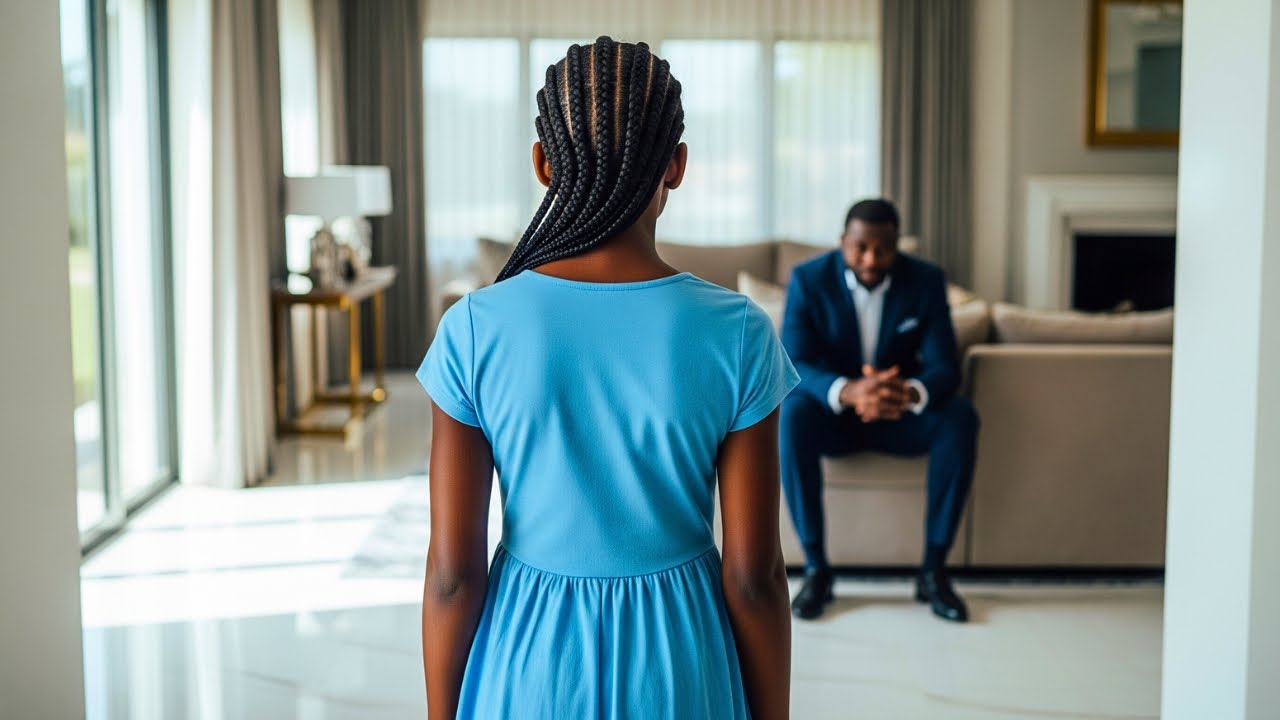
The moment Djuma walked through his own front door, dripping wet beside a seven-year-old street child, he knew he had crossed a line he could never uncross.
The girl was thin as a weed, her clothes torn in three places, her bare feet caked with mud that was now washing onto his wife’s marble floor. Rainwater ran from the ends of her tangled hair and gathered beneath her in a dark pool.
She didn’t apologize.
She didn’t shiver.
She didn’t make a sound.
She simply watched the enormous house with eyes that looked too old for her face, as though she had already learned that beautiful places could be just as dangerous as ugly ones.
At the top of the staircase, Kirani stood frozen in a silk robe, one hand resting on the polished railing. Her gold bracelets caught the fractured light from the storm outside.
“What is this?”
Her voice was not loud.
It was colder than the rain.
Djuma placed one hand gently on the child’s shoulder.
“This is Zafan.”
Kirani stared at him.
Then at the girl.
Then at the muddy footprints spreading across the white floor she had imported from Italy.
“I can see that she is a child,” Kirani said. “What is she doing in my house?”
“Our house,” Djuma corrected.
The words landed harder than he intended.
Kirani descended one step, then stopped.
“You brought her here,” she said slowly. “Without asking me.”
Djuma did not answer.
He had prepared explanations during the drive home. He had rehearsed sentences about compassion, responsibility, and doing what was right.
But standing beneath his wife’s gaze, every explanation suddenly sounded weak.
He had been watching Zafan for two weeks.
Every morning, on his way to the construction company he had built from nothing, he saw her sitting beneath the broken awning of a closed tailor shop. She never approached cars. She never pressed her hands against windows. She never begged.
She sat with her knees pulled to her chest and watched people hurry past.
The first day, he assumed someone would come for her.
The third day, he asked his driver to stop.
The fifth day, he left food beside her.
The sixth day, the food was gone, but the girl had not moved.
On the tenth day, he spoke to the vendors nearby.
No one knew where she had come from.
No one knew where she slept.
One woman selling roasted corn said the girl appeared after dark and disappeared before sunrise.
“She does not steal,” the woman told him. “She does not ask. But sometimes she wakes up screaming.”
On the fourteenth day, the rain arrived.
Djuma found Zafan crouched beside a clogged drain as water rose around her ankles. Cars splashed dirty water over her. Men stepped around her. A shopkeeper shouted that she was blocking his entrance.
Something inside Djuma broke.
He got out of the car, removed his jacket, wrapped it around her shoulders, and said, “Come with me.”
She looked at him for a long time.
Then she stood.
Now she was inside his home.
And Kirani looked as if he had dragged in a disease.
“You cannot collect children from the roadside like abandoned furniture,” she said.
“She has nowhere to go.”
“That is what shelters are for.”
“I called three. They are full.”
“Then call another.”
“She is staying tonight.”
Kirani’s eyes narrowed.
“Tonight?”
“Until we find somewhere safe.”
The child turned her face toward Kirani.
For the first time, something changed in her expression.
Not fear.
Recognition.
Zafan stared at the woman on the staircase with such fixed intensity that even Djuma noticed.
Kirani noticed too.
Her fingers tightened around the railing.
“What are you looking at?” she asked.
Zafan said nothing.
Lightning flashed beyond the windows.
For one second, the entire entrance hall glowed white.
Kirani’s face changed.
Only slightly.
But Djuma saw it.
A flicker of alarm crossed her eyes before she buried it beneath disgust.
“Get her out of here,” she whispered.
Djuma looked up at his wife.
“She is seven years old.”
“You do not know that.”
“She told me.”
“So she speaks?”
“When she wants to.”
Kirani’s attention returned to the girl.
“What else did she tell you?”
Djuma frowned.
“Almost nothing.”
Kirani descended the rest of the staircase.
Each step was controlled.
When she reached the bottom, she stopped several feet away from Zafan. The girl still wore Djuma’s jacket, the sleeves hanging beyond her hands.
“Where are your parents?” Kirani asked.
No answer.
“What is your family name?”
No answer.
“Where did you come from?”
Zafan’s lips parted.
Her voice, when it came, was hoarse from disuse.
“I don’t know.”
Kirani’s face relaxed for the first time.
It lasted less than a second.
Then she turned toward Djuma.
“One night,” she said. “Tomorrow, you take her somewhere else.”
Djuma nodded, though he had no intention of making that promise.
The housekeeper, Mama Siti, was called to prepare a bath and find clean clothes. She had worked for the family for sixteen years and had raised three children of her own. The moment she saw Zafan, her entire expression softened.
“Oh, little bird,” she murmured.
Zafan flinched when Mama Siti reached for her.
The older woman immediately lowered her hands.
“No one will touch you without asking,” she said. “Not here.”
Zafan glanced at Djuma.
He nodded.
Only then did she follow Mama Siti down the hallway.
Kirani waited until they disappeared.
Then she turned on her husband.
“Have you lost your mind?”
Djuma removed his wet shoes.
“I couldn’t leave her there.”
“You could have taken her to the police.”
“I did. They asked questions she could not answer, wrote down her name, and told me they would call if someone reported her missing.”
“And?”
“No one has.”
Kirani folded her arms.
“We have a son.”
“I am aware.”
“We have a reputation.”
“I am aware of that too.”
“You own one of the largest construction companies in this city. Strangers watch everything we do. Do you understand what it will look like if people hear that you brought a street child into our home?”
Djuma looked at her.
“What will it look like?”
Kirani did not respond.
He stepped closer.
“Say it.”
“It will look reckless.”
“No. It will look human.”
Her jaw tightened.
“Humanity does not require stupidity.”
Before Djuma could answer, footsteps sounded above them.
Their twelve-year-old son, Bari, stood halfway down the staircase, wearing headphones around his neck.
“Who is Zafan?” he asked.
Kirani and Djuma turned.
“You should be asleep,” Kirani said.
“I heard shouting.”
“We were not shouting.”
“You only say that when you were shouting.”
Bari looked past them toward the hallway.
“Is she really from the street?”
Djuma nodded.
“She will stay in the guest room tonight.”
“Can I meet her?”
“No,” Kirani said.
“Yes,” Djuma said at the same time.
The silence between husband and wife became its own argument.
Bari studied their faces, then quietly returned upstairs.
That night, Zafan slept in a room larger than every place she could remember living in combined.
Mama Siti had washed the mud from her feet and dressed her in one of Bari’s old T-shirts. The bed was covered in soft blue sheets. A lamp glowed beside the window.
Zafan sat on the edge of the mattress without lying down.
When Mama Siti brought food, she ate slowly, separating each piece of chicken from the bone with extraordinary care. Then she wrapped half a bread roll in a napkin and tucked it beneath the pillow.
“You can eat as much as you need,” Mama Siti said.
Zafan stared at her.
“No one will take it away.”
The girl’s fingers tightened around the bread.
Mama Siti did not force her to return it.
Later, just after midnight, the house woke to screaming.
Djuma reached the guest room first.
Zafan was pressed against the wall beside the bed, kicking at something that was not there.
“No!” she cried. “Don’t close it! Please don’t close it!”
Djuma stopped in the doorway.
“Zafan.”
She did not hear him.
“Zafan, you are safe.”
The word safe seemed to reach her.
Her eyes opened.
She looked around the room, breathing violently.
Then she saw Djuma.
Behind him stood Bari, Mama Siti, and Kirani.
For a moment, no one moved.
Zafan looked directly at Kirani.
The girl’s entire body became still.
“You,” she whispered.
Kirani’s face emptied of color.
Djuma turned toward his wife.
“What did she say?”
Kirani pulled her robe tighter around herself.
“She is confused.”
Zafan slid down the wall, trembling.
“You were there.”
Kirani took one step backward.
“I have never seen this child before in my life.”
Zafan looked at the gold bracelet on Kirani’s wrist.
A wide band with a carved green stone.
Her eyes fixed on it.
“The green eye,” she said.
Kirani covered the bracelet with her other hand.
“This is nonsense.”
She turned and left the room.
Djuma watched her walk away.
For the first time since bringing Zafan home, doubt entered his mind.
Not about the girl.
About his wife.
The next morning, Kirani announced that she had arranged for Zafan to be transferred to a private children’s center on the other side of the city.
Djuma put down his coffee.
“You arranged that overnight?”
“I made calls.”
“At two in the morning?”
“I know people.”
“What center?”
“Bright Haven.”
Mama Siti, who was serving tea, paused.
Djuma noticed.
“Have you heard of it?”
The housekeeper looked uncomfortable.
“Only the name.”
Kirani’s eyes sharpened.
“Then continue with your work.”
Djuma leaned back in his chair.
“I will visit it first.”
“That is unnecessary.”
“It is not.”
“They have already agreed to take her.”
“Why?”
Kirani stared at him.
“What do you mean?”
“Every reputable center I called yesterday had a waiting list. You made one call after midnight, and suddenly a private facility has space?”
Kirani’s spoon struck the edge of her cup.
“Must everything I do become an interrogation?”
“Only when it does not make sense.”
She stood.
“Keep the girl, then. Let her wander through our home and accuse me of whatever nightmare lives in her head.”
“You are the only one treating it like an accusation.”
Kirani left the dining room.
Zafan stood unseen behind the half-open door.
Over the next several days, Djuma postponed the transfer.
He told himself he was waiting for the police to finish searching for relatives. In truth, he had begun to notice changes in the house that he was not ready to end.
Bari showed Zafan how to use the television remote. She sat beside him without speaking, watching wildlife documentaries as if every animal were performing only for her.
Mama Siti braided her hair.
Djuma bought her shoes, but Zafan hid them beneath the bed and continued walking barefoot until Bari explained that no one would sell the shoes while she slept.
She began leaving small pieces of food in strange places—behind curtains, inside drawers, beneath cushions.
Bari found a boiled egg in his school bag.
Instead of laughing, he placed two granola bars in Zafan’s pocket the next morning.
“You don’t have to hide food,” he said. “But you can keep these anyway.”
Zafan looked at him for several seconds.
Then she gave him one.
It was the first thing she had offered anyone.
Kirani watched from the hallway.
Her expression was unreadable.
At first, she avoided Zafan.
Then avoidance became surveillance.
She asked Mama Siti where the girl had been.
She checked the rooms Zafan entered.
She instructed the guards not to let the child near the front gate.
One afternoon, Zafan wandered into Kirani’s private sitting room.
The space was forbidden even to Bari. It held Kirani’s jewelry cabinets, old photographs, and locked drawers filled with documents.
Zafan stood before a framed photograph of Kirani at twenty-five.
In the image, Kirani wore a white dress and stood beside a younger woman with similar eyes.
When Kirani entered and found her there, she screamed.
“Get out!”
Zafan startled so violently that she knocked the frame from the table.
The glass shattered.
Kirani grabbed the girl by the arm.
“What were you looking for?”
Zafan stared at the photograph on the floor.
“Who is she?”
“That is none of your business.”
“Her face—”
Kirani’s grip tightened.
“What about her face?”
Zafan winced.
Djuma appeared in the doorway.
“Let go of her.”
Kirani released the child immediately.
Djuma looked at the red marks forming on Zafan’s arm.
“What happened?”
“She broke something.”
“It fell,” Zafan whispered.
Kirani turned on her.
“You were searching through my things.”
“I looked at the picture.”
“You had no right to be here.”
Djuma crouched and picked up the frame.
The photograph had been taken before he met Kirani. He recognized his wife, but not the woman beside her.
“Who is this?” he asked.
Kirani snatched the frame from him.
“My cousin.”
“What is her name?”
“Why does it matter?”
“Because Zafan asked.”
Kirani laughed once, without humor.
“And we now answer every question asked by a child who cannot remember where she came from?”
Zafan looked up.
“Her name was Nalia.”
The room went silent.
Kirani’s hand loosened around the frame.
Djuma slowly stood.
“What did you say?”
Zafan pointed at the woman in the photograph.
“Nalia.”
Kirani’s lips moved, but no sound emerged.
Djuma looked from the girl to his wife.
“You said she was your cousin.”
“She was.”
“Was?”
“She died.”
“When?”
“A long time ago.”
“How does Zafan know her name?”
Kirani recovered quickly.
“She must have heard it from someone in the house.”
“No one here knew it,” Djuma said.
Mama Siti stood at the end of the hallway.
Her face had gone pale.
Kirani saw her.
For one second, the two women exchanged a look filled with years Djuma knew nothing about.
Then Mama Siti lowered her eyes.
Kirani stepped over the broken glass.
“This conversation is over.”
But it was not.
That evening, Djuma called Mama Siti into his office.
She stood near the door, wringing her hands.
“You knew the woman in the photograph,” he said.
Mama Siti did not answer.
“I saw your face.”
“Madam Kirani has had many friends.”
“She said Nalia was her cousin.”
“Yes.”
“And she died?”
Mama Siti swallowed.
“Yes.”
“How?”
“I do not know.”
“That is not true.”
The housekeeper looked toward the closed door.
Djuma softened his voice.
“You have lived in this house longer than anyone except Kirani and me. You helped raise Bari. I trust you.”
Mama Siti’s eyes filled with pain.
“Sometimes trust becomes a heavy thing, sir.”
“What does that mean?”
“It means a person can carry someone else’s secret so long that it begins to feel like their own sin.”
Djuma leaned forward.
“What secret?”
Before Mama Siti could answer, the office door opened.
Kirani stood there.
“I need to speak to my husband.”
Mama Siti stepped away immediately.
Djuma did not miss the fear in her face.
After she left, Kirani closed the door.
“You will not question my staff about my private life.”
“Our staff.”
“Do not play with words.”
“Then tell me the truth.”
“I have.”
“No. You have given me pieces. You had a cousin named Nalia. She died. A child you claim never to have seen knows her name and recognizes your bracelet.”
Kirani’s face hardened.
“The girl is manipulating you.”
“She is seven.”
“Children lie.”
“So do adults.”
The words stayed between them.
Kirani walked to the window.
“You think I am cruel,” she said.
“I think you are afraid.”
She turned.
“Of what?”
“That is what I am trying to understand.”
For a brief moment, her mask cracked.
Djuma saw exhaustion beneath it. Not anger. Not disgust.
Terror.
Then her expression closed again.
“Send her away,” Kirani said. “Before she damages this family.”
Djuma stared at his wife.
“She is not the one damaging it.”
The following week, the police called.
No missing-child report matched Zafan’s description. There were no hospital records under her name. No school enrollment. No registered relatives.
It was as though she had appeared from nowhere.
Djuma contacted a child psychologist, Dr. Selam Bekele, who specialized in trauma and memory loss. She agreed to visit the house.
During their first session, Zafan drew a narrow building with barred windows.
Beside it, she drew a tree with red flowers.
Under the tree stood three girls holding hands.
One girl was much taller than the others.
Above them, Zafan drew a green circle.
“What is that?” Dr. Selam asked.
“The eye.”
“Whose eye?”
Zafan stopped drawing.
“The woman who came at night.”
Djuma, watching from behind the partially open door, felt his stomach tighten.
“What did the woman do?” the psychologist asked.
Zafan pressed the black crayon so hard it snapped.
“She chose.”
“Chose what?”
“Who went away.”
That night, Djuma searched the internet for every children’s home in the region with a red-flowering tree near its entrance.
He found nothing.
The next morning, Mama Siti slipped a folded piece of paper beneath his office door.
It contained one name.
House of Mercy for Girls.
Below it was an address in a rural district three hours away.
Djuma drove there without telling Kirani.
House of Mercy had closed five years earlier.
The building stood behind a rusted gate at the edge of an abandoned coffee plantation. Most of the windows were broken. Weeds had swallowed the walkway.
Near the entrance stood a large African tulip tree.
Its branches were covered with red flowers.
Djuma sat in his car for several minutes, staring at it.
Then he walked inside.
The former caretaker lived in a small house behind the property. Her name was Sister Hana, though she no longer wore religious clothing.
When Djuma showed her a photograph of Zafan, the old woman gripped the table.
“Where did you find her?”
“So you know her?”
Sister Hana crossed herself.
“We called her Zafi.”
“How long did she live here?”
“Almost four years.”
“She is seven.”
“She arrived as a baby.”
“Who brought her?”
The woman looked toward the window.
“You should leave this alone.”
“I cannot.”
“You do not understand the people involved.”
“Then help me understand.”
Sister Hana studied him.
“Are you Djuma Arad?”
He stiffened.
“How do you know my name?”
She reached into an old cabinet and removed a newspaper clipping.
It showed Djuma and Kirani at the opening of a new hospital wing two years earlier.
Sister Hana tapped Kirani’s photograph.
“She came here.”
Djuma felt the room tilt.
“When?”
“Many times.”
“My wife says she has never seen Zafan.”
“Then your wife is lying.”
Sister Hana sat down.
Years earlier, she explained, House of Mercy had received donations through a charitable trust called the Nalia Foundation. The trust was registered in memory of Kirani’s dead cousin.
Kirani visited the home twice a year.
But the visits were not kind.
“She never came to meet the children,” Sister Hana said. “She came to inspect records.”
“What records?”
“Birth dates. Family histories. Medical information.”
“Why?”
“I asked her once. The next month, our funding was cut.”
Djuma’s hands became cold.
“Tell me about Zafan.”
The old woman hesitated.
“She was different from the other children.”
“How?”
“She had a file that was never kept with the others. We were instructed not to photograph her. Not to register her for school. Not to bring her to public clinics.”
“Who gave those instructions?”
“A lawyer representing the foundation.”
“What was his name?”
“Meran Dolu.”
Djuma knew the name.
Meran had been Kirani’s family attorney for nearly twenty years.
Djuma stood so abruptly that the chair scraped backward.
“What happened to the home?”
“An inspector came. Records were missing. Donations had disappeared. They accused us of negligence. The home was shut down.”
“And the children?”
“Transferred.”
“Zafan?”
Sister Hana’s eyes lowered.
“She was supposed to be transferred to Bright Haven.”
The name hit him like a blow.
The same facility Kirani had arranged after Zafan’s first night in their home.
“Was she taken there?”
“We do not know. The transport vehicle left with six children. It arrived with five.”
Djuma gripped the edge of the table.
“How did she survive?”
“She was always clever.”
The old woman stood and walked to another cabinet.
From inside, she removed a small metal box.
“When the home closed, I took what records I could. Most were destroyed before the inspectors arrived.”
She handed Djuma a faded intake form.
The paper listed Zafan’s approximate birth date, blood type, and medical notes.
The space for her mother’s name had been blacked out.
But beneath the ink, faintly visible, was a handwritten initial.
N.
Djuma looked up.
“What are you telling me?”
“I am telling you,” Sister Hana said, “that Zafan was not abandoned by strangers.”
When Djuma returned home, he found Kirani hosting a luncheon for six women from her charity board.
They sat beneath white umbrellas in the garden, drinking chilled juice and discussing an upcoming fundraiser for vulnerable children.
Zafan watched them from an upstairs window.
Djuma walked directly across the lawn.
Kirani saw the dust on his shoes.
She saw the document in his hand.
Her smile disappeared.
“Ladies,” she said, rising, “please excuse us.”
Djuma waited until the guests had gone.
Then he placed the intake form on the table.
“I went to House of Mercy.”
Kirani did not touch the paper.
“I do not know what that is.”
“Do not insult me.”
She stared at him.
“Sister Hana remembers you.”
“She is senile.”
“She remembers your lawyer too.”
Kirani turned away.
“Meran works with dozens of charities.”
“She remembers the special file you kept on Zafan.”
At the sound of the girl’s name, Kirani’s shoulders stiffened.
Djuma stepped closer.
“She was supposed to be transferred to Bright Haven five years ago. She disappeared on the way. And the first night she entered our home, that was exactly where you tried to send her.”
Kirani’s voice dropped.
“You have no idea what you are doing.”
“Then tell me.”
“I cannot.”
“You mean you will not.”
She faced him.
“You think truth is clean. You think you can drag it into the light and everyone will be grateful.”
“I think our marriage is collapsing because you refuse to tell me why you are terrified of a child.”
Kirani’s composure broke.
“She is not just a child!”
The words echoed across the garden.
Upstairs, a curtain shifted.
Djuma stared at his wife.
“What is she?”
Kirani pressed both hands to her face.
For several seconds, the only sound was water moving through the fountain.
Then she whispered, “She is a grave that learned how to walk.”
Djuma felt anger rise in him.
“She is a human being.”
“You do not understand.”
“Then make me understand.”
Kirani looked toward the house.
Her voice became almost inaudible.
“Nalia was not my cousin.”
Djuma waited.
“She was my sister.”
He said nothing.
“My younger sister,” Kirani continued. “Our father adored her. Everyone did. She was beautiful, impulsive, impossible to control.”
“Why did you lie?”
“Because after she died, my family erased her.”
“Why?”
Kirani sat down slowly.
“When Nalia was nineteen, she became pregnant.”
Djuma’s eyes moved toward the upstairs window.
“Zafan?”
“No.”
The answer came too quickly.
Kirani closed her eyes.
“She gave birth to a girl. Our father said the child had died. Nalia never believed him. She became unstable. She accused everyone. She searched hospitals, clinics, villages. For years.”
“What happened to her?”
“She died in a fire.”
Djuma stared at the bracelet on Kirani’s wrist.
“The woman with the green eye,” he said.
Kirani looked down at it.
“Nalia gave me this bracelet before the fire.”
“Why would Zafan remember you wearing it?”
Kirani stood.
“I do not know.”
“You visited her home.”
“To protect her.”
“From what?”
Kirani looked straight at him.
“From Nalia.”
The explanation made no sense.
“Nalia was dead before Zafan entered House of Mercy.”
Kirani froze.
Djuma had not told her that.
He watched the realization spread across her face.
“You knew when Zafan arrived there,” he said.
Kirani said nothing.
“You knew her age. You knew the timeline.”
She turned away.
Djuma’s voice hardened.
“Who is Zafan?”
Kirani walked back into the house without answering.
That evening, she locked herself in the bedroom.
The next morning, she was gone.
Her wardrobe was half empty. Her passport was missing. So were several jewelry boxes.
On the bed, she had left a single note.
Forgive me for protecting what you were never supposed to know.
Djuma called her phone until it went dead.
Then he called the police.
By noon, the story had begun to spread.
A prominent businessman’s wife had vanished after a dispute involving an unidentified child. Reporters gathered outside the gates. Someone leaked the name of House of Mercy.
Kirani’s charity board released a statement denying wrongdoing.
Meran Dolu, the family lawyer, stopped answering calls.
Bari learned what was happening from social media.
He stood in the kitchen holding his phone, his face white.
“Did Mom kidnap Zafan?”
“No,” Djuma said.
“Then why are people saying she did?”
“People say things before they know the truth.”
“Do you know the truth?”
Djuma could not lie to his son.
“Not yet.”
Bari looked toward Zafan, who sat at the table drawing.
“Is she our family?”
The crayon stopped moving.
Djuma looked at the girl.
“I don’t know.”
Zafan quietly turned over the paper.
On the other side, she had drawn a woman inside a room with no windows.
Beside the woman was a baby.
Above the door, she had drawn the same green circle.
Dr. Selam came that afternoon.
She asked Zafan about the drawing.
The child resisted at first. Then, piece by piece, memory surfaced.
Before House of Mercy, Zafan had lived in another building.
There were no other children.
Only one woman.
The woman had long hair and a scar on her wrist. She sang at night. She told Zafan stories about two sisters who grew up in a house with a blue gate.
Sometimes, a woman wearing a green bracelet came with a man.
The man shouted.
The woman with the scar begged.
Zafan remembered hiding beneath a bed.
She remembered smoke.
She remembered being carried into a car.
She remembered Kirani’s voice saying, “She cannot stay here.”
Djuma listened from the next room, his heart pounding.
“When did you last see the woman with the scar?” Dr. Selam asked.
Zafan’s expression went blank.
“The night the door closed.”
“What door?”
“The metal one.”
“Was there a fire?”
Zafan nodded.
“Did the woman escape?”
The girl’s eyes filled with tears.
“She told me to run.”
“Was she your mother?”
Zafan pressed both palms over her ears.
“I don’t know.”
That night, Djuma opened every locked drawer in Kirani’s sitting room.
He found bank statements, charity reports, and correspondence with Meran.
Most meant nothing.
Then, hidden beneath a false bottom in a jewelry cabinet, he found a bundle of letters tied with a white ribbon.
They were addressed to Kirani.
The handwriting belonged to Nalia.
The earliest letter was dated thirteen years before Zafan was born.
The last was dated only eight years ago.
Three years after Kirani claimed her sister had died.
Djuma read until dawn.
Nalia had not died in the fire.
The fire had been staged.
After giving birth at nineteen, Nalia’s daughter had been taken from her and placed with another family under a false name. Their father believed the pregnancy would destroy the family’s standing.
Nalia spent years searching for the child.
When she finally found her, the girl was already grown.
That girl was Kirani.
Djuma read the line three times.
Then he understood.
Kirani was not Nalia’s sister.
Kirani was Nalia’s daughter.
The woman in the photograph was not standing beside a cousin or a sibling.
She was standing beside the mother she had been raised to believe was her sister.
The family had buried the scandal by rewriting the relationship.
But the letters revealed something worse.
Nalia had later become pregnant again.
This time, she disappeared before the family could take the child.
That child was Zafan.
Kirani knew.
For years, she had secretly funded the places where Nalia and the baby were hidden. Not out of kindness, but fear.
If Nalia’s story became public, Kirani would lose control of the inheritance, the foundation, and the identity upon which her entire life had been built.
The final letter shook in Djuma’s hands.
Kirani,
You were taken from me once. I will not allow them to take Zafan too. She is your sister, whether you accept it or not. One day, she may come looking for you. When she does, do not punish her for the shame others taught you to carry.
Djuma sat alone in the dark.
Zafan was not a stranger.
She was Kirani’s half-sister.
She was Bari’s aunt.
And Kirani had known from the moment she saw her.
The plot was no longer about a frightened woman protecting her family from scandal.
It was about a woman who had allowed her own little sister to disappear into an unregistered institution so the past would remain buried.
Djuma took the letters to the police.
Within hours, investigators searched Kirani’s offices, the charity foundation, and Meran Dolu’s law firm.
They discovered altered birth records, payments to unlicensed facilities, and secret transfers made through shell organizations.
Bright Haven was not a reputable children’s center.
It was a holding facility used to hide children whose identities created legal or political problems for powerful families.
Zafan had escaped during transport five years earlier.
For years, she had moved between streets, abandoned buildings, and people who used children for labor. Her memory fractured under repeated trauma.
But one image survived.
Kirani’s bracelet.
The green eye.
The symbol of the woman who had looked at her through a metal doorway and chosen silence.
Police located Kirani two days later at a private airfield outside the city.
She was sitting inside a hired car with two suitcases and an envelope containing foreign currency.
Meran was arrested at the same location.
The footage appeared on every major news channel.
Djuma watched from the living room with Bari and Mama Siti.
Zafan sat on the floor, building a tower from wooden blocks.
On the screen, an officer opened the car door.
Kirani stepped out wearing sunglasses.
At first, she held her head high.
Then a reporter shouted, “Did you know the missing child was your sister?”
Kirani stopped.
Another reporter raised a photograph of Zafan.
“Why did you send her away?”
The airfield went silent.
Kirani slowly removed her sunglasses.
For the first time in all the years Djuma had known her, she had nowhere to hide.
Her eyes moved from the photograph to the cameras, then to the officers standing beside her.
Her mouth opened.
Nothing came out.
The confidence drained from her face in visible stages.
First came disbelief that the secret had escaped.
Then fear that everyone now understood it.
Finally came the unbearable recognition that the child she had treated as a threat had survived long enough to become a witness.
Kirani’s shoulders collapsed.
She looked smaller than Djuma had ever seen her.
Not because the cameras humiliated her.
Because the truth had forced her to see herself without the protection of wealth, family reputation, or carefully edited history.
Bari turned away from the television.
“Mom knew?” he asked.
Djuma nodded.
“All this time?”
“Yes.”
“Why didn’t she help her?”
Djuma looked at Zafan.
The girl had stopped stacking blocks.
“I think,” he said carefully, “your mother spent so many years being ashamed of what was done to her that she started protecting the people who did it.”
“That doesn’t make it right.”
“No.”
Bari’s eyes filled with tears.
“No, it doesn’t.”
The legal consequences came quickly.
Kirani and Meran were charged with conspiracy, obstruction, falsification of records, misuse of charitable funds, and child endangerment.
The investigation exposed dozens of children who had been hidden inside private institutions without proper registration.
Several officials resigned.
Two facilities were closed.
The Nalia Foundation’s assets were frozen and placed under independent control.
Kirani’s friends disappeared.
The women who had attended her garden luncheon released statements saying they had barely known her. Business partners claimed shock. Charity board members blamed one another.
But Mama Siti did not pretend innocence.
She came to Djuma one evening carrying a small suitcase.
“I should leave,” she said.
“Why?”
“I knew some of it.”
“How much?”
“I knew Madam Kirani had a younger relative hidden at House of Mercy. I knew the child should not have been there. I told myself I could not interfere in family matters.”
She looked at Zafan, who was asleep on the sofa.
“I was a coward.”
Djuma studied her.
“Why did you give me the address?”
“Because when she walked through that door, I realized silence had already stolen enough years from her.”
Djuma did not fire Mama Siti.
But he did not excuse her either.
“You will testify,” he said.
She nodded.
“I will.”
“And you will tell everything.”
“Everything.”
Zafan remained in Djuma’s home under temporary guardianship while the courts reviewed her identity.
DNA testing confirmed the truth.
Nalia was her mother.
Kirani was her half-sister.
But another question remained.
Was Nalia truly dead?
Investigators reopened the old fire case.
The building Zafan remembered had burned seven years earlier. Authorities had found one body, but the remains were too damaged for visual identification. Meran had arranged the burial.
Modern testing revealed that the remains did not belong to Nalia.
They belonged to a former employee of the foundation who had disappeared around the same time.
Nalia had survived.
For several weeks, investigators searched hospitals, shelters, and border records.
Then an officer found a woman living under an assumed name in a psychiatric care facility two provinces away.
She had been admitted six years earlier after being found wandering near a highway with severe burns and no identification.
The scar on her wrist matched Zafan’s drawing.
When Djuma brought Zafan to the facility, he did not tell her whom they were meeting.
He was afraid memory would fail.
He was afraid hope would become another cruelty.
The woman sat beneath a tree in the courtyard, wrapped in a gray shawl. Her hair had turned almost entirely white. Burn scars covered one side of her neck.
Zafan stopped walking.
The woman looked up.
For several seconds, neither moved.
Then the woman began to hum.
It was a soft melody, only six notes repeated again and again.
Zafan dropped the stuffed rabbit Bari had given her.
She ran.
The woman stood just before the child collided with her.
They held each other without speaking.
Djuma turned his face away.
Behind him, Mama Siti began to cry.
Nalia did not remember every detail of the years she had lost.
Some days, she forgot names.
Some days, she believed Zafan was still a baby.
But she remembered the song.
She remembered the metal door.
She remembered Kirani watching as Meran ordered the building sealed.
And she remembered pushing Zafan through a narrow service window before smoke filled the room.
Her testimony completed the case.
Months later, Kirani stood in court.
She wore no jewelry.
Her hair was pulled back. Her face looked older.
When Zafan entered with Djuma, Nalia, and Bari, Kirani lifted her eyes.
Zafan did not hide.
She stood beside the family that had chosen to protect her, even after learning what her existence could cost them.
Kirani looked first at Nalia.
Then at Zafan.
Finally, she looked at Bari.
Her son’s disappointment seemed to reach her more deeply than any charge read by the court.
She lowered her head.
During sentencing, Kirani asked to speak.
“I believed I was protecting my family,” she said.
Her voice shook.
“But I was protecting a lie.”
She turned toward Zafan.
The child watched her without expression.
Kirani swallowed.
“You came into my home with nothing, and I treated you as though you had come to take everything from me.”
She paused.
“The truth is that everything I had was built on what had already been taken from you.”
No one applauded.
No one forgave her in that moment.
Some truths arrive too late to erase the damage.
Kirani was sentenced to prison.
Meran received a longer sentence for his role in the false records, illegal transfers, and the death concealed in the fire.
The family estate connected to Kirani’s inheritance was placed in a trust for Zafan and other victims identified through the investigation.
Djuma sold the marble house.
He could no longer walk through its rooms without remembering the night a frightened child stood dripping on the floor while adults debated whether she deserved shelter.
He bought a smaller home near Nalia’s care facility.
There were no grand staircases.
No imported floors.
No locked sitting rooms.
Zafan chose a bedroom with yellow curtains.
For the first few months, she still hid bread beneath her pillow.
Then one morning, Mama Siti found the bread untouched on the kitchen counter.
Not hidden.
Not saved.
Simply left there because Zafan knew breakfast would come again.
Bari enrolled her at his school.
On her first day, she gripped his hand all the way to the gate.
When another student asked whether she was his sister, Bari hesitated.
The family tree was too complicated to explain.
Then he said, “She is Zafan. She is with us.”
That answer was enough.
A year after the arrests, Djuma established a legal aid organization using funds recovered from the foundation. It helped children without records prove their identities and reconnect with relatives.
He named it the Red Tree Project.
A photograph of an African tulip tree hung in the entrance.
Beneath it were the words:
No child should disappear because the truth makes an adult uncomfortable.
Nalia attended the opening with Zafan beside her.
She was still fragile. Some days remained better than others.
But when reporters asked Zafan what she remembered about living on the street, the girl looked toward Djuma.
“I remember that many people saw me,” she said.
The room became quiet.
“Only one person stopped.”
Djuma lowered his eyes.
He had once believed bringing Zafan home was the bravest thing he had done.
It was not.
The bravest thing had been refusing to send her away when the truth became expensive.
Years later, people would remember the scandal, the arrests, and the family name that collapsed under the weight of its own secrets.
But Zafan remembered something simpler.
A rainy afternoon.
A man stepping out of a car.
A jacket placed over her shoulders.
And a front door opening.
Because sometimes a family is not destroyed when its secrets are revealed.
Sometimes the secret destroys only the lie—and gives everyone else the chance to become a family at last.