On Monday morning, at precisely 8:17, a stranger sat across from me at the Calder Street Café and asked a question that stopped time.
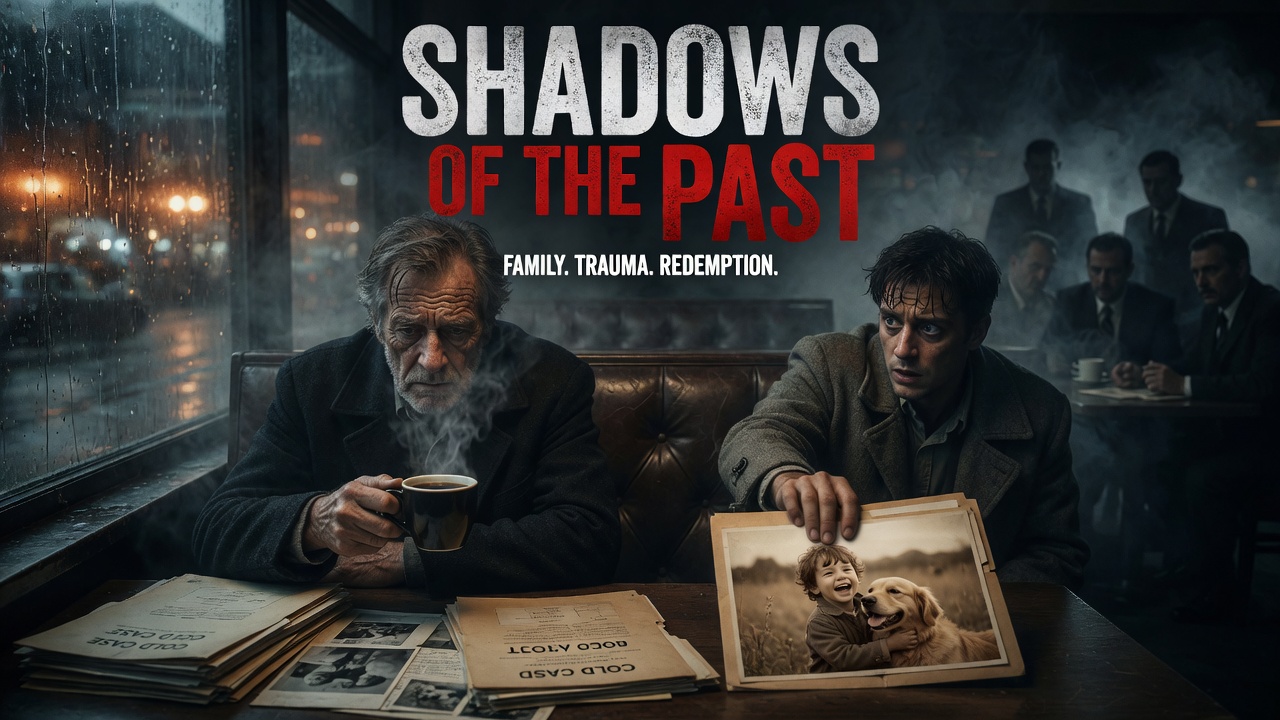
“You don’t recognize me, do you?”
I barely looked up.
At seventy-two, I had learned that strangers usually wanted one of three things: money, attention, or forgiveness. The man across from me looked as though he might need all three.
He was in his late thirties, perhaps forty. Dark hair. Gray eyes. An expensive navy coat that had been brushed too carefully. The kind of watch people bought when they wanted others to believe they had never worried about rent.
“I think you have the wrong table,” I said.
“No, Vincent. I don’t.”
My hand stopped above the cold-case file lying open beside my coffee.
Only old clients and older enemies called me Vincent without introduction.
The café was filled with its usual Monday crowd—students bent over laptops, office workers waiting for takeaway cups, retirees arguing quietly about baseball. Outside, rain pressed against the windows and turned New York traffic into a gray blur.
Nothing in the room had changed.
Yet suddenly, I could hear every small sound: the steam wand screaming behind the counter, a spoon striking porcelain, the ticking of the cheap clock above the pastry display.
The man placed a thin brown folder on the table.
“October 14, 1989,” he said. “Riverside Park. Four seventeen in the afternoon. A three-year-old boy disappeared near the carousel while his mother searched for his red mitten.”
My chest tightened.
The file beneath my hand was not that case. I never brought that case into public. I kept it locked in the bottom drawer of my desk, beneath Rebecca’s journals and a box containing one tiny red mitten.
“Who are you?” I asked.
He did not blink.
“The boy’s name was Benjamin Alexander Morgan.”
I reached slowly into my jacket.
The stranger noticed.
“If you’re reaching for a weapon, don’t. I’m not here to hurt you.”
“It’s a recorder.”
“That makes sense. You were a private investigator.”
“Retired.”
“Men like you don’t retire. They just stop getting paid.”
He pushed the folder toward me.
I did not touch it.
“Who sent you?”
“No one.”
“How do you know those details?”
“Because I was there.”
My throat closed.
The man leaned forward, and for the first time the confidence in his face cracked. Beneath it, I saw fear. Or a careful imitation of fear.
“My name is Marcus Reeves,” he said. “But that isn’t the name I was born with.”
I stared at him.
He swallowed.
“I’m Benjamin.”
For thirty-five years, I had imagined that sentence.
I had heard it in dreams, in crowded train stations, in the voices of boys calling to their fathers across playgrounds. I had imagined Benjamin returning as a teenager, then as a young man, then as someone old enough to have children of his own.
In every version, I recognized him immediately.
Reality was crueler.
The man sitting before me was a stranger.
“No,” I said.
His face tightened. “I knew you might react like this.”
“You don’t know anything about how I might react.”
“I know you searched for six years.”
“That was reported.”
“I know Mom blamed herself.”
My fingers curled around the edge of the table.
“Do not call her that.”
His eyes glistened.
“Rebecca kept a blue journal in the bottom drawer of her nightstand. She wrote in it after she thought you were asleep. She called me Little Sparrow because I used to make chirping noises when I wanted breakfast.”
I stood so quickly that my chair struck the floor.
Several people turned.
The stranger remained seated.
“Where did you hear that name?”
“I remembered it.”
“You were three.”
“I remember pieces. A yellow kitchen. A dog under the stairs. A woman singing when she washed dishes.”
My heartbeat became painful.
“Buddy,” he continued. “The golden retriever. He slept beneath the staircase because he was afraid of thunder. I used to crawl under there with him.”
That had never appeared in any police report.
Marcus opened the folder.
Inside was a faded photograph of a little boy standing beside a golden retriever. The child wore green overalls and held a wooden airplane.
My son.
The photograph had been taken two months before he disappeared.
On the back, in Rebecca’s handwriting, were the words:
Benjamin and Buddy, August 1989.
I snatched it from the folder.
“Where did you get this?”
“It was kept with me.”
“By whom?”
“The people who took me.”
The café seemed to tilt.
I forced myself to sit.
“Tell me what happened.”
Marcus looked toward the window.
“I don’t remember the park clearly. I remember a man offering to help find my mitten. I remember a white van that smelled like cigarettes and gasoline. After that, there are flashes. An airport. A woman speaking a language I didn’t understand. A room with six other children.”
“What language?”
“Romanian. I was taken to Bucharest.”
“By whom?”
“I never knew their real names. I was passed through people. Families. Institutions. Criminals. Eventually, an American couple adopted me through paperwork that was almost certainly false. They brought me to New Jersey when I was nine.”
“Names.”
“My adoptive parents were Samuel and Ruth Reeves.”
I took out my notebook.
“Addresses.”
“I brought everything I know.”
He pushed the folder closer.
His sleeves moved back slightly.
A pale crescent-shaped scar crossed the inside of his left wrist.
The scar had come from a broken glass door when Benjamin was two. Rebecca had carried him four blocks to the emergency room because traffic was frozen after an accident. Seven stitches. He had screamed until she sang “You Are My Sunshine.”
That detail had been excluded from the public description at my request.
I caught his wrist.
He flinched but did not pull away.
The scar was exactly where it should have been.
“What do you want?” I whispered.
Marcus looked at my hand gripping him.
“I wanted to find my father.”
“Why now?”
His silence lasted no more than two seconds.
For an ordinary man, it would have meant nothing.
For someone who had spent forty-five years interviewing liars, it was an alarm.
“I only discovered the truth recently,” he said. “My adoptive mother died last year. She left documents in a safe-deposit box.”
“And you came directly to me?”
“After months of verifying things.”
“How did you know where I would be?”
“You come here every Monday.”
“How did you know that?”
“I watched you.”
The honesty of the answer unsettled me more than a lie.
“For how long?”
“Three weeks.”
“Why didn’t you approach me earlier?”
“I was afraid you wouldn’t believe me.”
“I don’t.”
Pain appeared in his face.
It looked real.
That was the most dangerous part.
“I’m willing to take a DNA test,” he said. “Any laboratory you choose. Today.”
I released his wrist.
“If this is a fraud, I will uncover it.”
“I know.”
“If someone sent you to exploit me, I will find them.”
“I know that too.”
“And if you are my son…”
The sentence failed.
Marcus finished it quietly.
“Then we lost thirty-five years.”
I studied him across the table.
His eyes were not Rebecca’s. His nose was not mine. Yet something about the way he pressed his thumb against his forefinger when nervous struck me like a physical blow.
Benjamin used to do that.
Then I noticed another detail.
Marcus’s folder contained not only adoption records and photographs but a printed summary of the Morgan Family Trust.
A document connected to approximately $140 million.
Hope entered my heart.
Suspicion followed it through the same door.
“Come with me,” I said.
“Where?”
“To a laboratory you could not have prepared.”
Dr. Elise Hartman had assisted with three of my cases before I retired. She ran a private genetic laboratory on East Forty-Third Street and trusted no sample she had not collected herself.
She swabbed both of us in separate rooms, photographed the seals, and sent duplicate samples to an independent facility.
Marcus never objected.
Not when she examined his identification. Not when I requested a toxicology screen to ensure no foreign DNA had been introduced. Not even when I asked her to compare our full profiles rather than conduct only a basic paternity test.
“You’ve done this before,” he said while we waited in the hallway.
“I have exposed people who did.”
“How many?”
“Seven false heirs. Four stolen identities. Two women who switched infants in hospitals. One man who carried another person’s blood in a tube beneath his shirt.”
Marcus gave a weak smile.
“And how many missing sons?”
“Only one.”
The smile disappeared.
The expedited result would take forty-eight hours.
I spent those hours with Tony Delgado, my former partner and the only man alive who had searched for Benjamin almost as long as I had.
Tony was seventy, broad-shouldered, diabetic, and still capable of making a police lieutenant regret lying to him.
He read every document Marcus had brought.
“Samuel and Ruth Reeves existed,” he said. “Both deceased. Lived in Newark from 1995 until 2018. No biological children.”
“Adoption records?”
“Sealed and inconsistent. They claim he was adopted from Romania through a church organization that dissolved in 1997.”
“What about Marcus?”
“High school in New Jersey. Rutgers business degree. Married twelve years. Wife named Lauren. One daughter, Emily, age nine. Investment manager. No criminal record.”
“Too clean.”
Tony looked at me over his glasses.
“Clean doesn’t always mean false.”
“It does when someone waits thirty-five years to appear carrying trust documents.”
“You think he faked the scar?”
“I think pain makes people careless. Especially the person who wants something to be true.”
Tony closed the file.
“Vince, if the DNA matches, what will you do?”
I looked toward Rebecca’s photograph on my bookshelf.
She had died eleven years earlier, but grief had preserved her in my mind at every age. Twenty-six on our wedding day. Thirty-one holding Benjamin. Forty after another false lead collapsed. Fifty-seven in a hospital bed, asking whether I believed our son might still be alive.
I had lied.
I told her yes.
“I don’t know,” I said.
The call came at 3:06 on Wednesday afternoon.
Dr. Hartman asked us to return in person.
Marcus was already waiting when I arrived.
He stood beside the window with both hands in his pockets. His face looked pale.
Dr. Hartman placed two reports on the desk.
“The results from both laboratories agree,” she said. “The probability of paternity is 99.97 percent.”
No one spoke.
I stared at the number.
For thirty-five years, I had lived inside uncertainty. Was Benjamin alive? Was he cold? Did he remember us? Had he died calling for his mother? Every possibility had remained open, each one cutting in a different direction.
Now one answer existed.
My son was alive.
He was standing six feet from me.
Marcus began to cry.
Not elegantly. Not the measured tears of someone performing sadness. His mouth twisted. His shoulders shook. He turned away as if ashamed.
I crossed the room.
When I embraced him, his body went rigid.
Then his arms closed around me.
I smelled rain and unfamiliar cologne.
My son.
My stranger.
“I’m sorry,” I whispered. “I’m so sorry.”
“For what?”
“For not finding you.”
“I thought you stopped looking.”
“Never.”
“You did. The searches ended.”
“The public searches ended. Your mother was collapsing. Every call destroyed her again.”
“Did she think I was dead?”
“She never allowed herself to say it.”
Marcus pulled away.
“Where is she?”
The question was so simple that I nearly broke.
“She died eleven years ago.”
His lips parted.
“How?”
“Cancer. But grief had been taking pieces of her long before that.”
He sat down and covered his face.
“I was too late.”
I wanted to comfort him.
Instead, the investigator inside me watched.
He had asked about Rebecca only after the test. During three weeks of watching me, he had apparently never checked whether his mother was alive.
Perhaps he had been afraid.
Perhaps he already knew.
That evening, I invited him to my townhouse.
Marcus walked through the rooms like an archaeologist entering a buried city. He touched the height marks on the kitchen doorway. He stared at childhood photographs. He stood beneath the staircase where Buddy once slept.
“I remember this smaller,” he said.
“You were smaller.”
I showed him Rebecca’s journals.
He opened the first one carefully and read three pages before tears fell onto the paper.
That moment seemed sacred.
Then his eyes drifted toward the blue binder on my desk.
The Morgan Family Trust.
He noticed me watching.
“I suppose we should discuss it eventually,” he said.
“We’ve known each other for six hours.”
“I know how that sounds.”
“Do you?”
“My adoptive mother’s documents included information about the trust. That’s how I found your legal records.”
The trust had been created in 1988 by my father, Walter Kensington Morgan, a former federal prosecutor who believed inherited wealth destroyed more people than poverty did. Its assets included commercial real estate, early technology investments, and shares in two logistics companies.
The principal was now worth approximately $140 million.
The terms were unusual. I controlled the income during my lifetime, but the principal would ultimately pass to Benjamin—or to the charitable foundation designated in the event he was legally declared dead.
Because Benjamin had never been declared dead, the money remained locked.
“What exactly did you learn?” I asked.
“That I’m a beneficiary.”
“Eventually.”
“My attorney believes the distribution terms can be modified through a nonjudicial settlement agreement.”
“Your attorney?”
“Gerald Foster. He specializes in trusts.”
“You found your father this week and already have an attorney prepared to restructure his estate?”
His jaw tightened.
“I’ve spent months preparing to meet you.”
“For a reunion or a negotiation?”
“Both can be true.”
There it was.
The first clear edge beneath his grief.
Marcus rose and paced toward the window.
“I’m not asking for everything. We could divide it. Seventy million to you, seventy to me.”
“The trust is not a pie on a table.”
“It belongs to our family.”
“It exists because my father did not trust heirs with immediate control.”
“I’m thirty-eight years old, not eighteen.”
“And I met you today.”
He turned.
“I’m your son.”
“Biologically, yes.”
The words wounded him.
I saw it and hated myself for using them.
But I did not withdraw them.
Marcus left soon afterward.
Before stepping outside, he paused.
“I didn’t survive thirty-five years to steal from you.”
“I hope that’s true.”
“You don’t trust me.”
“I don’t know you.”
His voice became quiet.
“You could try.”
Three days later, I sat across from Marcus and Gerald Foster in Foster’s Manhattan office.
Foster was sixty, silver-haired, and smooth in the way of lawyers who charged by the silence between sentences. The proposed agreement covered ninety-four pages.
He explained tax exposure, beneficiary rights, changing circumstances, and the alleged danger of waiting until my death to distribute assets.
“The current structure is antiquated,” Foster said. “A negotiated division protects everyone.”
“Especially Marcus,” I replied.
“Your son has been deprived of his inheritance through circumstances beyond his control.”
“My son has been home for five days.”
Marcus shifted in his chair.
“Dad, this isn’t about taking from you.”
It was the first time he had called me Dad outside the laboratory.
The word entered me exactly where he intended.
Foster slid a pen across the desk.
“This agreement releases seventy million dollars to Marcus upon execution. You retain full benefit of the remaining assets.”
“I’ll have my attorney review it.”
“We were hoping to conclude today,” Foster said.
“Then you hoped incorrectly.”
Marcus’s restraint broke.
“You said you wanted to make up for lost time.”
“I cannot purchase thirty-five years.”
“It’s not a purchase. It’s what Grandpa intended for me.”
“You never met him.”
“Because I was kidnapped!”
The room went silent.
Marcus’s face flushed.
For a second, I saw not a sophisticated investment manager but an abandoned boy raging at a world that had continued without him.
Then the expression disappeared.
“I’m sorry,” he said. “I’m under pressure.”
“What kind?”
He looked at Foster.
The lawyer gave a small nod.
Marcus invited me to his penthouse that evening.
The apartment occupied the thirty-fourth floor of a glass tower overlooking the Hudson. Everything was expensive, spotless, and strangely impersonal. No family photographs. No child’s drawings. No evidence that Lauren or Emily lived there.
Marcus poured two drinks but barely touched his own.
“My company manages private investments,” he said. “Two major real-estate deals collapsed at the same time. Clients are nervous. I need bridge capital.”
“How much?”
“Eight-point-two million.”
“That is different from seventy.”
“The trust distribution would stabilize everything permanently.”
“Show me the company.”
He opened his laptop.
The presentation was polished: asset tables, projected returns, audited statements, contracts, and photographs of developments in Miami and Newark.
Too polished.
Fraud rarely looked chaotic. Good fraud looked cleaner than reality.
I read the auditor’s name.
Halloran, Pierce & Wexler.
I had never heard of them.
One development supposedly depended on financing from a bank that had stopped issuing commercial bridge loans eighteen months earlier. Another listed an environmental approval number with the wrong number of digits.
“How quickly do you need the money?” I asked.
“Seventy-two hours.”
“Then seventy-two hours will not be enough for me to verify this.”
“If you don’t help, hundreds of investors could lose everything.”
“How many employees do you have?”
“Forty-six.”
“Your payroll filings list eleven.”
He stared at me.
“You investigated me.”
“I read public records.”
“You’re treating me like a suspect.”
“You asked for $8.2 million.”
“I asked my father for help.”
“No. You presented your father with a deadline.”
Marcus slammed the laptop shut.
“Do you know what I learned growing up? Nobody gives you anything unless they control you. Samuel controlled food. Ruth controlled affection. The men before them controlled whether I slept indoors. I found you because I thought, for once, someone might choose me without making me beg.”
“If your business is legitimate, independent review protects both of us.”
“You still don’t believe I’m your son.”
“The DNA proved that.”
“Then what else do you need?”
“The truth.”
His face went still.
I left without giving him a dollar.
Tony began checking the companies that night.
By morning, Halloran, Pierce & Wexler had vanished. Its website was four months old. Its listed address belonged to a virtual-office service. One supposed partner had died in 2017. The Miami development existed, but Marcus had no ownership interest in it.
The financial statements were fiction.
At noon, Tony showed me another photograph.
Marcus stood outside a warehouse in Red Hook, handing an envelope to a thickset man with silver hair and a scar beneath his right eye.
“Arban Kraniki,” Tony said. “Albanian organized crime. Gambling, extortion, narcotics, construction fraud. Never convicted of anything serious.”
“What is Marcus doing with him?”
“Paying tribute, repaying debt, or buying time.”
We followed Marcus for four days.
He visited three shell-company offices, two currency exchanges, and a private gambling room above a restaurant in Queens. At the harbor, he met Kraniki again. This time, the conversation became heated.
Kraniki struck him across the face.
Marcus did not fight back.
Afterward, he remained alone beside his car for ten minutes, both hands pressed against the roof.
I watched from across the street.
A father wanted to cross that distance.
An investigator wanted to know why his son had been hit.
The investigator won.
Tony obtained access to a cloud backup associated with one of Marcus’s abandoned corporate accounts. We did not find one failed investment.
We found an empire of laundering.
More than three hundred million dollars had passed through offshore entities, fake consulting firms, manipulated property deals, and cryptocurrency accounts. Transfers were divided into amounts designed to avoid reporting thresholds. Client names were replaced with initials, but Kraniki appeared repeatedly.
Beside Marcus’s name was a figure:
$25,000,000 deficit.
He had gambled with the organization’s money and lost.
The $8.2 million was not enough to save his company. It was enough to delay his death. The seventy million from the trust would pay Kraniki, replenish missing funds, and give Marcus enough to disappear.
Then Tony found a draft email to Foster.
Once Vincent executes NJSA, transfer initial $25M within six hours. Remaining funds routed after medical certification if needed.
Medical certification.
“What does that mean?” Tony asked.
“It means if I refused, they planned to question my competence.”
A second file contained notes on my prescriptions, my cardiologist, and an episode of temporary confusion after anesthesia four years earlier.
Marcus had not merely found me.
He had built a strategy around my age.
That evening, two federal agents were waiting outside my townhouse.
Special Agent Caroline Voss introduced herself. Her partner, Daniel Cho, displayed a warrant related to unauthorized access of Marcus’s financial systems.
“We could arrest your friend Mr. Delgado,” Voss said.
“You could try.”
Tony sighed. “Vince.”
Voss did not smile.
“We have monitored Marcus Reeves for twenty-two months. Your interference has endangered an investigation involving Kraniki’s entire organization.”
“He is my son.”
“We know.”
Her answer chilled me.
Inside, she placed an old black-and-white photograph on my dining table.
My father stood outside a federal courthouse in 1985 beside a convicted Albanian crime boss named Besnik Kraniki.
Arban’s uncle.
“Walter Morgan prosecuted him,” Voss said. “Besnik received forty years. He died in prison.”
“What does that have to do with Benjamin?”
“We believe his abduction was retaliation.”
The room became silent.
Voss continued.
“A Kraniki associate was in New York in October 1989. Telephone records place him near Riverside Park. He left the country with forged documents and a child matching Benjamin’s description.”
I could barely breathe.
For thirty-five years, I had believed my son had been taken by an opportunistic predator.
Instead, he had been selected.
“My father knew?” I asked.
“He suspected. There was insufficient evidence.”
“He never told me.”
“He may have feared the family would be targeted again.”
“Rebecca spent her life blaming herself.”
Voss lowered her eyes.
“I’m sorry.”
Sorry was a small word for a grave that had just opened.
“Marcus’s childhood story is partly true,” Cho said. “He was moved through Romania. But he was not rescued from the criminal system. He was raised inside it. By his late teens, he was transporting cash. By twenty-five, he had become useful because he spoke several languages and understood Western financial institutions.”
“They turned my son into their accountant.”
“He made choices as an adult,” Voss said. “But yes, his childhood was engineered.”
I walked to the window.
Below, people moved along the sidewalk, unaware that one family’s tragedy had been planned four decades earlier by men seeking revenge against a prosecutor.
“Does Marcus know why he was taken?”
“We think Kraniki told him three years ago.”
“Then why come to me now?”
“Because he lost twenty-five million dollars. Kraniki gave him a deadline. Marcus searched for leverage and discovered the trust.”
The DNA had been real.
The scar had been real.
The memories had been real.
Even his pain might have been real.
But the reunion had begun as a financial operation.
“What happens when his deadline expires?” I asked.
Cho answered plainly.
“They kill him. Possibly his wife and daughter as well.”
I turned.
“Lauren and Emily?”
“Lauren knows some of his business is illegal, but not its scale. His daughter knows nothing.”
“What do you want from me?”
Voss placed a small black device on the table.
“We need Marcus to describe the laundering network, his debt, the trust scheme, and Kraniki’s threats. He trusts you enough to meet privately.”
“You want me to betray him.”
“He approached you intending to steal seventy million dollars.”
“He is still my son.”
“That is why he may speak to you.”
I looked at the device.
“If I help, you protect him.”
“We can protect a cooperating witness.”
“No. You protect him before he agrees.”
“We cannot promise immunity.”
“I didn’t ask for immunity. I asked that he remain alive long enough to choose.”
Voss considered it.
“We can take him into custody immediately after the meeting. If he cooperates, we will relocate Lauren and Emily and inform prosecutors of his assistance.”
“And Kraniki?”
“Simultaneous raids.”
I picked up the device.
“I’ll do it.”
The meeting was arranged for Friday evening at the Peninsula Hotel.
Marcus believed I had finally agreed to release the trust money.
The FBI placed a camera inside my pen, a transmitter beneath my shirt, and a panic button against my belt. Agents occupied nearby tables disguised as tourists, executives, and hotel staff.
“Don’t interrogate him,” Voss warned. “Let him explain. People confess most when they believe they are persuading someone.”
“I know how interviews work.”
“This is not an interview with a stranger.”
“No,” I said. “That is the problem.”
Marcus arrived seventeen minutes late.
He looked terrible. His cheek still carried a yellowing bruise. His hands shook as he sat.
“Did you bring your phone?” he asked.
“No.”
He searched my jacket with his eyes.
“Are you recording me?”
“If I were, would you tell me the truth?”
His expression sharpened.
“What did Foster say?”
“I told him I would sign after you answered my questions.”
“We don’t have time.”
“Then answer quickly.”
A waiter poured water.
Marcus did not touch it.
“I know about Kraniki,” I said.
All color left his face.
“You shouldn’t say that name.”
“I know about the twenty-five million.”
He looked toward the exits.
“Who told you?”
“I was a private investigator before you learned to hide money.”
“You have to leave.”
He stood.
I caught his wrist—the same wrist bearing the childhood scar.
“If you leave without the money, what happens?”
“You don’t understand these people.”
“I understand they abducted you because of my father.”
Marcus stopped moving.
“You know.”
“Yes.”
He sat slowly.
For several seconds, neither of us spoke.
Then he gave a broken laugh.
“I wondered how long it would take you.”
“When did Kraniki tell you?”
“Three years ago. He was drunk. He said I owed his family everything because they gave me a life after the Morgans destroyed theirs.”
“They stole your life.”
“They fed me. Trained me. Kept me alive.”
“They kidnapped a three-year-old.”
His eyes hardened.
“Where were you?”
The question struck with the force of a weapon.
“I searched for you.”
“But you didn’t find me.”
“No.”
“Samuel used to lock me in a basement when I spoke English. I forgot your face before I forgot the sound of Mom singing. Do you know what that does to a child? You learn memory is dangerous. Hope is worse.”
My anger weakened.
“I’m sorry.”
“Stop saying that.”
“It is all I have for the boy you were.”
“What about the man I became?”
“That depends on what he does next.”
Marcus looked down.
“Kraniki’s network moved money through my firms. I started diverting small amounts. I thought I could invest it and return everything before anyone noticed.”
“You gambled.”
“At first, investments. Then gambling. When you lose enough, the difference becomes meaningless.”
“How much did you launder?”
“About three hundred million over eight years.”
“And the trust?”
His eyes met mine.
“I needed seventy million.”
“You told me you wanted your inheritance.”
“I told myself that too.”
“Did you plan to have me declared incompetent?”
He flinched.
“Foster proposed options.”
“Do not hide behind your lawyer.”
“Yes,” he whispered. “If you refused, we had a doctor willing to review your medical history.”
“You were going to steal my identity, my money, and my right to make decisions.”
“I was trying to stay alive.”
“You also have a wife and daughter.”
His face changed.
“That is why you have to sign. Kraniki sent men near Emily’s school yesterday.”
“Then go to the FBI.”
“They’ll bury me.”
“Kraniki will bury you literally.”
“You think prison is salvation?”
“For a man with a death sentence outside it, perhaps.”
He studied me with sudden suspicion.
“Why are you talking like this?”
“Because I need to know whether any part of your return was real.”
His eyes filled.
“The DNA was real.”
“That is biology.”
“I remembered the staircase.”
“That is memory.”
“I wanted to see you.”
“Before or after discovering the trust?”
He looked away.
The silence answered.
I felt something inside me collapse—not loudly, but completely.
Marcus rubbed the scar on his wrist.
“At first, it was the money,” he said. “Kraniki gave me six weeks. Foster found the trust. I watched you at the café to learn how to approach you.”
“And after?”
“You ordered cinnamon tea even though everyone else drank coffee. Mom wrote that you hated coffee but met clients in cafés because it made them relax.”
I waited.
“You touched her photograph every morning before you left home,” he continued. “You still keep my wooden airplane. You paid Tony for six years after the official search ended. I learned that you didn’t forget me.”
His voice cracked.
“I hated you less.”
“That is not the same as loving me.”
“I don’t know how.”
There it was.
The most honest thing he had said.
I reached across the table.
“You can learn.”
He stared at my hand.
“Not if I’m dead.”
“You don’t have to die.”
Understanding moved into his face.
He jerked back and pulled open my jacket.
The transmitter wire showed against my shirt.
Marcus froze.
“You wired yourself.”
Agents around the dining room shifted.
“You betrayed me,” he whispered.
“I gave you a chance to tell the truth.”
“You brought them here.”
“I brought the only people who can keep Kraniki from killing your family.”
Marcus stood so violently that his chair fell.
“You don’t know what you’ve done!”
He reached inside his coat.
Three agents moved at once.
Voss struck his arm away as Cho forced him against the table. A small pistol hit the carpet.
Guests screamed.
Marcus fought until he saw the agents surrounding every exit.
Then his body went limp.
As Voss locked the handcuffs around his wrists, he looked at me.
Not like a criminal.
Like a three-year-old boy discovering that the person he trusted had disappeared.
“Dad,” he said.
One word.
An accusation and a plea.
I could not answer.
Across the city, federal teams raided six offices, two warehouses, Kraniki’s estate, and the gambling room in Queens. Arban Kraniki was arrested while attempting to destroy a hard drive. Agents recovered cash, weapons, forged passports, and records connecting his family to Benjamin’s 1989 abduction.
The operation was called a success.
I sat alone at the hotel table, staring at two untouched glasses of water.
No one in the room understood that I had just found my son and lost him again in the same week.
Marcus faced charges carrying more than sixty years in prison.
Wire fraud. Money laundering. Conspiracy. Racketeering. Attempted theft of trust assets. Illegal possession of a firearm.
Lauren entered witness protection with Emily after agreeing to testify. She filed for divorce before Marcus’s first hearing.
Gerald Foster claimed attorney-client privilege until prosecutors showed him emails in which he calculated how quickly I could be declared incompetent. He accepted a plea deal.
Kraniki denied everything.
Then agents found a cassette recording made by his uncle in 1991. On it, Besnik Kraniki described ordering the abduction of “the prosecutor’s grandson” so the Morgan family would “wake every day inside the same prison.”
My father had known enough to suspect the truth.
He had said nothing.
He had created the trust one year before the kidnapping because he feared retaliation. After Benjamin disappeared, he added secret provisions allowing the money to fund investigations into trafficking and organized crime.
Even in death, my father was still trying to prosecute the case.
Marcus eventually agreed to cooperate.
His information dismantled shell companies in four countries and led to twenty-three arrests. In exchange, prosecutors recommended thirty-five years rather than life. He would be eligible for review after twenty-five.
At sentencing, he wore a dark prison uniform and looked older than forty.
I sat in the back row.
He did not turn around.
When the judge asked whether he wanted to speak, Marcus unfolded a sheet of paper.
“My birth name was Benjamin Morgan,” he said. “That identity was stolen from me when I was three. Later, I used the name Marcus Reeves to steal from other people. For years, I believed what happened to me excused what I did to them.”
He paused.
“It does not.”
His voice weakened.
“I found my father because I wanted his money. Then I hated him for discovering the truth. I still do not know whether he saved me or destroyed me. Perhaps he did both.”
Only then did he look back.
Our eyes met.
“I am sorry, Dad.”
The judge sentenced him to thirty-five years.
I did not attend the press conference.
For four months, Marcus sent no letters.
Then an envelope arrived bearing the prison’s return address.
The first line read:
Dear Dad, if I am still allowed to call you that.
He wrote about the basement in Newark. About Romania. About waking at night unable to remember which language he had dreamed in. He described the first time Kraniki gave him a suitcase of money and told him that numbers were safer than people.
He did not ask for help.
He did not mention the trust.
At the end, he wrote:
I used to believe my life began when they took me. Now I understand they did not only steal my childhood. They taught me to continue the theft. I carried it into every room afterward.
I read the letter three times.
The following month, I visited him.
The prison stood behind gray walls and razor wire beneath a colorless sky. After two security checks, I entered a room divided by scratched glass.
Marcus appeared on the other side.
He had lost weight. His hair was shorter. The expensive coat and watch were gone. Without them, he looked younger and more like the boy I had spent decades imagining.
We lifted the telephones.
For several seconds, neither of us spoke.
“Do you hate me?” he asked.
“No.”
“You should.”
“I am angry with you.”
“That isn’t the same.”
“No.”
He lowered his eyes.
“I hated you after the hotel.”
“I know.”
“Some days I still do.”
“I know that too.”
“Why did you come?”
“Because you are my son.”
His mouth trembled.
“I tried to steal everything from you.”
“You tried to steal money.”
“I used Mom.”
“Yes.”
“I practiced crying before I met you.”
The confession hurt more than I expected.
“At the laboratory too?”
“No,” he whispered. “That was real.”
He pressed his forehead against the glass.
“I don’t know which parts of me are real anymore.”
“The parts that take responsibility are a beginning.”
He cried silently.
I told him about Rebecca.
Not only how she suffered, but how she lived. How she sang badly while cooking. How she once spent three hours rescuing a pigeon trapped inside a train station. How she continued buying birthday gifts for Benjamin until he would have turned eighteen.
“What happened to them?” Marcus asked.
“The gifts?”
He nodded.
“They’re in the attic.”
“Will you bring one next time?”
That was the moment I began to believe there might be a next time.
The Morgan Family Trust was restructured—but not as Marcus had planned.
One hundred million dollars established the Rebecca Morgan Foundation for Missing Children and Trafficking Survivors. The foundation funds DNA testing, private investigations, legal assistance, safe housing, and reunification services for families unable to afford them.
Tony became its first investigations director.
He complained about the title and then worked seventy hours during the first week.
The remaining assets were divided between long-term operations and a protected fund for Emily. A smaller account was reserved for Marcus. He cannot control it, borrow against it, or assign it to anyone. If he leaves prison and completes treatment, it will pay for basic housing, education, and a supervised path back into society.
Tony questioned the decision.
“You still want to leave him something?”
“A path,” I said. “Not a fortune.”
I visit Marcus once a month.
Some visits go well. We speak about books, Emily, and memories he is slowly recovering. Other visits end with anger. He accuses me of choosing the law over him. I remind him that Kraniki’s men were watching his daughter’s school.
Healing is not a straight road.
Sometimes it is not healing at all.
Sometimes it is merely returning to the same wound and discovering it no longer controls every breath.
Two years after Marcus’s arrest, the foundation solved its first long-term missing-child case.
A woman in Ohio submitted DNA after seeing one of our advertisements. She had been adopted illegally in 1994. Her biological mother, living in Pennsylvania, had searched for her for twenty-nine years.
I attended their reunion.
The mother recognized her daughter before the laboratory report was opened.
She crossed the room, touched the woman’s face, and said, “You still raise your left eyebrow when you’re frightened.”
They embraced.
Everyone applauded.
I stepped into the hallway because I could not breathe.
For years, I had imagined reunion as the end of pain.
It is not.
Reunion is only the moment when old pain meets everything that happened afterward.
Blood can prove where someone came from. It cannot restore the person they might have become. It cannot erase crimes, rebuild trust, or return a dead mother to the arms of her stolen child.
DNA gave me my son’s identity.
It did not give me my son.
That part must be built slowly, across prison glass, one truthful sentence at a time.
On what would have been Rebecca’s seventy-fourth birthday, I brought Marcus the final journal she had written.
The prison allowed him to read it during our visit but not keep it.
Near the end was an entry dated three weeks before her death.
If Benjamin is alive, she wrote, he may be someone we would not recognize. Pain changes children. Survival changes them more. Vincent will search for the boy forever, but I hope that if the man returns, he has the courage to meet the man as he is.
Marcus read the passage twice.
“Did she know?” he asked.
“Know what?”
“What I would become.”
“No. She understood that survival has a cost.”
He placed his hand against the glass.
I placed mine opposite it.
“I’m sorry I came for the money,” he said.
“I know.”
“I’m glad I found you.”
“I know that too.”
“Are you?”
I looked at the man before me—the criminal, the victim, the liar, the frightened child, the son I had mourned, and the stranger I was still learning to know.
“Yes,” I said. “Even like this.”
He closed his eyes.
For thirty-five years, I believed the worst possible truth was that my son had died.
I was wrong.
Death would have ended the questions.
The truth forced us to live inside them.
Was Marcus responsible for his crimes? Yes.
Was he shaped by people who stole him before he understood his own name? Yes.
Did he return to exploit me? Yes.
Did part of him also return because a three-year-old memory of a yellow kitchen, a frightened dog, and a mother’s song had survived everything done to him?
I believe so.
But belief is no longer evidence to me.
It is simply the fragile place where a father waits while a son decides who he will become next.
People often ask whether I regret wearing the wire.
They expect a simple answer.
They want me to say that justice mattered more than blood, or that family should have mattered more than law.
Life rarely offers such clean choices.
If I had signed the agreement, Kraniki would have taken the first twenty-five million. Marcus would have disappeared with the rest or been murdered while trying. Lauren and Emily might have vanished with him. Hundreds of millions in criminal money would have continued moving through his companies.
If I had confronted him privately, he might have run.
If I had refused to help, Kraniki would have killed him.
So I did the only thing left.
I betrayed the scheme to save the man behind it.
Perhaps Marcus will never fully forgive me.
Perhaps part of him should not.
A father is supposed to protect his child. But when that child becomes dangerous, protection cannot mean removing every consequence. Sometimes rescue looks like a locked door. Sometimes mercy arrives wearing handcuffs.
The last time I visited, Marcus told me he had begun helping investigators trace trafficking payments hidden inside legitimate businesses. He receives no reduction in his sentence for it. He does it because, according to him, numbers should finally lead someone home instead of making them disappear.
Before we ended the call, he asked me a question.
“If Mom could see me now, what would she say?”
I considered comforting him.
Then I chose the truth.
“She would be heartbroken.”
He nodded.
“And?”
“She would sit down.”
“What does that mean?”
“Your mother never abandoned someone merely because loving them had become difficult.”
His face crumpled.
The guard announced that our time was over.
Marcus stood, then turned back.
“Dad?”
“Yes?”
“Bring the red mitten next month.”
I had never told him I still possessed it.
Perhaps he guessed.
Perhaps he remembered.
Or perhaps Rebecca had written about it in the journal.
For once, I did not investigate.
“I will,” I said.
He smiled—not the polished smile from the café, not the desperate smile of a man hunting $140 million, but something small, uncertain, and almost childlike.
Then the guard led him away.
I remained behind the glass until the door closed.
Thirty-five years ago, someone stole my son to punish my father.
Decades later, greed brought him back.
At first, I thought that made our reunion meaningless.
Now I understand that the reason a person knocks on your door does not always determine what happens after you open it.
Marcus arrived with forged financial reports, a criminal debt, and a plan to exploit my grief.
He also arrived carrying a scar, a photograph, and fragments of a life that belonged to us.
Both truths entered together.
Neither canceled the other.
The foundation has now reunited fourteen families. It has funded more than six thousand DNA tests and helped dozens of trafficking survivors build new identities that belong to them rather than to the people who bought and sold them.
Rebecca’s photograph hangs in the main office.
Beneath it are words taken from her final journal:
When the missing return, do not ask only where they have been. Ask what they had to become to survive.
I read that sentence every Monday morning before walking to the Calder Street Café.
I still sit at the same table.
I still review cold cases.
Sometimes, when the door opens, I remember the stranger in the navy coat asking whether I recognized him.
The honest answer was no.
I did not recognize my son that morning.
I recognized evidence: a scar, a photograph, private details, and eventually DNA. I recognized manipulation, urgency, fabricated accounts, and the smell of fear beneath expensive cologne.
It took longer to recognize the boy buried inside the criminal.
It may take the rest of my life to understand the man.
But next month, I will carry a small red mitten through the prison gates. Marcus will place his hand against the glass, and I will place mine across from it.
There will still be crimes between us.
There will still be thirty-five stolen years.
There will still be a mother who never lived to hear him call her Mom.
Forgiveness will not erase any of that.
It should not.
Forgiveness is not pretending the betrayal never happened. It is refusing to let betrayal write the final sentence.
My son came back to steal an inheritance.
Instead, he uncovered the crime that had stolen his childhood, destroyed the organization that raised him, and transformed his mother’s grief into a lifeline for thousands of families.
He did not receive the $140 million.
He received something far more difficult.
The chance to become accountable for the life that remained.
And I received something I had stopped believing was possible.
Not the little boy I lost.
Not the reunion Rebecca deserved.
Not a happy ending untouched by guilt.
I received the truth.
It was brutal, incomplete, and late.
But it was alive.