The most terrifying sound at Auschwitz was not always a gunshot.
Sometimes, it was a violin.
Before sunrise, starving prisoners were driven from their barracks and arranged into columns. Their shoes sank into mud. Their striped uniforms offered almost no protection from the Polish winter. Some could barely stand, but the music ordered them forward.
One step. Another step. Keep pace.
Near the gate, an orchestra of prisoners played military marches while labor details left the camp and returned. On Sundays, musicians performed classical pieces, opera selections, and popular tunes for members of the SS.
The music was not there to comfort the prisoners.
It was there to make the machinery run more smoothly.
And beside that machinery stood women in grey uniforms.
Some held sticks. Some carried whips. Some kept records. Some counted prisoners at roll call. Some entered hospital blocks and decided who was still useful enough to live.
They did not arrive at Auschwitz looking like monsters.
They arrived looking ordinary.
A former office clerk.
A farm worker.
A hospital assistant who had once wanted to become a nurse.
Women who had grown up in small towns, worked modest jobs, worried about money, and lived lives so unremarkable that no neighbor could have imagined their names would later be spoken in courtrooms beside descriptions of mass murder.
Yet at Auschwitz, more than 200 women served the SS in various capacities. Nearly 200 worked as female guards or overseers, most trained at Ravensbrück before being assigned to the expanding women’s camp. By the end of the war, approximately 3,700 women had served as guards throughout the Nazi concentration-camp system.
Among them were two women whose names would become inseparable from the horror.
Maria Mandl.
And Irma Grese.
They were separated by eleven years, different backgrounds, and different levels of authority.
But both discovered the same terrible truth:
In a system built on cruelty, cruelty was rewarded.
Maria Mandl was born in Austria in 1912.
Before the concentration camps, she had worked as an office clerk. There was nothing in that occupation that predicted what she would become. No blood on her hands. No weapon. No power over life and death.
Then she entered the camp system.
Mandl began working as a guard in 1938. She served at Lichtenburg and Ravensbrück before being sent to Auschwitz in October 1942. There, she rose to become the senior female overseer—the woman who stood near the top of the chain of command in the women’s camp.
Her authority was enormous.
Thousands of female prisoners lived beneath it.
She controlled subordinate guards, influenced work assignments, supervised punishment, and participated in the process that separated those considered useful from those marked for death. Former prisoners remembered her as one of the most feared women in Birkenau.
The transformation did not happen in a single dramatic moment.
There was no thunderclap.
No dark ceremony.
No instant in which an ordinary clerk announced that she had become evil.
It happened through promotions, habits, privileges, and choices.
A uniform was issued.
A prisoner failed to stand quickly enough.
A blow was delivered.
Nothing happened to the guard.
Another prisoner was punished more severely.
A superior approved.
A privilege followed.
Soon, violence was no longer an exception. It became proof of discipline.
Then it became routine.
Mandl learned that compassion could damage a career, while brutality could strengthen one. In the camp hierarchy, a guard who hesitated appeared weak. A guard who punished without hesitation appeared reliable.
And Maria Mandl wanted to be reliable.
The Auschwitz Memorial records that she served as head of the female guards from October 1942 and remained at the camp until November 1944. She was considered one of its most brutal overseers. During a typhus epidemic, the administration even awarded her a financial bonus for additional work performed under dangerous conditions.
The system did not merely tolerate her.
It paid her.
It promoted her.
It showed her that the suffering below her boots was not an obstacle to advancement.
It was the work.
 Irma Grese came from a different world.
She was born in 1923, the third of five children. She left school young, worked on a farm, and later found employment as a hospital assistant. According to her own postwar statement, she had wanted to become a nurse.
Instead, in 1942, she entered concentration-camp service.
She later claimed, “I was made to join the SS.”
It was a useful sentence after Germany had lost the war.
But inside the camp, Grese did not behave like someone quietly resisting an unwanted assignment.
She adapted.
Then she advanced.
At Ravensbrück, she learned how the camp system operated. At Auschwitz, she became a report leader in the women’s section—a position that gave her direct authority over prisoners during roll calls, labor movements, inspections, and punishments.
She was barely twenty years old.
That youth would later fascinate newspapers. Reporters struggled to reconcile her age with the accusations described in court. They expected mass cruelty to have an older face, a hardened face, a face that announced danger.
Grese’s face did not.
That was precisely what made it unsettling.
She could have been mistaken for a shop assistant, a student, or a young woman waiting for a bus.
But in Auschwitz, survivors testified that she carried a stick and, for a time, a whip. Grese herself admitted carrying both, although she disputed many allegations concerning how she used them. She also acknowledged ordering prisoners to perform exhausting punitive exercises—known in the camp as “sport”—when they failed to answer her questions.
In another life, a twenty-year-old woman might have been learning a profession.
Grese learned how quickly a human being could collapse after hours of standing at roll call.
She learned which punishments left visible marks.
She learned how fear moved through a prisoner column before she even spoke.
She learned that a polished boot, a straight posture, and a raised stick could turn thousands of exhausted women silent.
The prisoners learned something too.
They learned to watch her hands.
A hand reaching for a stick meant pain.
A finger pointing toward a line could mean separation.
A glance toward another guard could mean a name would be written down.
Inside Auschwitz, survival often depended on interpreting the smallest movement made by someone who did not see you as human.
The women’s camp at Birkenau was established as the number of female prisoners increased. The first female guards arrived with prisoner transports in March 1942. Many had been trained at Ravensbrück, where they learned regulations, roll-call procedures, punishment methods, and the absolute racial hierarchy on which the camps depended.
The training did not need to tell them, “Become monsters.”
It only needed to teach them a new language.
Prisoners were not mothers, teachers, musicians, doctors, seamstresses, or children.
They were numbers.
They were labor units.
They were political enemies.
They were “asocials.”
They were Jews.
They were Roma.
They were bodies classified by whether the Reich could still extract work from them.
Once that language was accepted, everything else became easier.
A woman was not being beaten. Discipline was being maintained.
A sick prisoner was not being sent to her death. An unproductive element was being removed.
A child was not being murdered. A transport was being processed.
Words created distance.
Uniforms completed it.
The female guards slept outside the prisoner barracks. They ate better food. They wore clean clothing. They received wages and leave. They could step beyond the wire, rest, speak with colleagues, and return the next morning.
The prisoners could not.
That difference mattered.
Every evening, a guard was given the opportunity to remember that the women inside the barracks were human.
Every morning, she chose whether to act on that knowledge.
A small minority did.
Records and survivor accounts mention several female overseers who treated prisoners with unusual restraint or kindness. One, Emilia Macha, was remembered by prisoners as “Mutti”—Mother. Another female supervisor lost her position after protesting the shooting of Polish women.
Their existence destroys one of the most common excuses.
Cruelty was not automatic.
Not every woman behaved like Mandl or Grese.
There were choices, even within that brutal system.
Some choices carried risk.
Others carried reward.
But they were still choices.
That is what makes the story harder to dismiss.
If every guard had been equally cruel, they could all have claimed that the institution erased individual responsibility.
But some guards refrained.
Some objected.
Some preserved small fragments of humanity.
Mandl and Grese did not.
They moved in the opposite direction.
 Auschwitz-Birkenau was the largest of the German Nazi concentration camps and killing centers. More than 1.1 million people died there, including approximately one million Jews.
The scale is almost impossible to hold in the mind.
One million is too large to picture.
So picture one arrival.
A train stops.
The doors open.
People fall into the air because they have been packed inside for days.
Children are crying. Older people search for luggage. Families call one another’s names. Guards shout orders in a language many deportees do not understand.
They do not yet know that most of them will never be registered as prisoners.
They do not know that those selected for immediate death will be led toward buildings disguised as shower facilities.
They do not know that their last possessions will be sorted, stored, and shipped away.
They still believe obedience may protect them.
That belief lasts only minutes.
Auschwitz operated by turning confusion into control.
Men were separated from women.
Children clung to mothers.
Doctors and guards examined bodies with practiced speed.
Useful.
Not useful.
Labor.
Death.
A small movement of the hand could separate a woman from her husband, a mother from an older child, or a grandmother from the final hours of her family.
Not every female guard stood on the arrival ramp conducting these selections. Their duties varied, and postwar retellings have sometimes blurred specific roles.
But female overseers participated in selections within the camp and prisoner infirmaries. They assembled women, identified those considered sick or weak, enforced orders, and delivered lists into a system whose destination was often the gas chamber.
One surviving document carries Maria Mandl’s signature.
It is a list dated September 21, 1943.
On it were the names of 498 female prisoners selected for death in the gas chambers.
Four hundred and ninety-eight.
Not an abstract statistic.
A list.
Names.
Women who had once answered when someone called them to dinner.
Women whose handwriting appeared in family letters.
Women who had favorite songs, private jokes, childhood fears, and people waiting for them somewhere beyond the wire.
By the time their names reached that page, the camp had reduced their lives to administrative entries.
Mandl’s signature helped turn the entries into a death order.
A signature can look harmless.
Ink on paper.
A few controlled movements of the hand.
That is one of bureaucracy’s most dangerous disguises.
The hand does not feel the gas.
The pen does not hear the children.
The document does not display the final room.
It simply moves the process forward.
Then there was the orchestra.
The women’s orchestra at Birkenau was created in 1943. It was initially directed by the Polish music teacher Zofia Czajkowska and later by Alma Rosé, an internationally known Jewish violinist.
The musicians were prisoners.
Their talent gave some of them a temporary advantage in the struggle to survive. They rehearsed after exhausting work, played marches as labor columns left and returned, and performed concerts for SS personnel.
Sometimes they played German and Austrian classical music.
Sometimes opera.
Sometimes popular dance tunes.
The documented record does not require the claim that they were formed specifically to drown out screams. The truth is disturbing enough: culture was placed beside mass murder and made to serve it.
The camp took something human and beautiful, then forced it into the rhythm of forced labor.
Imagine the contradiction.
A bow moves across violin strings.
A prisoner collapses in the mud.
A melody reaches the fence.
Smoke rises beyond the buildings.
An SS officer recognizes a favorite piece.
A woman in the orchestra keeps playing because stopping may mean losing the thin protection her music provides.
On one side of the instrument is beauty.
On the other is survival.
The guards understood that contradiction.
They listened anyway.
They requested songs.
They applauded performances.
Then they returned to the barracks, the roll calls, the beatings, and the selections.
That may be one of the most chilling details of all.
The people who participated in Auschwitz were not incapable of recognizing beauty.
They were capable of enjoying beauty while ignoring suffering a few steps away.
They could be moved by music without being moved by the prisoner forced to play it.
By 1944, the killing at Auschwitz had reached a terrible intensity.
Transports arrived from across occupied Europe. The camp expanded its capacity to classify, exploit, and murder. Prisoners disappeared into barracks, labor details, hospitals, punishment blocks, gas chambers, and crematoria.
Mandl remained in authority until November.
Grese was transferred from Auschwitz to Ravensbrück and later to Bergen-Belsen.
The war was turning against Germany, but inside the camps, the uniform still carried power.
That power must have felt permanent.
For years, prisoners had been beaten for looking directly at a guard.
Complaints had nowhere to go.
Witnesses could be punished.
Records could be falsified.
Bodies could be burned.
The camp system had been designed to make accountability seem impossible.
Then the front moved closer.
Orders changed.
Documents were destroyed.
Prisoners were forced onto evacuation marches.
Guards who had once walked slowly through lines of terrified women now searched for ways to disappear into a collapsing country.
Some removed insignia.
Some changed clothes.
Some returned to their hometowns.
Some rehearsed explanations.
They had only obeyed.
They had known nothing.
They had been too young.
They had needed work.
They had been assigned.
They had never personally killed anyone.
It was the system.
It was the war.
It was someone else.
For years, they had reduced prisoners to numbers.
Now they hoped the world would reduce their own actions to circumstances.
In April 1945, British forces liberated Bergen-Belsen.
They found tens of thousands of prisoners in catastrophic conditions and thousands of unburied bodies. Disease, starvation, and administrative collapse had turned the camp into a landscape of death.
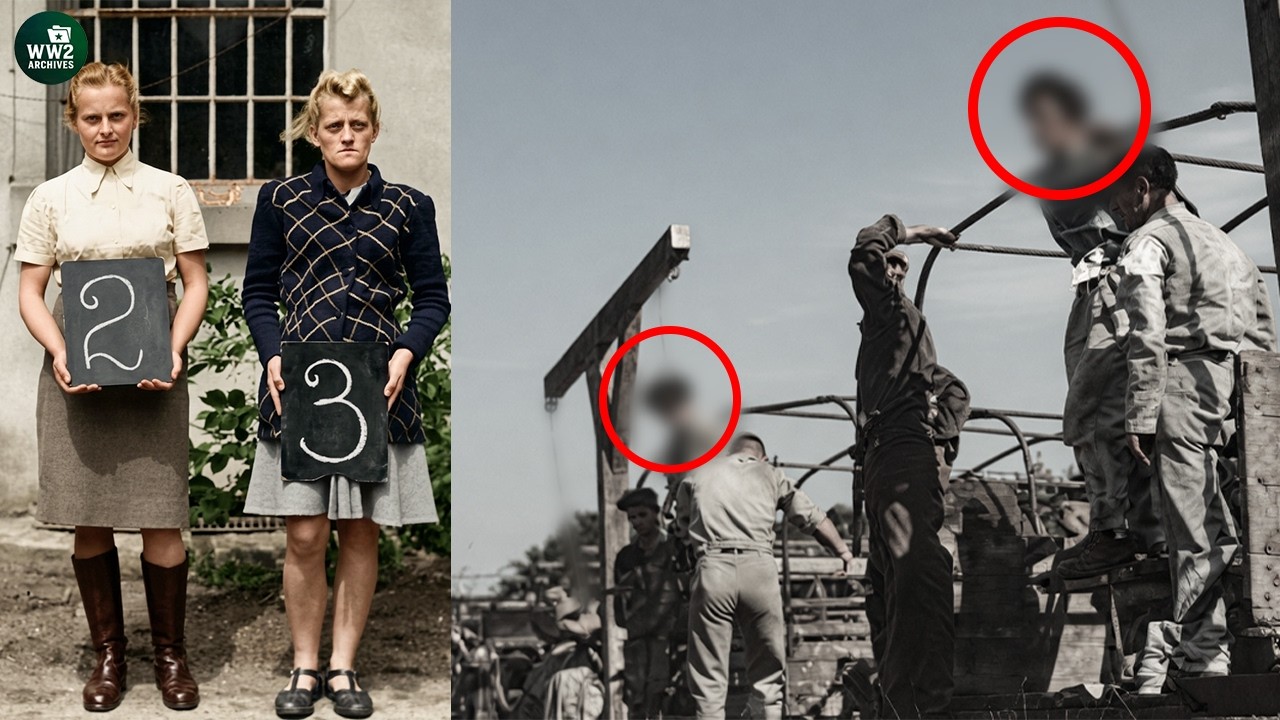
Among the captured staff was Irma Grese.
The uniform no longer protected her.
That was the first reversal.
The young woman who had once stood over prisoners with a stick was now photographed under guard. She could no longer end an accusation with a command. She could no longer order a witness away.
She had to listen.
In September 1945, Grese and forty-four other defendants were brought before a British military court at Lüneburg in what became known as the first Belsen trial.
Former prisoners entered the courtroom.
They were thin. Some were still recovering. Many had lost entire families.
But they walked in freely.
And Grese sat in the dock.
That was the moment the architecture of power changed.
At Auschwitz, she had possessed the uniform, the stick, the regulations, and the right to punish.
In court, the survivors possessed something she had never allowed them inside the camp.
A voice that had to be heard.
Witness after witness described conditions at Auschwitz and Bergen-Belsen. They spoke of beatings, punitive exercises, selections, starvation, and death. Defense lawyers challenged their memories. The accused denied or minimized accusations.
Grese admitted carrying a walking stick and, for a period, a whip. She acknowledged forcing prisoners to perform “sport,” though she attempted to frame such punishment as discipline rather than cruelty.
The language had changed, but the instinct remained.
At the camp, brutality had been called duty.
In court, it was called misunderstanding.
Yet the prisoners were no longer standing at roll call.
The judge did not salute her.
No one lowered their eyes because she entered the room.
For perhaps the first time since she put on the uniform, Irma Grese had to remain seated while people she once controlled spoke her name into an official record.
She could hear each sentence.
She could watch each witness leave without her permission.
There was no whistle to stop them.
No guard to drag them away.
No punishment block waiting outside.
Her face could remain composed, but the truth was visible in the room:
The fear had changed sides.
The British court convicted Grese of war crimes and sentenced her to death. The sentence was carried out at Hamelin Prison on December 13, 1945.
She was twenty-two years old.
Later retellings added theatrical details about her final expression and behavior. They are repeated because people want evil to provide one last dramatic performance.
The documented reality needs no decoration.
At twenty-two, Irma Grese had already spent years exercising power over defenseless prisoners. She died not because she was a woman who had entered a man’s war, nor because she was young, but because a court found her responsible for crimes committed under the authority she had willingly used.
Maria Mandl’s reckoning came later.
After leaving Auschwitz, she served at another camp before the collapse of Nazi Germany. She was eventually arrested and handed over to Polish authorities.
In 1947, Mandl stood trial in Kraków with other members of the Auschwitz staff.
She was no longer the senior overseer entering a barracks.
She was the accused.
The courtroom contained what the camp had tried to erase: survivors, documents, names, dates, assignments, signatures, and memories that had crossed the war alive.
Mandl could deny intention.
She could point upward in the chain of command.
She could say that doctors made selections, commanders issued orders, and the state designed the machinery.
But the paper remained.
A list of 498 women.
Her signature beneath it.
The same bureaucracy that had helped conceal murder now helped prove participation.
That was the final twist the perpetrators had not expected.
They had believed paperwork created distance from the crime.
Instead, it created a trail.
They had believed obedience erased responsibility.
Instead, the chain of command showed how responsibility traveled.
They had believed prisoners would vanish.
Instead, some survived, entered courtrooms, and described what had happened.
Maria Mandl was convicted and sentenced to death.
On the morning of January 24, 1948, she was hanged at Montelupich Prison in Kraków. Therese Brandl, another former female guard, was executed the same day.
The woman who had once decided which prisoners were permitted another day of life had reached a place where her own authority meant nothing.
No subordinate waited for her orders.
No column stood at attention.
No orchestra played.
The uniform was gone.
Only the record remained.
It would be comforting to end the story there.
Two notorious guards captured.
Two trials.
Two sentences.
Justice delivered.
But history does not offer such a clean ending.
Among the nearly 200 female guards who served at Auschwitz, only a small number were ever sentenced. Many disappeared into the confusion of postwar Europe. Some resumed ordinary lives. Some married, worked, raised children, and grew old without facing a courtroom.
Their neighbors may never have known.
Or they may have chosen not to ask.
That silence is part of the warning.
Grese and Mandl became symbols because their cases were visible, their reputations notorious, and their punishments severe. But Auschwitz did not function because of two women.
It required thousands of people.
Commanders.
Doctors.
Clerks.
Railway employees.
Accountants.
Guards.
Secretaries.
Factory managers.
Officials who prepared schedules.
Workers who processed stolen belongings.
People who knew everything.
People who knew enough.
People who suspected and preferred not to know more.
The killing center depended on fanatics, but it also depended on professionals who completed forms, followed procedures, and returned home.
It depended on people who decided their responsibility ended where their assigned task ended.
The guards offer a particularly uncomfortable lesson because society often treats cruelty as masculine and women as naturally protective, gentle, or maternal.
Auschwitz destroyed that illusion.
Women could comfort prisoners.
Women could resist.
Women could risk punishment to preserve another person’s dignity.
And women could also beat, humiliate, select, and terrorize.
Gender did not determine the choice.
Character did.
Power did not invent every violent impulse, but it removed restraints and offered rewards. Ideology provided permission. Bureaucracy provided distance. The uniform provided belonging.
Indifference did the rest.
That is why these women should not be remembered as creatures from another species.
Calling them monsters creates a safe distance between them and us.
A monster is born different.
A monster cannot be understood.
A monster has nothing to teach ordinary people.
Maria Mandl was not born signing death lists.
Irma Grese was not born carrying a whip.
They entered institutions that taught them to divide human beings into categories. They accepted the categories. They benefited from them. Then they defended the system that gave them power.
The descent happened through actions small enough to excuse.
One insult.
One punishment.
One order obeyed.
One face ignored.
One signature.
Then another.
By the time the consequences became enormous, cruelty felt normal.
That is how evil protects itself.
It rarely arrives announcing that it is evil.
It arrives as a regulation.
A promotion.
A joke everyone else is laughing at.
A victim described as a problem.
A colleague humiliated while the room remains silent.
An order that seems easier to obey than question.
A person in authority saying responsibility belongs somewhere else.
And every time someone looks away, the machinery gains another part.
The prisoners at Auschwitz were stripped of names, homes, families, health, freedom, and life.
But the perpetrators tried to surrender something too.
Responsibility.
The trials returned it to them.
Not equally.
Not completely.
Not soon enough.
But unmistakably.
A uniform could explain their position.
It could not erase their choices.
A superior could issue an order.
That did not make the person carrying it out innocent.
A system could encourage cruelty.
That did not make cruelty compulsory.
Maria Mandl and Irma Grese had opportunities, however limited, to recognize the people before them as human.
Again and again, they chose power instead.
Their story is not a warning only about Nazi Germany.
It is a warning about the moment any society teaches people that another group deserves less empathy, less dignity, fewer rights, or no voice.
It is a warning about institutions in which obedience becomes more valuable than conscience.
It is a warning about the pleasure some people discover when authority removes consequences.
And it is a warning about ordinary indifference—the quiet decision to see suffering and continue with the day.
Evil has no gender.
It has no single face.
It does not always shout.
Sometimes it files a report.
Sometimes it checks a list.
Sometimes it stands beside a gate while an orchestra plays.
And the first defense against another Auschwitz is not confidently believing that we would have been heroes—it is refusing, in the ordinary moments of our own lives, to become the person who looks away.