“No Service. No Sacrifice. All Fiction,” Dad Told the Court—Then a General’s Letter Hit the Bench
CHAPTER ONE
THE ACCUSATION
The first lie Harold Calder told about his daughter sounded clean enough to be carved in stone.
“No service. No sacrifice. All fiction.”
He delivered the words from the witness stand without raising his voice.
That made them worse.
A storm pressed against the tall windows of the Ironwood County Courthouse, smearing the January morning into gray bands of rain and bare sycamore branches. Wet coats steamed on the backs of wooden benches. Old radiators knocked beneath the walls. The room smelled of damp wool, furniture polish and the bitter coffee the bailiff had carried inside before sunrise.
Every seat in Courtroom Two was occupied.
Local veterans filled the first three rows. Some wore caps embroidered with unit names. Others wore service pins on winter jackets. Reporters sat behind them with open laptops, waiting for the small-town scandal that had already spread beyond the county line.
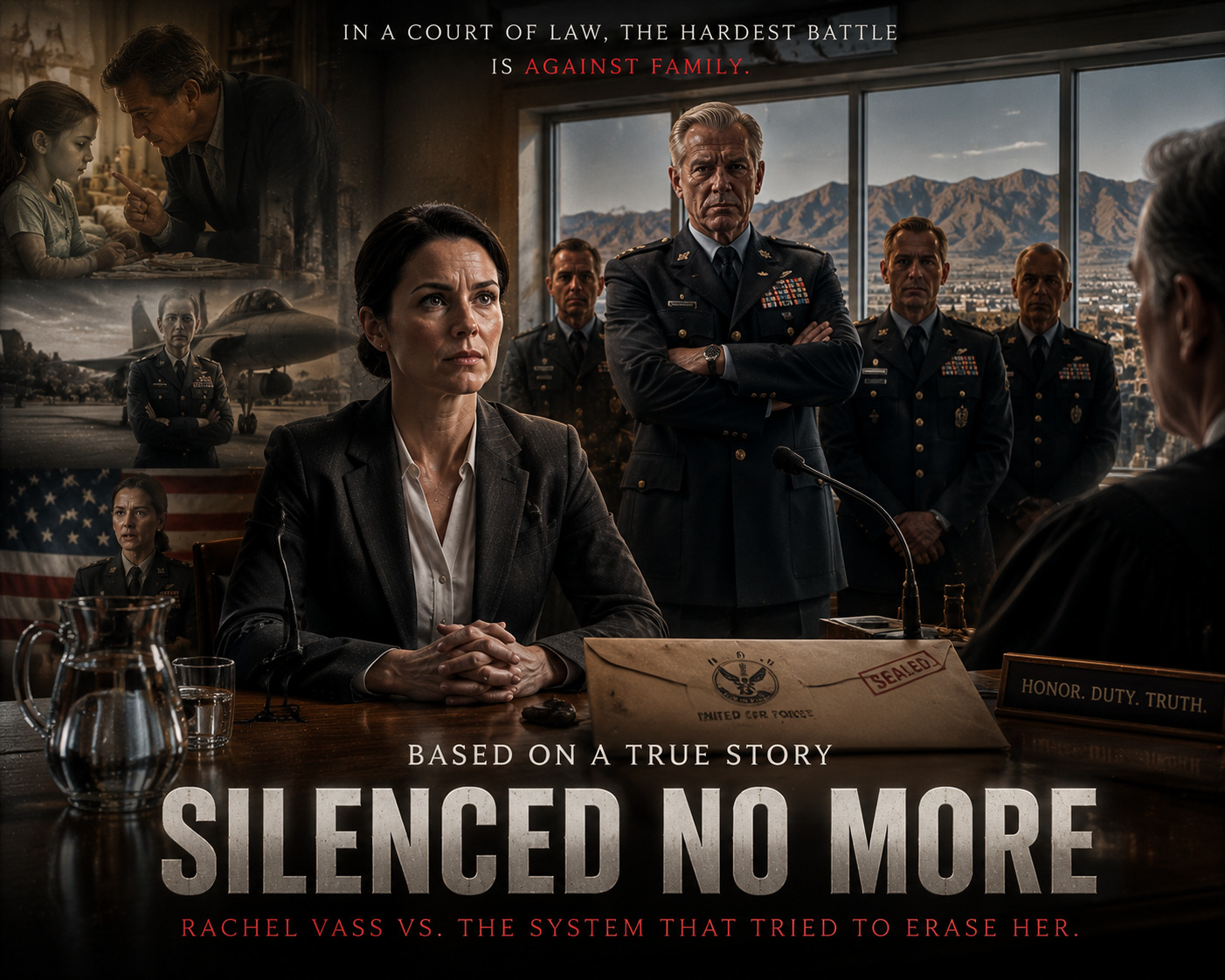
At the defense table, Rachel Voss sat alone.
Forty-seven years old. Charcoal suit. No jewelry except a narrow silver watch. Her dark hair was pulled into a knot at the base of her neck, exposing a pale scar that ran from behind her right ear to the collar of her blouse.
Her hands rested on a closed legal pad.
She had not written a single word.
Harold looked at her from the witness stand.
He was seventy-three, broad through the shoulders despite the years, with iron-gray hair combed straight back and the posture of the high school principal he had been for three decades. He wore a navy suit that had last been tailored before his wife became ill. A small American flag pin gleamed on his lapel.
His left thumb rubbed the edge of his wedding ring.
It was the only part of him that moved.
“My daughter,” he continued, “has spent twenty-five years telling people she served in classified units. She used that claim to avoid questions, disappear for months and explain why she was never present when her family needed her.”
Rachel’s gaze remained on the bench.
Judge Evelyn Shaw watched Harold over the rims of black-framed glasses. She was sixty-one, silver-haired and known for allowing witnesses enough silence to reveal what their words were trying to hide.
Harold mistook her patience for agreement.
“She told my late wife she had been deployed. She told neighbors she could not discuss her assignments. She allowed people to believe she had been wounded in combat.”
His lawyer, Martin Vale, stepped closer to the witness stand.
“Did she ever show you military orders?”
“No.”
“A discharge certificate?”
“No.”
“Official photographs?”
“No.”
“Medals?”
Harold’s mouth tightened.
“She kept a locked metal case in our basement. After my wife died, I opened it.”
Vale lifted an evidence bag from his table.
Inside lay a Bronze Star, a folded ribbon rack and a dark coin bearing an eagle over a broken compass.
A ripple moved through the gallery.
“Were these items accompanied by documentation?” Vale asked.
“No.”
“What did you conclude?”
“That she bought them.”
Rachel’s right index finger pressed once against her legal pad.
Nothing else changed.
Vale faced the judge.
The hearing had begun as a dispute over Eleanor Calder’s will.
Eleanor had left the family’s thirty-eight-acre property, including the farmhouse where she and Harold had lived for forty-nine years, to Rachel. The will instructed Rachel to convert the land into temporary housing for injured veterans and military families in crisis.
Harold claimed his wife had been manipulated.
He argued that Rachel had used a fictional military career to gain Eleanor’s trust, isolate her during cancer treatment and persuade her to sign away the home.
If the court agreed, the will would be invalidated.
The property would pass to Harold.
More importantly to him, the county would know he had not raised a hero who abandoned her dying mother.
It would know he had raised a liar.
Vale turned back toward the witness.
“Mr. Calder, when did you first suspect that your daughter’s military career was fabricated?”
Harold looked directly at Rachel.
“The morning her mother went into surgery.”
Rachel’s chin lifted a fraction.
“Eleanor was frightened,” Harold said. “She asked for Rachel. I called six times. No answer. A message came later saying Rachel was involved in an operation and could not leave.”
“How long was Mrs. Calder hospitalized?”
“Eleven days.”
“And did Rachel visit?”
“No.”
“Did she attend the follow-up appointments?”
“No.”
“Did she provide any proof of this supposed operation?”
“No.”
Vale allowed the silence to settle.
“And when Mrs. Calder died?”
Harold’s thumb stopped moving against his ring.
“Rachel arrived after the funeral.”
Someone in the gallery whispered, “Dear God.”
Rachel heard it.
She had heard worse through thinner walls.
Vale returned to his table and selected a folder.
“Your Honor, the petitioner will demonstrate that there is no publicly verifiable record of Rachel Calder or Rachel Voss serving in any branch of the United States military.”
Judge Shaw looked toward Rachel.
“Ms. Voss, you understand that the petitioner is challenging both your credibility and your eligibility to administer your mother’s estate?”
“Yes, Your Honor.”
Her voice was lower than the gallery expected.
Controlled.
Unhurried.
“Do you intend to call counsel?” the judge asked.
“No.”
“Do you intend to present service records?”
“Not at this time.”
A murmur moved through the benches.
Judge Shaw tapped her pen once against the file.
“Ms. Voss, silence may carry consequences in a civil proceeding.”
“I understand.”
Harold leaned toward the microphone.
“That is what she does.”
Vale glanced at him, but Harold continued.
“She goes silent and expects everyone else to treat the silence like proof.”
Rachel finally turned her head.
Father and daughter looked at each other across twenty feet of polished oak.
Harold’s face held anger, but beneath it was something older and less certain.
A man standing at a locked door, furious because he feared what might be behind it.
Rachel’s expression revealed nothing.
Vale called his first military witness.
Retired Colonel Dean Mercer entered through the side door in a dark green blazer with airborne wings pinned above the pocket.
Harold sat straighter.
For the first time that morning, Rachel opened her legal pad.
She wrote three words.
He believes this.
Then she closed it again.
CHAPTER TWO
THREE MEN WHO KNEW
Dean Mercer had spent thirty-two years in the Army National Guard.
He had commanded troops after hurricanes, deployed twice to the Middle East and built a second career speaking to civic organizations about stolen valor.
His voice carried the rough authority of someone accustomed to being believed before he finished a sentence.
“I conducted a records inquiry using the names Rachel Marie Calder and Rachel Marie Voss,” he testified. “I found no ordinary service record matching the career she described to her family.”
“Would a decorated officer normally leave a trace?” Vale asked.
“Yes.”
“Promotions?”
“Yes.”
“Unit assignments?”
“Yes.”
“Retirement or separation documents?”
“Yes.”
“Could all of those records simply disappear?”
Mercer considered the question.
“Not under normal circumstances.”
Vale nodded as though normal circumstances were the only kind that existed.
Rachel stood for cross-examination.
She carried no papers to the lectern.
Mercer looked at her with disappointment rather than hostility. That made him more dangerous. He did not think he was helping destroy an innocent woman. He thought he was protecting honorable veterans from a fraud.
“Colonel Mercer,” Rachel said, “which database did you search?”
He named two public military verification systems and one veterans’ archive.
“Do those systems contain personnel assigned to waived-access special programs?”
“Some.”
“All?”
“No.”
“Do they contain identities protected under counterintelligence directives?”
“Not in searchable form.”
“Can personnel serve under modified biographical data?”
“In rare cases.”
“Can a record be removed from routine access by security order?”
Mercer’s jaw tightened.
“Yes.”
“Then your testimony is not that I never served.”
“My testimony is that I found no evidence you served.”
“Those are different statements.”
“They lead to the same question.”
“No, Colonel. One questions the evidence. The other convicts the person.”
Mercer looked toward the judge.
Rachel returned to her seat.
The second witness was retired Major Judith Sloane, formerly an Army personnel officer.
She had examined photocopies of the documents Harold found in the basement.
“The formatting is inconsistent with standard award orders,” she testified. “There are missing control numbers, redactions without visible classification markings and a signature block belonging to a command I cannot identify.”
Vale held up the Bronze Star.
“In your opinion, does the presence of this medal prove military service?”
“No. Decorations can be purchased online.”
Harold looked at Rachel as though each answer restored something inside him.
Rachel rose again.
“Major Sloane, did you examine the original documents?”
“No. I was provided copies.”
“By whom?”
“Mr. Calder’s attorney.”
“Were you told the metal case had been forced open?”
Sloane glanced toward Harold.
“No.”
“Were you told the originals had been stored inside tamper-evident sleeves?”
“No.”
“Were you told one of the documents was marked for review only by a special security officer?”
“No.”
Vale stood.
“Objection. Counsel is testifying.”
“I am not counsel,” Rachel said.
Judge Shaw looked at her.
“That is becoming increasingly apparent. Ask questions, Ms. Voss.”
Rachel faced Sloane.
“Would removing a classified document from its sleeve affect your ability to authenticate it?”
“Yes.”
“Would copying it on a commercial machine destroy embedded verification features?”
“It could.”
“Then the copies you reviewed were insufficient for a final determination?”
Sloane hesitated.
“They raised serious concerns.”
“That was not my question.”
The major looked down.
“No. They were not sufficient for a final determination.”
Rachel returned to her chair.
Harold’s hand tightened around the rail of the witness box.
The third witness was the one who hurt.
Sergeant First Class Owen Pike walked with a carbon-fiber brace under his left trouser leg. He had lost part of the limb to an explosive device fifteen years earlier. Rachel watched him approach the stand with the careful rhythm of a man who had converted pain into routine.
Pike and Harold attended the same church.
They had repaired the roof together after a windstorm. Harold had driven Pike to physical therapy when Pike’s wife was working double shifts.
Pike did not want to testify against Rachel.
His discomfort showed in the way he kept adjusting the knot of his tie.
Vale approached gently.
“Sergeant Pike, did Ms. Voss ever claim to know details of your deployment?”
“Yes.”
“What kind of details?”
“She knew the route where my convoy was hit.”
The gallery stirred.
“She knew the medical evacuation call sign,” Pike continued. “She knew the type of aircraft that came for us and how long it took.”
“Did that make you believe she had served?”
“At first.”
“What changed?”
“She said she had been in the operations center that night.”
“And?”
Pike swallowed.
“I checked with two men who were there. Neither remembered a Rachel Calder.”
Harold’s face softened with gratitude.
Vale turned toward the jury box, though there was no jury.
“So she knew private details of a wounded veteran’s worst day and used them to support a false identity?”
Pike looked at Rachel.
“I don’t know what she used them for.”
“But you found no evidence she was present.”
“No.”
Rachel stood.
Pike’s shoulders lowered.
She stopped several feet from the witness stand.
“Sergeant Pike, when your convoy was struck, what happened to the primary communications relay?”
“Destroyed.”
“What happened to the backup?”
“Jammed.”
“How did the evacuation aircraft find you?”
Pike stared at her.
“A remote operator redirected a surveillance platform and marked our position.”
“Did you ever learn that operator’s name?”
“No.”
“Did you ask?”
“For years.”
“Why?”
His fingers curled around the edge of the witness stand.
“Because whoever it was stayed on the net after the fire spread. They talked our medic through a chest decompression. They kept the pilot from landing in a mined field.”
Rachel’s face remained composed.
“What did the operator say when the pilot wanted to abort?”
Pike’s breathing changed.
The courtroom waited.
He answered almost in a whisper.
“‘You have eleven men beneath you. Fear can circle once. Duty cannot.’”
Harold frowned.
Rachel had said those words at the Calder kitchen table eight years earlier.
Pike stared at her as though the walls had moved.
“How do you know that?” he asked.
Vale rose sharply.
“Objection.”
Judge Shaw leaned forward.
“I would also like an answer.”
Rachel looked at Pike.
But when she spoke, it was to the judge.
“I cannot answer that question in open court.”
A sound of disgust came from the veterans’ section.
Harold closed his eyes.
There it was again.
The locked door.
The silence.
Vale spread his hands.
“No records. No witnesses. No answers.”
Rachel returned to her chair.
Pike remained on the stand, watching her.
The judge called a recess.
As the gallery rose, Harold stepped down and passed close to Rachel’s table.
“You could stop this,” he said.
Rachel looked up.
“So could you.”
His face hardened.
“I buried your mother without you.”
“I know.”
“You always know. You are never there.”
The bailiff asked Harold to move along.
He took one step, then turned back.
“When this court strips that house from you, at least one lie will end.”
Rachel’s gaze dropped to his wedding ring.
“You think this is about the house?”
“It is about your mother.”
“No,” Rachel said. “It is about the day you decided grief needed a defendant.”
Harold recoiled as though she had struck him.
Then Judge Shaw’s clerk entered through the side door carrying a sealed black envelope.
A red wax insignia had been pressed across its flap.
The clerk placed it on the bench.
“Your Honor,” she said, “this was lodged with the court eight years ago. The release condition has been met.”
Judge Shaw examined the envelope.
The color left her face.
Printed beneath the seal were the words:
FROM THE OFFICE OF LIEUTENANT GENERAL MARCUS A. WEBB
TO BE OPENED ONLY IF THE MILITARY SERVICE OF RACHEL M. VOSS IS CHALLENGED UNDER OATH
The judge looked toward Rachel.
Rachel looked at the envelope as if she had spent years hoping never to see it again.
CHAPTER THREE
THE GENERAL’S LETTER
The courtroom filled more quickly after recess.
Someone had posted a photograph of the black envelope online. Reporters crowded near the doors. The judge ordered all phones switched off and warned that anyone attempting to record the proceedings would be removed.
Harold sat beside his attorney.
“What is it?” he whispered.
Vale shook his head.
“I wasn’t informed.”
“You should have been.”
“It was sealed by court order.”
“Then challenge it.”
Vale looked at the red insignia.
“I intend to authenticate it first.”
At the opposite table, Rachel sat exactly as before.
Only the hand beneath the desk betrayed her.
Her fingers had closed so tightly around the edge of the chair that the knuckles had gone white.
Judge Shaw entered.
Everyone stood.
She carried the envelope herself.
“Be seated.”
The room obeyed.
The judge placed two documents beside the envelope.
“The court has contacted the Department of Defense liaison listed in the filing record. The seal and signature have been authenticated. A declassification authorization was transmitted to chambers at ten forty-three this morning.”
Vale rose.
“Your Honor, the petitioner objects to admitting a letter whose author cannot be cross-examined.”
“On what grounds is the author unavailable?”
“He is deceased.”
Rachel’s eyes closed briefly.
Harold noticed.
Judge Shaw adjusted her glasses.
“General Marcus Webb died three years ago. However, this letter was sworn before a federal military judge, accompanied by corroborating orders and deposited with this court by the late Mrs. Calder’s attorney. I will admit it subject to evidentiary weight.”
Vale sat.
The judge broke the seal.
The sound was small.
It traveled through the entire room.
Inside were eleven pages, a brass command coin and a photograph turned facedown.
Judge Shaw began to read.
“To the judge presiding over any proceeding in which the service of Rachel Marie Voss is denied, questioned or portrayed as fraudulent:
“I write because Rachel will not defend herself with information that endangers others, even when silence costs her reputation. This quality has saved lives. It has also allowed people who love her to misunderstand her.”
Harold’s jaw shifted.
Rachel stared at the rain on the windows.
“I first met Rachel Voss in 1999, when she was a twenty-year-old cadet who corrected my navigation calculations during an exercise and then apologized to the map.”
A subdued laugh moved through the courtroom.
It died when Rachel’s face did not change.
“She was commissioned into Army intelligence after graduating near the top of her class. Her early service record remains partially protected because she participated in a counterproliferation program targeting illicit weapons networks in Central Asia and Eastern Europe.”
Mercer leaned forward in the gallery.
Judge Shaw continued.
“Rachel did not begin her career as a hero. She began as an officer who distrusted praise, challenged lazy assumptions and possessed an unfortunate talent for being correct in rooms where senior men had already agreed with one another.”
This time even the bailiff nearly smiled.
Harold did not.
He was staring at Rachel as if the judge were describing a stranger wearing his daughter’s face.
“In 2004, Captain Voss identified falsified transportation records connected to the disappearance of military-grade explosives. Her report implicated an allied colonel and two American contractors. She was advised to revise her findings.
“She refused.
“Her vehicle was attacked forty-eight hours later.”
Rachel’s thumb moved to the scar behind her ear.
Harold saw it.
He had once asked how she got the scar.
She told him it came from broken glass.
He had laughed and said she had always been careless.
The judge read on.
“The attack killed Staff Sergeant Mateo Ruiz and civilian analyst Claire Donnelly. Captain Voss survived with injuries to her neck and right shoulder. Before losing consciousness, she concealed the evidence beneath a drainage culvert and transmitted coordinates using a damaged emergency beacon.
“The resulting investigation dismantled a network operating across four countries.”
The courtroom had become so quiet that rainwater could be heard traveling through the building’s gutters.
“Captain Voss declined public recognition because the case remained active and because the families of two protected sources would have been endangered by disclosure.”
Harold looked at the medal in its evidence bag.
The Bronze Star no longer resembled an object purchased online.
It looked like something stolen from a grave.
Judge Shaw turned the page.
“In 2009, Major Voss was assigned to the Joint Recovery Coordination Cell. On the night Sergeant First Class Owen Pike’s convoy was ambushed, enemy fire destroyed both primary and secondary communications.
“Major Voss remained on an unsecured emergency frequency for fifty-three minutes while artillery impacted within two hundred meters of her position.”
Pike’s hand rose to his mouth.
“She redirected aerial surveillance, identified a mined landing zone and guided the evacuation aircraft toward a dry river channel. When the pilot requested permission to abort due to incoming fire, Major Voss replied…”
The judge paused.
Pike closed his eyes.
“‘You have eleven men beneath you. Fear can circle once. Duty cannot.’”
Pike bent forward on the bench.
His shoulders began to shake.
Rachel did not look at him.
Harold did.
For the first time that morning, uncertainty entered his face without disguising itself as anger.
Judge Shaw continued.
“All eleven soldiers survived transport.
“Major Voss never met them.
“She asked that her name be removed from the after-action summary because the emergency frequency had exposed the location of a protected operations center.”
Pike whispered, “It was her.”
No one corrected him.
“In 2012, Lieutenant Colonel Voss assumed command of Task Force Meridian, a recovery unit responsible for locating personnel taken or abandoned in denied areas. During her tenure, the task force recovered twenty-eight American service members, nine allied personnel and the remains of six missing operators whose families had been told recovery was impossible.”
The veterans in the first rows no longer watched Rachel with suspicion.
They watched the floor.
“Her record includes the Distinguished Service Cross, two Defense Superior Service Medals, a Bronze Star with valor device and a Purple Heart. Portions of the citations remain classified.”
Vale’s pen stopped above his legal pad.
Harold whispered, “No.”
It was not loud enough to interrupt the judge.
It was loud enough for Rachel to hear.
She turned toward him.
His eyes were fixed on the pages.
“I personally recommended Rachel Voss for promotion to brigadier general after Operation Glass Harbor.”
Judge Shaw stopped reading.
Something in the room seemed to draw inward.
The reporters froze over their keyboards.
Mercer slowly removed his glasses.
Harold stared at his daughter.
The judge resumed.
“During that operation, then-Colonel Voss was ordered to evacuate a regional command center after intelligence indicated an imminent attack. She determined that the evacuation order had been manipulated to leave a team of allied interpreters and their families outside the security perimeter.
“She disobeyed the timetable.
“She kept the airfield open.”
Rachel’s gaze went distant.
The courtroom disappeared behind heat, rotor wash and the metallic taste of smoke.
She saw children pressed beneath cargo netting.
A little girl carrying a yellow backpack with one broken strap.
A staff officer shouting that the final aircraft had to depart.
A colonel threatening to relieve Rachel on the runway.
She heard herself answer, “You can relieve me after they are airborne.”
The judge’s voice followed her into the memory.
“For nine hours, Colonel Voss coordinated aircraft, ground convoys and medical teams while hostile forces advanced through the outer districts. Sixty-four interpreters, eighty-three family members and nineteen wounded soldiers were evacuated.
“The command center was struck twelve minutes after the final aircraft departed.”
Harold’s fingers found his wedding ring again.
The morning Eleanor underwent surgery, Rachel had sent one message:
I cannot leave. I am bringing families out.
Harold had read it beside his wife’s hospital bed.
He had thrown the phone against the wall.
General Webb’s letter continued.
“Rachel’s mother entered surgery during Operation Glass Harbor.
“Rachel knew.”
Harold’s thumb stopped.
“She requested relief twice. Both requests were denied because no other officer possessed full visibility over the evacuation channels.
“At 0317 local time, I ordered her onto the final aircraft.
“She refused until every civilian listed under the recovery directive had crossed the runway.”
Rachel’s breathing became shallow.
Harold looked at her.
For the first time, he did not see the daughter who had failed to answer six calls.
He saw a woman standing beside an aircraft while someone else’s children climbed aboard.
It did not erase Eleanor’s empty chair.
It made the emptiness more complicated.
“After landing, Colonel Voss called her father from a secure medical station. The call did not connect.”
Harold remembered the hospital basement.
No service.
The storm had knocked out reception.
He had seen three missed calls the next morning and deleted them without listening to the messages.
“I later learned that Mr. Calder believed his daughter chose her career over her mother. That is not entirely false.
“Command requires choices that injure innocent people.
“Rachel has carried this one without asking her family to forgive what she was not permitted to explain.”
The judge turned another page.
“In 2017, Rachel Marie Voss was confirmed by the United States Senate for promotion to brigadier general.
“She subsequently served as deputy commander of the Special Recovery Directorate, overseeing missions involving missing personnel, compromised units and families endangered by their support of American forces.”
Harold’s lips parted.
His lawyer placed a hand on his sleeve.
Harold pulled away.
“The absence of a public biography was deliberate. A foreign intelligence service had targeted officers connected to Task Force Meridian. General Voss’s family association with the Calder name was removed from routine records after a threat assessment identified her parents’ residence.”
A tremor passed through Harold’s shoulders.
Rachel had not hidden her family because she was ashamed of them.
She had erased the connection because someone had been searching for them.
“General Voss objected to this measure,” the letter said. “I ordered it over her protest.”
Rachel looked down.
“She has never falsely claimed military service.
“She has, in fact, understated it.
“If this letter is being read, then someone has forced her to choose between an oath and her name. The fault is not hers alone. Institutions that depend on secrecy often ask honorable people to absorb the cost of being doubted.”
The judge’s voice softened.
“I therefore certify, under oath, that Rachel Marie Voss served with distinction under my command and held the rank of brigadier general at the time this letter was executed.”
Judge Shaw lifted the final page.
There was more.
Rachel’s eyes snapped toward the bench.
For the first time, fear broke through her composure.
“Your Honor,” she said, standing. “I request that you stop.”
The courtroom reacted with a collective breath.
Judge Shaw studied her.
“On what legal basis?”
“The remaining section concerns my family.”
“This is a family proceeding.”
“It was not written for them.”
Harold rose.
“Read it.”
Rachel turned.
The command in his voice sounded as it had when she was sixteen and late for curfew.
But his face no longer belonged to the man who had called her a fraud.
It belonged to a father standing beneath the first crack in everything he believed.
Rachel’s voice dropped.
“You may not want what comes next.”
Harold held her gaze.
“You did not let me choose for twenty-five years.”
Rachel’s jaw tightened.
Then she sat.
Judge Shaw read the final section.
“Harold Calder will believe this letter proves his daughter was important.
“He will be wrong.”
Harold went still.
“Rachel’s rank is not the most important truth about her.
“The most important truth is that she repeatedly returned to people who had already decided she would not.”
Rachel lowered her head.
“When her father refused money during Eleanor’s illness, Rachel arranged for medical expenses to be paid through a veterans’ assistance trust.
“When Harold believed an anonymous charity had modified the farmhouse for Eleanor’s wheelchair, Rachel allowed him to believe it.
“When he accused her of using classified service as an excuse, she did not reveal that threats associated with her command had required federal protection around his property for fourteen months.”
Harold looked toward the rear doors.
He remembered unmarked utility vans parked down the road.
He had complained to the county.
“When Eleanor asked Rachel to accept the property and build a refuge for injured veterans, Rachel initially refused. She believed Harold should remain in the house for life.
“The final will includes that right.
“Mr. Calder cannot be removed unless he voluntarily leaves or commits a felony on the property.”
Vale began turning rapidly through his copy of the will.
Harold stared at him.
“You said she was taking my home.”
Vale’s face tightened.
“The trust structure was ambiguous.”
“No,” Judge Shaw said. “It was not.”
Harold looked across the courtroom.
Rachel sat beneath the fluorescent lights in a plain charcoal suit.
No uniform.
No ribbons.
No single silver star.
Nothing visible had changed.
And yet every person in the room now understood that the woman he had accused of inventing sacrifice had built her life around sacrifices he had mistaken for absence.
Judge Shaw reached the last paragraph.
“Rachel once asked me what to do if the truth arrived too late to repair her family.
“I told her truth is not a repair.
“It is a door.
“Those on either side must decide whether to walk through.”
The judge lowered the pages.
The letter rested on the bench between them.
No one spoke.
Harold slowly removed the American flag pin from his lapel.
He held it in his palm as though unsure whether he still had the right to wear it.
CHAPTER FOUR
WHAT THE LETTER DID NOT FORGIVE
Judge Shaw recessed the court for twenty minutes.
No one left.
The reporters remained seated, afraid movement might break whatever had settled over the room.
Colonel Mercer approached Rachel first.
He stopped at the edge of her table.
“I owe you an apology.”
Rachel placed General Webb’s command coin beside the unopened legal pad.
“You testified to what you found.”
“I testified beyond what I found.”
“Yes.”
Mercer absorbed the correction.
“I have spent fifteen years telling people that stolen valor insults every person who served.”
“It does.”
“And today I helped accuse a serving general.”
“Retired,” Rachel said.
He blinked.
“As of six months ago.”
No one in the room had known that either.
Mercer removed the airborne pin from his blazer and turned it between his fingers.
“I wanted fraud to look obvious.”
Rachel looked toward her father.
“Most people do.”
Major Sloane came next.
She said nothing at first.
She placed the photocopied award documents on Rachel’s table.
“I should have refused to authenticate copies.”
“You qualified your conclusions.”
“Not loudly enough.”
Rachel nodded once.
Sloane left.
Owen Pike approached last.
His brace clicked softly against the tile.
He stopped in front of Rachel and tried to speak.
Nothing came.
Rachel saved him from the attempt.
“How is your son?”
Pike stared at her.
“You know about Daniel?”
“Your casualty file included dependent information.”
“That was fifteen years ago.”
“He was three.”
“He is eighteen now.”
“College?”
“Marine Corps.”
Rachel’s eyes closed briefly.
Pike almost smiled.
“I tried to stop him too.”
“That never works.”
“No.”
He looked at the scar behind her ear.
“All these years, I wanted a name.”
“Now you have one.”
“I told the court you used my worst day to lie.”
“You were given incomplete information.”
“I wanted to believe Harold.”
“Because he helped you.”
“Yes.”
Rachel glanced at her father.
“That is not a small thing.”
Pike’s throat worked.
“What do I do with this?”
“Tell the truth when someone asks.”
He straightened.
Then, slowly, he raised his right hand to salute.
Rachel stopped him before his fingers reached his brow.
“Not here.”
“General—”
“Rachel.”
His arm lowered.
“Thank you, Rachel.”
She watched him return to the gallery.
Harold remained beside his attorney.
Vale whispered urgently, pointing at sections of the will. Harold did not appear to hear him.
When court resumed, Judge Shaw returned to the bench and looked first at Harold.
“Mr. Vale, does your client wish to continue his petition?”
Vale stood.
“Your Honor, the letter addresses military service but does not conclusively establish that Mrs. Calder’s will was free from undue influence.”
Harold turned toward him.
Vale continued.
“The decedent’s admiration for her daughter’s rank may itself have impaired—”
“Sit down,” Harold said.
Vale stopped.
“Mr. Calder?”
“I said sit down.”
“Your petition—”
Harold pulled his sleeve away from the lawyer’s reach.
“I am withdrawing it.”
The courtroom rustled.
Vale lowered his voice.
“You hired me to protect your interest.”
“I hired you to prove she lied.”
“Our case may still—”
“She did not lie.”
The sentence seemed to take something physical from him.
His shoulders lowered.
His face aged in front of the room.
Judge Shaw looked at Rachel.
“Do you consent to dismissal?”
“Yes, Your Honor.”
“Do you intend to seek attorney’s fees or sanctions?”
“I represented myself.”
“Costs, then?”
“No.”
Vale sat, visibly relieved.
Judge Shaw did not dismiss the case immediately.
“Ms. Voss, the petitioner publicly alleged fraud, manipulation and stolen valor. You would be within your rights to seek further remedy.”
Rachel looked at Harold.
He had spent years teaching students that consequences gave rules their meaning. He had suspended children for forged signatures and expelled an athlete for lying about a stolen exam.
Now he waited for his daughter to punish him in front of the county.
Part of her wanted to.
Not the general.
Not the commander.
The thirteen-year-old girl who had brought home a ninety-seven on a mathematics exam and heard Harold ask where the other three points had gone.
The nineteen-year-old who announced she had been accepted into military training and heard him say, “You are running from adulthood.”
The thirty-nine-year-old standing in an airport hangar while her mother’s funeral took place without her.
Rachel felt every old wound ask for rank, authority and a witness.
She closed her eyes.
When she opened them, the child had not disappeared.
She had simply stepped back.
“I want the record to reflect that the witnesses were not acting maliciously,” Rachel said. “They were provided incomplete material.”
Vale shifted uncomfortably.
Judge Shaw understood.
“And your father?”
Rachel’s gaze remained on Harold.
“He believed what he said.”
“That does not make it harmless.”
“No.”
“What remedy do you request?”
Rachel considered the question.
“A correction.”
“Explain.”
“The allegations were reported publicly. I want the withdrawal stated publicly.”
Harold looked up.
Rachel continued.
“Not my rank. Not my decorations. The false accusation.”
Judge Shaw nodded.
“That is reasonable.”
Harold stood before his lawyer could stop him.
“I accused Rachel Voss of fabricating her military career.”
His voice shook.
The reporters began typing.
“I said she had no service and made no sacrifice.”
He looked at Rachel.
The next words would not come.
His lips moved once.
Nothing.
The courtroom waited.
Rachel could have rescued him.
She had built a career around bringing people out of impossible places.
She remained seated.
Harold gripped the edge of the table.
“My accusations were false.”
He drew a breath that shuddered inside his chest.
“She served.”
Rachel’s expression did not change.
Harold understood that the sentence was insufficient.
He forced himself onward.
“She served with distinction. I had no evidence that she lied. I mistook what I could not see for something that did not exist.”
The judge looked toward Rachel.
“Is that adequate?”
Rachel’s voice was quiet.
“It is accurate.”
Judge Shaw dismissed the petition.
The gavel struck once.
The sound should have ended the matter.
Instead, it opened everything the case had kept contained.
Harold crossed the aisle before the bailiff could announce adjournment.
He stopped beside Rachel’s table.
Up close, she saw the broken red vessels in his eyes and the faint shaving cut beneath his chin.
“You paid for the ramp?” he asked.
“Yes.”
“The downstairs shower?”
“Yes.”
“Your mother’s medication?”
“Some of it.”
“The night nurse?”
“Yes.”
His face tightened.
“She told me a veterans’ foundation had approved us.”
“It did.”
“Your foundation?”
“One I could access.”
“You let me thank strangers.”
“You would not accept money from me.”
“You could have told me.”
“I tried.”
“No. You sent messages. You disappeared. You wrapped every answer in classification.”
Rachel stood.
They were almost the same height now. Harold remembered when she had barely reached his belt and followed him through the school corridors on Saturdays, carrying chalk in both hands.
“You did not want an answer,” she said. “You wanted a confession.”
“That is not true.”
“You asked whether I was lying before you asked whether I was safe.”
His mouth opened.
She did not allow him to interrupt.
“You asked whether my career was real before asking why I woke up on your kitchen floor during thunderstorms.”
Harold’s face went pale.
“You said you slipped.”
“I said what you could hear.”
“That is not fair.”
“No.”
The word came without heat.
“None of it was fair.”
He looked around the emptying courtroom.
“You made me look like a fool.”
Rachel’s eyes hardened.
“I did not file this case.”
The sentence landed cleanly.
Harold looked toward Vale, the reporters and the evidence bag containing the medal he had carried into court like contraband.
His anger rose automatically, searching for someone else to inhabit.
Then it failed.
He lowered his head.
“Why did your mother believe you?”
Rachel picked up General Webb’s coin.
“Because when I told her I was serving, she asked whether I was eating.”
Harold closed his eyes.
That was Eleanor.
Belief expressed through soup, blankets and questions about the weather.
“When did she know your rank?”
“She never did.”
He looked up.
“She left you the property without knowing?”
“She knew what I wanted to build.”
“And she trusted you.”
“Yes.”
The answer contained no cruelty.
Harold experienced it as one.
CHAPTER FIVE
THE HOUSE ON VOSS ROAD
The farmhouse stood six miles outside town beneath a ridge of black oak and pine.
Eleanor had painted the front door yellow because she said every house needed one unreasonable decision. After her death, the paint faded. Harold never repaired it.
Three weeks after the hearing, Rachel arrived in a rental car shortly before dusk.
Snow remained in the shaded ditches. Wind moved through the dead grass with a sound like paper being folded.
Harold was in the barn, cutting warped boards from an old stall.
He heard the car door close but did not come out.
Rachel entered without knocking.
The barn smelled of cedar dust, machine oil and the leather harnesses Eleanor had refused to throw away after they sold the last horse.
Harold guided a board through the table saw.
Rachel waited until the blade stopped.
“You should wear eye protection.”
He removed his glasses from the workbench and put them on.
“Happy?”
“No.”
He brushed sawdust from the board.
“Court order says I can remain here.”
“I know.”
“You are not turning my bedroom into a dormitory.”
“The housing units will be built beyond the west field.”
“You will ruin the view.”
“The view is trees.”
“They are my trees.”
Rachel walked to the workbench.
A newspaper lay folded beside the saw.
Her photograph appeared beneath the headline:
LOCAL WOMAN REVEALED AS RETIRED BRIGADIER GENERAL AFTER FATHER’S COURT CLAIM COLLAPSES
Harold had drawn a line through the word “revealed.”
Rachel touched the paper.
“What is wrong with it?”
“You were not revealed. You were exposed.”
She studied him.
“Is there a difference?”
“There should be.”
He picked up the board again.
“Reporters have been calling.”
“You do not have to answer.”
“They ask whether I am proud.”
“What do you say?”
Harold measured the board twice.
“That it is private.”
Rachel looked toward the rafters.
“Some things become private only after they stop being useful as weapons.”
He set the pencil down.
“You came here to punish me?”
“No.”
“Then why are you here?”
“To discuss the construction schedule.”
“Send a contractor.”
“I did. You threatened him with a shovel.”
“He parked on the septic field.”
“He did not know where it was.”
“He should have asked.”
Rachel exhaled through her nose.
For an instant, Harold saw the girl who had inherited his impatience and spent her life disciplining it.
She spread a site plan across the workbench.
“Six cottages. A medical office. Shared kitchen. Child-care room.”
“A military barracks in my field.”
“A temporary home for families.”
“Strangers.”
“People whose relatives are recovering at the medical center.”
Harold studied the plan despite himself.
“Why six?”
“Funding allows six.”
“There is drainage here.”
Rachel followed his finger.
“The engineer marked it stable.”
“The engineer has never watched spring water cross that field. Move the third cottage twenty yards north.”
She made a note.
Harold’s eyes narrowed.
“You are listening?”
“You are right about the drainage.”
He looked almost offended.
They worked over the plan for twenty minutes.
It was the longest conversation they had shared in years without either mentioning Eleanor, service or court.
When the light faded, Rachel rolled up the drawings.
Harold remained at the bench.
“Did you kill anyone?”
The question arrived without warning.
Rachel’s hands stopped.
Outside, wind pushed against the barn doors.
“Why are you asking?”
“I am trying to understand what you did.”
“That is not where understanding starts.”
“Where does it start?”
“With why you need to know.”
Harold removed his glasses.
“If I learn you did terrible things, perhaps I can explain why you became someone who could leave her mother.”
Rachel’s face emptied.
The old pattern returned so quickly Harold almost failed to recognize it.
Pain transformed into prosecution.
“I did not leave her because I stopped loving her.”
“You still left.”
“Yes.”
The answer stripped him of the argument he had prepared.
Rachel placed the drawings beneath her arm.
“General Webb taught me that command is choosing which promise to break.”
“And you broke ours.”
“I broke many.”
“Do you regret it?”
“Every day.”
“Would you make the same choice?”
She looked at the darkening doorway.
“Children were waiting beside an airfield.”
Harold understood.
He hated that he understood.
“Yes,” she said. “I would.”
His mouth trembled.
“Then what am I supposed to do with that?”
Rachel’s voice softened.
“Stop asking the truth to make you feel better.”
She walked toward the door.
Behind her, Harold said, “I listened to the messages.”
Rachel stopped.
“From the hospital,” he continued. “The calls that did not connect. The phone company recovered them years ago when I changed devices. I listened after the funeral.”
Rachel turned slowly.
“You never told me.”
“You said you were sorry. You said you could not explain. You asked me not to let your mother die believing you chose not to come.”
The barn seemed to narrow.
“What did you tell her?” Rachel asked.
Harold stared at the floorboards.
“That you were busy.”
Rachel’s grip tightened around the plans.
“Those were your words?”
“Yes.”
“You told her I was busy?”
“I was angry.”
“She died with that?”
Harold’s eyes filled.
“I do not know.”
Rachel crossed the distance between them before he realized she had moved.
Her voice remained low.
That made it more frightening than a shout.
“You stood in court and said I fabricated everything because I did not come home. You knew I called.”
“I did not know about the operation.”
“You knew I begged you to tell her I loved her.”
“I wanted you to say it yourself.”
“I was on another continent.”
“You always had a reason.”
“And you always needed the reason to be smaller than your pain.”
Harold stepped back against the workbench.
The shame in his face was raw now, without courtroom language or a lawyer to shape it.
“I wanted her to need me,” he said.
Rachel’s anger faltered.
Harold looked toward the house.
“She always defended you. Every missed Christmas. Every call cut short. Every time you arrived with another scar and no explanation.”
He pressed both hands against the bench.
“I bathed her. I changed the dressings. I slept on the floor beside her bed. And still, when she woke from surgery, she asked whether you had called.”
Rachel looked away.
“I hated you for being absent,” Harold said. “Then I hated you because even absent, you were in the room.”
No one spoke.
A strip of orange light remained beneath the clouds beyond the barn.
Harold’s voice broke.
“I wanted one thing that belonged only to me.”
“Her death?”
His face collapsed.
“No.”
The word sounded like a plea.
Rachel waited.
“Her trust,” he whispered.
There it was.
Not the house.
Not the rank.
Not stolen valor.
A man who had spent fifty years fearing that love could be measured and discovering, at the end, that he did not know how he had scored.
Rachel looked at him for a long time.
Then she placed the construction plans back on the bench.
“The third cottage moves north,” she said.
Harold stared at her.
“That is all?”
“No.”
She headed toward the door.
“At the dedication, you will tell the truth about the court.”
His shoulders stiffened.
“I already issued a statement.”
“You read words under a judge’s order.”
“What do you want?”
“For you to stand where the women can see you.”
“What women?”
“The veterans you said I manipulated your wife to help.”
Harold’s face hardened with instinctive resistance.
Rachel opened the barn door.
Cold air rushed inside.
“You wanted a consequence,” she said. “That is mine.”
CHAPTER SIX
THE WOMEN HE CALLED FICTION
Construction began in March.
Harold objected to the trucks, the noise and every tree marked for removal. He attended each planning meeting anyway.
He corrected the drainage map.
He rebuilt two porch railings after the contractor installed them half an inch out of level.
He designed storage benches for prosthetic equipment and pretended not to notice when Rachel approved his design without alteration.
By late October, six cedar cottages stood along the west field.
The main building faced the ridge. Eleanor’s yellow door had been removed from the farmhouse, restored and installed at the entrance to the community kitchen.
A brass plaque beside it read:
THE ELEANOR VOSS HOME
NO FAMILY RECOVERS ALONE
Rachel had used her mother’s maiden name.
Harold noticed.
He said nothing.
The dedication drew veterans, county officials and families from three states. News vans lined the gravel road. Children ran between folding chairs beneath a cold blue sky.
Rachel arrived in civilian clothes.
The reporters were disappointed.
Harold was relieved.
He had not seen her in uniform and was uncertain what it would do to him.
At noon, a van from the regional medical center pulled beside the first cottage.
A young woman stepped out on crutches.
Her name was Captain Lena Brooks. Thirty-one. Helicopter pilot. Burns along one side of her neck and a right leg ending below the knee. Her husband carried their sleeping two-year-old daughter.
Harold watched them enter the cottage he had insisted be moved north.
The wheelchair ramp met the porch without a single lip.
Lena tested it with one crutch and nodded.
“Good work,” she told him.
Harold looked toward Rachel.
She was speaking with a silver-haired woman near the kitchen.
“Her work,” he said.
Lena followed his gaze.
“You are her father.”
It was not a question.
Harold’s face tightened.
“Yes.”
“My crew was recovered by her directorate.”
He glanced at Lena’s missing leg.
“I am sorry.”
“Do not be. The leg was gone before they reached us. We were told weather made extraction impossible.”
“What happened?”
“General Voss asked the weather whether it outranked her.”
Lena smiled.
“The weather lost.”
Harold almost smiled back.
Then the ceremony began.
A small platform had been built near the yellow door. Rachel stood beside Judge Shaw, Owen Pike and representatives from the veterans’ hospital.
Harold remained near the rear.
He had prepared three pages.
They felt like armor in his coat pocket.
Judge Shaw spoke first. Then Pike described the need for family housing and the night an unnamed officer had remained on the radio while his convoy burned.
He did not say Rachel’s name until the end.
When he did, no one applauded immediately.
They stood.
One by one.
Wounded soldiers. Spouses. Children. Construction workers. County residents who had watched the courtroom story unfold in headlines.
Rachel’s face tightened.
She did not enjoy standing ovations. Harold could see that now. Praise did not feed her. It exposed her.
When the crowd sat, Rachel approached the microphone.
“My mother believed every person deserved a door they could close while the world was asking them to be brave.”
She rested one hand on the yellow wood behind her.
“She also believed soup could solve most problems and that no child should learn hospital hallways by heart.”
A few people laughed.
Harold looked down.
“This home is not a monument to military service,” Rachel continued. “It is a place for the hours after service, when uniforms are folded, doctors leave the room and families discover that survival has a cost.”
She spoke for less than four minutes.
She did not mention her rank.
She did not mention the court.
When she finished, Judge Shaw looked toward Harold.
It was his turn.
He walked to the platform.
The three prepared pages remained in his pocket.
From the microphone, he could see the first cottage and the ramp he had rebuilt. Lena Brooks stood beside it with her daughter on her hip.
Harold looked at Rachel.
She gave him nothing.
No rescue.
No warning.
No permission to retreat.
He faced the crowd.
“My name is Harold Calder.”
The speakers carried a faint tremor in his voice across the field.
“Last January, I stood in a courtroom and accused my daughter of inventing her military service.”
A camera shutter clicked.
“I brought witnesses. I brought medals that I claimed she had purchased. I said she had made no sacrifice.”
His hand moved toward the pages in his pocket.
He stopped himself.
“I was wrong.”
Wind passed over the chairs.
“I would like to say that I was deceived by incomplete records. That would be partly true. I would like to say grief impaired my judgment. That would also be partly true.”
He looked toward the yellow door.
“But partial truths are how I built the lie.”
Rachel’s eyes lifted.
“I accused my daughter because I could not control what I did not understand. I believed service should leave evidence I could inspect. A uniform. Orders. Stories told at the dinner table.”
Harold’s voice roughened.
“When Rachel gave me silence, I treated it as guilt.”
A woman in the front row lowered her head.
Harold recognized her from court. She had whispered, “Dear God,” after hearing Rachel missed the funeral.
“I also used my wife’s death to punish the daughter who could not be there.”
Rachel went still.
Harold looked at her.
“She called. I heard the messages later. I did not tell my wife what Rachel asked me to say.”
The audience shifted.
There was no admiration in their silence now.
This was not a confession shaped to earn forgiveness.
It was a blade laid on the table.
Harold continued.
“I cannot repair that. I cannot return the words to my wife or the years to my daughter.”
He looked toward Lena Brooks, the wounded pilot.
“But I can tell the truth to the people I helped insult.”
His eyes moved across the veterans and families.
“When I said Rachel’s service was fiction, I treated every invisible wound as suspect. I treated secrecy as proof of dishonor and absence as proof of indifference.”
He removed the flag pin from his lapel.
The same pin he had worn in court.
“I wore this while doing it.”
He placed it on the lectern.
“I do not know whether apology is enough.”
Rachel’s voice came from beside him.
“It is not.”
The audience turned.
Harold nodded.
“No,” he said. “It is not.”
For the first time, he did not collapse beneath the answer or defend himself from it.
He stepped away from the microphone.
The crowd remained silent.
Then Captain Lena Brooks moved forward on her crutches.
She stopped in front of Harold.
“My father said I was not a real pilot after I lost my leg,” she said.
Harold looked at her.
“He could not bear the injury, so he reduced the life before it.”
Harold’s eyes moved to the prosthetic beneath her coat.
“What did you do?”
“I stopped asking him to understand.”
She glanced at Rachel.
“That did not mean he was beyond learning.”
Lena continued toward her cottage.
The ceremony ended without applause for Harold.
He had expected humiliation to feel like heat.
Instead it felt cold and clean.
A place where excuses could not survive.
CHAPTER SEVEN
ONE STAR
The first winter storm arrived two months later.
Ice coated the roads and knocked out power across half the county. The Eleanor Voss Home switched to backup generators. Harold spent the night checking cottage pipes and delivering firewood with Owen Pike.
At two in the morning, a military sedan turned into the driveway.
Rachel stepped out wearing a dark overcoat over her dress uniform.
Snow caught in her hair.
Harold stood beneath the porch light with an armful of split oak.
For a moment, neither moved.
He had imagined the uniform after the court hearing.
He had pictured rows of ribbons and decorations bright enough to explain the years.
The reality was quieter.
Dark blue fabric.
Silver insignia.
A single star on each shoulder.
The decorations did not make her larger.
They made the cost visible.
Rachel walked toward him.
“The interstate is closed.”
“You should have stayed where you were.”
“I was six miles away.”
“At two in the morning?”
“I came from Webb’s memorial.”
Harold looked at the black band around her sleeve.
“I thought he died three years ago.”
“His family held a private service then. Tonight the directorate dedicated a recovery center in his name.”
She glanced toward the cottages.
“All generators running?”
“Yes.”
“Heat?”
“Stable.”
“Medical cottage?”
“Battery backup tested an hour ago.”
Rachel looked at him.
“You made a checklist.”
“You left one in the office.”
“I left six.”
“Yours were repetitive.”
A smile touched her mouth and disappeared.
Harold shifted the firewood.
“I have never seen you in uniform.”
“No.”
“Your mother would have liked it.”
Rachel looked toward the yellow door.
“She liked me in red.”
“She said blue made you look severe.”
“She was right.”
Snow gathered on Harold’s shoulders.
He wanted to ask about the ribbons.
He wanted to know which one belonged to the attack, the convoy or the airfield.
He did not.
Instead he asked, “Have you eaten?”
Rachel’s eyes moved back to him.
The question had belonged to Eleanor.
For a second, Harold feared he had no right to use it.
Rachel answered.
“Not since noon.”
“There is soup.”
“What kind?”
“Chicken noodle.”
“Homemade?”
“Canned.”
“That is unfortunate.”
They entered the community kitchen.
The yellow door closed against the snow.
Inside, emergency lights cast a warm amber glow over the long tables. Children’s drawings covered one wall. A pair of crutches leaned beside the fireplace. Someone had left a half-finished puzzle near the window.
Harold heated soup on the gas stove.
Rachel removed her overcoat but kept the uniform jacket on. She sat at the table where families gathered for meals.
He placed a bowl in front of her.
She tasted it.
“You added pepper.”
“The can lacked judgment.”
Rachel ate another spoonful.
Harold sat across from her.
“I read about generals after the hearing.”
“That sounds dangerous.”
“There are fewer than I thought.”
“Yes.”
“How many people did you command?”
“It varied.”
“That means you do not want to answer.”
“That means the number is not important.”
“It is important to me.”
Rachel placed the spoon down.
“Why?”
Harold considered lying.
The old instinct still arrived first.
He let it pass.
“Because I am trying to understand how someone trusted you with thousands of lives when I could not trust you with the truth.”
Rachel looked at the steam rising from the bowl.
“They had clear orders.”
“And I did not?”
“You had a daughter.”
The answer silenced him.
Rachel continued.
“Soldiers did not need to know everything about me. They needed me to make decisions.”
“What did you need from me?”
The emergency generator hummed beneath the floor.
Rachel looked toward the children’s drawings.
“To believe the smallest thing I told you.”
Harold’s eyes burned.
“That you served.”
“Yes.”
“I should have.”
“Yes.”
No rescue.
No softening.
He nodded.
“General Webb’s letter said truth was a door.”
“He liked metaphors more after retirement.”
“Did you walk through?”
“Through what?”
“The door.”
Rachel looked at him.
“I came for soup.”
Harold laughed once.
It broke in the middle and became something dangerously close to a sob.
Rachel’s expression changed.
She reached across the table.
Her hand stopped before touching his.
For years, she had commanded aircraft into storms, teams through hostile streets and frightened officers through decisions that would follow them for life.
This movement frightened her more.
Harold turned his palm upward.
Rachel placed her hand in it.
Her fingers were cold.
The scar on her wrist caught the amber light.
“Does this mean you forgive me?” he asked.
“No.”
He swallowed.
“Will you?”
“I do not know.”
The truth hurt.
It did not destroy him.
Harold closed his fingers gently around hers.
“All right.”
Rachel studied his face.
“You are not going to argue?”
“I am trying something new.”
Outside, snow erased the tire tracks leading to the house.
Inside the cottages, wounded veterans slept while spouses rested in rooms without hospital alarms. Children dreamed behind doors painted bright colors. The generator carried warmth beneath frozen ground.
Harold looked at the single star on Rachel’s shoulder.
For most of her life, he had demanded evidence large enough to overpower his doubt.
The evidence had finally arrived in a courtroom: medals, orders, missions, a dead general’s sworn letter.
None of it had restored what disbelief had taken.
That work would be smaller.
A repaired railing.
A moved cottage.
A confession without applause.
Soup at two in the morning.
Harold released her hand and stood to refill the bowl.
Rachel watched him at the stove.
“Dad.”
He stopped.
She had not called him that since the funeral.
“Yes?”
“General Webb did not watch me earn everything.”
Harold turned.
“That is what the letter said.”
“He watched me earn the rank.”
“What did he not see?”
Rachel looked toward the yellow door her mother had painted decades earlier.
“The people who made me return.”
Harold waited.
“My team. The families. Mom.”
Her eyes met his.
“Even you.”
His face tightened.
“I tried to destroy you.”
“You taught me what authority looks like when it needs to be right.”
Harold lowered his gaze.
“That does not sound like praise.”
“It was useful.”
He carried the pot back to the table and filled her bowl.
Rachel lifted her spoon.
“You still added too much pepper.”
“You always complained about my cooking.”
“I always told the truth.”
Harold sat across from her.
This time, neither of them looked away.
Beyond the windows, the storm buried the dark fields, the courthouse road and every track left by the past.
It could not erase what had happened.
Snow was not forgiveness.
Silence was not innocence.
A letter was not a family.
But beneath the January ice, six cottages remained warm because people had chosen to build them on difficult ground.
And in the kitchen behind Eleanor’s yellow door, a retired brigadier general ate soup with the father who had called her entire life fiction.
There was no salute.
No audience.
No judge to order the truth spoken aloud.
Only two people seated on opposite sides of an old wooden table, learning that respect was not the moment a hidden rank was revealed.
It was what remained after rank could no longer save them.