My Father Said, “You Ruined My Party”—Then a General Changed Everything
1. The Stain
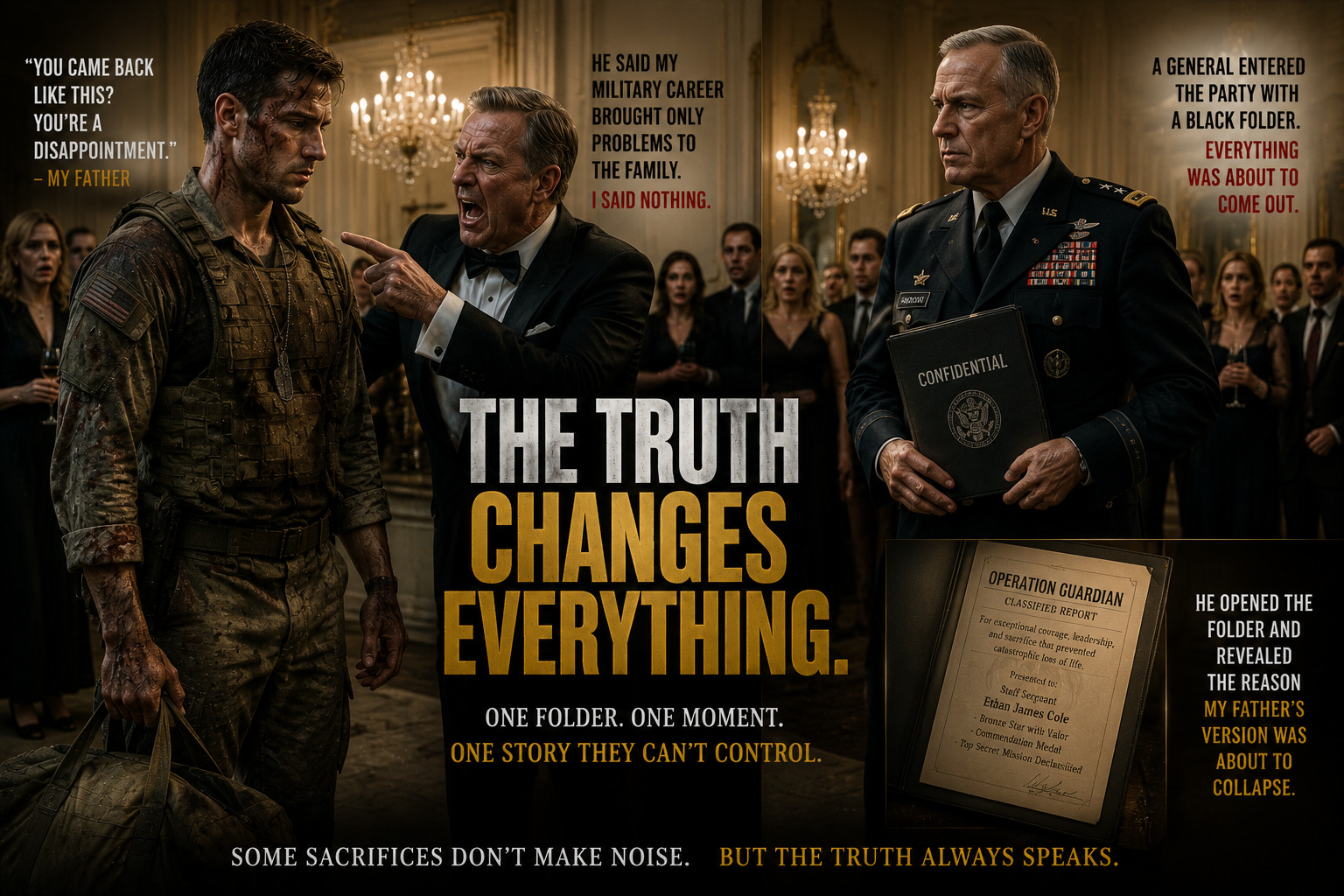
The first thing my father saw was not the blood crusted beneath my fingernails.
It was not the split above my eyebrow, the gray dust embedded in my hair, or the burn climbing from the collar of my combat uniform to the edge of my jaw.
He saw the rug.
His gaze followed the dark footprints I had left across the ivory Persian carpet, each one glistening beneath the chandeliers like a wound refusing to close.
“Rose.”
My father never needed to raise his voice. Harrison Calder had spent forty years learning how to make powerful men lean closer when he spoke softly.
A string quartet stopped in the middle of a waltz.
Two hundred guests turned toward me.
Senators, defense executives, television anchors, retired admirals, and women wearing diamonds that could have paid for an infantry platoon’s equipment watched me stand beneath the arched entrance of Calder House.
Outside, freezing rain tapped against the tall windows. Inside, the ballroom smelled of cedar smoke, champagne, and white roses arranged in silver urns.
My father stood at the center of it all in a midnight tuxedo, one hand resting on the shoulder of my older brother, Grant.
Behind them, a forty-foot banner displayed the emblem of Calder Strategic Systems.
PROTECTING THOSE WHO PROTECT US.
My father looked down at the blood spreading from my boots into the fibers of the rug.
Then he said the words that would follow him for the rest of his life.
“You ruined my party.”
No one laughed.
That made it worse.
I had imagined this moment during the seventeen-hour flight home. In some versions, he pulled me into his arms. In others, he asked what had happened.
In the most realistic version, he called his lawyer before calling me his daughter.
I had not imagined the rug.
“It isn’t my blood,” I said.
The musicians stared at their instruments.
My father’s expression hardened.
“That is supposed to make this better?”
My left hand began to tremble. I closed it around the folded field jacket pressed against my stomach.
Inside the jacket were Staff Sergeant Thomas Boone’s identification tags, a shattered section of body armor, and an encrypted drive that could end my father’s company.
It could also send my brother to prison.
“I need ten minutes with you,” I said. “Privately.”
Grant stepped forward.
At forty-two, he had inherited our father’s height, our mother’s dark eyes, and the permanent expression of a man listening to disappointing quarterly results.
He looked immaculate in a tailored dinner jacket.
I wondered whether he had ever seen blood outside a television screen.
“Rose, this isn’t the time.”
“This is the only time.”
A photographer near the stage lowered his camera. The red light on top continued blinking.
Grant noticed it too.
His mouth tightened.
“Turn that off,” he told the photographer.
My father did not take his eyes off me.
“What happened to your face?”
It was the closest thing to concern he had offered.
“An explosion.”
Someone near the bar inhaled sharply.
My father glanced toward the senator standing beside the podium, then toward General Marcus Bell’s empty chair at the head table.
The general had not arrived yet.
That was why I still had a chance.
My father descended the three marble steps separating us. His polished shoes stopped inches from the first bloody footprint.
“You disappeared for fourteen months,” he said. “No calls. No address. Your mother’s memorial came and went.”
“I was deployed.”
“You are always deployed.”
“I couldn’t tell you where.”
“You never tell me anything.”
His words slipped under my ribs more easily than shrapnel.
I had learned to endure interrogation, sleep deprivation, and the screams of wounded men waiting for evacuation.
My father still knew where to cut.
“I’m telling you something now,” I said. “Stop tonight’s contract announcement.”
Grant went still.
For the first time since I entered the room, fear appeared on his face.
My father saw it.
“What contract announcement?”
“The Sentinel armor extension.”
A murmur moved through the ballroom.
The Sentinel contract was worth 4.8 billion dollars over eight years. Everyone in the room knew it was the reason for the gala, even if the invitation called the evening a celebration of military families.
My father’s eyes narrowed.
“That decision is above your pay grade, Major.”
There it was.
Not daughter.
Major.
The rank spoken as an insult.
He had always believed I had joined the Army to punish him. West Point instead of Yale. Infantry support instead of corporate law. A uniform instead of a seat on his board.
What he did not know was that the rank on my chest represented less than half of what I had been doing.
“Please,” I said. “Give me ten minutes.”
“Is this some kind of protest?”
“No.”
“Then explain yourself.”
“Not here.”
His gaze passed over my stained uniform and the watching crowd.
All his life, Harrison Calder had believed dignity was something other people granted you when you gave them nothing ugly to look at.
Blood was ugly.
So was fear.
He hated both.
“You arrive looking like this,” he said, “in front of my guests, on the most important night this company has had in a decade, and then demand that I cancel a contract employing thousands of people?”
“I’m not demanding.”
“What would you call it?”
“A warning.”
A muscle moved in Grant’s jaw.
My father’s voice dropped lower.
“You have spent your entire adult life running toward chaos, Rose. I will not let you drag it into this house.”
The ballroom disappeared.
For half a second, I was back beneath a black sky in the Karsan Mountains, listening to bullets tear through sheet metal.
Thomas Boone was on the ground beside me.
His hands were slick with his own blood.
The ceramic plate inside his vest had broken into three pieces.
He gripped my sleeve and whispered, “Tell them it broke before I did.”
Then the chandeliers returned.
The white roses.
The banner.
My father’s perfect party.
I looked at the blood beneath his shoes.
“You invited the chaos,” I said. “You just dressed it in a tuxedo.”
Grant moved before my father could answer.
He seized the folded jacket from my hands.
The broken armor plate struck the marble floor with a sound like a gunshot.
The jacket opened.
Thomas Boone’s blood-darkened identification tags slid across the floor and stopped at my father’s feet.
Stamped into the fractured plate was the Calder Strategic Systems insignia.
My father stared down at it.
His face emptied.
“Where did you get that?”
“The soldier whose blood is on your rug was wearing it when he died.”
Behind us, the front doors opened.
Cold air swept through the ballroom.
A man in a dress uniform entered with four stars on each shoulder.
General Marcus Bell looked from the shattered armor to the blood on my boots.
Then he looked at me.
Everyone waited for him to greet my father.
Instead, the general came to attention.
“Wren Actual,” he said.
And saluted me.
2. The Name No One Knew
No one moved.
Not my father.
Not Grant.
Not the senator whose hand remained suspended above his champagne glass.
The only sound was rain striking the windows and the faint electric hum of the chandeliers.
General Bell held the salute.
I forced my trembling hand upward and returned it.
The motion pulled at the bandage beneath my uniform. Heat spread along my side.
The general saw the pain cross my face.
“You were ordered to remain at Walter Reed.”
“Staff Sergeant Boone’s family had been notified, sir.”
“That wasn’t my question.”
“No, sir.”
His gaze traveled over the blood, the fractured plate, and the stunned faces surrounding us.
Then he lowered his hand.
My father recovered first.
“General Bell. We were not expecting you for another twenty minutes.”
“I changed the schedule.”
“Of course. We’re honored.”
My father extended his hand.
The general did not take it.
“Major Calder asked me to come early.”
My father looked at me.
The expression in his eyes was not pride. It was betrayal.
“You arranged this?”
“I tried to speak to you privately.”
“You brought a four-star general into my home to threaten me?”
General Bell stepped between us.
“I suggest you listen before deciding who is threatening whom.”
Grant bent to retrieve the broken armor plate.
“Don’t touch that,” I said.
His fingers froze an inch above it.
Two military police officers entered behind General Bell, followed by a woman in a dark civilian suit carrying a sealed evidence case.
Deputy Inspector General Helena Price.
Grant slowly stood.
The guests began moving away from him.
Powerful people always knew when proximity became dangerous.
My father looked around his ballroom as if seeing it for the first time. The cameras, the donors, the board members, the employees who had spent years fearing his disappointment.
“This is a private event,” he said.
“Not anymore,” Price replied.
Grant’s voice sharpened.
“Do you have a warrant?”
“We have preservation orders, emergency suspension authority, and testimony from twelve soldiers. A warrant will be the least of your concerns.”
My father turned to me.
“What did you do?”
I almost laughed.
Not because it was funny.
Because after everything, he still assumed I was the damage.
General Bell faced the room.
“Ladies and gentlemen, the contract presentation scheduled for tonight will not take place.”
The senator stepped away from the podium.
Someone near the bar began whispering into a phone.
General Bell continued.
“Thirty-one hours ago, a joint American task force was attacked in the Karsan corridor. The enemy had advance knowledge of their movement, their communications were disabled, and their primary extraction route had been mined.”
My father’s eyes remained fixed on me.
The general pointed toward the shattered plate.
“Six Sentinel armor plates failed during that engagement.”
A woman on the Calder board covered her mouth.
Grant shook his head.
“That isn’t possible. Sentinel plates exceed every federal standard.”
“On paper,” Price said.
The two words landed harder than an accusation.
General Bell’s voice remained steady.
“The task force commander was killed during the first strike. His executive officer suffered a traumatic brain injury. Enemy fighters closed from three sides.”
He looked at me.
“Major Rose Calder assumed command.”
My father blinked.
“She’s an intelligence liaison.”
“That is what her public file says.”
The general’s answer moved through the room like a cold draft.
My father’s lips parted, but no sound came out.
For eleven years, he had introduced me as his daughter who “worked in Army administration.”
He believed my scar came from a vehicle accident.
He believed my silences came from stubbornness.
He believed the brass oak leaf on my chest represented a respectable but unremarkable career.
I had allowed him to believe it.
Some secrets protected missions.
Others protected the people we still wanted to love.
General Bell walked toward the stage.
“Major Calder was operating under the call sign Wren Actual as commander of Task Force Wren, a joint recovery and threat-interdiction unit whose missions are not discussed at fundraisers.”
Several retired officers in the room turned toward me with new expressions.
Recognition.
Not of my face.
Of the name.
An older colonel near the orchestra whispered, “That was her?”
My father heard him.
General Bell continued.
“Major Calder reorganized the surviving personnel, established a defensive corridor, and coordinated air support while enemy forces were within seventy meters of her position.”
Images struck me in fragments.
A radio spitting static.
Boone dragging a wounded specialist behind a stone wall.
The smell of burning rubber and copper.
My own voice calling coordinates while rounds snapped over my head.
“Danger close,” the pilot had warned.
“I know,” I had answered.
General Bell’s voice pulled me back.
“She personally carried three wounded soldiers to the evacuation point. She remained behind when the first helicopter departed because eleven of her people were still on the ground.”
My father’s face had changed.
The anger was gone.
Something more vulnerable had taken its place.
Confusion.
He had built his life around knowing the value of everyone in the room.
For the first time, he had no idea who his daughter was.
“How many survived?” someone asked.
“Twenty-three,” General Bell said. “Because she refused to leave them.”
Applause began near the rear of the ballroom.
One person.
Then three.
Then a dozen.
It spread before anyone could decide whether it was appropriate.
My father stood in the middle of it, looking at me as strangers applauded the parts of my life he had spent years dismissing.
I hated the satisfaction that moved through me.
Hated how warm it felt.
Revenge was not always a knife.
Sometimes it was simply the truth arriving while your enemy was still speaking.
General Bell lifted a hand.
The applause stopped.
“This is not an award ceremony,” he said. “A soldier is dead.”
The warmth vanished.
He turned toward me.
“Major, show them.”
I knelt beside the broken plate.
My side screamed.
I picked up Thomas Boone’s identification tags and wrapped the chain around my fingers.
“The plate that failed Staff Sergeant Boone was manufactured at Calder Plant Seven,” I said. “Lot number S-19-440.”
Grant answered too quickly.
“That lot passed inspection.”
“It failed three independent impact tests.”
“That’s false.”
“I have the reports.”
“Then they’re fabricated.”
“I have the original laboratory recordings.”
His face lost color.
I looked at my father.
“The contract announcement has to stop. Every plate from that lot has to be recalled. Immediately.”
My father stared at the Calder insignia embedded in the cracked ceramic.
“How many were distributed?”
No one answered.
His head snapped toward Grant.
“How many?”
Grant swallowed.
“Eleven thousand four hundred.”
A sound escaped someone in the crowd.
My father’s shoulders dropped half an inch.
To anyone else, it would have meant nothing.
I had spent my childhood studying him for signs of danger.
Half an inch meant the ground beneath him had disappeared.
“You told me the production variance was cosmetic,” he said.
“It was supposed to be.”
“You told me no operational units received those plates.”
Grant looked toward the exits.
The military police officers shifted their stance.
General Bell watched him carefully.
Grant turned back to our father.
“We were going to replace them during the next equipment cycle.”
“When?”
“Within eight months.”
My grip tightened around Boone’s tags.
“He had eight minutes.”
Grant flinched.
For one second, shame broke through his composure.
Then survival covered it again.
“You don’t understand what was at stake.”
“I understand exactly what was at stake.”
“No, you understand one battlefield.”
His voice rose.
“I was responsible for four thousand employees, three manufacturing towns, pensions, hospitals, mortgages. Sentinel was already two years behind schedule. If we disclosed another failure, the government would have canceled the extension. Plant Seven would have closed before Christmas.”
“So you sent defective armor to soldiers.”
“We sent armor that still passed minimum requirements.”
“Thomas Boone is dead.”
“And thousands of people are still employed.”
The room reacted as if he had struck me.
Grant heard the ugliness of his own words too late.
He looked around at the faces watching him.
“I didn’t mean—”
“Yes, you did,” I said. “That’s why it was easy.”
My father moved toward his son.
“Did you alter the reports?”
Grant said nothing.
“Answer me.”
“I corrected an interpretation.”
“You altered the reports.”
“The adhesive failures occurred under temperature conditions outside the expected operational range.”
“The Karsan Mountains were inside that range,” I said.
“No one predicted deployment there.”
“Soldiers don’t get to fight only where your spreadsheets predict.”
My father reached for the back of a chair.
His fingers pressed into the polished wood.
Grant looked at him with the desperation of a boy who had spent his entire life trying to earn a nod.
“You taught me the company came first.”
“I taught you responsibility.”
“You taught me survival.”
My father recoiled.
Grant’s eyes shone, but his voice remained controlled.
“When the banks called, I fixed it. When the supply chain collapsed, I fixed it. When Congress threatened to move production overseas, I sat in those hearings while you recovered from surgery and I fixed it. You never asked how. You only asked whether the problem was gone.”
My father’s grip tightened on the chair.
Grant pointed at me.
“She gets to disappear for years, return covered in blood, and suddenly she’s the honorable one?”
“Leave her out of this,” my father said.
“I spent my life inside your company. She spent hers running away from it.”
I rose slowly.
The room tilted before settling.
“I didn’t run away from the company.”
Grant laughed without humor.
“You ran from all of us.”
“No,” I said. “I ran toward people who didn’t make me earn the right to belong.”
The words struck more than Grant.
My father looked away.
General Bell turned to Inspector Price.
“Secure the evidence.”
She opened the case.
As one of the officers bent toward the shattered plate, my father spoke.
“Wait.”
His voice was different now.
Older.
He looked at Grant.
“You said I approved the substitution.”
“You did.”
“I approved a supplier contingency. Not falsified testing.”
Grant’s eyes hardened.
“You signed the operational risk waiver.”
My father went completely still.
Inspector Price looked up.
“What waiver?”
Grant stared at our father.
The last affection between them disappeared.
“The one he hoped no one would ever read.”
3. What My Father Signed
The ballroom had become a courtroom without a judge.
No one left.
They pretended to stay because the exits were partially blocked, but that was not true.
They stayed because disgrace has its own gravity.
My father looked smaller beneath the chandeliers.
Not weak.
Harrison Calder would have considered weakness a moral failure.
But stripped of certainty, he appeared suddenly human.
“What waiver?” I asked.
He did not answer.
Grant did.
“Six months ago, Plant Seven discovered inconsistencies in the bonding resin. The supplier claimed the issue affected less than point-zero-two percent of plates.”
“And the laboratory disagreed,” I said.
“The laboratory recommended additional testing.”
“You ordered them to stop.”
“I ordered them to use the existing federal model.”
Inspector Price held out her hand.
“Where is the waiver?”
Grant smiled faintly.
“In the packet Rose brought.”
He had known what I carried from the moment I entered.
That was why he grabbed it.
Price retrieved the encrypted drive from the field jacket.
“Password?”
I gave it to her.
She connected the drive to an isolated tablet.
My father watched the screen wake.
I watched him.
“When did you know?” I asked.
“I knew there was a dispute.”
“That wasn’t my question.”
His eyes lifted to mine.
“Rose.”
“When did you know the plates could fail?”
The old authority returned to his voice.
“Not here.”
A bitter laugh escaped me.
“Now you want privacy?”
His face tightened.
I stepped closer.
My boots left new marks on the rug.
“You had your chance.”
Grant looked almost relieved.
If our father fell, perhaps Grant would not fall alone.
Price opened the document.
The Calder company seal appeared at the top of the screen.
Beneath it was my father’s electronic signature.
She read silently for several seconds.
Then she looked at him.
“This authorizes distribution before completion of thermal-fracture testing.”
My father’s lips pressed together.
“It was an emergency production measure.”
“It states that any increase in risk was statistically negligible.”
“That was the engineering assessment I received.”
I pointed toward the broken plate.
“Did you read the dissenting assessment?”
He said nothing.
“Did you read it?”
“Yes.”
The word barely carried across the ballroom.
My chest felt hollow.
I had come prepared for Grant’s guilt.
Some part of me had still believed my father was merely vain, cruel, and careless.
Not complicit.
“What did it say?” I asked.
His eyes moved toward the blood on the carpet.
“That the failure rate could not be established without further testing.”
“And you signed anyway.”
“The government had issued an accelerated delivery request.”
“You signed anyway.”
“Three brigades were waiting for armor.”
“So you sent them armor you weren’t sure would work.”
“I sent them the best armor available under the circumstances.”
Thomas Boone’s final breath filled my memory.
Thin.
Wet.
Surprised.
My father continued, speaking faster now.
“If we had stopped production, soldiers would have deployed with older systems. Systems with documented vulnerabilities. There was no perfect choice.”
“There was an honest one.”
“Honesty would not have produced more armor.”
“It would have allowed the Army to decide the risk.”
“And while committees debated, people might have died.”
“One did.”
His face twisted.
“You think I don’t understand that?”
“I don’t think you understood it until his blood touched something you valued.”
The sentence silenced the room.
My father looked down at the rug.
For decades, that carpet had been the centerpiece of Calder House. Handwoven in Isfahan. A gift from a foreign minister. Insured for more than most Americans earned in ten years.
When I was nine, I spilled grape juice on one corner.
My father did not speak to me for two days.
Our mother had knelt beside me with a towel and whispered, “Your father grew up believing stains meant something was falling apart.”
I had believed that explanation for years.
Standing there, I understood the darker truth.
My father did not fear stains.
He feared evidence.
“Thomas Boone was twenty-nine,” I said. “He had a wife named Alicia and a seven-year-old son who believes his father is coming home because no one has found the words to tell him yet.”
My father closed his eyes.
“He was the platoon medic,” I continued. “He kept four men alive after the first strike. When my armor plate cracked, he exchanged vests with me.”
General Bell’s head turned.
I had not included that detail in my report.
My father opened his eyes.
“What?”
“Boone gave me his plate.”
My voice faltered for the first time.
I hated myself for it.
“He said the commander had to stay standing. I told him we would switch back after extraction.”
The black mountains rose around me again.
Boone tightening the straps at my side.
His grin bright beneath a face covered in dust.
You can court-martial me when we’re home, ma’am.
Then the second explosion.
A flash.
The violent pressure of the earth punching upward.
Boone falling against me.
My hands searching for the wound.
His armor plate opening like broken pottery.
“I carried him for almost a mile,” I said. “His blood soaked through my uniform before the helicopter arrived.”
My father’s gaze dropped to my chest.
“He died at Walter Reed?”
“Two hours ago.”
“And you came here?”
“The contract was being announced tonight.”
“You should have stayed at the hospital.”
“He was already gone.”
“You were injured.”
“So were twenty-three other people.”
“You’re my daughter.”
The words came out raw.
Not Major.
Not embarrassment.
Daughter.
I looked at him for a long moment.
“I was your daughter when I walked through the door.”
He had no answer.
A camera shutter clicked.
My father turned toward the sound.
The photographer lowered his lens.
In another life, Harrison Calder would have ordered security to remove him.
This time, my father looked back at me.
“Did Boone know whose company made the plate?”
“Yes.”
“What did he say?”
I unwrapped the identification tags from my fingers.
“He told me to tell you it broke before he did.”
My father’s breathing changed.
His hand moved toward the tags but stopped before touching them.
Perhaps he understood he had not earned that right.
Grant stepped forward.
“This is tragic. I’m not denying that. But one battlefield failure does not invalidate an entire system.”
General Bell turned on him.
“Six plates failed.”
“Under exceptional circumstances.”
“War is an exceptional circumstance.”
“General, with respect—”
“You have none left to spend.”
Grant’s face reddened.
My father continued staring at Boone’s tags.
“What happens now?” he asked.
Inspector Price answered.
“The contract is suspended. All affected lots will be recalled. The Department of Justice will open a criminal inquiry. The board’s communications and financial records will be seized.”
“The employees?” my father asked.
“Are not under investigation.”
“The plants?”
“That depends on the board and the government.”
Grant laughed bitterly.
“So there it is. Four thousand families get to suffer so everyone in this room can feel righteous.”
I faced him.
“No. They suffer because you gambled with lives and called it leadership.”
“You have no idea what leadership costs.”
I stepped close enough to smell the whiskey on his breath.
“Leadership costs the leader first.”
Grant’s eyes flickered toward the scar on my face.
“You think that makes you better than me?”
“No.”
My answer surprised him.
“I think believing I’m better would make me more like you.”
For the first time, he had nothing to say.
My father lifted his head toward General Bell.
“You came here to expose us publicly.”
“No,” the general said. “I came because your daughter asked me to give you a choice.”
My father looked at me.
“What choice?”
General Bell nodded toward the stage, where the podium waited beneath the Calder banner.
“You can let investigators announce what happened.”
He paused.
“Or you can walk to that microphone and tell the truth yourself.”
4. The Podium
My father looked at the stage.
Twenty feet separated him from the podium.
I had seen men cross open ground under sniper fire with less fear in their eyes.
Every symbol of his life waited beneath those lights.
His company emblem.
His board.
His friends.
The senator prepared to praise him.
The empty display case intended for the National Patriot Leadership Medal General Bell had been scheduled to present.
For three weeks, newspapers had advertised the evening as a celebration of Harrison Calder’s service to the country.
Now he had to decide what the word service meant.
His lawyer appeared at his elbow.
Leonard Voss had been part of our family for so long that he had attended my high school graduation and Grant’s first divorce.
“Do not speak publicly,” Voss whispered. “Not one word. We can control the legal exposure if we move quickly.”
My father did not respond.
Voss gripped his arm.
“Harrison, listen to me. Nothing has been established. The general’s presence does not change evidentiary standards.”
My father looked at the hand on his sleeve.
Voss released him.
Grant moved closer.
“Dad, he’s right. We need to think.”
My father’s eyes shifted to him.
“We had six months to think.”
“We can still protect the company.”
“From whom?”
“From this.”
Grant gestured toward me.
The movement was small.
It was enough.
My father struck him.
The sound cracked across the ballroom.
Grant staggered sideways, one hand rising to his cheek.
My father stared at his own palm.
I had never seen him hit anyone.
Violence did not suit him. He preferred destruction that arrived through signatures, silence, and closed doors.
Grant’s eyes filled with rage.
“You blame me because she’s watching.”
“I blame you because I finally am.”
Grant’s expression collapsed.
For one terrible second, he looked twelve years old.
Then the mask returned.
“Fine,” he said. “Confess. Hand them everything. Let the company die. But don’t pretend this is courage. You’re choosing her because she brought an audience.”
My father looked toward the guests.
Grant was not entirely wrong.
That was what made the accusation hurt.
My father had always performed best beneath observation.
Even his apologies came dressed for dinner.
I moved between them.
“Don’t do this for me.”
My father’s gaze settled on my scar.
“Then why did you come?”
“To give you the truth before strangers did.”
“You knew what would happen.”
“I knew what might happen.”
“You wanted me humiliated.”
Part of me wanted to deny it.
Instead, I looked at the people who had watched him shame me for bringing a dead soldier’s blood into his ballroom.
“Yes,” I said. “Part of me did.”
Pain moved across his face.
I continued before courage left me.
“I wanted you to feel small. I wanted every person who laughed when you called my service a phase to see you salute the truth you ignored.”
“I never laughed.”
“You let them.”
His eyes lowered.
“But that isn’t why I brought General Bell,” I said. “I brought him because if investigators arrived first, you would call this an attack. If reporters broke the story, you would call it distortion. If I came alone, you would call me emotional.”
He flinched.
“I needed someone whose rank you respected enough to make you listen.”
General Bell’s expression did not change, but something softened in his eyes.
My father glanced at the four stars on the general’s shoulders.
Then at the oak leaf on mine.
“You were right,” he said.
Those three words should have felt like victory.
Instead, they hurt.
All my life, I had wanted my father to admit I was right.
I had never imagined a dead man would have to prove it.
My father walked toward the stage.
Voss tried once more.
“Harrison.”
My father kept moving.
The guests parted.
His shoes crossed the bloodstained carpet. For the first time that night, he did not step around the marks.
He climbed the steps and stood behind the podium.
The cameras rose.
General Bell remained beside me.
“Is this what you wanted?” he asked quietly.
“No, sir.”
“Good.”
My father adjusted the microphone.
The room waited.
“My name is Harrison Calder,” he began.
His voice shook.
He stopped.
Closed his eyes.
Started again.
“My name is Harrison Calder, and tonight I was scheduled to accept an award for supporting American service members.”
He looked toward the empty display case.
“I will not accept it.”
The senator stared at the floor.
“My company manufactured protective equipment that failed during an operation thirty-one hours ago. Staff Sergeant Thomas Boone died while wearing that equipment.”
Grant turned away.
My father’s hands gripped the sides of the podium.
“Six months ago, I authorized distribution before additional testing was complete. I was advised the statistical risk was minimal. I also received a dissenting report warning that the risk was unknown.”
A board member whispered, “Oh, God.”
“I signed the authorization anyway.”
The cameras clicked faster.
“I told myself I was preventing a production delay. Protecting jobs. Meeting an urgent military need. Those facts may explain my decision.”
My father looked at me.
“They do not excuse it.”
The ballroom seemed to shrink around him.
“When Major Rose Calder entered this house tonight, she was covered in the blood of a soldier who died after saving her life.”
His voice cracked on the word saving.
“I looked at her, and I worried about my carpet.”
No one moved.
“I told my daughter she had ruined my party.”
He lowered his head.
“The truth is that my decisions ruined far more.”
Grant’s lawyer was now whispering urgently into a phone.
My father continued.
“Effective immediately, I resign as chairman of Calder Strategic Systems. I have instructed company counsel to cooperate fully with military and federal investigators. All compensation due to me this year will be placed in an independent fund for affected service members and their families.”
Voss’s face went white.
My father looked toward the employees gathered near the rear.
“None of you are responsible for the choices made in executive rooms. You deserved leadership that did not ask you to trade silence for security.”
Then he turned toward Grant.
“My son believed he was protecting what I built.”
Grant’s jaw tightened.
“I taught him to believe the company was our family. It was not.”
My father’s eyes found mine.
“I had a family. I treated them like employees whose performance disappointed me.”
Every instinct told me to look away.
I did not.
“Major Calder came here to give me the chance to speak before I was forced to,” he said. “I did not deserve that mercy.”
The word mercy unsettled me more than any accusation.
My father stepped away from the podium.
No applause followed.
There should not have been.
He descended from the stage into a silence no amount of money could control.
Inspector Price approached him.
“Mr. Calder, we will need your phone, access credentials, and passport.”
He removed the phone from his jacket and placed it in her hand.
Then he took out his passport.
Grant watched him.
“You’re just giving up?”
My father faced his son.
“No.”
His voice steadied.
“For the first time, I am giving back what was never mine to keep.”
Grant shook his head.
“You think one speech fixes this?”
“No.”
“You think she’ll forgive you?”
My father glanced at me.
“No.”
Grant looked around for an ally.
He found only people avoiding his eyes.
The military police officer stepped forward.
“Mr. Grant Calder, we need you to accompany us for questioning.”
“Am I under arrest?”
“Not at this time.”
Grant laughed once.
“Then I’m leaving.”
He took three steps toward the doors.
Inspector Price spoke without raising her voice.
“The preservation order prohibits removal or destruction of electronic records. Our forensic team detected a remote wipe request from your phone four minutes ago.”
Grant stopped.
My father closed his eyes.
The officer extended a hand.
“Your phone, sir.”
Grant looked at me.
The hatred in his face was almost clean.
“You did this.”
“No,” I said. “I survived it.”
He handed over the phone.
As the officers led him away, he passed close enough to whisper, “He’ll always choose you now.”
I watched our father standing alone beneath the chandeliers.
“No,” I said. “Now he has to learn how to choose for himself.”
Grant disappeared through the doors.
The party was over.
But my father’s punishment had only begun.
5. After the Music
Guests left in clusters.
No one said goodbye.
The quartet packed their instruments while investigators photographed the broken armor and marked the bloodstains with numbered evidence cards.
Workers removed the untouched food from silver trays.
Three hundred crystal glasses stood beneath the lights, most of them still full.
Rain slid down the windows in crooked lines.
General Bell found me near the fireplace.
“You need a hospital.”
“I’ve had worse.”
“That sentence is why officers like you become paperwork.”
“I thought my public file said I already was paperwork.”
He almost smiled.
Then his gaze shifted toward my father.
Harrison sat alone at a table stripped of its decorations. His bow tie hung loose. Without the crowd, he looked less like a titan of industry and more like a tired man waiting for bad news.
General Bell lowered his voice.
“The recommendation for your promotion was approved.”
I looked at him.
“To lieutenant colonel?”
“And command of the permanent task force.”
The news should have filled me with pride.
Instead, I thought of Boone.
“He should be alive to hear that.”
“Yes.”
The general did not offer comfort.
That was one reason I trusted him.
He removed a small envelope from his jacket.
“Boone wrote this before the operation. Standard contingency letter.”
Alicia Boone’s name was written across the front.
“I need to take it to her.”
“You’re in no condition to drive.”
“I’ll manage.”
“No. You won’t.”
He signaled to his aide.
A young captain approached.
“Captain Ellis will take you.”
I accepted the envelope.
General Bell studied me.
“What happens with your father is not an operational objective.”
“I know.”
“You cannot command this outcome.”
“I know.”
“You cannot save everyone.”
My eyes moved toward Boone’s blood.
“I know that too.”
The general left before I could lie again.
My father remained seated as the ballroom emptied.
I could have walked past him.
Part of me wanted to.
A larger part had been walking away for twenty years.
I stopped across the table.
He looked at my uniform.
“You’re still bleeding.”
I glanced down.
A thin stain had spread along my side.
“This part is mine.”
He stood immediately.
“Sit down.”
“I’m fine.”
“You are visibly not fine.”
“Now you notice?”
The words came out harsher than I intended.
He absorbed them without defense.
“Yes,” he said. “Now I notice.”
He removed his tuxedo jacket and folded it against the back of a chair.
Then he pulled out the chair for me.
A small gesture.
Too late.
Still human.
I sat.
He lowered himself across from me.
For several seconds, neither of us spoke.
The house settled around us. Pipes clicked behind the walls. Somewhere upstairs, a door closed.
“I blamed you for your mother’s death,” he said.
The sentence arrived without warning.
My body went still.
“I know.”
“No. You knew I was angry that you missed the funeral.”
“I arrived twelve hours after.”
“You were not there when she asked for you.”
I looked toward the dying fire.
“I was in Mosul.”
“You told me Turkey.”
“I lied.”
His mouth tightened, then relaxed.
“Of course you did.”
“I was under orders.”
“She kept asking whether you were safe.”
“I wasn’t.”
He looked at me.
I had never said that aloud.
“The convoy was hit the same night she died,” I continued. “Two of my soldiers were trapped. I could have left when the evacuation opened. I stayed.”
My father’s eyes filled.
“Did you know she was dying?”
“Yes.”
“Then why?”
The question was not angry.
That made it harder.
“Because their mothers were waiting too.”
He looked down at his hands.
My father’s fingernails were perfectly trimmed. A pale line marked the place where his wedding ring had rested before my mother’s death.
“I thought you chose strangers over her.”
“I chose the people in front of me.”
“And tonight you came here instead of staying with Boone.”
“He wasn’t in front of me anymore.”
My father nodded slowly.
“I have spent years calling your sense of duty selfish because it did not center around me.”
I said nothing.
He reached into his shirt pocket and removed a folded piece of paper, worn soft at the edges.
“I’ve carried this for nine years.”
He placed it on the table.
My mother’s handwriting crossed the front.
For Harrison, when you are ready to stop being afraid.
“What is it?”
“Her last letter to me.”
“You never opened it?”
“I opened it.”
His shame answered the next question before I asked.
“She wrote about you.”
My fingers hovered above the paper.
“She knew I blamed your service for taking you away,” he said. “She said I was wrong. She said you had inherited the part of me I buried when success became more important than courage.”
I unfolded the letter.
My mother’s handwriting leaned slightly to the right, impatient even near the end.
Harrison,
You keep saying Rose left us. She did not. She became the person we raised her to admire, and then you punished her because that person could not be controlled.
The rest blurred.
I blinked until the words sharpened again.
Do not make her return home only to prove she was right to leave.
I lowered the paper.
“You had this.”
“Yes.”
“For nine years.”
“Yes.”
“And you said nothing.”
“I was angry with a dying woman for understanding me.”
My hand began trembling again.
This time I did not hide it.
“You let me believe she died disappointed in me.”
“I know.”
“That was crueler than anything you said tonight.”
“I know.”
I wanted him to defend himself.
I wanted him to become the cold, arrogant man I understood how to hate.
Instead, he sat before me without armor.
“I cannot ask you to forgive that,” he said.
“No.”
“I cannot repair it.”
“No.”
“But I will tell the investigators everything. Not to impress you. Not to protect Grant. Not to save the company.”
“Why?”
He looked at the bloodstained carpet.
“Because a man died before I was willing to see what I had become.”
I folded my mother’s letter.
“You’re not the victim tonight.”
“I know.”
“If Grant goes to prison, you don’t get to pretend he became this alone.”
“I know.”
“If the company collapses, people will hate you.”
“They should.”
“No. They should know what you did. Hatred is their decision.”
He nodded.
I stood carefully.
He did not ask me to stay.
That was the first evidence he had listened.
At the doorway, I heard him speak.
“Rose.”
I turned.
He looked toward the blood on the rug.
“Did Boone suffer?”
There are lies we tell to protect ourselves.
There are lies we tell to protect others.
In the Army, we learn that mercy sometimes requires accuracy.
“He was afraid,” I said. “But he wasn’t alone.”
My father closed his eyes.
“Thank you.”
I left him in the ruined ballroom.
For once, he did not call me back.
6. The House Without Armor
Alicia Boone lived in a brick house outside Alexandria with yellow porch lights and a bicycle lying on the lawn.
Captain Ellis waited in the vehicle while I walked to the door.
The freezing rain had become snow.
It gathered on my shoulders and melted against the dried blood.
Alicia opened the door before I knocked.
She had Thomas’s eyes.
That nearly broke me.
Behind her, a little boy sat on the floor arranging plastic soldiers into two straight lines.
Alicia looked at my uniform.
Then at the envelope in my hand.
Her fingers rose to her mouth.
“No,” she whispered.
I had delivered death notices before.
There is no honorable way to destroy a person’s world.
No perfect words.
No speech that turns sacrifice into enough.
I told her Thomas had saved lives.
I told her he had done his duty.
I told her he had spoken about her and their son.
Then I gave her the letter and stood while she fell apart.
Her son watched from the hallway.
“Is Dad coming home?” he asked.
Alicia made a sound I would hear in my sleep for years.
I knelt despite the pain in my side.
“No,” I said.
He stared at the scar on my face.
“Were you with him?”
“Yes.”
“Was he brave?”
I thought of Boone joking while tightening my armor. Dragging wounded men under fire. Giving me the plate that should have saved him.
“Yes.”
The boy looked down at his plastic soldiers.
“My dad said brave means doing something when you’re scared.”
“He was right.”
“Were you scared?”
“Yes.”
He considered that.
“Then you were brave too.”
Children offer mercy without understanding its price.
I left before I could cry in front of him.
In the vehicle, Captain Ellis pretended not to see my hands shaking.
We drove to Walter Reed.
Surgeons removed two fragments from my side. The burn along my neck required grafting. My left hand tremor, they said, might fade with time.
Three days later, the Justice Department announced a criminal investigation into Calder Strategic Systems.
Within a week, the board removed Grant as chief executive.
Within two months, prosecutors charged him with conspiracy, procurement fraud, obstruction, and destruction of evidence.
My father was not charged immediately.
He testified for eleven hours before a grand jury.
Then he testified again.
He surrendered every privilege he could legally surrender.
The company survived, though barely. The government placed its defense division under independent oversight. Plant Seven remained open to manufacture replacement equipment after the workers voted to cooperate with investigators.
Four executives resigned.
Two engineers came forward.
A laboratory technician produced archived footage proving the failed tests had been deliberately excluded.
The truth did not arrive as one explosion.
It arrived as a series of doors opening.
Grant eventually pleaded guilty to fraud and obstruction. At sentencing, he spoke for forty minutes about the jobs he had saved.
Alicia Boone spoke for four.
“My husband did not die because armor is difficult to make,” she said. “He died because powerful men believed his life belonged in the margin of an acceptable-risk calculation.”
Grant received nine years.
My father sat behind him in the courtroom.
I sat beside Alicia.
None of us looked at one another.
The National Patriot Leadership Medal was never awarded.
General Bell presented me with the Distinguished Service Cross in a closed ceremony at Fort Liberty.
I asked that Thomas Boone’s family stand beside me.
When the photographer raised his camera, Alicia placed her son in front of us.
The boy wore his father’s identification tags beneath his shirt.
My promotion took effect the following month.
Lieutenant Colonel Rose Calder.
Commander of Task Force Wren.
My father sent no flowers.
Instead, he mailed a single note.
Your mother would have stood in the front row. I am sorry I spent so many years blocking her view.
I placed it in a drawer.
I did not answer.
Not then.
7. The Stain That Stayed
Six months after the party, I returned to Calder House.
The mansion was for sale.
Protective sheets covered the furniture. The chandeliers were dark. Without music and guests, the ballroom felt smaller than I remembered.
My father stood near the windows wearing an old blue shirt with the sleeves rolled to his elbows.
I had never seen him dressed that way.
His hair had grown longer. He had lost weight.
“You came,” he said.
“You asked me to.”
“I wasn’t sure that still mattered.”
“It doesn’t always.”
He accepted the answer.
The Persian rug remained in the center of the ballroom.
The bloodstains had darkened to brown.
“You didn’t replace it,” I said.
“The cleaners said they could remove most of it.”
“Most?”
He looked down at the footprints crossing the ivory fibers.
“They asked which sections mattered.”
“And?”
“I told them all of it mattered.”
There was no dramatic reconciliation.
He did not pull me into his arms.
I did not call him Dad.
Some wounds close slowly because the body knows better than the heart.
He walked beside me to the center of the room.
“The house closes next week,” he said. “The proceeds are going into the independent testing foundation.”
“That won’t change what happened.”
“No.”
“It won’t make Alicia forgive you.”
“I know.”
“It won’t make me forgive you.”
“I know.”
He had become very good at saying those words.
Knowing was easier than changing.
But it was a beginning.
My father looked at the Calder company banner still rolled beside the stage.
“I built everything because I was afraid of becoming my father,” he said.
I knew little about my grandfather beyond the facts my father permitted. Coal miner. Alcoholic. Violent when drunk. Dead before I was born.
“When I was eight,” my father continued, “he came home bleeding after a fight. He collapsed on our living-room carpet. My mother spent the night cleaning it because the landlord was coming in the morning.”
He looked down at Boone’s blood.
“I decided then that no one would ever bring disorder into my home.”
“You confused disorder with shame.”
“Yes.”
“And control with safety.”
“Yes.”
The wind pressed against the windows.
He placed his hands in his pockets.
“When you walked in that night, I was eight years old again, staring at blood on a carpet.”
“You were also sixty-seven years old, humiliating your wounded daughter.”
“Yes.”
No excuse.
No demand that trauma erase responsibility.
I had not known how much I needed that.
He turned toward me.
“I do not know how to be your father now.”
“You weren’t very good at it before.”
A faint, painful smile crossed his face.
“No.”
I looked at the footprints.
They began at the entrance and ended where the shattered armor had fallen.
Evidence markers had been removed, but pale rectangles remained where investigators had photographed each stain.
“My new command leaves in three weeks,” I said.
His smile vanished.
“Where?”
“You know I can’t tell you.”
“For how long?”
“I don’t know.”
Fear appeared in his face.
This time, he did not turn it into anger.
“Will you contact me when you can?”
“I’ll try.”
He nodded.
Not a demand.
Not a complaint.
A request.
I reached into my coat and removed a small black box.
Inside was a replica of Thomas Boone’s unit insignia. Alicia had approved its use.
My father stared at it.
“What is this?”
“The independent testing foundation needs a seal.”
He did not touch the box.
“You want Boone’s insignia?”
“I want everyone who approves equipment to remember who carries the consequences.”
His eyes filled.
“Why are you giving this to me?”
“Because remorse that stays private is just another form of self-protection.”
He picked up the insignia carefully.
“I won’t waste it.”
“That is not a promise you make to me.”
“No.”
He closed the box.
We stood together in the empty ballroom, surrounded by covered furniture and the remains of an empire that had mistaken polish for honor.
At the door, my father spoke one last time.
“Rose.”
I looked back.
His eyes moved to the scar along my jaw, then to the rank on my uniform.
He seemed to understand that neither was the most important thing about me.
“I am proud of you,” he said.
I had waited most of my life to hear those words.
They did not heal me.
They did not erase Thomas Boone’s blood, my mother’s hidden letter, Grant’s betrayal, or the years my father had used silence as punishment.
But they no longer had the power to define me either.
“I know who I am without that,” I said.
Pain crossed his face.
Then pride replaced it.
“I know,” he answered.
I stepped outside.
Morning sunlight broke through the clouds, turning the wet pavement silver. A military vehicle waited at the end of the drive.
Captain Ellis opened the rear door.
Before getting in, I looked back at Calder House.
My father remained in the entrance, holding Boone’s insignia against his chest.
Behind him, the bloodstained rug stretched across the ballroom floor.
He never had it cleaned.
The stain never came out.
That was the first honest thing our house had ever kept.