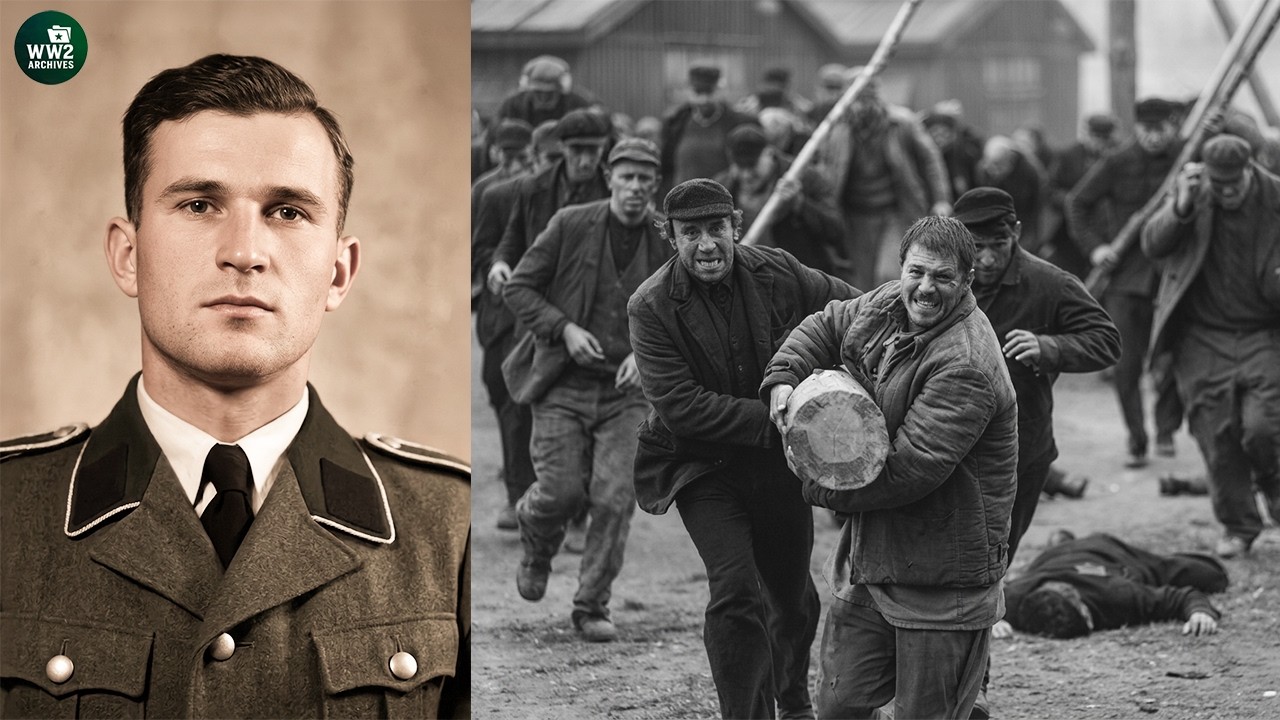
At approximately four o’clock on the afternoon of October 14, 1943, SS officer Siegfried Graetschus walked into a workshop inside the Sobibor extermination camp.
He believed he had come to try on a coat.
The prisoners had made it for him from material stolen from people who had arrived at the camp carrying suitcases, family photographs, house keys, wedding rings, and the belief that they were being relocated for work.
Graetschus was accustomed to taking what he wanted from the dead.
He commanded the camp’s auxiliary guards. He carried a pistol. He wore the uniform of a system that had taught everyone behind the barbed wire to step aside when he approached.
That afternoon, the tailors appeared obedient.
The coat was ready.
The room was quiet.
But behind a curtain, two starving Jewish prisoners were holding axes.
One was Arkady Wajspapir, a wounded former Red Army sergeant. The other was Yehuda Lerner, still only seventeen years old.
They had been waiting for nearly an hour.
Graetschus did not know that several SS officers had already been marked for death. He did not know that prisoners were moving between workshops with secret messages. He did not know that the men he considered powerless had spent days studying his habits, his schedule, his vanity, and the exact distance between his office and the tailor’s barracks.
For years, doors had closed on victims at his command.
Now a door closed behind him.
To understand how a farmer from East Prussia ended up in that room, wearing a stolen coat while two prisoners waited behind a curtain, the story must return to Berlin ten years earlier.
January 30, 1933.
There was no explosion when Adolf Hitler entered the Reich Chancellery as Germany’s new chancellor. No buildings collapsed. No alarm sounded across Europe.
There were uniforms, handshakes, official documents, photographers and political ceremonies.
To many Germans, it looked like another transfer of power.
It was not.
What changed that day was not merely the name of a government leader. The boundary of what the state was permitted to do to a human being began to move.
First came the language.
 Political opponents became traitors. Jewish citizens became contaminants. Roma became a social danger. Disabled people became economic burdens. Anyone who did not fit the racial fantasy of the new regime could be described as diseased, disloyal or less valuable.
Then came the laws.
Then the arrests.
Then the camps.
Dachau opened in March 1933, less than two months after Hitler’s appointment. It became a model for a camp system that would spread across Germany and occupied Europe. By the end of the Nazi era, Germany and its allies had established more than 44,000 camps, ghettos and other sites of imprisonment, forced labor, persecution and murder.
The system did not begin with gas chambers.
It began with categories.
It began when neighbors accepted that another neighbor could be reduced to a label. It began when clerks stamped forms, doctors signed evaluations, railway employees prepared schedules and guards convinced themselves that following orders relieved them of responsibility.
One of the young men who found a place in this new order was Siegfried Graetschus.
Born in Tilsit, East Prussia, in 1916, Graetschus left school after a basic education and worked as a farmer. There was nothing in that beginning to suggest that his name would one day be connected to some of the most efficient killing centers in human history.
His hands had known soil.
They had known tools, animals, weather and harvests.
But in December 1935, at the age of nineteen, he joined the SS.
In 1936, he joined the Nazi Party.
Those decisions mattered.
Graetschus was not dragged into the organization as a prisoner. He was not threatened with death if he refused to apply. He chose the uniform at a time when that uniform promised belonging, advancement and authority to young men willing to surrender their judgment to the state.
For someone with limited schooling and few prospects, the SS could appear to offer a larger identity. It replaced obscurity with rank. It replaced uncertainty with commands. It offered permission to look down on people whom the regime had placed beneath him.
The transformation did not happen in a single moment.
It happened through repetition.
A command obeyed.
A prisoner struck.
A humiliation ignored.
A body stepped over.
A promotion accepted.
Before joining the Nazi “euthanasia” program, Graetschus served at Sachsenhausen, the concentration camp established in 1936 north of Berlin.
Sachsenhausen was designed not merely to confine people, but to reorder the moral universe of everyone inside it.
Prisoners lost their names and became numbers. Colored triangles classified them according to the regime’s prejudices. Starvation, forced labor and arbitrary punishment were built into daily life. Guards learned that cruelty was not a violation of the system.
Cruelty was evidence that the system was working.
The prisoners included political opponents, Jews, Roma, gay men, Jehovah’s Witnesses, Soviet prisoners and people classified by the Nazis as “asocial.” Prominent captives would later include Yakov Dzhugashvili, the son of Joseph Stalin. But the famous names represented only a fraction of the men and women whose identities were crushed behind the fences.
There is no reliable evidence that Graetschus personally witnessed Yakov’s death.
What the record does show is more important.
Sachsenhausen gave Graetschus his first sustained education in institutional dehumanization. It taught him how ordinary routines could coexist with extraordinary suffering. A guard could eat breakfast, report for duty, terrorize prisoners and return to his quarters without ever being required to describe himself as a murderer.
The uniform provided the explanation.
The order provided the excuse.
The institution absorbed the blame.
Soon, the regime decided that imprisonment was no longer enough.
In 1939, Nazi authorities began a secret program to murder Germans with mental and physical disabilities. Its administrative center stood at Tiergartenstrasse 4 in Berlin, giving the operation its later name: Aktion T4.
Doctors reviewed forms and marked patients for death without examining many of them. Families received false explanations. Death certificates listed invented illnesses. Ashes were sent to relatives who had no way of knowing whether they belonged to the person named on the urn.
The victims were transported to six killing facilities, including Grafeneck, Brandenburg and Bernburg.
Graetschus was assigned to the program.
At Sachsenhausen, he had learned to guard a world in which prisoners were treated as objects.
At T4, he learned how to make those objects disappear.
His work placed him among the men known as burners. After victims were killed in gas chambers, these workers removed the bodies and transported them to crematoria. The process included searching the dead for valuables and destroying physical evidence of the killing.
The task required no battlefield courage.
The victims were unarmed.
Many were sick. Some were children. Others had lived for years in hospitals or care institutions. They had been delivered to the killers by buses with painted windows, escorted by medical personnel and paperwork.
There was nowhere to run.
A photograph preserved by the United States Holocaust Memorial Museum shows Graetschus at Grafeneck in early 1940. Another photograph shows him sitting in a boat with Karl Pötzinger and Johann Niemann during a break from their work at the Brandenburg killing facility.
They look relaxed.
That is what makes the image so frightening.
There are no visible monsters. There are young men enjoying an afternoon outside. The photograph does not show the gas chamber, the crematorium or the families receiving falsified letters.
It shows how easily mass murder could be placed beside leisure.
A man could burn bodies in the morning and sit by the water later that day.
He could smile for a camera.
He could preserve the moment as a pleasant memory.
According to T4’s own records, 70,273 patients were murdered in its centralized gas chambers between January 1940 and August 1941. The broader Nazi campaign against disabled people continued through starvation, lethal injections, neglect and decentralized killings, claiming an estimated 250,000 lives by the end of the war.
But T4 was not only a campaign against disabled people.
It was a training ground.
The program taught its personnel how to transport large groups under false pretenses. It taught them how to construct sealed chambers, introduce poisonous gas, remove bodies, operate crematoria, falsify records and conceal evidence.
Most importantly, it identified the men who could perform these tasks without refusing.
Graetschus passed the test.
So did many of his colleagues.
When Nazi Germany expanded its murder campaign against the Jewish population of occupied Poland, numerous T4 employees were transferred east. The buildings changed. The victims changed. The scale expanded beyond anything the men had previously experienced.
But the knowledge traveled with them.
In the autumn of 1941, the SS began organizing what became known as Operation Reinhard: the systematic murder of Jews in the German-occupied General Government of Poland.
Three primary killing centers were constructed for the operation.
Belzec.
Sobibor.
Treblinka.
They were not ordinary concentration camps where prisoners were primarily held for long periods or exploited for labor.
Their central purpose was killing.
Trains delivered Jewish families from ghettos and transit points. Deception controlled them during arrival. Gas chambers murdered them. Prisoners temporarily spared for labor were forced to sort the possessions of the dead and dispose of their bodies.
The operation and its associated shootings would claim approximately 1.7 million Jewish lives.
Graetschus was sent into this expanding machinery.
At Belzec, he participated in experiments involving the conversion of a gray postal vehicle into a mobile gas chamber. Exhaust fumes could be directed into a sealed compartment while the vehicle moved or stood with its doors closed.
The idea was presented as a technical solution.
That language was deliberate.
The killers did not speak of mothers, fathers or terrified children inside the compartment. They discussed capacity, timing, fuel and efficiency.
A slow death was treated as a mechanical defect.
A body became an output.
A delay became a problem in production.
The mobile method was not considered efficient enough for the scale the Nazis intended. Belzec moved toward fixed gas chambers supplied with carbon monoxide from an engine.
Here, the experience of T4 proved invaluable.
The victims were told they had arrived at a transit facility. They were ordered to surrender money and valuables. They were instructed to undress for disinfection. Men were separated from women and children.
The process depended on speed, confusion and false reassurance.
The lie continued until the doors were sealed.
Between March and December 1942, approximately 434,500 Jews were deported to Belzec and murdered.
Almost none survived.
Graetschus was not the sole inventor of this system. He was not its principal commander.
His role was, in some ways, more revealing.
He was one of the trained functionaries who allowed the system to move from theory to operation. He belonged to the class of perpetrators who knew how the killing process worked because they had already practiced its essential stages elsewhere.
He was useful because he had become accustomed to the unacceptable.
By the time Belzec’s killing operations ended, the Nazis faced another technical challenge.
Not how to kill.
How to erase.
Bodies were exhumed and burned. Buildings were dismantled. The ground was leveled. A manor house was built, and trees and crops were planted to make the site resemble a farm. A former auxiliary guard was installed on the property to strengthen the deception.
The murderers hoped that ordinary scenery could defeat memory.
A field would replace a camp.
Crops would cover graves.
A farmhouse would persuade future visitors that nothing unusual had happened there.
The same logic appeared at Treblinka, where Graetschus served briefly before his transfer to Sobibor.
Treblinka became the deadliest of the Operation Reinhard centers. From late July 1942 through September 1943, its personnel murdered an estimated 925,000 Jews, along with an unknown number of Roma, Poles and Soviet prisoners of war.
When the camp was dismantled, the remaining prisoners were forced to destroy the buildings. Many were then shot.
Lupine flowers were planted across the grounds.
A farmer was placed on the property.
Once again, those responsible tried to make a landscape lie.
The flowers were not planted to honor the victims.
They were planted to hide them.
The method was repeated because it seemed to work.
Kill the witnesses.
Burn the records.
Remove the buildings.
Plant something green.
Wait for the world to forget.
But Sobibor would not end according to that plan.
Graetschus arrived there in 1942 and eventually became commander of the Trawniki auxiliary guards, largely Soviet prisoners of war who had agreed to serve the Germans and were trained to support SS operations.
Sobibor stood near a railway line, hidden by forests of pine and birch. Its isolation served the deception. Transports could arrive, unload and disappear from public view.
The camp was divided into separate zones.
One contained administrative areas, workshops and living quarters.
Another received the deportees and held the warehouses where their clothing and belongings were sorted.
A third, carefully isolated from the rest, contained the gas chambers and burial areas.
Most people arriving at Sobibor were murdered within hours.
A small number were temporarily selected for labor. They repaired boots, tailored uniforms, sorted clothing, cut hair, cleaned railway cars and handled property taken from the victims.
Their survival depended on being useful.
But usefulness was temporary.
The workers understood something the SS never openly admitted: when the transports ended and the camp was no longer needed, the remaining prisoners would become evidence.
Evidence had to disappear.
At least 167,000 people were murdered at Sobibor. Among them were tens of thousands deported from the Netherlands, as well as Jewish families from Poland, Germany, Austria, Czechoslovakia, France, Slovakia and the Soviet territories.
Graetschus stood near the center of the camp’s power structure.
The prisoners knew his rank.
They knew his habits.
They knew which workshops he visited and how he treated the auxiliary guards under his command. He was protected by weapons, fences, watchtowers and a minefield around the camp.
To him, the prisoners were exhausted laborers waiting for death.
He had seen thousands arrive stripped of everything.
He had watched fear become obedience.
He had spent years inside institutions where the victims rarely possessed the means to strike back.
That history produced his fatal mistake.
He confused enforced submission with permanent powerlessness.
By September 1943, Jewish Soviet prisoners of war arrived at Sobibor. Among them was Lieutenant Alexander Pechersky, an experienced soldier who quickly joined the existing underground resistance.
The prisoners had considered escape before.
The problem was not simply crossing a fence.
Armed guards occupied towers. A minefield surrounded the camp. An open revolt could be destroyed in minutes. Even a successful escape by a few prisoners might trigger collective punishment and the murder of everyone left behind.
Pechersky and the underground developed a more audacious plan.
They would separate the SS officers.
They would lure them into workshops one at a time.
Then they would kill them silently, take their weapons and attempt to lead hundreds of prisoners out of the camp before the guards understood what had happened.
The plan used the officers’ own weaknesses against them.
Their vanity.
Their greed.
Their confidence that prisoners existed to serve them.
An officer might be invited to inspect a fine coat.
Another might be promised new boots.
A third might come to examine expensive property stolen from murdered deportees.
The prisoners had almost no firearms.
They had axes, knives and tools.
They also had something Graetschus could no longer understand.
They had reached the point where the certainty of death made resistance more rational than obedience.
October 14, 1943.
The operation began during the afternoon.
Deputy commandant Johann Niemann was lured to the tailor’s shop to try on a leather jacket. Prisoners killed him and took his pistol.
Other SS men were summoned to different workshops.
One by one, they entered spaces where apparently submissive laborers were waiting.
The camp continued to look normal.
Prisoners carried materials.
Guards moved between posts.
Commands were shouted.
Behind workshop walls, the chain of command was being cut apart.
Graetschus was a priority target.
As commander of the auxiliary guards, he could organize resistance if he discovered the plan. He had to be removed before the general escape began.
Arkady Wajspapir and Yehuda Lerner were assigned to kill him.
They entered the workshop carrying axes and hid behind a curtain.
Then they waited.
Minutes passed.
Graetschus did not arrive.
The delay must have felt enormous. Every person involved knew that a single suspicious guard, an unexpected inspection or one misplaced body could expose them all.
If the plan failed, the punishment would not stop with the conspirators.
Hundreds could be murdered.
Still they waited.
Finally, Graetschus appeared.
He entered to inspect and try on the coat the prisoners had prepared.
Perhaps the room felt different.
Perhaps one of the tailors avoided his eyes too carefully.
Perhaps he noticed the curtain move.
No surviving account preserves his exact expression in the final seconds. But the mechanics of the ambush reveal the instant when authority changed sides.
Wajspapir stepped from concealment.
Graetschus turned.
For a fraction of a moment, the SS officer who had supervised armed guards and participated in a system of industrial murder was no longer looking at prisoners who feared him.
He was looking at two men who had already accepted the risk of dying.
The first axe blow made him stagger.
The second brought him down.
Accounts differ over which prisoner delivered the fatal strike, but both Wajspapir and Lerner participated in the attack. They took Graetschus’s pistol and concealed his body beneath a pile of clothing.
The man who had helped turn human beings into anonymous remains was hidden beneath property stolen from the dead.
Moments later, an auxiliary guard entered and noticed the pile.
He too was killed.
The prisoners now had additional weapons.
There was no time to celebrate.
The wider plan began to break down before every intended target had been eliminated. A gunshot alerted parts of the camp. The prisoners could no longer rely on walking through the main gate in an organized formation.
Pechersky climbed onto a table and called for action.
Hundreds ran.
Some rushed the fences.
Some attacked guards.
Some tried to reach the armory.
Machine-gun fire crossed the camp. The minefield exploded beneath the feet of people racing toward the forest.
Prisoners fell.
Others climbed over them.
Approximately 300 escaped the camp during the uprising. Many were later hunted down and killed. Around fifty are known to have survived the war.
Eleven members of the SS staff were killed that afternoon, including Niemann and Graetschus.
The uprising did not destroy Nazi Germany.
It did not stop the Holocaust.
It did not bring back the people murdered in Sobibor’s gas chambers.
But it shattered one of the central lies on which the camp depended.
The prisoners were not objects.
They were not numbers.
They were not a passive material that could be transported, processed and erased without resistance.
The SS had built Sobibor around absolute control. On October 14, that control collapsed from inside workshops where prisoners had been forced to repair the uniforms of their killers.
After the revolt, the Nazis dismantled the camp.
Buildings were destroyed.
The killing area was plowed.
Pine trees were planted to conceal the site.
Once again, the perpetrators tried to use nature as an accomplice.
But this time, people had escaped.
They carried names.
They carried memories.
They could describe the trains, the deception, the gas chambers, the workshops, the guards and the afternoon when men with axes waited behind a curtain.
The Nazis could remove the buildings.
They could not dismantle the testimony.
Graetschus was twenty-seven years old when he died.
His life had traveled a terrible distance in less than a decade: from agricultural work in East Prussia to the SS; from Sachsenhausen to the T4 killing facilities; from burning the bodies of disabled patients to serving inside Operation Reinhard; from a position of armed authority to the floor of a prisoner workshop.
It is tempting to call men like him monsters.
That word can be comforting.
A monster belongs to another species. A monster is born outside ordinary morality. A monster allows everyone else to imagine that they could never follow the same path.
But Graetschus was born human.
He was a young man with an ordinary profession who made a sequence of choices. He joined. He obeyed. He adapted. He accepted promotion. He learned not to see the people before him as people.
The killing system did not require every participant to be consumed by hatred every minute of the day.
It required them to value career over conscience.
Belonging over judgment.
Obedience over another person’s life.
That is why the photograph of Graetschus sitting in a boat is more frightening than any image of a screaming fanatic.
He could work near a gas chamber and still enjoy the sunshine.
He could help destroy families and still think of himself as a normal man having a normal day.
At Belzec, the Nazis planted crops over mass graves.
At Treblinka, they planted lupines.
At Sobibor, they planted pine trees.
They believed beauty could erase evidence.
They were wrong.
Fields remember when people refuse to remain silent.
Forests remember when survivors speak.
And history remembers the afternoon when a man who had spent years treating human lives as disposable walked into a workshop, looked toward a moving curtain, and realized—one heartbeat too late—that the people he had condemned to powerlessness had never surrendered their humanity.
Because every system of cruelty begins by asking ordinary people to stop seeing others as human—and it begins to collapse the moment someone refuses.