She Lived in Her Sister’s Shadow—Until the Most Desired Mafia Boss Couldn’t Take His Eyes Off Her
The first time Carter Battaglia said my name, my sister had just told three hundred people I was there to clean up after her.
I was kneeling beneath an auction table in a black dress I had altered myself, holding a two-hundred-year-old document beneath the beam of a pocket microscope.
Above me, crystal glasses chimed. A string quartet played near the marble staircase. Beyond the arched windows of the Franklin Electric Hall, November rain polished Philadelphia into a city of black streets and gold reflections.
My sister Vivienne stood on the stage beneath a chandelier, luminous in silver silk.
At thirty-eight, she had learned how to make a room lean toward her.
Her blond hair swept over one shoulder. Diamonds flashed at her ears. Even the way she held the microphone looked expensive.
“For those wondering,” she said, smiling at the guests staring in my direction, “that’s my younger sister, Mara. She works with damaged paper.”
Laughter moved through the ballroom.
Vivienne let it settle before adding, “So naturally, we put her near the antiques.”
More laughter.
I kept my eye against the microscope.
The document beneath my hands was supposed to be an original 1924 deed transferring six acres of Delaware River waterfront to the Battaglia family. It was the final item in Vivienne’s charity auction and the most valuable.
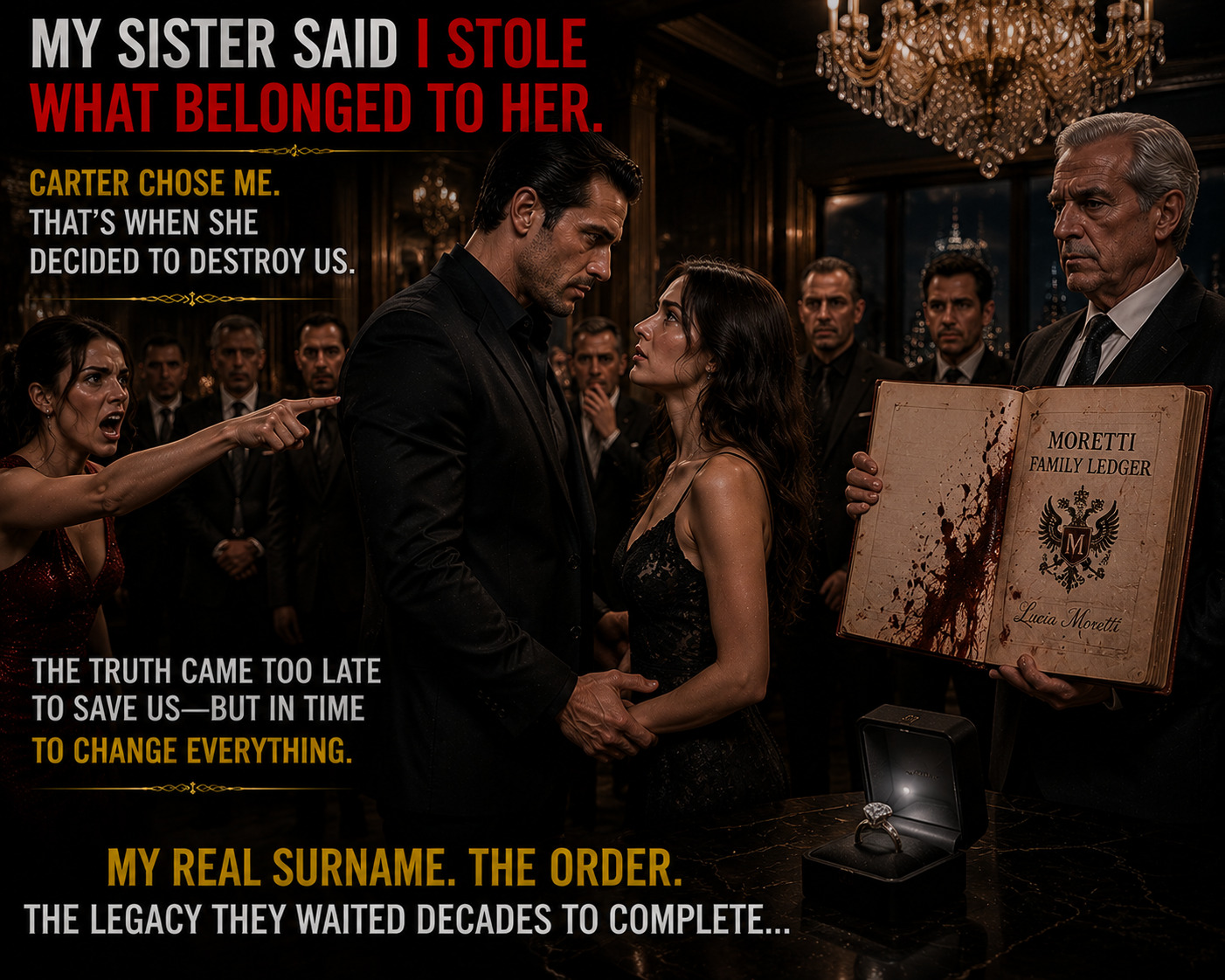
The opening bid was one million dollars.
Carter Battaglia had already raised his paddle.
To the society pages, he was Philadelphia’s most elusive bachelor.
To federal prosecutors, he was a man whose trucks crossed every port on the Eastern Seaboard while leaving almost no legal fingerprints.
To anyone who had ever done business south of Washington Avenue, he was the head of the Battaglia family.
The word mafia was rarely spoken in the same room as Carter.
People valued their teeth.
I adjusted the microscope.
The ink looked brown beneath the ballroom lights, but under magnification it sat on the paper in glossy black islands.
It hadn’t soaked into the fibers.
It had melted onto them.
Toner.
The document was not from 1924.
It had been printed recently, treated with tea, smoked, and mounted between sheets of salvaged rag paper.
I stood.
Vivienne’s smile tightened when she saw me approaching the stage.
“Mara,” she whispered without lowering the microphone, “whatever it is, handle it quietly.”
“You can’t sell that document.”
Her fingers closed around my arm.
The pressure of her nails felt familiar.
At sixteen, she had gripped me the same way before family photographs, pushing my shoulders back and telling me not to look miserable.
At twenty-three, before her engagement party, she had squeezed harder and said, Just stand behind me. You’re good at disappearing.
Now her smile remained flawless.
“The deed has been authenticated,” she said.
“By a general antiques dealer. Not a paper laboratory.”
“Go back downstairs.”
“It’s a forgery.”
The quartet stopped.
No one had instructed them to stop. They had simply felt the room change.
Vivienne’s nails dug deeper.
“You repair library books in a basement,” she said softly. “Do not humiliate me in front of these people.”
A chair scraped against the floor.
Carter Battaglia stood from the front table.
He was forty-one, tall without the bulky vanity of a man who lived in a gym. His black tuxedo fit close across his shoulders. Silver had begun to touch his temples, though there was nothing soft about him.
A pale scar ran from beneath his left ear to the edge of his jaw.
Women had been watching him all evening.
He had watched no one.
Until then.
“What did you find?” he asked.
He wasn’t looking at Vivienne.
He was looking at me.
My sister released my arm.
“The toner rests on the surface,” I said. “The paper is old, but the printing is modern. Whoever made it split antique sheets, inserted the forgery, then resealed them.”
The auctioneer cleared his throat.
“That is an extraordinary accusation.”
“It’s an observable fact.”
Vivienne gave a brittle laugh. “Mara becomes intense about her work.”
Carter walked toward the stage.
The crowd separated before he reached it.
He stopped close enough that I caught the scent of cedar, rain, and something metallic beneath his cologne.
“Show me,” he said.
Vivienne stepped between us.
“Carter, this event has raised more than four million dollars for the children’s hospital. There’s no reason to derail the evening because my sister—”
“Her name is Mara.”
My sister went still.
Carter didn’t raise his voice.
That made the silence heavier.
He took the microscope from my hand without touching my fingers and bent over the deed.
For several seconds, the most powerful man in the room said nothing.
Then he straightened.
“Withdraw the lot.”
The auctioneer blinked. “Mr. Battaglia—”
“Withdraw it.”
Security closed around the table.
Guests began reaching for their phones. Vivienne’s face remained composed, but a pulse flickered at the base of her throat.
Carter handed the microscope back to me.
“You just saved me a million dollars.”
“I stopped someone from selling a lie.”
His eyes stayed on mine.
Dark eyes. Almost black.
Eyes accustomed to making other people look away.
I didn’t.
Something shifted in his expression—not warmth, exactly. Recognition.
As if he had spent years speaking a language no one else understood and had just heard me answer.
“What would you charge,” he asked, “to examine the rest of my family’s records?”
Vivienne laughed too quickly.
“Mara doesn’t take private clients.”
“I can answer for myself.”
The words escaped before I could soften them.
My sister’s head turned.
Carter’s mouth moved at one corner.
Not a smile.
The beginning of one.
“Then answer,” he said.
I knew what he was.
Every person in the ballroom knew.
But for once, someone had asked what I thought before deciding what I was allowed to say.
“My laboratory rate is two hundred dollars an hour.”
“Send me a contract.”
“I haven’t agreed.”
That beginning of a smile deepened.
“No,” Carter said. “You haven’t.”
Behind him, Vivienne stared at me as though I had stolen something she believed had always belonged to her.
She didn’t know yet how much she was prepared to destroy to get it back.
Neither did I.
Three days later, a black sedan collected me outside the Philadelphia Historical Library.
I had worked there for eleven years, six of them as senior paper conservator.
My office was below street level, behind a climate-controlled steel door. The public rarely saw the laboratory. They saw the exhibits—the presidential letters, the abolitionist newspapers, the maps that had survived fires and floods.
They did not see the hours I spent coaxing mold from paper one fiber at a time.
Vivienne called it hiding underground.
I called it saving evidence.
Carter’s headquarters occupied a converted shipping exchange near the river. The building was all soot-darkened brick, steel-framed windows, and quiet men with jackets that hung too heavily beneath their arms.
The security chief who met me was named Gabriel Marchesi.
He had the flattened nose of a former boxer and the careful manners of a funeral director.
“Ms. Bell.”
“Mara is fine.”
His expression suggested that very little in his world was fine.
He brought me to the top floor.
Carter stood at the windows overlooking the Delaware, his suit jacket draped across a chair. His white shirtsleeves were rolled to the forearms.
On the table behind him sat a fire-damaged ledger.
The leather cover had curled inward. Half the spine was gone. Soot darkened the exposed pages.
I set down my case.
“What happened to it?”
“Warehouse fire. Thirty years ago.”
“You keep all your business records this carefully?”
“Only the sentimental ones.”
I looked at him.
“That was almost a joke.”
“I’m told I should practice.”
He moved aside while I examined the ledger.
The paper was brittle but recoverable. Several pages had fused from heat and moisture. Someone had attempted repairs with household tape.
I winced.
Carter noticed.
“Is that bad?”
“The fire was bad. The tape is personal.”
He leaned against the table.
“What can you recover?”
“More than whoever did this expected.”
A silence opened between us.
Outside, a cargo horn sounded on the river. Rain tapped against the old glass.
Carter watched my hands as I turned a page with a microspatula.
Most people became impatient when I worked. They filled silence because they thought silence meant nothing was happening.
Carter understood stillness.
“Why paper?” he asked.
“Because it remembers pressure.”
He glanced at the charred ledger.
“Explain.”
“You can erase ink. Burn edges. Tear out pages. But writing leaves impressions beneath the page. Folds remember how a document was carried. Fibers hold oils from the hands that touched them. People think destruction removes the truth.”
“And it doesn’t?”
“Not completely.”
His gaze dropped to the scar across my left palm.
I curled my fingers.
“What happened?”
“Glass.”
“You always answer questions with one word?”
“Only when the longer answer belongs to me.”
Gabriel, standing near the door, lowered his eyes to conceal something that might have been amusement.
Carter did not appear offended.
He looked interested.
That was more dangerous.
I worked for two hours.
When I finished the initial assessment, Carter slid an envelope across the table.
I didn’t touch it.
“I invoice monthly.”
“That isn’t payment. It’s a confidentiality agreement.”
I read every page.
He watched me cross out three paragraphs, rewrite the liability clause, and initial the changes.
“My lawyers wrote that contract,” he said.
“Your lawyers don’t handle nineteenth-century iron-gall ink.”
“Neither does this agreement.”
“Then they should stay in their lane.”
This time he did smile.
It transformed his face so abruptly that I understood why women made mistakes around him.
The severity remained, but something younger appeared beneath it. Something he rarely allowed into daylight.
“Dinner,” he said.
“No.”
Gabriel coughed into his hand.
Carter glanced at him, then back at me.
“You thought about that quickly.”
“I came to assess a ledger.”
“You did.”
“I don’t date clients.”
“Then finish the ledger.”
“It could take six weeks.”
“I’ve waited longer for less.”
I closed my case.
There were men in Philadelphia who would have mistaken persistence for permission.
Carter only nodded.
“Six weeks, then.”
As I reached the door, he spoke again.
“Mara.”
I turned.
“At the gala, why didn’t you let your sister sell the deed?”
“Because it was false.”
“She embarrassed you before you spoke.”
“That didn’t make the deed real.”
His eyes held mine.
“Six weeks,” he repeated.
I left with my heartbeat striking too hard against my ribs.
Carter did not flirt with me during those six weeks.
That would have been easier.
Instead, he paid attention.
When I mentioned once that the laboratory coffee tasted like boiled bark, a small Italian machine appeared in the restoration room the next morning.
When I developed a migraine from the building’s overhead lights, he had warm lamps installed before my next visit.
He never mentioned either thing.
He asked questions and remembered the answers.
He learned that I hated roses because Vivienne had filled every birthday party with them.
He learned I took my coffee without sugar, walked when I was angry, and could not pass a secondhand bookstore without going inside.
I learned he read history late at night because sleep made him feel undefended.
I learned he never sat with his back to a door.
I learned the scar along his jaw came from a shard of metal when a bomb tore apart his mother’s car.
He had been twelve.
His younger brother had been nine.
Only Carter had survived.
“My father said the Provenzano family ordered it,” he told me one night.
We were alone in the restoration room while sleet struck the windows.
The ledger lay beneath a humidification dome between us.
“What happened to them?” I asked.
His face hardened.
“They disappeared.”
“That isn’t an answer.”
“It’s the only one I have.”
There was something in the way he said it—not pride, but inheritance. A sentence repeated so often it had become architecture.
I did not ask whether the Battaglias had made the Provenzanos disappear.
He did not insult me by pretending they hadn’t.
“Do you believe children inherit their parents’ debts?” I asked.
Carter looked toward the river.
“I believe unpaid debts grow.”
“That’s not what I asked.”
His jaw flexed.
“No,” he said finally. “Children shouldn’t inherit anything they didn’t choose.”
The answer sounded like a belief he wanted to have.
Not one he had tested.
Two weeks later, he took me to dinner.
Not to the private dining room of an impossible restaurant where everyone knew his name.
He took me to a bakery in South Philadelphia at one in the morning.
The owner locked the door behind us and brought out hot bread, sharp cheese, and bowls of tomato soup.
Carter removed his jacket. I rolled up my sleeves.
For an hour, he was not the man people feared.
He was a tired forty-one-year-old who hated fennel, loved old jazz, and had once wanted to design buildings before his father informed him that Battaglia men did not build things for strangers.
“What did Vivienne want to be?” he asked.
“Famous.”
“And you?”
I looked down at the steam rising from my bowl.
“No one ever asked me that when I was young.”
He waited.
“A person with a room that was mine,” I said. “A door I could close without someone accusing me of being ungrateful.”
“That’s what you wanted to become?”
“That’s what I wanted to have.”
“And now?”
The bakery’s refrigerator hummed behind the counter.
Outside, snow drifted through the yellow streetlight.
“I want to stop apologizing for taking up space.”
Carter’s expression changed.
The dangerous men I had known in books were loud. They threw glasses, raised fists, filled rooms with themselves.
Carter became more dangerous when he grew quiet.
“Who made you apologize?” he asked.
“It doesn’t matter.”
“It matters to me.”
I should have stepped away then.
Instead, I fell in love with him.
Not at the bakery.
Love did not arrive as one clean moment.
It gathered.
It gathered when he waited outside my laboratory because a power failure had trapped me underground.
It gathered when he sent Gabriel, not flowers, after I had the flu because he knew flowers made me feel managed.
It gathered when he listened as I spoke about paper acidity with the same concentration other men reserved for stock prices.
It gathered when he came to dinner at my mother’s house and Vivienne tried to seat me near the kitchen.
Carter picked up his place card from beside Vivienne and moved it beside mine.
The conversation stopped.
Vivienne’s cheeks flushed beneath her makeup.
Mother stared at the tablecloth.
Carter unfolded his napkin.
“I prefer this seat,” he said.
He did not look at me.
He did not need to.
For the first time in my life, someone had stepped into the small humiliation while it was happening.
Not afterward.
Not privately.
At the table.
Where everyone could see.
Vivienne hardly spoke through dinner.
On the front steps afterward, cold wind rushed along Rittenhouse Square.
“You enjoyed that,” I said.
Carter buttoned his coat.
“Your mother’s chicken was dry.”
“You know what I mean.”
He turned toward me.
Streetlight caught the silver at his temples.
“Your sister has spent years teaching that family to look through you.”
“And you decided to teach them a lesson?”
“No.”
He stepped closer.
“I decided I was tired of looking across the table to see you.”
His hand rose, then stopped before touching my face.
“May I?”
No one had ever asked me that way.
As though permission mattered even when desire was obvious.
I nodded.
His palm settled against my cheek.
The kiss was slow, almost careful. The kind of kiss a man gives when he has broken many things and is determined not to break this one.
When he pulled away, his forehead rested against mine.
Through the window behind us, Vivienne stood motionless in the dining room.
Watching.
My sister began with small things.
She “forgot” to include me in our mother’s birthday dinner.
She told a society reporter Carter had hired me to clean damaged documents.
She sent photographs of him with other women from years before, each accompanied by a concerned message.
You know men like him don’t change.
Please don’t confuse attention with respect.
I stopped responding.
Then the board of the Bell Foundation offered me a permanent position overseeing its historical collection.
The offer came from Carter, who had recently become the foundation’s largest donor.
Vivienne had chaired its public events for six years.
“You did this,” she said, standing in my apartment with the offer letter trembling in her hand.
“I applied.”
“He created the position.”
“The archive already existed.”
“Not as a paid department.”
“Then perhaps it should have.”
Her face looked different without a ballroom around it.
Older.
Frightened.
“You think this is about a job?” she asked.
“I think you walked into my home without calling.”
“I built that foundation.”
“You hosted parties for it.”
“I made people care.”
“You made people photograph themselves pretending to care.”
The words landed harder than I intended.
Vivienne’s eyes filled, but she did not cry.
She had learned young that tears ruined makeup and gave other people leverage.
“You always do this,” she whispered.
“Do what?”
“Stand silently in the corner while everyone else carries the weight. Then one day you say one sharp, perfect thing and suddenly you’re the honest one.”
I stared at her.
“When Dad died, I was twenty-two,” she continued. “Mother couldn’t get out of bed. The bank was calling. You were away at college restoring little scraps of paper while I kept the house, paid the bills, smiled at every donor and told everyone we were fine.”
“I didn’t know.”
“Of course you didn’t. No one ever made you know.”
For a moment, I saw the sister beneath the armor.
The young woman who had learned that beauty could open doors when grief could not.
The daughter who kept the lights on and discovered that praise felt like oxygen.
Then her gaze dropped to the contract.
“This was supposed to be mine.”
“The foundation?”
“Something.”
Her voice cracked.
“Something was supposed to stay mine.”
She placed the letter on the table.
At the door, she looked back.
“He won’t choose you when choosing you costs him something.”
The certainty in her voice frightened me more than the words.
Three nights later, Carter summoned me to Pier Forty.
The warehouse sat at the edge of the river beneath sodium lights and freezing rain.
Gabriel met me outside. He did not say hello.
Inside, Carter stood beside a steel table.
No jacket.
No tie.
His sleeves were rolled up, but the familiarity of the sight had vanished.
Three photographs lay before him.
In the first, I entered a federal office building.
In the second, I sat across from Assistant U.S. Attorney Daniel Cross.
In the third, I handed him a black folder.
A flash drive rested beside the photographs.
Carter pressed a button on a recorder.
My voice filled the warehouse.
“Carter trusts me. I can get the ledger out before Friday.”
The sentence was clear.
My stomach dropped.
He played another recording.
“There are names in it. Shipping routes. Dates. Enough to destroy them.”
Every word was mine.
I had never spoken those sentences.
“Where did you get this?”
“The drive was found in your laboratory.”
“I didn’t put it there.”
“Security footage shows you entering the federal building.”
“I was there for a preservation consultation. The prosecutor’s office has flood-damaged evidence.”
“The appointment doesn’t appear on your calendar.”
“It was confidential.”
Carter’s fingers curled against the table.
“Of course it was.”
The words were quiet.
Bleeding.
I looked at the photographs again.
The timestamps matched.
The coat was mine. The folder was mine.
Someone had constructed a perfect version of betrayal using pieces of my real life.
“Listen to the recordings,” I said. “Not the words. The background.”
His face did not change.
“The first sentence came from the voicemail I left when I offered to transport the ledger. The second came from the lecture I gave on shipping archives.”
“You expect me to believe someone built a confession from your lectures?”
“I expect you to know my voice well enough to hear when it’s been cut apart.”
Carter looked at me.
For five months, those eyes had found me in every room.
Now they searched for a stranger.
“Gabriel,” he said.
The security chief stepped forward.
“Leave us.”
Gabriel hesitated before obeying.
When the warehouse door closed, rain hammered against the roof.
I moved nearer to Carter.
He stepped back.
It was only half a step.
It hurt more than a slap.
“Look at me,” I said.
“I am.”
“No. You’re looking for your father’s enemy.”
His jaw tightened.
“I trusted you inside my home. Inside my business.”
“You trusted me when it was easy.”
“There is evidence.”
“There was evidence on the auction table too.”
His eyes flickered.
“You asked me what I saw,” I continued. “You did not ask the auctioneer who he feared. You didn’t ask the donor what story made him comfortable. You looked at the evidence.”
“This is different.”
“Because this time the lie confirms what you already fear.”
He turned away.
That was when I knew.
Not that he believed I had betrayed him.
That a part of him needed betrayal to be possible.
It was the only way his world made sense.
Everyone left.
Everyone lied.
Everyone eventually became a debt to collect.
“If you need me to perform innocence,” I said, “then you never understood what you were looking at.”
His shoulders went rigid.
I waited for him to stop me.
He did not.
I walked out of the warehouse alone.
By morning, the story had reached the library board.
Anonymous evidence suggested I had removed confidential materials from a private client and delivered them to federal investigators.
I was placed on administrative leave.
My access card stopped working before lunch.
Mother called once.
She did not ask whether the accusation was true.
She asked whether I could avoid involving the Bell name.
Vivienne arrived at my apartment with groceries and an expression of practiced concern.
I left her standing in the hallway.
For three days, I barely slept.
On the fourth morning, I played the audio again.
Not through speakers.
Through laboratory headphones Naomi Greene had smuggled out of the library.
Naomi was fifty, brilliant, impatient, and loyal in ways that did not require speeches.
She sat at my kitchen table while I isolated the background noise.
Beneath the first sentence, an air-conditioning unit vibrated at sixty hertz.
Halfway through the word trusts, the vibration changed.
Not volume.
Pitch.
A second room.
In the next recording, a church bell rang twice behind my voice.
Then, between two words, the bell vanished before its echo had finished.
Naomi leaned toward the screen.
“Someone cut this with professional software.”
“Can you prove it?”
“I can prove it was assembled. Not who did it.”
I studied the photographs.
The black folder I had handed Daniel Cross belonged to the library.
A small silver stamp marked the lower corner.
Vivienne’s company had sponsored the library’s winter exhibit. Her photographer had taken hundreds of publicity images inside the building.
Including images of me carrying that folder.
I enlarged the third photograph.
Rain streaked the federal building’s glass doors.
My reflection appeared beside them.
But there was no reflection of Daniel Cross.
Two separate images had been combined.
Naomi exhaled.
“Your sister’s advertising agency uses this compositing program.”
“So do thousands of companies.”
“Not with that export signature.”
She pointed to a string of metadata.
The software license ended in VBS-01.
Vivienne Bell Strategies.
My hands went cold.
That afternoon, Gabriel Marchesi arrived at my apartment.
He looked as though he had not slept.
“Mr. Battaglia heard the edits.”
“Did he hear them before or after deciding I was disposable?”
Gabriel accepted the blow without defending him.
“The flash drive was planted using a cloned access card. We traced the duplication request.”
“To Vivienne.”
“Yes.”
I looked toward the rain-blurred window.
“Where is Carter?”
“At the Bell Foundation press conference.”
Vivienne was announcing a new historical preservation wing.
The department I had been hired to lead.
“Of course she is.”
Gabriel held out my coat.
“Mr. Battaglia thought you would want to be there.”
“Carter has done enough thinking for me.”
I took the coat anyway.
Vivienne stood behind a podium when we entered the foundation hall.
Television cameras faced the stage. Donors filled the front rows. My mother sat beneath the foundation seal, wearing navy blue and pearls.
Carter waited near the wall.
He looked at me as soon as I entered.
He always did.
This time, I kept walking.
Vivienne faltered mid-sentence.
Gabriel handed a folder to the reporters in the first row.
Inside were the audio analyses, image metadata and access-card records.
Whispers spread.
Vivienne gripped the podium.
Carter stepped into the aisle.
His voice carried without a microphone.
“The allegations against Mara Bell were fabricated.”
Cameras turned toward him.
“The evidence was created through software owned by Vivienne Bell Strategies. Ms. Bell’s laboratory credentials were duplicated under authorization from this office.”
Mother rose.
“Vivienne?”
My sister’s face emptied.
For years, I had watched her control rooms through timing, posture and smiles.
Now there was nothing she could arrange.
Nothing she could charm back into place.
Her eyes found Carter.
Then me.
“You don’t understand,” she said.
I walked to the front.
“Then explain it.”
The microphones caught every breath.
Vivienne’s hands left the podium and hung at her sides.
“He would have destroyed you.”
“You tried first.”
“I was protecting you.”
“You cost me my job.”
“I knew you’d get it back.”
“You made the man I loved believe I betrayed him.”
Her mouth twisted.
“You loved him because he looked at you.”
The room went silent.
Vivienne’s voice rose.
“One man finally looked past me, and you built your whole life around it.”
“No,” I said. “You built yours around being looked at.”
The recognition struck visibly.
Her lips parted.
A tremor crossed her face before she pressed it still.
For one second, Vivienne looked like a child who had climbed too high and discovered no one was waiting beneath her.
Then anger returned.
“You think he chose you because you’re special?” she whispered. “He chose you because he doesn’t know what you are.”
Carter’s expression sharpened.
“What does that mean?”
Vivienne looked toward our mother.
Mother turned white.
My sister reached into her handbag and removed a red leather envelope.
It was old, cracked at the edges, sealed with black wax.
A crest had been pressed into the wax.
A sword beneath a burning crown.
Carter stopped breathing.
I had seen that symbol before.
Stamped faintly inside the fire-damaged ledger.
Vivienne held the envelope toward me.
“I found it in Dad’s safe after he died,” she said. “Your birth certificate. A photograph. Letters.”
Mother whispered her name.
Vivienne ignored her.
“You were never a Bell, Mara.”
Carter moved close enough to see the crest.
The color drained from his face.
Vivienne’s eyes shone with tears she refused to release.
“Her real name is Elena Provenzano.”
No one moved.
Carter stared at me as though the floor had opened beneath us both.
The Provenzanos.
The family his blood had sworn to erase.
For one week, Carter and I had been free.
One week between the destruction of Vivienne’s lie and the arrival of the older one.
During that week, he came to my apartment without security.
He stood in my kitchen and apologized without explanation, without qualification, without asking me to make his shame easier.
“I believed fear before I believed you,” he said.
“Yes.”
“I can’t undo that.”
“No.”
“I can spend the rest of my life refusing to do it again.”
I had not forgiven him because he was powerful.
I forgave him because he placed the ugliest part of himself on the table and did not ask me to call it beautiful.
Three nights later, he took me to the roof of the historical library.
Snow covered the city.
The skyline glowed beyond us, soft and distant.
He held out a ring that had belonged to his mother.
An emerald surrounded by small diamonds.
“I don’t love you because no one else saw you,” he said. “I love you because you saw me clearly and didn’t confuse understanding with surrender.”
His voice roughened.
“Marry me.”
For one perfect moment, I belonged nowhere except inside my own life.
I said yes.
Now Carter stood inside the foundation hall with that ring in one hand and the red envelope in the other.
By midnight, the Battaglia council had authenticated the documents.
I was born Elena Maria Provenzano, daughter of Luca Provenzano.
The last living heir of the family blamed for the car bombing that killed Carter’s mother and brother.
At two in the morning, Carter came to my apartment.
He remained outside the door.
“The council issued an order,” he said.
“What kind of order?”
His hand tightened around the folded paper.
I already knew.
“Blood pays for blood.”
The hallway seemed to narrow.
“And what do you believe?”
His eyes were red from exhaustion.
“I believe I will kill anyone who comes through this door.”
“That isn’t what I asked.”
“Mara—”
“What do you believe?”
He looked down at the ring in his palm.
Then at the death order.
A wedding in one hand.
An execution in the other.
“I don’t know who I am without the rules that made me,” he said.
I stepped closer.
“Then find out.”
“If I refuse the council, they will come for you. If I dissolve the order, half the family will call it weakness. Aldo will move against me.”
Aldo Battaglia was Carter’s uncle, his father’s oldest adviser and the keeper of the family oath.
He had taught Carter to shoot.
He had identified the Provenzano soldiers who were executed after the bombing.
He had helped raise Carter after his father died.
“What are you asking me to do?” I said.
“Disappear.”
“No.”
“I can put you somewhere no one will find.”
“I spent thirty-five years disappearing for people who said it was for my own good.”
“This is different.”
“It always feels different to the person asking.”
Footsteps sounded on the stairs below.
Carter’s hand moved beneath his coat.
Gabriel appeared at the landing.
He looked from Carter to me.
“Aldo called the council for tomorrow night.”
Carter’s jaw hardened.
“Where?”
“Saint Aurelia.”
The church where the Battaglia oath had been sworn thirty years earlier.
Gabriel hesitated.
“They expect you to bring her.”
Carter’s face became the face Philadelphia feared.
But I had learned to see what lived beneath it.
A twelve-year-old boy climbing out of a burning car.
A son fed one version of the truth until it became his bones.
I took the death order from his hand.
The paper was cream-colored, handmade, and signed in blue-black ink.
Pressure marks indented the lower half of the sheet.
Writing from a page that had rested above it.
I tilted the document toward the hallway light.
Three words emerged.
Ledger. Maria. Dock Nine.
My pulse quickened.
“Who wrote the order?”
“Aldo.”
“Where does he keep his correspondence paper?”
“His office.”
“Does he use a writing pad?”
Carter stared at me.
“You see something.”
“Your uncle wrote a note before he wrote my death order.”
I held the paper beneath the light.
“He mentioned your mother’s name and the warehouse where the ledger burned.”
The laboratory reinstated me the next morning after Carter’s lawyers released the proof of fabrication.
I went directly to the fire-damaged ledger.
Naomi locked the door behind us.
Using an electrostatic detection plate, we examined the pages beneath the ones that had burned away.
Invisible pressure marks appeared on the monitor.
Numbers.
Initials.
Payment instructions.
Aldo B.
S. Battaglia.
Dock Nine.
Then a line written in a different hand.
Maria knows. Luca has the copies. Move before Sunday.
Carter stood behind the glass observation panel.
He did not move for eighteen minutes.
I separated two fused pages with controlled humidity.
Between them, protected from the worst of the fire, was a narrow strip of paper.
The handwriting matched the note.
S. has arranged the car. He will blame Luca. Take Elena to Daniel Bell if I fail.
The note was signed with a single letter.
M.
Maria Battaglia.
Carter’s mother.
His knees seemed to weaken, though he remained standing.
The truth had been present in his family’s ledger for thirty years.
Burned, taped over and misunderstood.
But paper remembered pressure.
My mother provided the final piece.
Daniel Bell, the man I had called Dad, had been a paramedic assigned to Dock Nine after an explosion at a Provenzano warehouse.
Maria Battaglia had met him behind the burning building with blood on her dress and an infant in her arms.
Me.
She told Daniel that her husband, Salvatore Battaglia, had arranged the warehouse explosion and the car bombing to eliminate Luca Provenzano, the man helping her expose his smuggling operation.
She had placed me in Daniel’s ambulance moments before Aldo arrived.
Daniel took me home.
Maria died in the car explosion two days later.
Carter had been inside the car.
His father had known.
Aldo had known.
They let a twelve-year-old boy believe the Provenzanos murdered his mother, then used his grief to build an empire around revenge.
Carter listened to my mother’s confession without interrupting.
When she finished, he walked to the window.
“What did my father gain?” he asked.
Mother wiped her face.
“The Provenzano shipping routes. Their warehouses. Their political contacts.”
“And Aldo?”
“Everything your father left behind.”
Carter’s reflection stared back from the dark glass.
“My whole life,” he said, “I thought I survived an attack.”
He turned.
“I survived an execution.”
His father had been willing to kill him too.
The realization did not break across his face dramatically.
It settled.
His eyes went flat. His shoulders lowered. Every part of him became unnaturally still.
That was the moment Carter Battaglia became most dangerous.
Not because he wanted revenge.
Because revenge was the only language his family had ever taught him, and he had finally understood who had written the dictionary.
“We go to Saint Aurelia,” he said.
Gabriel nodded.
I did not.
“We go with evidence.”
“Aldo won’t confess because you show him old paper.”
“No. He’ll confess because he believes he has already won.”
Carter looked at me.
I placed my engagement ring on the table between us.
“Bring me to the church.”
His face hardened.
“No.”
“He expects you to choose the oath.”
“I will not put you in front of him.”
“You already told me children shouldn’t inherit debts they didn’t choose.”
“I remember.”
“Then let me end mine.”
Saint Aurelia had been abandoned for twelve years.
Rain leaked through the bell tower. Wind moved through broken stained glass, scattering blue and red light across the cracked stone floor.
Twenty-seven members of the Battaglia council waited in the nave.
Aldo stood before the altar.
He was sixty-seven, silver-haired and immaculate in a charcoal suit. His face held the calm benevolence of a grandfather waiting for a family photograph.
Vivienne stood beside him.
Her wrists were bound.
A bruise darkened her cheek.
My breath caught.
Aldo smiled when Carter and I entered.
“There she is,” he said. “The last Provenzano.”
Carter walked beside me.
In his right hand, he carried a pistol.
In his left, my wedding ring.
The council watched him approach.
Aldo’s gaze settled on the ring.
“Sentiment makes men careless.”
“No,” Carter said. “Grief does.”
Aldo’s smile thinned.
Vivienne looked at me.
“I’m sorry,” she whispered.
Aldo struck her across the mouth.
Carter raised the gun.
Every man in the church reached beneath his coat.
Silence locked the room.
Aldo lifted one hand.
“You contacted me first,” he reminded Vivienne. “You wanted help separating them.”
Carter’s eyes shifted toward her.
Vivienne’s tears spilled freely now.
“I found Mara’s documents years ago,” she said. “I knew what she was. When Carter started seeing her, I panicked.”
“You fabricated the evidence with Aldo?”
“He gave me access codes. Names. The software.”
“Why?” Carter asked.
Aldo answered for her.
“Because Provenzano blood had entered your house.”
“You knew she was alive.”
“Your father suspected Daniel Bell took the child. We watched the family for years.”
My skin went cold.
Every childhood home.
Every school.
Every birthday Vivienne had spent making sure she stayed at the center.
Somewhere beyond the photographs, men had been waiting to see which daughter carried a dead family’s face.
“Why didn’t you kill me before?” I asked.
Aldo’s eyes moved over me.
“You were harmless.”
The word struck something deep.
Not pain.
Recognition.
All my life, harmless had been another word for invisible.
Aldo gestured toward Carter.
“Then he looked at you. He gave you access. Influence. A future.”
“So you helped Vivienne frame me.”
“I encouraged an anxious sister to protect her family.”
Vivienne closed her eyes.
Aldo continued, “When the evidence failed, I allowed the truth of your blood to surface.”
“Allowed?” Carter said.
“Everything has brought us here.”
Aldo nodded toward the gun.
“Finish what your father began.”
Carter looked at me.
Rain whispered through the ruined roof.
The council waited for blood.
He lifted the pistol.
Vivienne made a broken sound.
My mother’s letter rested beneath my coat. Maria’s note pressed against my ribs.
Carter aimed at my heart.
For one endless second, his face showed nothing.
Then he turned and fired into the stone crest above the altar.
The Battaglia sword split down the middle.
Stone crashed across the floor.
Men shouted and drew weapons.
Gabriel and his security team emerged from the side aisles, guns raised.
Carter placed my ring on the altar.
“No more inherited debts,” he said.
Aldo stared at the shattered crest.
The first crack appeared in his composure.
A tiny movement in his left cheek.
Then his eyes darted toward the exits.
He understood.
Not that Carter had refused the order.
That the room was no longer his.
Carter removed the fire-damaged ledger from beneath his coat and laid it beside the ring.
“My father ordered the car bombing,” he said. “Aldo arranged payment and blamed the Provenzanos.”
Murmurs spread through the council.
Aldo laughed.
“One damaged ledger against thirty years of history?”
“Not only the ledger.”
Vivienne lifted her bound hands.
“There are recordings.”
Aldo’s head snapped toward her.
She reached into the torn lining of her dress and pulled out a small device.
“When he helped me fabricate the evidence, I recorded every call,” she said. “I thought I might need protection from him.”
Aldo’s face changed.
The pleasant mask vanished.
His mouth twisted. His nostrils widened. He looked suddenly older and far more ordinary.
A frightened man who had mistaken control for immortality.
“You stupid girl.”
“Yes,” Vivienne said.
Her voice shook.
“But not harmless.”
Aldo lunged for her.
Carter moved first.
The shot struck Aldo’s shoulder and spun him against the altar rail.
Before anyone else fired, floodlights burst through the broken windows.
Federal agents entered from every door.
Carter had sent them the Battaglia financial records six hours earlier.
Not only Aldo’s crimes.
All of them.
Including his own.
Aldo lay on the floor, clutching his shoulder.
He looked up at Carter with disbelief.
“You gave them the family.”
Carter lowered his weapon.
“No.”
He glanced at me.
“I ended it.”
Aldo Battaglia was convicted of murder, racketeering, conspiracy and obstruction.
He died in federal prison three years later without receiving a single visit from the men who had once kissed his ring.
Vivienne pleaded guilty to evidence tampering, unlawful access and conspiracy.
Her lawyers expected probation.
She refused to let them blame emotional instability or coercion.
At sentencing, she stood before the judge without diamonds, cameras or prepared tears.
“I hurt my sister because I believed love was a limited resource,” she said. “I thought if someone finally saw her, I would disappear.”
She served fourteen months.
I visited once.
We sat across from each other beneath fluorescent lights while a vending machine hummed against the wall.
Her blond hair had grown out dark at the roots.
For the first time in my life, she looked exactly as tired as she felt.
“Do you forgive me?” she asked.
“Not yet.”
She nodded.
“Do you think you ever will?”
“I don’t know.”
She looked down at her hands.
It was not the answer she wanted.
It was the truth.
And for once, she did not ask me to change it.
My mother resigned from the Bell Foundation.
She sold the Rittenhouse house and used the money to create a legal fund for families harmed by organized crime.
It did not erase her silence.
But silence was no longer the only thing she gave me.
Carter pleaded guilty to financial conspiracy, unlawful transportation and obstruction.
The prosecutors acknowledged that his records dismantled three criminal networks and solved eleven cold cases.
He served twenty-six months.
He could have run.
He could have bought better lies.
Instead, he stood in court and said, “A man does not become innocent simply because someone worse taught him how to sin.”
I visited every week.
We spoke through glass.
There were no guards opening doors because he said his name. No men standing when he entered. No city holding its breath.
For the first time, Carter owned nothing but his choices.
That was where we learned whether we truly loved each other.
Not on rooftops.
Not beneath chandeliers.
In a room bolted to the floor, with forty minutes on a clock and no power left to impress each other.
When he was released, snow was falling.
He walked through the prison gates carrying a paper bag and wearing the same dark coat he had worn the night he first kissed me.
Silver had spread farther through his hair.
The scar along his jaw remained.
So did the way his eyes found me before anything else.
I waited beside my car.
For several seconds, neither of us moved.
Then he reached into his coat.
The emerald ring lay in his palm.
“They let you keep that?”
“Gabriel is persuasive.”
“That sounds legally questionable.”
“Very.”
He stopped in front of me.
“I don’t have the house anymore.”
“I know.”
“The companies are being restructured.”
“I know.”
“I’m not the man you met in that ballroom.”
“No.”
His fingers closed around the ring.
“Is that a problem?”
I looked at the prison behind him.
At the open road ahead.
At a man who had once inherited a death sentence and chosen to destroy the throne that demanded it.
“No,” I said. “It’s the reason I’m still here.”
We married six months later inside the restored reading room of the Philadelphia Historical Library.
There were no society photographers.
No family crests.
No seating arrangement that placed one sister in front of the other.
Vivienne attended quietly and sat in the final row.
When I reached the aisle, she stood with everyone else.
Our eyes met.
She did not smile.
Neither did I.
But she stepped aside and gave me room to pass.
Carter waited beneath the high windows, morning light falling across his shoulders.
My name was still Mara Bell.
Elena Provenzano was part of my history, but blood was not a command, and survival did not obligate me to become the person dead men had planned.
At the altar, Carter took both my hands.
Years earlier, I had believed being chosen would finally prove my worth.
I had been wrong.
Carter did not create my value by seeing me.
He simply became the first person willing to stand still long enough for me to see it too.
The people who keep you in their shadow are rarely afraid that you are weak.
They are afraid of what will happen when you finally understand that you never needed their light.