Mafia Boss Married Me for Revenge—Until He Saw My Scars on Our Wedding Night
CHAPTER ONE
THE BRIDE WAS THE PRICE OF PEACE
“Smile,” Diego Ramos murmured as the priest lifted his hands over us. “Your brother is watching me take everything he owns.”
Beyond Diego’s shoulder, three hundred guests filled the Cathedral of Saint Gabriel, their diamonds flashing beneath the candlelight. Senators sat beside shipping executives. Judges shared pews with men whose names had never appeared on a tax return.
Outside, freezing rain polished the streets of Chicago black.
Inside, my brother Thomas watched from the front row, smiling as if he had not traded me for forty-eight hours of peace.
His gray eyes met mine.
He tapped one finger against his wrist.
A warning.
Do what you were told.
I turned back to the man I was about to marry.
Diego Ramos was forty-two, broad-shouldered, and dressed in a midnight-black tuxedo that made everyone around him look unfinished. A pale scar cut through his left eyebrow. His face held the stillness of a man who had learned that anger was most useful when no one could see it coming.
For six years, he had been dismantling my family one warehouse, one politician, and one body at a time.
Now he was marrying me.
Not because he loved me.
Not because he wanted peace.
He believed I had helped my brother murder his younger sister.
“By midnight,” Diego continued beneath the choir’s final note, “the Martin accounts in Zurich will be frozen. By morning, your brother’s captains will know he traded his only sister to save himself.”
“You won’t make it to midnight,” I whispered.
For the first time, something moved behind his eyes.
“What did you say?”
“The second violinist.”
Diego did not turn his head.
Neither did I.
The musicians sat beneath a marble statue of the Virgin Mary. Eleven violinists moved their bows in perfect rhythm.
The twelfth man was pretending.
His fingers did not press the strings.
His right shoulder bulged beneath his jacket.
And every time Diego shifted, the man’s eyes followed the movement.
“The weapon is under his music stand,” I said. “He’ll fire when the priest tells you to kiss me.”
Diego’s jaw tightened by less than an inch.
“Is this Thomas?”
“If it were Thomas, the shooter would know how to hold a violin.”
The priest smiled at us, unaware that half the congregation carried guns.
“You may now seal your vows with a kiss.”
The false violinist reached beneath the stand.
Diego’s hand closed around my waist.
I expected him to pull me behind him.
Instead, he spun us both.
The gunshot cracked through the cathedral.
A marble angel exploded above the altar. White fragments rained across the flowers. Guests screamed and dropped between the pews as Diego’s men drew their weapons.
I saw the shooter rise.
I also saw Thomas remain seated.
Too calm.
Too prepared.
The shooter aimed again.
I seized the heavy silver candlestick from the altar and hurled it.
It struck his forearm as he fired. The second bullet tore through Diego’s sleeve instead of his chest.
Then two Ramos guards brought the man down.
The choir scattered. A woman in the third row fainted. Somewhere behind us, a child began crying beneath a pew.
Diego looked at the line of blood spreading across his white shirt cuff.
Then he looked at me.
Not with gratitude.
With calculation.
Thomas finally stood.
“This is an outrage,” he announced, his voice carrying through the chaos. “My sister could have been killed.”
Diego’s gaze remained on my face.
“Your sister,” he said, “just saved my life.”
Thomas’s expression did not change.
His right hand, however, curled into a fist.
That was when I knew the gunman had not been sent to stop the wedding.
He had been sent to make certain I never survived long enough to speak after it.
Diego bent close enough that his breath touched my ear.
“What do you know?”
“Enough to understand why my brother insisted on giving me away.”
“And why is that?”
I glanced at Thomas.
His face was smooth again. Respectable. Concerned. The beloved chief executive of Martin Maritime, comforting frightened guests while one of his lawyers quietly removed a phone from a dead man’s pocket.
“Because this marriage was never meant to save his empire,” I said.
The bells began ringing above us, though no one had pulled the ropes.
“It was meant to bury me inside yours.”
CHAPTER TWO
WHAT THE WEDDING DRESS HID
The wedding reception was canceled.
The marriage was not.
Our signatures had already been placed on the license. The agreements had been witnessed. More importantly, the forty-eight-hour ceasefire between the Ramos and Martin organizations had gone into effect the moment Diego put a ring on my finger.
By ten o’clock, I was standing in the bridal suite of the Halcyon Hotel, listening to sleet strike the windows thirty floors above the city.
Diego entered without knocking.
He had removed his jacket. A black shoulder holster crossed his white shirt, and a narrow bandage wrapped his forearm where the bullet had grazed him.
Two men remained outside the door.
Not protection for me.
Protection from me.
“You saw the shooter before any of my people did,” Diego said.
I stood before the mirror, working at the pearl buttons along the back of my dress.
“My brother spent twenty years teaching me to notice danger before it reached him.”
“And yet you still married his enemy.”
“I stood where Thomas told me to stand.”
“You could have warned me before the ceremony.”
“I did.”
“Three seconds before a bullet.”
“Three seconds was all I had after I recognized him.”
Diego moved closer, his reflection appearing behind mine.
“Who was he?”
“Calvin Dreyer. Former military contractor. Thomas hired him twice to clean up internal problems.”
“How do you know that?”
“I approved the invoices.”
His eyes hardened.
There it was.
The version of me he had constructed before we met.
Navy Martin, thirty-four years old. Chief financial officer of the Martin Foundation. Quiet sister of Chicago’s most polished criminal. The woman whose signature appeared beneath land purchases, shell companies, insurance settlements, and payments made after twelve dockworkers died in a warehouse fire six years earlier.
Including Elena Ramos.
Diego’s twenty-nine-year-old sister.
“You helped build his machine,” he said.
“I kept records of it.”
“That sounds like a distinction people make before sentencing.”
“It is a distinction people understand after they survive.”
The final pearl button would not come loose. My fingers had begun to tremble, and I hated them for it.
Diego noticed.
He stepped forward.
I turned so quickly that my shoulder struck the mirror.
His hands stopped in the air.
For several seconds, neither of us moved.
Then he lowered them.
“I’m not going to touch you.”
The room seemed to tighten around those words.
Men who intended kindness rarely announced it.
Men who intended violence often did.
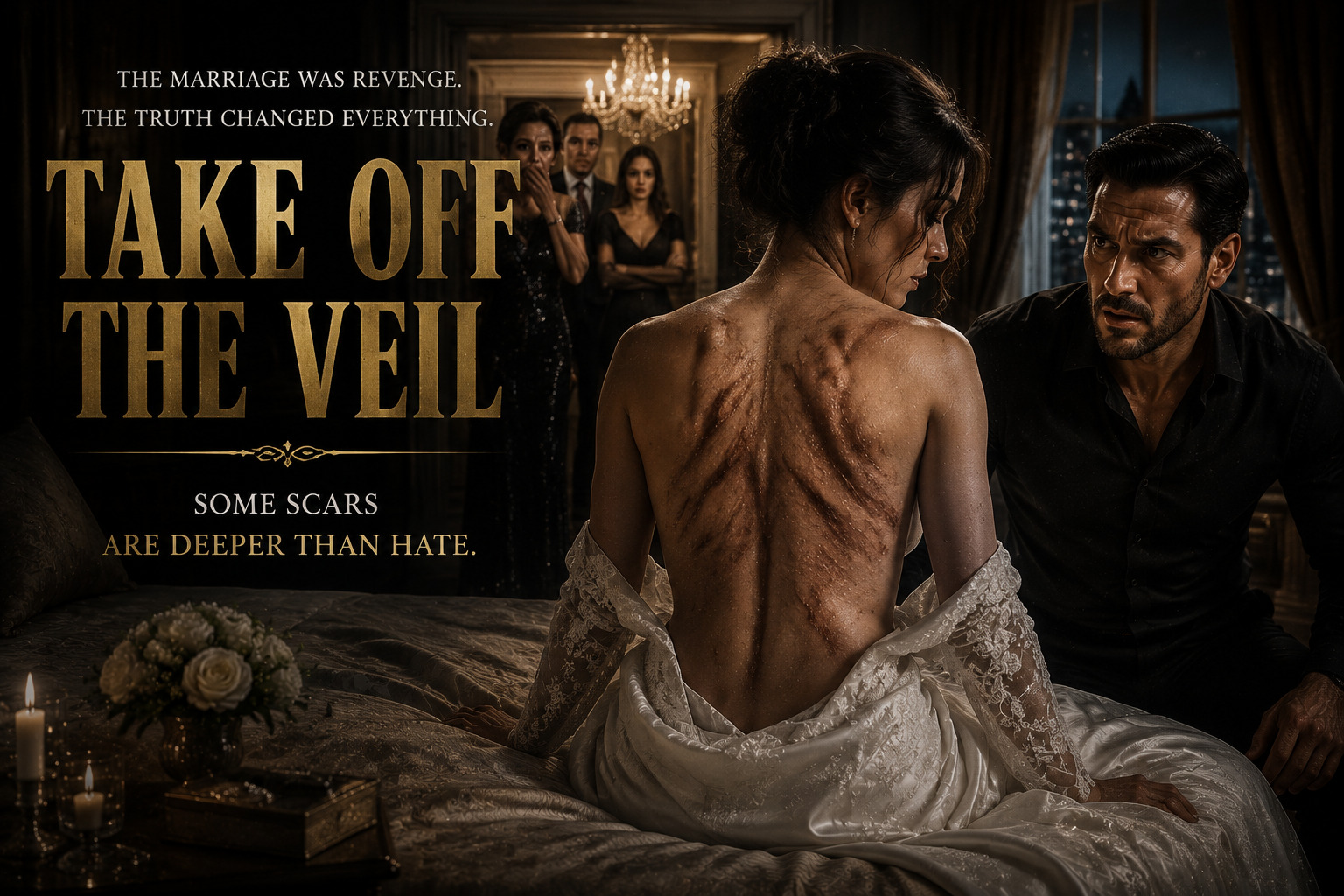
I reached behind my neck and pulled hard. Three pearl loops snapped. The dress opened across my back.
Diego stopped breathing.
The silence changed.
I watched his reflection as his gaze moved across the scars.
A white ridge curved beneath my left shoulder blade. Below it lay three round marks, evenly spaced, where heated metal had touched skin. Fainter lines crossed my ribs. Two thin bands circled my wrists, old injuries left by plastic restraints that had cut through flesh.
The worst scar traveled from my right hip to the center of my back, uneven and silver against my skin.
Fire had made that one.
Thomas had made the rest.
Diego’s face emptied of everything except focus.
“Who did this?”
I pulled the dress closed.
“You already know.”
“Say his name.”
“My brother.”
A muscle jumped in Diego’s cheek.
“Thomas burned you?”
“The fire was an accident,” I said. “What happened afterward was not.”
He stepped around me, blocking the door.
“What fire?”
I looked at him.
For six years, Diego had carried photographs of Dock Seventeen like scripture. He knew the time the flames started. He knew the wind direction, the accelerant, the names of the dead and the exact place each body had been found.
He believed I had been sitting safely in my family’s Gold Coast townhouse while his sister burned.
“Dock Seventeen,” I said.
The blood drained from his face.
“You weren’t there.”
“I was in the records room.”
“That building was locked from the outside.”
“Yes.”
His eyes dropped to the long burn scar disappearing beneath the dress.
The realization reached him slowly, then all at once.
His lips parted.
No sound came out.
That was the moment Diego Ramos first understood that the woman he had married for revenge had nearly died in the same fire that created it.
“Elena found me,” I said. “Smoke had filled the corridor. I was tied to a pipe because Thomas wanted a password I refused to give him.”
Diego’s fingers curled at his sides.
“My sister untied you?”
“She cut through the restraints with a piece of broken glass. She got me to the loading floor before the roof started collapsing.”
“Then why didn’t she get out?”
“Because she went back.”
“For what?”
I walked to the bed and lifted the hem of my wedding gown.
A thin brass key had been stitched into the lining.
I cut it free with the small blade hidden beneath my garter and placed it on the white comforter between us.
“Elena went back for the ledger that could destroy both our families,” I said.
Diego stared at the key.
“And Thomas has spent six years believing I know where she hid it.”
The sleet rattled harder against the glass.
Diego raised his eyes.
“Do you?”
I looked at the man who had married me to punish my brother.
“Yes.”
A knock sounded at the door.
One of Diego’s guards entered without waiting.
“Boss, we have a problem.”
He held out a tablet.
Security footage showed flames pouring from the windows of a Martin-owned archive building on the South Side.
The records room had been emptied earlier that afternoon.
One person had not made it out.
The dead man was the priest who had performed our wedding.
Across the burning wall, someone had painted three words in white:
GIVE HER BACK.
CHAPTER THREE
THE HOUSE WITH NO LOCKED DOORS
Diego’s home stood above Lake Michigan behind limestone walls and iron gates.
It did not resemble the lair of a crime lord. There were no gold statues, no velvet ropes, no armed men drinking in hallways.
The house was clean, quiet, and almost aggressively restrained.
Walnut floors. Gray stone fireplaces. Tall windows facing the frozen water.
Every door inside the house remained unlocked.
I noticed because I checked all of them.
At breakfast, Diego sat across from me beneath a pendant light, reading reports while coffee cooled untouched beside his hand.
His security chief, Gabriel Vale, stood near the window. Gabriel had served Diego’s father before him. At sixty, he wore silver hair cropped close and the patient expression of a man accustomed to cleaning up the mistakes of younger men.
“Thomas has denied involvement in both attacks,” Gabriel said.
“He always denies involvement,” I replied.
Gabriel glanced at me. “You speak as if he sends engraved invitations before murder.”
“He sends invoices.”
Diego lowered the report.
“Show me.”
He slid a tablet across the table. It contained the shooter’s known accounts, travel history, and phone records.
I ignored the names and opened the payment schedule.
Most people looked at numbers as individual facts.
I saw behavior.
The same way a hunter saw broken branches, I saw rounded transfers, staggered dates, duplicate vendor codes, and charitable grants that vanished through three jurisdictions before reappearing as cash.
“This payment isn’t from Thomas,” I said.
Diego leaned forward.
“How can you tell?”
“My brother never pays an outside contractor from an operational account. He uses the Martin Health Initiative. Dental clinics, addiction centers, mobile cancer screenings. No one audits dying people closely.”
Gabriel’s mouth flattened.
“The payment came from Halberd Security.”
“Halberd is a mirror company. Follow the insurance premiums, not the payroll.”
Diego turned the tablet toward himself.
“Why the insurance?”
“Thomas uses policy loans to move money without marking the transfers as withdrawals. The premiums are paid by one entity. The loans are collected by another.”
I took the tablet back and opened a spreadsheet.
The room became silent except for the faint scrape of my fingernail against glass.
“There.”
A chain of six transactions led to a private holding company in Delaware. The listed director was a seventy-eight-year-old nun who had died nine years earlier.
Gabriel swore under his breath.
Diego watched me.
Not the screen.
Me.
“How long have you been able to do this?”
“Since I was twelve.”
“At twelve, most children hide money from their parents.”
“At twelve, I learned my father was using my mother’s hospice foundation to pay customs officers.”
The mention of my mother left a familiar hollow behind my ribs.
She had died when I was thirteen. Thomas had been nineteen. Our father had taken us to the funeral in separate cars because he believed grief made people careless.
Afterward, Thomas became my protector.
Until protecting me became inconvenient.
Diego pushed his coffee toward me when he noticed my hands were cold.
The gesture was so small I almost mistrusted it more than the armed guards.
“What does the company connect to?” he asked.
I studied the account number.
Something tightened in my chest.
“It connects to the Northlight Pension Trust.”
Gabriel frowned. “Never heard of it.”
“You have,” I said. “You just know it by the names of the men whose widows receive checks every month.”
Diego went still.
Northlight managed the pensions of Ramos employees killed in the line of duty. Drivers, guards, dockworkers, men who had obeyed orders and left families behind.
Thomas had been stealing from them.
Not much at a time.
Three percent from one fund. Five from another. Enough to remain unnoticed. Enough to finance a war while Diego unknowingly wrote checks to replace the missing money.
“The attack on the wedding wasn’t paid for by Martin Maritime,” I said. “It was paid for with your dead men’s pensions.”
Gabriel crossed the room and snatched up the tablet.
“That’s impossible.”
“Numbers don’t care what you find possible.”
His eyes flashed.
Diego lifted one hand.
Gabriel stopped.
“Where does the money go next?” Diego asked.
“To a data facility outside Milwaukee. Thomas keeps a live mirror of his private accounts there because he trusts paper even less than people.”
“You can get us inside?”
“I designed the authorization system.”
Gabriel gave a humorless laugh.
“And Thomas left you with access?”
“No. He broke three of my fingers until I gave him the administrator code.”
My right hand rested on the table.
The fingers had healed slightly crooked.
Diego looked at them.
Gabriel did too.
The older man’s expression shifted, but pride would not allow him to look away first.
I wrapped both hands around the coffee cup Diego had given me.
“Fortunately,” I continued, “the code I gave Thomas was not the administrator code.”
For the first time, Diego almost smiled.
“What was it?”
“A surveillance account. Every time he used it, the system recorded what he opened, copied it, and sent the duplicate somewhere he couldn’t reach.”
“Where?”
I looked toward the frozen lake.
“Elena’s account.”
Diego rose so quickly that his chair struck the floor.
“My sister has been dead for six years.”
“Her body is dead.”
I met his stare.
“Her dead-man protocol is still running.”
CHAPTER FOUR
THE WOMAN AT THE TABLE
The next night, Diego took me to a meeting in the basement of an old private bank.
Twelve men sat around a circular oak table beneath green-shaded lamps. Together, they controlled trucking routes, union votes, construction contracts, and enough secrets to ruin half the city.
Every conversation stopped when I entered.
One man smirked.
Another checked his watch as if Diego had brought his wife to dinner by mistake.
Gabriel stood behind Diego’s chair. He had objected to my presence three times during the drive.
Diego had answered him only once.
“She sees what we don’t.”
Now Diego pulled out the chair beside his.
Not behind him.
Beside him.
I sat.
A port captain named Victor Salvi leaned back and examined me. “No offense, Mrs. Ramos, but your brother has spent the last decade laundering money through women’s charities. Perhaps family loyalty makes this discussion uncomfortable.”
“Does stealing from widows make you uncomfortable, Mr. Salvi?”
His smile disappeared.
A few men glanced toward Diego.
He remained silent.
I placed twelve folders on the table.
Each contained evidence that Thomas had been skimming from the Ramos network. Pension funds. Fuel accounts. Medical trusts. Funeral benefits.
Victor opened his folder.
Color spread up his neck.
“What is this?”
“Your signature approving transport insurance through Wexler Mutual.”
“I sign hundreds of forms.”
“This one moved two million dollars into a company owned by Thomas.”
“You accusing me of treason?”
“No.”
I folded my hands.
“I’m accusing you of laziness. Treason would require you to understand what you signed.”
Someone at the table coughed to hide a laugh.
Victor rose, palms hitting the wood.
Diego did not move.
That was more frightening than if he had reached for a weapon.
“Sit down,” Diego said.
Victor sat.
I connected my laptop to the wall screen. A map appeared, linking companies, accounts, and shipments across four states.
For twenty minutes, I showed them how Thomas had converted their war into a business model. Every stolen truck produced an insurance claim. Every dead soldier generated a pension reserve he could borrow against. Every retaliatory attack increased security contracts sold through companies he secretly owned.
Thomas did not merely survive conflict.
He earned money from both sides of it.
When the screen went black, no one spoke.
These were men who had spent their lives measuring strength through fear.
I had shown them something they feared more.
Being made foolish.
“What do you need?” Diego asked.
“Access to the Milwaukee facility. Ninety minutes without Thomas knowing we’re inside.”
Gabriel shook his head. “Security rotates every hour.”
“Not tonight.”
“Why?”
“Because Thomas is hosting an emergency board meeting. He will pull six men from the facility to guard the directors.”
Diego studied me. “How do you know?”
“My brother believes frightened executives should see weapons. It reminds them who protects them.”
“And who frightened the executives?”
“I did.”
I placed my phone on the table.
At six that morning, I had sent an anonymous copy of the pension records to every member of the Martin Maritime board.
Diego looked at the message, then at me.
“You started this before asking permission.”
“I did not realize marriage had damaged my ability to send email.”
Several men lowered their eyes.
Diego’s mouth moved again, almost becoming a smile.
Then Gabriel’s phone vibrated.
He read the screen.
The color vanished from his face.
“The Milwaukee facility just went dark.”
I stood.
“He knows.”
Diego was already reaching for his coat.
“No,” I said. “Thomas doesn’t shut down data. Data is the only thing he trusts.”
The lights above us flickered.
Once.
Twice.
Then every phone around the table began ringing at the same time.
Diego answered his.
A distorted voice came through the speaker.
“You married the wrong Martin.”
Behind the voice, I heard a woman crying.
I recognized her immediately.
Anna Bell had been my mother’s nurse. After my mother died, Anna had stayed in our house and raised me whenever the men were too busy making war.
I had moved her to a private residence six months earlier.
Only one other person knew where.
Thomas.
The voice continued.
“Come to Dock Seventeen alone, Navy. Or the woman who taught you kindness dies because you finally learned cruelty.”
The call ended.
Diego reached for my phone.
I closed my fingers around it.
“He wants me frightened enough to make a mistake.”
“Are you?”
“Yes.”
My voice did not shake.
“That is why he is going to make one first.”
CHAPTER FIVE
THE DEAD WOMAN’S ACCOUNT
We did not go to Dock Seventeen.
Not immediately.
Thomas expected panic. He expected me to beg Diego for men, weapons, and a rescue dramatic enough to leave our defenses exposed.
Instead, I went to Elena Ramos’s apartment.
Diego had kept it untouched for six years.
Dust covered the piano. A wool coat still hung beside the door. Three coffee cups sat upside down on a drying towel, preserved as though Elena might return and complain that someone had disturbed them.
Diego remained near the entrance.
He had not stepped inside since her funeral.
I could see it in the way his body resisted the room.
“Elena hated that coat,” I said.
His gaze moved to the gray wool.
“You knew her well?”
“We met every Thursday for seven months.”
“Where?”
“The public library on Michigan Avenue. She used the name Isabel. I used the name Claire.”
Diego laughed once, without amusement.
“My sister could not lie about her age at a bar.”
“She was terrible at lying. That was why people believed her.”
I walked to the piano.
Elena had been a compliance attorney for the Ramos shipping companies. After discovering that someone inside her family was selling route information to Thomas, she began investigating in secret.
Her search led her to me.
At first, she believed I was part of the laundering system.
Then she noticed what no one else had.
Every transaction bearing my signature contained a mathematical error in the fifth decimal place.
A code.
I had been marking evidence for years.
“We built the ledger together,” I said. “Thomas’s companies. Ramos leaks. Judges. Contractors. Every person profiting from the war.”
Diego’s face tightened.
“Why didn’t she tell me?”
“Because the leak was close to you.”
His gaze shifted to the doorway.
Gabriel waited in the hall.
I pretended not to notice.
“Elena planned to give you the ledger after she confirmed the name,” I continued. “Thomas found out first. He took me to Dock Seventeen. He believed pain would make me surrender the encryption key.”
Diego looked at my wrists.
“Elena followed him.”
“She set off the fire alarm to create confusion. Thomas’s men panicked. One of them knocked over a drum of solvent. The flames moved faster than anyone expected.”
“And Elena died saving you.”
“She died saving the ledger.”
“That is not better.”
“No.”
The word settled between us.
I touched one of the piano keys.
A low note rolled through the apartment.
“Elena knew she might not get out. She told me that if she failed, I had to survive long enough to finish it.”
“And you let me believe you killed her.”
“Thomas controlled the police report, the witness statements, and my medical records. I woke in a private clinic three weeks later. By then, Elena was buried and your men were looking for me.”
“You could have come to me.”
“I had burns across thirty percent of my body. I could not stand without help. Thomas placed a guard outside my door and told me you had ordered the fire.”
Diego’s eyes darkened.
“You believed him?”
“For eight days.”
“What changed?”
“Thomas came into my room drunk. He said Elena had screamed your name before the roof fell.”
I looked at him.
“He could not have known that unless he had been there.”
Diego turned away, pressing one hand against the piano.
His shoulders remained rigid.
But his head lowered.
For the first time since I had met him, Diego Ramos looked less like a ruler than a brother who had been denied the truth about his sister’s final hour.
I wanted to touch him.
I did not.
Compassion had been used as a leash in my family. Thomas would hurt someone, then appear beside my bed with ice, medicine, and reasons.
I no longer trusted tenderness simply because it arrived quietly.
“Elena’s account,” Diego said after a moment. “How do we open it?”
I lifted the brass key from my pocket.
“This unlocks a safe-deposit box under the piano bench.”
Diego stared at me.
“You hid the key in your wedding dress.”
“I knew Thomas would search everything I owned before giving me to you. He would not touch the dress. He considered it your property.”
The lock clicked.
Inside the bench lay a small steel box containing a rosary, a photograph, and a black security token no larger than a coin.
Diego picked up the photograph.
It showed Elena and me sitting on the library steps, holding paper cups, both of us laughing at something outside the frame.
The sight struck him harder than the scars had.
“She trusted you,” he whispered.
“Yes.”
“Did you trust her?”
“With my life.”
He raised his eyes.
“And me?”
“Not yet.”
The honesty did not anger him.
It wounded him.
Before he could respond, a floorboard creaked in the hall.
Diego reached for his gun.
The first bullet punched through the apartment wall.
He threw me behind the piano as glass exploded across the room. Gabriel shouted outside. Two more shots followed, then the heavy impact of a body hitting the floor.
Diego moved toward the doorway.
I caught his wrist.
“Wait.”
A shadow crossed beneath the door.
Not approaching us.
Leaving.
Diego pulled the door open.
Gabriel stood alone in the corridor, gun drawn. One Ramos guard lay bleeding near the elevator.
The stairwell door slammed below.
Gabriel cursed and ran after the shooter.
Diego knelt beside the wounded man.
I remained in the doorway, staring at the shell casing on the carpet.
Something about it was wrong.
Thomas used imported ammunition with a red seal around the primer.
This casing had no seal.
I picked it up with the edge of my sleeve.
Stamped across the base were two letters.
RV.
Ramos Vale.
Gabriel’s private security company.
I closed my fist around the casing before Diego could see it.
The leak Elena had died trying to identify had not been close to Diego.
It had been standing behind him his entire life.
CHAPTER SIX
THE MAN WHO CALLED BETRAYAL DUTY
Dock Seventeen had never been rebuilt.
The city fenced off the property after the fire, but rust and winter had eaten holes through the chain links. Snow drifted across broken concrete. The remaining warehouse wall rose beside the river like a burned tooth.
Thomas waited beneath a hanging work light.
Anna sat bound to a chair beside him. Blood darkened one side of her silver hair, but she was alive.
Six armed men stood in the shadows.
Diego had wanted to surround the dock.
I refused.
Gabriel had argued in favor of an assault, which told me everything I needed to know. He needed confusion. He needed Thomas dead before Thomas could speak.
So Diego and I came alone.
At least, that was what everyone believed.
Thomas smiled when I entered.
He was forty, handsome in the careful way our father had trained into him. Dark blond hair. Tailored coat. No visible weapon.
He looked like the man who had taken me to school after our mother died.
He also looked like the man who had held my hand against a table while someone broke my fingers.
“Navy,” he said. “You always did choose the most theatrical solution.”
“You kidnapped a seventy-two-year-old nurse and brought her to a burned warehouse.”
“Yes, but I know I’m theatrical.”
Diego stopped several feet behind me.
Thomas’s eyes moved to him.
“Did she show you the scars?”
The temperature seemed to drop.
Diego’s voice remained quiet.
“You should be grateful she asked me to let you speak.”
Thomas laughed.
“She asks. You obey. That happened quickly.”
I walked toward Anna.
One of the guards raised his weapon.
Thomas lifted two fingers, stopping him.
“You sent the shooter to the wedding,” I said.
“No.”
“You burned the archive.”
“Yes.”
“You murdered the priest.”
“No. He was dead before the fire. Ask the man who paid him to alter Elena Ramos’s death certificate.”
Diego’s attention sharpened.
Thomas glanced past him, toward the entrance.
“Gabriel always did believe paperwork was more dangerous than bullets.”
“You worked with him,” I said.
“I survived him.”
Thomas removed his gloves.
A scar crossed his right palm, thick and white.
Our father had given him that scar when Thomas was sixteen, after he lost a shipment manifest. Thomas had told me he cut himself fixing a window.
For years, he had hidden the truth to protect me from knowing what kind of house we lived in.
Then, eventually, he became the house.
“Father borrowed money from Gabriel Vale when Martin Maritime was weeks from collapse,” Thomas said. “Gabriel arranged routes, buyers, judges. When Father died, I inherited nine thousand employees, four hundred million in debt, and a partner who owned enough evidence to bury us all.”
“You could have walked away,” I said.
“To where? Bankruptcy court? Prison? You think the men who depended on us would have followed you into your clean little moral universe?”
“You tortured me.”
“I tried to obtain a password that would have prevented a war.”
“You chained me to a pipe.”
“You were going to hand the ledger to Elena.”
“She was trying to stop people from dying.”
“She would have destroyed both families.”
Thomas’s composure cracked.
“Do you know what happens when an organization that large collapses overnight? Drivers lose pensions. Families lose homes. Rival crews move in. People disappear. I kept the structure standing.”
“By feeding it bodies.”
“By choosing which parts could be sacrificed.”
His eyes dropped for one fraction of a second.
Recognition passed between us.
I finally understood the belief that had allowed him to sleep.
Thomas did not think of himself as cruel.
He thought of himself as the person willing to make decisions everyone else was too weak to make.
And I had been one of those decisions.
“You told yourself you were saving the family,” I said. “But every time survival required a sacrifice, you chose someone who wasn’t you.”
His mouth tightened.
Diego stepped beside me.
“Where is Gabriel?”
Thomas looked toward the darkness behind us.
“Closer than you think.”
A red point appeared on Diego’s chest.
Sniper laser.
I shoved him sideways as the shot came.
The bullet struck the concrete where his heart had been.
The work light shattered.
Darkness swallowed the dock.
Gunfire erupted from the catwalk.
Thomas’s men scattered. Anna screamed. Diego pulled me behind a support column while bullets sparked against steel.
“This was your plan?” he shouted.
“No.”
“Good. I was beginning to question your standards.”
Another shot tore through his coat.
I heard engines outside.
Then the main warehouse doors slammed shut.
Emergency lights flickered red along the walls.
A man’s voice came through the old speaker system.
Gabriel.
“Thank you for gathering all the remaining liabilities in one place.”
Thomas fired toward the catwalk.
“You see?” he called to me. “This is what your precious truth buys us.”
The ventilation fans began turning.
A sharp chemical odor filled the building.
Diego smelled it too.
“Gasoline.”
Not gasoline.
Solvent.
The same industrial solvent that had fed the first fire.
Gabriel was going to burn the warehouse again.
This time, he intended to erase everyone.
CHAPTER SEVEN
I WAS NEVER THE HOSTAGE
We had less than four minutes.
I knew because Gabriel had copied Thomas’s favorite method: solvent through the floor drains, remote ignition through the electrical grid, exits locked from a central panel.
Thomas dragged Anna’s chair behind a concrete divider. Diego covered them while I ran toward the west control box.
A bullet struck the railing beside my head.
I kept moving.
Fear did not feel like panic anymore.
It felt precise.
Count the shooters.
Watch the angles.
Find the system.
At the control panel, I ripped open the rusted metal door. New wires had been threaded through old circuits.
Gabriel had prepared the building in advance.
Which meant he had expected us to come here.
Which meant someone had been feeding him our movements since the wedding.
I looked at Diego.
He was firing toward the catwalk, protecting the brother he had sworn to kill.
“Your cuff link,” I shouted.
“What?”
“The silver cuff link I gave you before we left. Break it.”
He stared at me for half a second.
Then he understood.
Diego tore it from his sleeve and crushed it beneath his boot.
A blue light flashed inside.
Thomas saw it.
His face changed.
“What did you do?”
“I invited witnesses,” I said.
The cuff link contained a transmitter linked to Elena’s dead-man account. Every word spoken in the warehouse had been recorded and sent to three federal prosecutors, two investigative journalists, and every director of Martin Maritime.
Thomas’s confession.
Gabriel’s voice.
The location.
Everything.
Diego looked at me across the red-lit warehouse.
“You planned this.”
“I planned most of it.”
“Since when?”
“Before the wedding.”
Thomas stopped shooting.
“What?”
I opened the control panel and inserted Elena’s security token.
“The anonymous leak that pushed you into offering the marriage alliance came from me,” I said. “The rumor that Diego was preparing to seize your Canadian routes came from me. The insurance audit, the pension discrepancy, the board panic—me.”
Thomas stared as if the sister he knew had vanished.
Perhaps she had.
“You made me trade you,” he said.
“I made you do what you always do when frightened. Sacrifice the person you believed had the least power.”
Diego’s gaze did not leave my face.
“You engineered our marriage.”
“I needed access to Elena’s apartment. Your security would never have admitted Navy Martin. But it would protect Navy Ramos.”
Something fierce and wounded moved across his expression.
“You used me.”
“Yes.”
The word hurt more than I expected.
I forced myself to continue.
“Elena trusted you. She wrote that you would choose justice over vengeance if someone gave you the truth before rage made the choice for you.”
“You could have asked.”
“Would you have believed me?”
His silence answered.
The solvent fumes thickened.
Above us, Gabriel laughed through the speakers.
“Touching. But Elena was wrong about both of you.”
The control panel rejected the token.
ACCESS DENIED.
A timer appeared.
02:11.
Gabriel had changed the system.
Thomas moved beside me.
“The panel is a decoy.”
I looked at him.
“How do you know?”
“Because I designed the original fire protocol with Gabriel.”
Diego raised his gun.
Thomas did not flinch.
“Kill me after we get out,” he said. “The manual cutoff is beneath the eastern loading bay.”
The eastern loading bay was where Elena’s body had been found.
I ran.
Diego followed.
Thomas remained with Anna, firing at the catwalk.
We crossed the warehouse as bullets struck the floor behind us. The red lights pulsed. Each flash transformed the building into the place I remembered: black smoke, melted plastic, Elena’s bleeding hands sawing through the restraints around my wrists.
At the loading bay, I dropped to my knees and pulled open a warped steel hatch.
Inside lay three valves.
No labels.
Diego knelt beside me.
“Which one?”
“I don’t know.”
The timer showed ninety seconds.
He looked at me.
“You always know.”
“I know numbers. I know patterns. I do not know which pipe Gabriel replaced.”
For the first time that night, my hands began to shake.
Diego covered them with his.
Not restraining.
Steadying.
“Navy.”
I looked up.
“If we leave this building,” he said, “you will never have to manipulate your way to safety again.”
The promise struck a place inside me I had kept guarded longer than any bank account.
“You’re angry.”
“I’m furious.”
“You may never trust me.”
“Then we begin with the next ninety seconds.”
Behind him, fire blossomed along the western wall.
Gabriel had started the ignition early.
The warehouse roared.
I looked at the valves again.
Two were clean.
One carried a faint crescent of soot beneath the handle.
A replacement would be clean.
The original fire had marked the old one.
I seized the scorched valve and turned.
Nothing happened.
Diego gripped it beside me.
Together, we forced it down.
Sprinklers detonated across the ceiling.
Water crashed through the smoke. The solvent channels flooded. Flames crawled several more feet, then collapsed into black steam.
The timer reached zero.
No explosion came.
From the catwalk, Gabriel screamed.
He had lost control.
Diego stood.
Now it was his turn to take it.
CHAPTER EIGHT
THE FACE OF A MAN WHO FINALLY UNDERSTOOD
Gabriel tried to escape through the northern stairwell.
The exit had locked with the rest of the building.
By the time Diego reached the catwalk, the man who had advised three generations of Ramos leaders was beating the steel door with the butt of his gun.
His silver hair hung wet against his forehead. Blood ran from a cut above his eye.
He turned.
For the first time, I saw fear on Gabriel Vale’s face.
Not fear of dying.
Fear of being known.
“You ungrateful boy,” he said to Diego. “Your father would have lost everything without me.”
“My father lost everything because of you.”
“I built this family.”
“You sold our routes to Thomas.”
“I managed balance. Your father grew sentimental. Elena became curious. You became reckless. Someone had to maintain order.”
Diego approached slowly.
Below them, the warehouse filled with sirens. Federal vehicles poured through the gates. The transmission had worked.
Gabriel looked down and saw the agents.
Then he looked at me.
His face seemed to fold inward.
The woman he had dismissed as collateral had placed an audience around his confession.
The bride he tried to bury had brought the grave to him.
His gun lowered by half an inch.
That was the moment of recognition.
His eyes moved from the federal lights to Diego, then to Thomas below, and finally to the small black token in my hand.
Elena’s token.
Six years of control disappeared from Gabriel’s posture.
His shoulders dropped.
His mouth opened, but no command came out.
Around him, men who had obeyed his voice for decades began lowering their weapons.
Silence stripped him of more power than bullets ever could.
Gabriel raised the gun toward Diego.
Thomas fired first.
The shot struck Gabriel’s shoulder and spun him against the railing. Diego closed the distance, tore the weapon away, and drove him to the floor.
Gabriel gasped beneath his knee.
“Kill me,” he said.
Diego pressed the barrel against the older man’s chest.
Every person in the warehouse watched.
I knew what Diego wanted.
I could see Elena in the set of his jaw. Six years of funerals. Six years of waking with revenge as the first breath in his lungs.
Gabriel smiled through the pain.
He wanted the bullet.
Death would preserve the story he had told himself—that he was a soldier defeated by another soldier.
I climbed the stairs.
“Do not give him that,” I said.
Diego’s finger tightened against the trigger.
“He murdered my sister.”
“He wants to die as the man who built your family.”
I stopped beside him.
“Make him live as the man who sold it.”
Gabriel’s smile disappeared.
Diego looked down at him.
Then, slowly, he lowered the gun.
Federal agents reached the catwalk moments later.
They handcuffed Gabriel while cameras gathered outside the doors.
Thomas remained below with Anna.
He had placed his weapon on the ground.
When two agents approached, he lifted his hands.
His eyes found mine across the warehouse.
For one second, I saw my older brother as he had been before our father carved fear into him. Nineteen years old, standing beside our mother’s grave, promising no one would ever hurt me again.
Then I saw every choice he had made after breaking that promise.
“I saved your life,” he said as the agents took his arms.
“You saved yourself from one fire.”
“Navy.”
His voice cracked.
I waited.
Perhaps he would apologize.
Perhaps he would finally say that none of it had been necessary.
Instead, he looked around at the ruined warehouse, the agents, the cameras, and the empire collapsing beyond the walls.
“Everything I did was for the family.”
I walked close enough that only he could hear me.
“No, Thomas. Everything you did was so the family would still need you.”
His eyes closed.
The agents led him away.
CHAPTER NINE
WHAT WE BUILT FROM THE ASHES
Martin Maritime did not survive the week.
The board removed Thomas before his arraignment. Banks froze the company’s credit lines. Reporters filled the sidewalks outside headquarters. Politicians who had attended my wedding suddenly claimed they had never met my brother.
The full ledger exposed forty-three shell companies, nine public officials, two judges, and a network that had turned violence into profit for nearly fourteen years.
Gabriel Vale was charged with racketeering, conspiracy, arson, embezzlement, and multiple murders.
Thomas accepted responsibility for kidnapping, obstruction, unlawful imprisonment, financial crimes, and his role in the Dock Seventeen fire.
He did not ask for leniency.
I visited him once before sentencing.
A sheet of reinforced glass separated us. Without his tailored suits and assistants, he looked smaller. Not harmless.
Simply human.
“I thought you would come sooner,” he said.
“I had work.”
“Taking apart my company?”
“Repairing what you used it to break.”
A restitution trust had been created using seized Martin assets. Pensions were restored first. Then medical funds. Then payments to the families of the dockworkers who had died beside Elena.
Thomas leaned toward the glass.
“And Ramos?”
“Diego is converting the shipping companies into legal employee-owned operations.”
He laughed softly.
“You believe that?”
“I audited them myself.”
His mouth tightened.
Even in prison, being outmaneuvered bothered him more than being hated.
“You always were better with numbers,” he said.
It was the closest he had ever come to admitting my value.
Years earlier, those words would have fed me for months.
Now they arrived too late to matter.
“Goodbye, Thomas.”
He pressed his palm against the glass.
The scar from our father caught the fluorescent light.
“Navy.”
I paused.
“When you look at me,” he asked, “do you remember any of the good things?”
I thought of him teaching me to ride a bicycle. Sleeping outside my bedroom after our mother died. Bringing me contraband chocolate in the hospital after one of our father’s rages.
“Yes,” I said.
Hope moved across his face.
“That is what makes the rest unforgivable.”
I left him sitting beneath the white lights.
Diego waited outside.
Snow had begun falling over the city, softening the courthouse steps and the roofs of passing cars.
He did not ask what Thomas said.
He had stopped demanding access to every locked room inside me.
That was one reason I had begun opening them.
“You could have sent a driver,” I said.
“I was nearby.”
“You have been nearby every Thursday for seven weeks?”
“Yes.”
“That seems statistically unlikely.”
He held out a paper cup.
Coffee. One sugar. No cream.
The way Elena used to bring it to the library.
I accepted it.
For weeks after the warehouse, Diego and I had occupied separate rooms in the lake house. We worked together during the day, arguing over contracts, restitution payments, and which of his captains could survive in a legitimate business.
At night, we learned each other in smaller ways.
He disliked music during dinner because his father had used it to hide conversations.
I could not sleep with locked doors.
He never stood between me and an exit.
I never lied to him again, even when the truth was inconvenient.
Trust did not arrive like lightning.
It arrived like brickwork.
One honest choice placed carefully on another.
At the bottom of the courthouse steps, Diego stopped.
“I have something for you.”
He handed me a thin folder.
Inside were annulment papers.
Already signed by him.
My name remained blank.
The cold seemed to sharpen around us.
“What is this?”
“A choice.”
His face revealed nothing, but the hand at his side was clenched.
“You married me because you needed access to Elena’s account,” he said. “I married you because I wanted revenge. Neither of those is a reason to remain married.”
I looked down at his signature.
“You want me to leave?”
“No.”
The answer came immediately.
“I want you to stay for a reason neither of us has to be ashamed of.”
Snow gathered in his dark hair.
Cars moved along the street behind him. Reporters shouted questions from the courthouse entrance. Somewhere, a church bell marked the hour.
“What reason would that be?” I asked.
Diego stepped closer, stopping before he entered the space around me.
“Because you are the only person who has ever looked at everything I am capable of and demanded I become more.”
My throat tightened.
He continued.
“Because you make rooms tell the truth.”
A tear burned behind my eye. I refused to let it fall.
“And because,” he said, quieter now, “when I saw your scars, I did not see something broken.”
His gaze held mine.
“I saw proof that every person who tried to erase you had failed.”
The courthouse, the cameras, the traffic—all of it seemed to recede.
I handed the folder back.
He looked at it, then at me.
Slowly, I tore the annulment papers in half.
Diego exhaled.
It was not triumph.
It was relief.
I touched the scar above his eyebrow.
He remained perfectly still.
“Ask me properly,” I said.
His voice lowered.
“Navy Martin Ramos, knowing exactly who I am and what it will cost to build something better with me, will you choose this marriage?”
“Yes.”
He kissed me beneath the falling snow.
Not like a conqueror claiming what he had won.
Like a man receiving something that could only be given.
Six months later, the ruins of Dock Seventeen were demolished.
We did not replace them with luxury apartments or another private warehouse. A vocational center rose on the property, funded by the recovered pension money and named for the twelve people who died in the fire.
Elena’s name appeared first.
At the opening ceremony, Anna stood beside me with one hand looped through my arm. Former dockworkers filled the courtyard. Widows who had once received shrinking checks sat in the front row.
Diego remained behind the crowd.
He understood that the moment did not belong to him.
When the memorial lights came on, they reflected across the river where flames had once turned the sky orange.
I pressed my fingers against the scar beneath my shoulder.
For years, I had hidden it beneath high collars, silk sleeves, and carefully fastened dresses. I believed survival meant making certain no one saw where I had been hurt.
I know better now.
Scars do not reveal where we are weak.
They reveal where someone tried to end our story—and failed.
My brother traded me because he believed I was the least valuable piece on the board.
Diego married me because he believed I was a weapon he could use against another man.
Gabriel tried to burn me because he understood too late that I carried the one thing his empire could not survive.
The truth.
They all believed power belonged to the person who inspired the most fear.
They were wrong.
Real power belonged to the woman they had underestimated long enough for her to learn every secret, survive every wound, and choose exactly when to stand up.
And by the time they finally saw my value, I was no longer asking any of them what I was worth.