1. The Glass
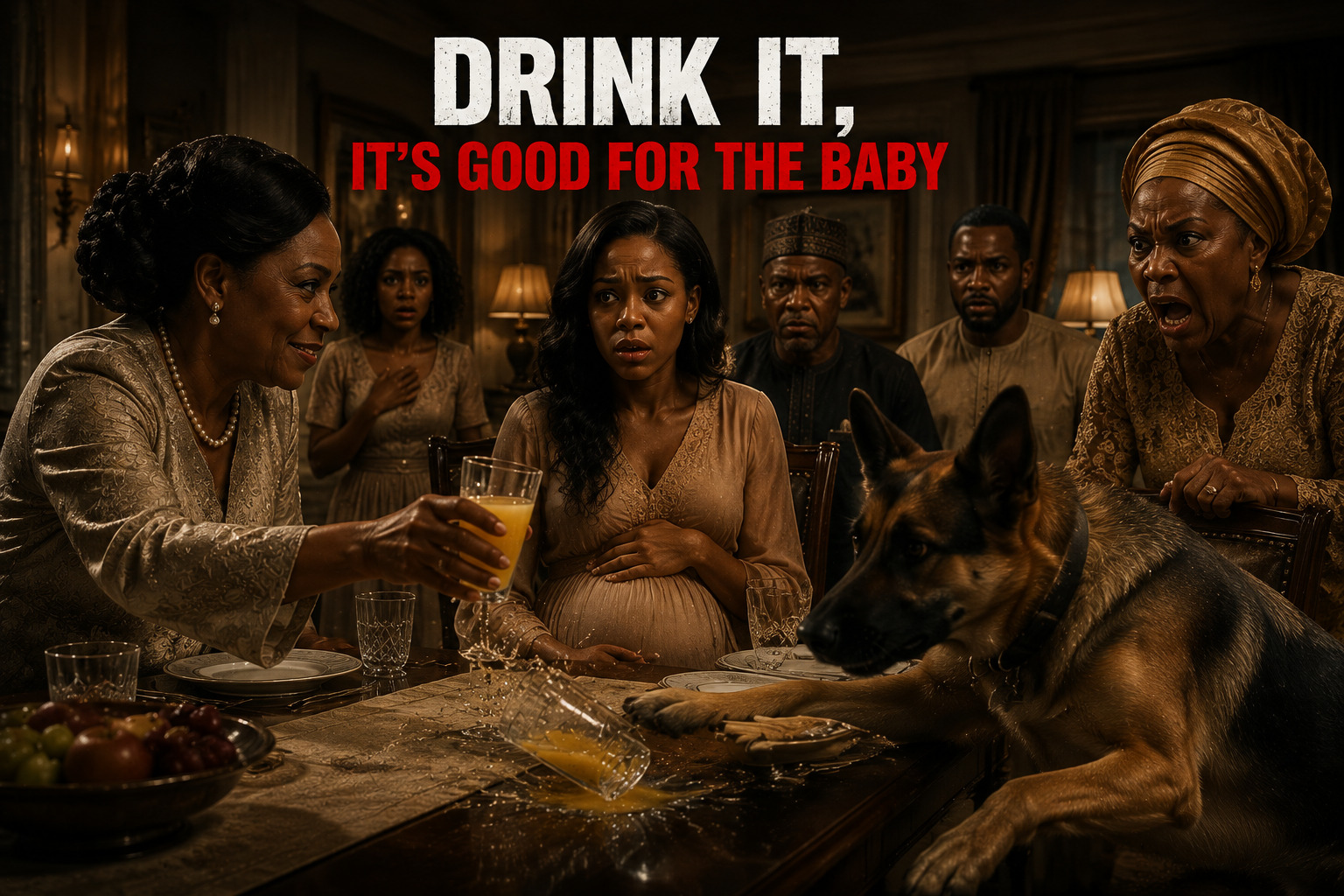
“Drink it. It’s good for the baby.”
Mam Béatrice’s voice barely rose above the soft scrape of silverware against porcelain.
She pushed the glass across the dining table with two fingers, her smile calm, practiced, and entirely wrong.
The juice was pale gold, almost luminous beneath the chandelier. A thin ring of foam clung to the rim. It smelled of pineapple, ginger, and something Dorcas couldn’t name—something bitter hiding beneath the sweetness.
Around the table, eleven members of the Hale family watched her.
Not openly.
Béatrice’s younger sister pretended to straighten her napkin. Uncle Luc cut the same piece of lamb three times without eating it. Lydia, Evan’s older sister, stared at the glass as though she had already decided how the evening would end.
Dorcas rested one hand over the small curve beneath her navy-blue dress.
Fourteen weeks.
After two years of fertility appointments, one surgery, and a miscarriage that had left an empty room at the end of the hallway, fourteen weeks felt less like a number and more like a fragile country she was afraid to enter.
Across from her, her husband Evan gave a tired smile.
“Mom has been making that blend forever,” he said. “Remember? The ginger thing.”
Béatrice did not look at him.
Her eyes remained on Dorcas.
“Your stomach has been sensitive,” she said. “This will settle it.”
Dorcas lifted the glass.
From beneath the table came a low, vibrating growl.
Everyone froze.
Kito stood beside Dorcas’s chair, his broad black head level with her knee. The Rhodesian ridgeback rarely made noise indoors. Even when delivery drivers came to the house, he watched in silence, ears forward, body still.
Now the fur along his spine had risen.
“Kito,” Dorcas whispered.
The dog’s gaze was fixed on the glass.
Mam Béatrice’s smile tightened.
“That animal should not be at the table.”
“He’s not begging,” Dorcas said.
“He is always begging. You indulge him.”
Kito’s growl deepened.
Evan reached down. “Easy, boy.”
Dorcas brought the glass closer to her mouth.
Kito lunged.
His shoulder struck her wrist. The glass flew from her hand, shattered against the marble floor, and sprayed golden juice across Béatrice’s cream-colored shoes.
The room erupted.
Béatrice shot to her feet so quickly that her chair toppled backward.
“That animal attacked me!”
“He hit the glass,” Dorcas said.
“He could have bitten someone.”
Kito planted himself between Dorcas and the table, his body rigid, his lips pulled back just enough to reveal the white edges of his teeth.
Uncle Luc stood, his face flushed from wine. “Get him outside before I do it myself.”
“No one is touching my dog.”
Dorcas’s voice came out quieter than she expected.
That quietness made several people look at her.
For four years, they had mistaken it for softness.
Béatrice stared down at the juice soaking into her shoes. Her nostrils flared. One hand gripped the tablecloth so hard her knuckles turned gray.
But Dorcas did not see anger in her face.
She saw fear.
It vanished almost immediately.
Béatrice pressed a hand to her chest and turned toward her son.
“Evan, I will not be threatened in my own home.”
“He didn’t threaten you,” Dorcas said.
“He ruined dinner.”
“It was a glass of juice.”
“It was not just juice.”
The words escaped Béatrice before she could stop them.
Silence spread across the room.
Somewhere in the kitchen, an old refrigerator motor clicked off. Rain whispered against the tall windows. The grandfather clock in the foyer counted four seconds before Béatrice bent down and began gathering pieces of broken glass with a napkin.
Dorcas watched her.
Not just juice.
Evan stood and reached for his mother’s arm.
“Let Nella clean that.”
“I am capable of cleaning my own home.”
Béatrice’s voice had changed. It was brisk now, almost sharp. “Take your wife upstairs. She looks pale.”
Dorcas did not feel pale.
She felt awake.
As Evan guided her away from the table, Kito stayed close enough that his side brushed her leg.
At the doorway, Dorcas looked back.
Mam Béatrice had stopped cleaning.
She was staring at the broken glass.
And when she realized Dorcas was watching, she kicked one wet shard beneath the china cabinet.
The guest bedroom occupied the east side of the Hale mansion, where tall windows faced a line of bare November trees.
Rain pressed silver fingers against the glass.
Evan shut the door and exhaled through his nose.
“What was that?” Dorcas asked.
He loosened his tie. “Kito got spooked.”
“I’m not talking about Kito.”
“Then what are you talking about?”
“Your mother said it wasn’t just juice.”
“She was upset.”
“She looked terrified.”
“She had a ninety-pound dog jump at her.”
“He jumped at the glass.”
Evan turned away and rubbed both hands over his face. At thirty-nine, he still looked younger when he was tired—his shoulders rounded, his dark curls falling across his forehead, the deep confidence he carried into architectural meetings dissolving the moment he entered his mother’s house.
Dorcas had loved that softness once.
Tonight, it frightened her.
“Your family was watching me,” she said.
“They always watch everyone.”
“No. They were waiting.”
Evan dropped his hands. “Waiting for what?”
“I don’t know.”
His jaw moved.
That small motion told her he was angry, but not at the right person.
“Dorcas, my mother cooked for three days because she wanted to make peace.”
“Your mother invited us here because the board meets tomorrow.”
“That doesn’t mean—”
“She has ignored me for six weeks. She did not call after the ultrasound. She did not answer when you told her the baby was healthy. Then, the night before an emergency board meeting, she suddenly wants to make peace and insists I drink something she prepared herself.”
“You’re connecting things that aren’t connected.”
“Maybe.”
She looked down at Kito.
The dog sat beside the bedroom door, staring into the hallway.
“But he smelled something.”
Evan laughed once, without humor. “He’s a dog, Dorcas.”
Her eyes lifted.
“Yes,” she said. “And he’s the only one in this house who reacted honestly.”
Evan flinched.
Before he could answer, Kito rose.
His nose pressed against the narrow gap beneath the door. He inhaled, turned his head, and looked back at Dorcas.
Then he scratched once.
A deliberate stroke of his paw against the wood.
“Kito.”
He scratched again.
Dorcas opened the door.
The hallway was empty.
Warm light spilled from wall sconces onto oil paintings of dead Hale men standing beside ships, warehouses, and early cargo trucks. The entire corridor smelled faintly of beeswax, roast lamb, and damp wool.
Kito walked toward the back staircase.
“Where are you going?” Evan asked.
The dog did not stop.
Dorcas followed.
They passed the darkened library, descended the narrow servants’ stairs, and entered the kitchen.
The dinner dishes had been cleared, but no one was there. Nella, the longtime housekeeper, had left a damp cloth near the sink and disappeared.
Kito crossed the black-and-white tile floor.
He went directly to a locked cabinet beneath the far counter.
Then he began to scratch.
2. The Cabinet
The cabinet was old mahogany, darker than the others and fitted with a brass lock.
Dorcas crouched beside Kito.
He pushed his nose against the seam, inhaled, then sneezed violently. A thread of saliva hung from his mouth.
Evan pulled him back by the collar.
“Enough.”
“What does your mother keep in there?”
“I don’t know.”
“You grew up in this house.”
“I didn’t inventory the cabinets.”
Dorcas examined the lock. There were fresh scratches around the keyhole.
From the hallway came the click of heels.
Mam Béatrice appeared in the doorway.
She had changed her shoes, but a damp stain darkened the hem of her silk trousers.
“What are you doing?”
Her eyes moved from Dorcas to Kito, then to the cabinet.
Evan stepped forward. “He came down here.”
“I asked her.”
Dorcas rose slowly.
“Kito smelled something in this cabinet.”
Béatrice’s face did not change. Only her left thumb moved, rubbing once across the wedding ring she had continued wearing eight years after her husband’s death.
“There are cleaning supplies.”
“In a locked wooden cabinet?”
“This is my home.”
“Then open it.”
Evan turned. “Dorcas.”
Mam Béatrice lifted her chin.
For decades, that gesture had ended arguments in this family. Dorcas had seen grown men lower their voices when Béatrice Hale raised her chin.
“Your dog destroys my glassware,” Béatrice said. “Then you wander through my kitchen demanding that I open private cabinets?”
“Open it.”
The words landed harder the second time.
Béatrice’s eyes narrowed.
“You have always had a talent for making yourself the victim.”
Dorcas felt the old sting, but she did not move.
Four years of small humiliations crowded the kitchen.
Béatrice introducing her as “Evan’s friend” three months after the wedding.
Béatrice asking whether Dorcas’s “little technology project” provided health insurance.
Béatrice telling dinner guests that some women waited until their late thirties to become pregnant because they were “too focused on proving something.”
Each insult had been wrapped in manners and delivered with a smile.
Dorcas had swallowed every one to keep Evan from being torn between them.
Now, with her unborn child beneath her hand, she discovered she had nothing left to swallow.
“Open the cabinet,” she said again.
Béatrice stepped closer.
“You think carrying my grandchild gives you authority in this family?”
“No.”
Dorcas’s voice stayed level.
“But it gives me a reason to stop pretending you don’t hate me.”
Evan shut his eyes.
Béatrice stared at Dorcas for a long moment. Then she reached into her pocket and removed a key.
She unlocked the cabinet.
Inside were silver-polishing cloths, bottles of furniture oil, two boxes of candles, and a stack of linen placemats.
Nothing else.
Béatrice spread one hand.
“Satisfied?”
Kito shoved past Evan.
He thrust his head into the cabinet, knocking over a bottle of polish. Then he pawed at the back panel.
The wood gave a hollow knock.
Dorcas leaned closer.
Behind the folded placemats was a narrow seam.
A false back.
Béatrice moved first.
She slammed the cabinet door, catching Dorcas’s fingers before Dorcas could pull them free.
Pain shot through her hand.
Kito barked.
The sound cracked through the kitchen like a gunshot.
Evan grabbed the door and yanked it open.
“Mom!”
Dorcas clutched her fingers to her chest. Red lines rose across her knuckles.
Béatrice stepped back.
For the first time that evening, her composure broke completely.
“You need to leave.”
“What is behind the panel?” Dorcas asked.
“Leave my house.”
Evan stared at his mother. “Why did you close the door on her hand?”
“It slipped.”
“No, it didn’t.”
Béatrice’s breathing grew shallow.
She looked at her son as though he had spoken in a language she did not recognize.
Then Uncle Luc appeared behind her.
“What is going on?”
“Evan and his wife are leaving,” Béatrice said.
Luc looked at the open cabinet, the false panel, and Dorcas’s injured hand.
Something passed across his face.
Recognition.
Then dread.
He stepped into the kitchen and quietly closed the door behind him.
“Béatrice,” he said, “give me the key.”
She did not answer.
“Give me the key.”
Dorcas watched them.
“You know what is in there.”
Luc’s lips parted, but Béatrice turned on him.
“You have said enough in this family for one lifetime.”
Evan reached behind the placemats and pulled the thin wooden panel forward.
Mam Béatrice made a sound from deep in her throat.
Behind the panel stood a small brown bottle.
Its label faced the wall.
Dorcas reached for it, but Béatrice seized her wrist.
Their eyes met.
Béatrice’s fingers trembled.
“Do not touch that.”
Dorcas slowly turned the bottle around.
A white pharmacy label had been fixed across the glass.
Beneath Mam Béatrice’s name, printed in red capital letters, were six words:
NOT FOR USE DURING PREGNANCY.
3. The Heartbeat
The emergency department at Sibley Memorial was overlit and cold.
A television bolted to the wall showed a muted football game no one was watching. Wheels squeaked across waxed floors. Behind the curtains, machines chirped and strangers coughed into paper masks.
Dorcas lay beneath a thin hospital blanket with one hand on Kito’s collar.
The nurse had protested when Evan brought the dog inside. Dorcas had not raised her voice. She had simply refused to release him until security called the charge physician, who recognized Kito’s medical support certification.
Now he rested his head against the edge of the bed.
A portable ultrasound machine hummed beside them.
The doctor moved the probe slowly.
Evan stood at Dorcas’s shoulder, his hand hovering above hers without touching it.
Neither of them spoke.
Then the room filled with a rapid, galloping sound.
The baby’s heartbeat.
Dorcas closed her eyes.
Her breath left in a broken wave.
Evan gripped the bed rail. His shoulders folded inward, and for a moment he seemed unable to stand.
The doctor studied the screen.
“The heartbeat is strong,” she said. “I don’t see signs of immediate distress.”
“Immediate?” Dorcas asked.
“We sent your blood and the bottle to toxicology. We also need to know whether you swallowed any of the drink.”
“No.”
“The dog knocked it away.”
The doctor looked down at Kito.
“He may have saved you from a very dangerous night.”
Evan covered his mouth.
Dorcas watched the pulse flickering on the screen. Tiny. Defiant.
Alive.
A police officer arrived twenty minutes later.
By then, Mam Béatrice had called Evan fourteen times.
She had also sent a message to the family group chat.
DORCAS HAS MISUNDERSTOOD A PRIVATE MEDICATION. PLEASE DO NOT ENCOURAGE PANIC.
Lydia responded first.
This is getting out of control.
Uncle Luc wrote nothing.
The officer placed the brown bottle in an evidence bag and asked who had prepared the juice.
Evan stared at the floor.
“My mother,” he said.
The words seemed to age him.
Dorcas answered the rest of the questions.
She described the dinner, the dog, the cabinet, the label, Béatrice’s reaction. She did not add theories. She did not raise her voice.
The officer took notes and asked whether there were cameras in the kitchen.
Evan shook his head.
“My mother hates cameras inside the house.”
“There’s one in the rear corridor,” Dorcas said. “Above the service entrance.”
He looked at her.
“How do you know?”
“I noticed it when we arrived.”
The officer glanced between them. “Does it cover the kitchen?”
“No,” Evan said. “Only the back door.”
“Then it may show who entered and left with items.”
As the officer walked away, Evan sat down.
For a long time, he studied his hands.
“I kept telling myself she was difficult,” he said. “That she was grieving. That she didn’t know how to share me.”
Dorcas looked at him.
He swallowed.
“I made you live inside excuses I wouldn’t have accepted from anyone else.”
There was no dramatic apology.
No speech.
Only a man finally looking at the shape of his own cowardice.
Dorcas turned back toward the ultrasound monitor.
“You didn’t put anything in that glass.”
“No.”
“But you asked me to drink it.”
His face tightened.
She did not say more.
Near midnight, the toxicology fellow returned.
He closed the curtain behind him and sat beside the bed.
“The bottle contains a concentrated herbal compound that can stimulate uterine contractions,” he said. “It is sometimes marketed for use after childbirth. It should never be given to a pregnant woman.”
Evan went white.
“How much was in the juice?” Dorcas asked.
“We don’t have the juice.”
Dorcas remembered the cream linen tablecloth. The golden liquid spreading beneath Béatrice’s plate. Nella pressing a towel against the stain while everyone shouted.
“The cloth,” she said.
“What?”
“The tablecloth absorbed it.”
Evan was already standing.
“I’ll call the house.”
“No.”
Dorcas caught his wrist.
“Your mother will destroy it.”
He stared at her.
Then they both looked at the police officer beyond the curtain.
But before the officer could reach the Hale house, Nella called.
She was whispering.
“Mrs. Dorcas,” she said, “Mam Béatrice is burning something in the courtyard.”
4. Ashes
By the time the police arrived, the rain had weakened to a mist.
Smoke curled from the stone courtyard behind the mansion. The air smelled of wet cedar, scorched linen, and the sweet chemical bite of lighter fluid.
Mam Béatrice stood beneath the covered patio holding an umbrella.
At her feet, the remains of the tablecloth smoldered inside a copper fire bowl.
She told the officers it had been ruined by juice and broken glass.
She told them she had burned it because stains embarrassed her.
She told them the bottle in the cabinet was part of a private postpartum treatment recommended by a woman from her church.
She told them Dorcas had always been suspicious, emotional, and prone to “inventing insults where none existed.”
Every sentence was calm.
Every answer was reasonable by itself.
Together, they formed a wall.
Nella stood near the kitchen door, twisting the corner of her apron.
Dorcas watched her through the window.
Their eyes met.
Nella lowered hers.
The police collected the ashes anyway.
They also downloaded footage from the rear corridor camera.
At 5:42 that afternoon, Mam Béatrice appeared carrying a small paper bag.
At 5:48, she entered the kitchen.
At 6:03, she emerged without the bag.
It did not prove what she had done inside.
But it proved the bottle had arrived shortly before dinner.
The next morning, the Hale family gathered in the hospital cafeteria.
They did not come to see Dorcas.
They came to contain her.
Lydia arrived first, wearing a camel coat and an expression sharpened by sleeplessness. Uncle Luc followed. Two cousins stood near the coffee machines, pretending not to listen.
Mam Béatrice did not come.
Lydia placed her phone on the table.
“Mother’s attorney says the police have no grounds to keep the bottle.”
Dorcas stirred tea she did not intend to drink.
“The police disagree.”
“You know what I mean.”
“I don’t.”
Lydia leaned forward.
“This family is already under pressure. The company is in the middle of a financing crisis. Rumors could destroy us.”
“A rumor is something unverified.”
“You have no proof she put anything in your drink.”
“Kito reacted to the glass.”
“He is not a laboratory.”
“No. The laboratory found the same compound in my blood.”
The cousins stopped pretending not to listen.
Lydia’s mouth opened.
Dorcas placed a copy of the preliminary report on the table.
There had been only a trace in her system, most likely transferred from residue on her fingers when the juice spilled. It was not enough to harm the pregnancy.
It was enough to prove the compound had been present at dinner.
Uncle Luc sat down heavily.
Lydia did not touch the report.
“This can still be handled privately.”
Dorcas looked at her.
“How privately should an attempted miscarriage be handled?”
A coffee cup slipped from someone’s hand across the cafeteria. Ceramic cracked against tile.
Lydia’s face tightened.
“You are enjoying this.”
Evan stepped between them.
“Stop.”
His sister looked at him.
He had spent most of the night beside Dorcas’s bed. His shirt was wrinkled, his eyes bloodshot, his voice rough.
“You have humiliated my wife for four years,” he said. “I watched. I explained it away. I will carry that for the rest of my life. But you will not stand in a hospital and accuse her of enjoying this.”
Lydia’s expression shifted.
It was the first time Evan had spoken to her that way.
Uncle Luc rubbed both palms over his face.
“Béatrice is afraid,” he said.
Dorcas turned to him.
“Of what?”
He looked toward the windows.
Morning traffic moved beyond the glass in red streaks of brake lights.
“The company.”
“What about it?”
Luc glanced at Evan.
“You don’t know?”
“Know what?”
“Hale Meridian has missed two loan payments.”
Evan stared at him.
“That’s impossible.”
“The bank accelerated the debt last month.”
“Why wasn’t I told?”
“Because your mother has been trying to fix it.”
Evan pushed a hand through his hair. “The board packet showed positive cash flow.”
Luc’s laugh was small and bitter.
“The board packet was fiction.”
Silence settled over the table.
Hale Meridian Foods employed more than four hundred people across Maryland and Virginia. Evan’s grandfather had started with one delivery truck in 1957. Under Béatrice and her late husband, the company grew into a regional supplier for hospitals, schools, and grocery chains.
The Hale name was engraved on university buildings, church wings, and scholarship plaques.
It was also, apparently, weeks away from collapse.
“The debt was purchased by a private holding company,” Luc continued. “Harbor Nine Capital. No one knows who controls it. They could force liquidation at tomorrow’s meeting.”
Dorcas stopped stirring her tea.
The spoon became still against the side of the cup.
Lydia noticed.
“What?”
“Nothing.”
“Why did you react?”
“I didn’t.”
“You know the name.”
Evan looked at his wife.
Dorcas folded the laboratory report and returned it to her bag.
“We should go.”
Lydia stood. “What aren’t you telling us?”
Dorcas rose slowly.
For years, Lydia had spoken to her as though volume could establish rank. Now, for the first time, uncertainty entered her voice.
Dorcas put on her coat.
“At tomorrow’s board meeting,” she said, “you should read every page before you sign anything.”
Then she walked away.
Behind her, Uncle Luc whispered a question that Evan heard clearly.
“Who exactly did you marry?”
5. The Woman They Never Asked About
They had met at an airport during a snowstorm.
Evan’s flight to Boston had been canceled. Dorcas was sitting on the carpet near Gate 23 with her laptop balanced on a carry-on suitcase and Kito, then a lanky adolescent dog, sleeping across her shoes.
Evan had asked if the seat beside her was taken.
Dorcas had looked at the empty chair.
“Yes,” she said.
He waited.
She let him stand there for three uncomfortable seconds before smiling.
“By you, apparently.”
He fell in love with her humor first.
Her ambition came later, in fragments.
She told him she worked in “data logistics.” She rented a modest townhouse in Silver Spring and drove a six-year-old Subaru with a cracked dashboard. She wore the same gold earrings nearly every day.
Evan assumed she was doing well.
He never asked how well.
Three years before their wedding, Dorcas had founded Lantern North, a software company that traced risk through food and pharmaceutical supply chains. She had built its first predictive model after a contaminated shipment killed six residents in a nursing home where her mother worked.
The tragedy had never made national news.
The settlement had barely covered funeral costs.
Dorcas spent the next decade building a system that could identify hidden failures before they reached hospital kitchens, school cafeterias, or medicine cabinets.
Lantern North’s earliest office had been a storage room above a laundromat.
By the time Dorcas met Evan, the company operated in seven states.
By the time they married, it served three of the country’s largest health networks.
The year before her pregnancy, Lantern North had closed a private investment round valuing the company at just over nine hundred million dollars.
Dorcas remained its largest shareholder.
She was not a billionaire.
But she was close enough that the difference had become technical.
The Hales never knew.
They never asked what “data logistics” meant.
At family dinners, Uncle Luc called it Dorcas’s computer hobby. Lydia once offered to introduce her to a cousin who needed a website for his dental practice.
Mam Béatrice referred to her as “self-employed.”
Dorcas had corrected none of them.
Partly because she disliked discussing money.
Partly because she enjoyed knowing exactly how people behaved when they thought she had none.
But mostly because Evan’s family had made their judgment so quickly that correcting them would have felt like begging for admission to a room she no longer wanted to enter.
Evan learned the truth six months into their marriage, when a business magazine placed Dorcas on its cover.
He had stared at the photograph, then at his wife standing barefoot in the kitchen, eating cereal from the mixing bowl.
“Why didn’t you tell me?”
“You never asked.”
He had laughed then.
Later, they agreed not to disclose her finances to his family. Hale Meridian was proud, traditional, and perpetually concerned about appearances. Dorcas wanted to be treated as a person before she was treated as capital.
That experiment had failed.
Three months before the dinner, Evan had quietly told her Hale Meridian was struggling. He did not know how badly. He only knew suppliers were calling, payments were late, and his mother had stopped sharing full financial statements.
Dorcas had asked Lantern North’s legal team to review the public debt.
What they found alarmed her.
Hale Meridian’s main loan was secured not only by warehouses and equipment, but by employee retirement funds through a structure that should never have passed an independent audit.
If the company collapsed, Béatrice would not simply lose a family business.
Hundreds of employees could lose part of their pensions.
Dorcas created Harbor Nine Capital and purchased the distressed debt through intermediaries.
She intended to stabilize the company, replace its accounting systems, protect the pensions, and leave Béatrice with enough dignity to announce the solution as her own.
She had planned to tell Evan after the board meeting.
Now they sat in their townhouse kitchen while dawn light spread across the counters.
Kito slept beside the refrigerator.
Evan held the Harbor Nine documents with both hands.
“You own the debt.”
“Yes.”
“You can take the company.”
“I can stop the bank from breaking it apart.”
“You did all of this without telling me.”
“You asked me not to interfere with your family.”
“I didn’t mean buy their debt.”
“I know.”
He stood and paced to the window.
The November sky was low and colorless. Rainwater trembled on the power lines.
“Were you ever going to tell them?”
“At the meeting.”
“Before or after my mother tried to poison you?”
Dorcas looked down.
The anger left his face.
He crouched in front of her chair.
“I’m sorry.”
She did not ask which part.
“I thought silence made things easier,” he said. “I thought keeping the peace was the same as protecting you.”
Dorcas’s eyes filled, but she did not let the tears fall.
“My mother used to do that,” she said. “She would make herself smaller until everyone else felt comfortable. When she died, people called her gentle.”
Evan waited.
“She wasn’t gentle,” Dorcas continued. “She was exhausted.”
Kito lifted his head.
Dorcas rested a hand against her stomach.
“I will not teach my child that love means disappearing.”
Evan nodded once.
Then his phone rang.
It was Uncle Luc.
He did not say hello.
“Your mother knows who owns Harbor Nine.”
Evan put the call on speaker.
“How?”
“She found a document in your father’s old safe. A trust amendment.”
“What trust?”
Luc’s breath crackled through the phone.
“The voting trust. The one that gives Béatrice control of Hale Meridian.”
Dorcas felt the room narrow around her.
“What does the amendment say?” she asked.
Luc hesitated.
Then he answered.
“Her control ends when Evan’s first child is born.”
6. The Clause
The trust had been created by Evan’s father during his final months of life.
Robert Hale had known the company was overleveraged. He had also known his wife’s instinct, when frightened, was to tighten her grip until nothing could breathe.
The amendment allowed Béatrice to retain temporary voting control after his death.
That control would transfer to Evan upon the birth of his first child.
At that moment, the company would be required to undergo an independent audit before the shares could pass to the next generation.
Béatrice had hidden the amendment for eight years.
Evan had never known it existed.
Neither had Lydia.
Uncle Luc had discovered it accidentally while searching for old property records, then confronted his sister.
“She said the company needed stability,” Luc explained over the phone. “She said Evan wasn’t ready.”
“And you accepted that?” Evan asked.
“At first.”
“How long have you known?”
“Two years.”
Evan’s face hardened.
“Two years.”
Luc lowered his voice.
“The company was already in trouble. Béatrice said an audit would trigger defaults and layoffs. She said we needed time.”
Dorcas looked at the debt schedule spread across her kitchen table.
“Then I became pregnant.”
“Yes.”
“And the audit became unavoidable.”
Luc said nothing.
Dorcas’s fingers went cold.
The attempted poisoning had not been spontaneous.
It had not grown from a cruel remark, a family argument, or a sudden loss of control.
Mam Béatrice had seen an unborn child as a deadline.
The baby’s birth would open the books.
The books would expose everything.
“When did she learn about Harbor Nine?” Dorcas asked.
“Last week. One of the attorneys traced a filing back to Lantern North’s outside counsel.”
Evan looked at Dorcas.
“She knew.”
“Not that Dorcas owned it,” Luc said. “Only that Lantern North was connected.”
Mam Béatrice had thought the mysterious creditor and the daughter-in-law she despised were working together.
She had not known they were the same person.
“She believed you were preparing to take control through the baby,” Luc said. “She said you had trapped Evan, bought the debt, and timed the pregnancy.”
Dorcas almost laughed.
Not because it was funny.
Because the accusation was so perfectly shaped from Béatrice’s own fears.
“Why are you telling us this now?” Evan asked.
On the other end, Luc exhaled.
“Because I watched my sister burn that tablecloth.”
The line went quiet.
Then Luc spoke again.
“She used to be the bravest person I knew. When our father died, she left college and worked nights to keep us in school. When Robert’s first warehouse burned, she slept in the office for three months and rebuilt the route schedule by hand.”
His voice thinned.
“She has spent her whole life saving things. Somewhere along the way, she stopped asking whether they wanted to be saved.”
Dorcas looked at Kito.
The dog was awake now, eyes fixed on the front door.
“Will you testify?” she asked.
Luc did not answer immediately.
When he did, his voice was barely audible.
“Yes.”
A knock sounded at the door.
Three slow strikes.
Evan crossed the room and looked through the peephole.
His body stiffened.
“Who is it?” Dorcas asked.
He turned.
“My mother.”
Mam Béatrice stood on the porch alone.
No attorney.
No family members.
No umbrella.
Rain had darkened her gray hair and soaked the shoulders of her coat. She looked smaller than she had at the head of the dining table, but not weaker.
Kito moved between her and Dorcas as soon as the door opened.
Béatrice looked down at him.
“The hero,” she said.
Dorcas remained in the kitchen.
“What do you want?”
“To speak without police.”
“You lost the right to set conditions.”
A muscle tightened in Béatrice’s cheek.
She entered only when Evan stepped aside.
For the first time in four years, Mam Béatrice stood in Dorcas’s home without commenting on its size, its furniture, or the dog hair near the stairs.
Her gaze fell on the Harbor Nine documents.
“So it is true.”
Dorcas said nothing.
“You bought the debt.”
“Yes.”
“With whose money?”
“Mine.”
Béatrice gave a short laugh.
“Do not play games with me.”
“I’m not.”
“You expect me to believe your little company has the funds to purchase a forty-eight-million-dollar note?”
Dorcas looked at her husband.
Evan did not rescue his mother from the answer.
“Lantern North is valued at nine hundred and twenty million dollars,” Dorcas said. “I own fifty-eight percent.”
The room went still.
Béatrice stared at her.
Rain tapped the kitchen window.
The old refrigerator hummed.
For several seconds, nothing in Béatrice’s face moved.
Then her eyes flicked toward Dorcas’s simple earrings, her worn cardigan, the ceramic mug with a chipped handle.
She was recalculating every dinner, every insult, every time she had spoken slowly to Dorcas as if explaining business to a child.
“You hid this,” she said.
“I kept it private.”
“You allowed us to believe—”
“You chose what to believe.”
Béatrice’s lips pressed together.
“You bought my family’s company.”
“I bought its debt because you endangered four hundred pensions.”
“I kept four hundred people employed.”
“You falsified inventory.”
“I delayed losses.”
“You moved retirement funds.”
“I used every available resource.”
“You lied to the board.”
“I prevented panic.”
Each answer came faster than the one before.
Béatrice was not confessing.
She was defending a war no one else had agreed to fight.
Dorcas stepped closer.
“And the juice?”
For the first time, Béatrice looked away.
Evan’s voice broke.
“Mom.”
Béatrice stared through the window.
“I needed time.”
Dorcas felt the baby shift—or perhaps it was only a muscle tightening beneath fear.
“You needed my child not to be born.”
“I needed the audit delayed.”
“You put something in her glass,” Evan said.
Béatrice turned on him.
“You think companies survive on goodness? You think your father built Hale Meridian by telling the truth every time the truth became inconvenient?”
“My father never tried to kill his grandchild.”
“I was not trying to kill anyone.”
The words rang through the kitchen.
Kito growled.
Béatrice’s eyes dropped to Dorcas’s stomach.
“It was early,” she said. “The doctor said you had already lost one.”
Dorcas stopped breathing.
Evan moved so quickly his chair struck the wall.
“Get out.”
Béatrice’s face changed.
Not with remorse.
With shock.
Her son had never ordered her from a room.
“I did it for you,” she said.
“No.”
“For this family.”
“No.”
“For the employees whose names you do not know.”
Evan opened the front door.
“You did it because you could not survive a future you didn’t control.”
Béatrice looked at him.
Then at Dorcas.
Her eyes were wet now, but her back remained straight.
“You think you are different?” she asked Dorcas. “You bought the debt in secret. You created a shell company. You planned to walk into my boardroom and decide whether my life’s work survived.”
“Yes.”
Dorcas held her gaze.
“But I was going to save it.”
Béatrice’s breath caught.
Dorcas continued.
“I had a restructuring agreement ready. No liquidation. No mass layoffs. Full pension protection. You would have remained chair for one year during the transition.”
The rain seemed louder.
“I was going to let you announce it,” Dorcas said. “I was going to let everyone believe you had negotiated the rescue.”
Something broke behind Béatrice’s eyes.
Not tears.
Certainty.
For the first time, she understood that the woman she had tried to remove from the family had been quietly building the bridge beneath it.
Evan pointed toward the open door.
“Leave.”
Béatrice stepped onto the porch.
She turned once.
“What happens tomorrow?”
Dorcas looked at the rain running down the older woman’s face.
“The truth enters the boardroom.”
7. The Boardroom
Hale Meridian’s headquarters stood beside an industrial rail line in Hyattsville, a six-story brick building with narrow windows and the company name carved above the entrance.
At 8:55 the next morning, the boardroom smelled of coffee, old leather, and fear.
Twelve directors sat around a polished walnut table.
Mam Béatrice occupied the chair at the head.
She wore a white suit, pearl earrings, and the expression of a woman prepared to outlive the truth.
Lydia sat on her right. Uncle Luc sat on her left.
Evan took a seat near the middle.
The chair beside him remained empty.
At nine o’clock, the general counsel closed the doors.
“Harbor Nine Capital has requested immediate review of the company’s default status,” he said. “Their representative is on the way up.”
Béatrice’s hands rested flat on the table.
Only Luc noticed the slight tremor in her right index finger.
The elevator chimed outside.
Footsteps approached.
The doors opened.
Dorcas entered wearing a charcoal-gray suit and low black heels. Her hair was pulled back. She carried no designer bag, no visible jewelry beyond her wedding ring.
Kito walked beside her.
Behind them came Lantern North’s chief legal officer, a forensic accountant, two pension representatives, and the police detective assigned to the poisoning case.
The room rose into chaos.
“What is the dog doing here?”
“Why are the police present?”
“Béatrice, what is this?”
Dorcas took the empty seat beside Evan.
The general counsel stared at her.
“Mrs. Hale, this is a closed board session.”
Dorcas placed a leather folder on the table.
“My name is Dorcas Mbele-Hale. I am the managing member of Harbor Nine Capital and the founder and chief executive officer of Lantern North.”
No one moved.
Lydia’s face emptied.
One director removed his glasses and cleaned them, though the lenses were already clear.
Dorcas opened the folder.
“Harbor Nine currently controls sixty-three percent of Hale Meridian’s secured debt. Under the default agreement, we have the authority to demand immediate repayment or begin liquidation.”
Béatrice’s voice cut across the room.
“She acquired that debt under false pretenses.”
“No,” the chief legal officer said. “Harbor Nine acquired it through a lawful secondary-market transaction.”
“She is married to a trust beneficiary.”
“That relationship was disclosed to the bank and reviewed by independent counsel.”
Lydia stared at Dorcas.
“You could have told us.”
Dorcas met her eyes.
“You never asked what I did.”
The words were not loud.
They did not need to be.
The forensic accountant distributed thick reports.
The first pages showed missed payments.
The next documented fictitious inventory.
Then unauthorized pension transfers.
Then a series of wire transactions approved by Béatrice and concealed through subsidiary accounts.
Gasps moved around the table.
Béatrice did not open the report.
“I made decisions to preserve this company,” she said.
“You pledged employee retirement assets without informing the trustees,” Dorcas replied.
“If I had not, the bank would have closed our credit line.”
“You had other options.”
“From whom? Men who offered pennies for the warehouses? Consultants who would fire half the staff and call it efficiency?”
“You had me.”
Béatrice looked at her.
The room became very quiet.
Dorcas slid a second document across the table.
“A fully funded rescue package. Forty-eight million in debt restructuring. Eleven million in working capital. Pension restoration completed within thirty days. No facility closures for eighteen months. No executive bonuses until employee accounts are whole.”
A board member flipped through the pages.
“This was prepared before the default meeting.”
“Six weeks ago,” Dorcas said.
Lydia’s head snapped toward her mother.
“You knew Lantern North was connected.”
Béatrice did not answer.
“You knew someone was offering a rescue.”
“I did not know it was her.”
“Would that have changed the numbers?”
Béatrice looked at her daughter.
“No.”
The detective placed a sealed evidence report on the table.
“The laboratory completed analysis of the residue recovered from the burned tablecloth,” he said.
Béatrice’s shoulders went rigid.
The room seemed to contract around her.
“The compound matches the contents of the bottle collected from Mrs. Hale’s kitchen. Concentration levels indicate it was deliberately added to the beverage.”
Lydia pushed back from the table.
Her chair rolled several inches.
She looked at her mother, then at Dorcas’s stomach.
“Tell me that isn’t true.”
Béatrice stared at the report.
“Mother.”
No answer.
“Tell me.”
Béatrice’s gaze moved across the room.
Her brother would not look at her.
Her son stood beside his wife.
The directors she had commanded for years sat with their hands folded, waiting—not for her decision, but for her explanation.
Then Kito rose.
He did not bark.
He simply stepped closer to Dorcas and rested his head against her leg.
Béatrice looked at the dog.
The color drained from her face.
Her mouth opened, but no words came.
That was the moment everyone saw it.
Not the confident chairwoman.
Not the widow who had saved the company after a warehouse fire.
Not the matriarch who hosted charity dinners beneath crystal chandeliers.
They saw a frightened woman who had built her identity around being indispensable and had mistaken control for love.
Her eyes dropped.
Her hands, always perfectly still in public, began to shake.
“I needed more time,” she whispered.
Lydia covered her mouth.
One director stood and walked out.
Another removed the Hale Meridian pin from his lapel and placed it on the table.
Evan said nothing.
His silence wounded more deeply than any accusation.
Béatrice turned toward Dorcas.
“Do you know what happens when four hundred people lose their jobs?”
“Yes.”
“Do you know what it is to sign checks when there is no money?”
“Yes.”
“Do you know what it is to watch men wait outside your office because their children need insurance?”
Dorcas held her gaze.
“Yes.”
Béatrice’s voice cracked.
“Then you know why.”
“No.”
Dorcas placed one hand over her child.
“I understand your fear. I understand the impossible choices. I understand what it means to carry other people’s survival on your back.”
She leaned forward.
“But the moment you put that fear into my glass, it stopped being leadership.”
The detective stepped beside Béatrice.
“Mam Béatrice Hale, I need you to come with me.”
Béatrice did not resist.
As she stood, she looked toward the framed portrait of her late husband hanging above the boardroom credenza.
For one second, her face softened.
Then the detective guided her toward the doors.
The entire board watched her leave.
No one followed.
8. The Cost of Silence
The criminal case took eleven months.
Mam Béatrice pleaded guilty to attempted poisoning, evidence destruction, falsification of corporate records, and misuse of protected retirement funds.
Her attorneys argued that she had acted during an extended mental health crisis intensified by grief, financial pressure, and untreated anxiety.
The judge considered it.
He also considered the hospital report, the burned tablecloth, the hidden bottle, and the life she had treated as an obstacle on a calendar.
Béatrice received a prison sentence, followed by supervised release.
She was permanently barred from serving as an officer or director of any company managing employee retirement assets.
The court did not erase the woman she had once been.
It did not erase the workers she had helped, the scholarships she had funded, or the years she had held Hale Meridian together after her husband’s death.
It simply refused to let those good acts purchase immunity from the terrible one.
Uncle Luc testified.
Afterward, he resigned from the board.
Lydia did not speak to Dorcas for five months.
When she finally came to the townhouse, she stood on the porch holding a small cardboard box.
Inside were baby clothes Mam Béatrice had bought before the poisoning.
Dorcas stared at them.
“She bought these?” she asked.
Lydia nodded.
“Two weeks before the dinner.”
The contradiction settled between them.
A woman could buy clothes for a child and still decide the child was inconvenient.
A woman could love an idea of a grandbaby while trying to destroy the real baby who threatened her power.
Human beings did not always divide cleanly into monsters and victims.
Sometimes the worst danger came from people who believed their love excused their cruelty.
“I hated you,” Lydia said.
Dorcas looked up.
“Because you had money?”
“No.”
Lydia’s fingers tightened around the box.
“Because you never seemed impressed by us.”
Dorcas almost smiled.
“I was trying to be respectful.”
“I know that now.”
Lydia glanced through the doorway, where Kito slept beside the stairs.
“We thought your silence meant you wanted something.”
“I wanted a family.”
Lydia’s eyes filled.
“We were not very good at being one.”
“No.”
The answer was gentle.
That made it hurt more.
Hale Meridian survived.
Under the restructuring agreement, Dorcas appointed an independent board, restored the pension accounts, and required executives to spend one day each quarter working inside warehouses, delivery hubs, and hospital receiving docks.
Evan became chief operating officer, but only after interviewing with the new board like every other candidate.
He did not ask his wife for special treatment.
She did not offer it.
For the first time in his life, his last name opened no doors.
He discovered he liked the sound of earning the key.
Dorcas refused the chairmanship.
Instead, she placed a former warehouse supervisor named Carla Ruiz in the role. Carla had worked at Hale Meridian for twenty-seven years and had once warned Béatrice about irregular inventory numbers.
Béatrice had called her “too emotional for leadership.”
At the first company-wide meeting, Carla stood on a loading dock in steel-toed boots and announced that every pension account had been restored.
Four hundred people erupted.
Some cheered.
Some cried.
One elderly driver removed his cap and pressed it against his chest.
Dorcas stood near the back with Kito.
No one introduced her.
No one needed to.
9. The Visit
Dorcas gave birth to a daughter on a bright morning in late May.
The delivery lasted eighteen hours.
Rain swept over Washington before dawn, then disappeared, leaving the sky scrubbed blue and clean.
Evan held Dorcas’s hand until his fingers went numb.
When the baby finally cried, every fear Dorcas had carried for nine months seemed to leave her body at once.
They named her Amara.
Grace.
For the first six weeks, Kito slept beneath the bassinet.
He woke whenever Amara moved.
If she coughed, his head rose.
If she cried, he walked to Dorcas and pressed his nose against her knee.
He had saved her before she had taken her first breath.
He seemed determined to keep the job.
When Amara was four months old, a letter arrived from Mam Béatrice.
Dorcas left it unopened for three days.
On the fourth morning, she sat at the kitchen table while sunlight warmed the floor and read it.
There were no excuses.
No claims of misunderstanding.
No requests to have the sentence reduced.
Béatrice wrote about fear.
She wrote about losing Robert, then spending eight years waking before dawn with the certainty that the company would collapse if she loosened her grip.
She wrote about the employees who had brought casseroles after Robert’s funeral and the families who depended on Hale Meridian’s insurance plan.
She wrote that every lie had begun as a temporary measure.
Every stolen dollar was going to be replaced.
Every concealed report would be corrected after the next contract.
Every compromise had needed only one more month.
Then Dorcas became pregnant, and time stopped obeying her.
Near the end, Béatrice wrote one sentence Dorcas read three times.
I told myself I was choosing four hundred lives over one, because admitting I was choosing my power over your child would have made it impossible to lift the glass.
Dorcas folded the letter.
Two weeks later, she visited the prison.
Béatrice entered the visitation room in a gray uniform.
Her hair had gone almost completely white.
Without pearls, tailored jackets, or the Hale mansion surrounding her, she looked both older and more recognizable.
She sat across from Dorcas.
For several seconds, neither woman spoke.
Then Dorcas placed a photograph on the table.
Amara was lying on a yellow blanket with one hand wrapped around Kito’s ear.
Béatrice looked at the photograph.
Her lips trembled.
“She has Evan’s eyes.”
“She has her own.”
Béatrice nodded.
A tear slipped down her cheek.
“I don’t expect forgiveness.”
“That is good.”
The answer startled her.
Dorcas kept her hands folded.
“Forgiveness is not the same as access. Remorse does not rebuild trust on its own.”
“I know.”
“No. You are beginning to know.”
Béatrice lowered her eyes.
Dorcas watched the woman who had once made an entire dining room hold its breath.
The silence no longer belonged to Béatrice.
It belonged to Dorcas now.
And Dorcas did not use it as a weapon.
She used it as a boundary.
“When Amara is old enough,” Dorcas said, “she will know who you are.”
Béatrice looked up.
“She will know the whole truth. The company you helped build. The people you employed. The scholarships. Her grandfather. The glass. The bottle. All of it.”
Pain crossed Béatrice’s face.
“You would tell a child?”
“I will not teach my daughter that family history must be edited to preserve powerful people.”
Béatrice stared at the photograph.
“Will she hate me?”
“I don’t know.”
Dorcas stood.
“But whatever she feels will belong to her. You will not control that either.”
She left the photograph on the table.
At the door, Béatrice called her name.
Dorcas turned.
“Why did you save the company?”
It was the question no one in the family had been brave enough to ask.
Dorcas looked through the reinforced window toward the pale autumn sky.
“Because four hundred innocent people should not lose everything just because the person leading them lost herself.”
Then she walked out.
10. What the Dog Knew
A year after the dinner, Hale Meridian held its annual employee celebration in the largest distribution warehouse.
The loading bays were open to a warm evening. Strings of lights hung between steel beams. Music echoed across polished concrete while children chased balloons between tables.
No crystal chandelier.
No silver place settings.
No one watching to see who belonged.
Carla Ruiz stood on a temporary stage and announced the company’s strongest quarter in six years.
Evan held Amara near the front.
Lydia stood beside him, laughing as the baby tried to steal her glasses.
Uncle Luc had come too. He no longer sat on the board, but he volunteered with the company’s employee assistance fund.
Dorcas stayed near the back with Kito.
The dog’s muzzle had begun to gray.
He leaned against her leg while she watched hundreds of employees applaud one another.
A warehouse driver named Samuel approached carrying two paper cups of lemonade.
He handed one to Dorcas.
Kito immediately lifted his head.
Samuel froze.
Dorcas looked down at the dog.
Kito sniffed the cup, then sneezed.
For one terrible second, the warehouse disappeared.
Dorcas saw the chandelier.
The pale gold juice.
Béatrice’s fingers sliding the glass across the table.
Then Kito wagged his tail and sat.
Samuel laughed nervously.
“Does that mean it passed inspection?”
Dorcas smiled.
“It means he wants some.”
She poured a little lemonade into her palm.
Kito licked it, then looked offended by the sourness.
Dorcas laughed.
The sound surprised her.
Not because she had forgotten how.
Because fear had spent a year trying to claim ordinary moments, and she had finally taken one back.
Evan joined her with Amara in his arms.
Their daughter reached down and grabbed a fistful of Kito’s loose skin.
The old dog stood perfectly still.
“Carla wants you onstage,” Evan said.
“For what?”
“She wants everyone to know who saved the company.”
Dorcas looked toward the bright platform.
“No.”
“Still hiding?”
“Not anymore.”
She took Amara from him.
“I just don’t need a microphone to know my value.”
Evan smiled.
Across the warehouse, the workers began chanting Carla’s name.
Dorcas watched the woman step forward, steel-toed boots visible beneath her blue dress, and receive the applause Béatrice had once believed belonged to the family name.
Power had changed hands.
Not through revenge.
Through sunlight.
Through documents no one could burn.
Through witnesses who finally spoke.
Through a husband who stopped confusing obedience with love.
Through a woman who had been underestimated because she did not announce every weapon she possessed.
And through a faithful dog who had smelled the truth before anyone else was brave enough to face it.
Dorcas looked down at Kito.
“You knew,” she whispered.
His amber eyes held hers.
Perhaps he had smelled the bitter compound.
Perhaps he had seen Béatrice’s hand move when no one else was watching.
Or perhaps loyalty was simply a form of attention—pure, uncorrupted attention—and Kito had noticed what every human at that table had trained themselves to ignore.
Danger rarely arrives looking like danger.
Sometimes it wears pearls.
Sometimes it speaks softly.
Sometimes it smiles, slides a glass toward you, and calls itself family.
Never mistake a woman’s silence for surrender; sometimes she is only giving the lie enough room to say its own name.