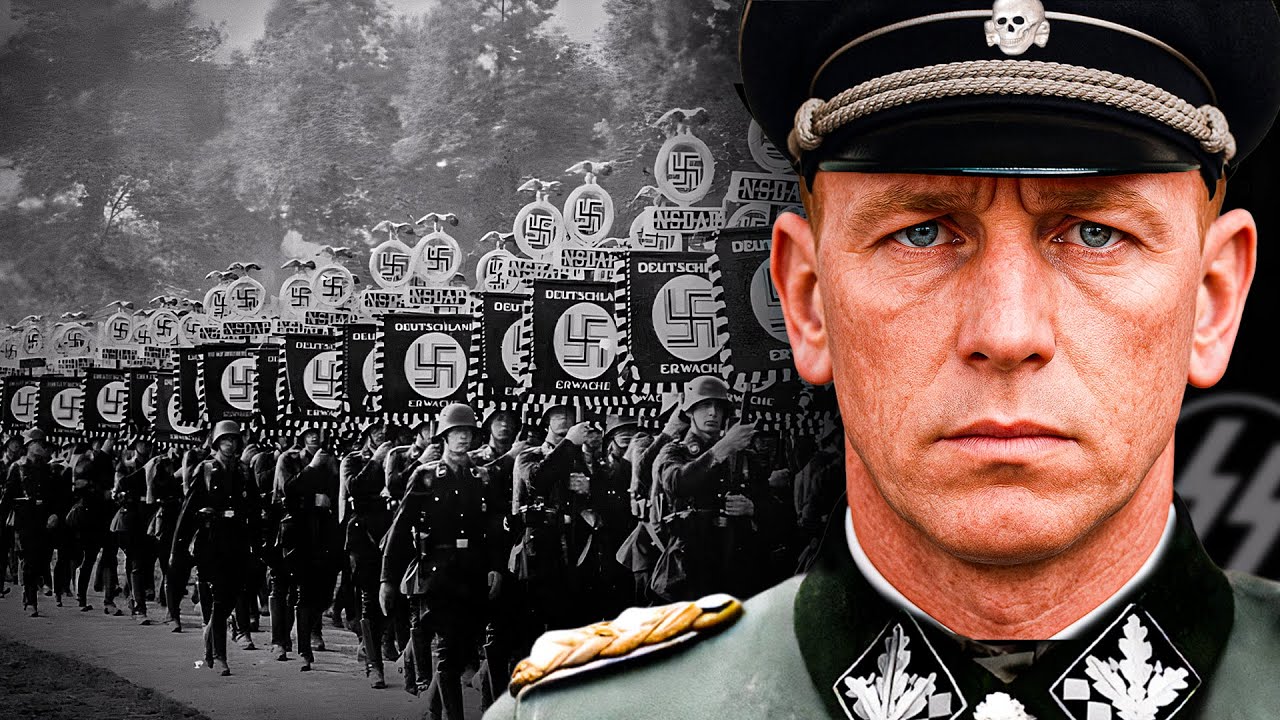
In May 1945, the men who had once marched beneath Hitler’s banners were no longer marching.
They were running.
Some threw their uniforms into rivers. Some buried insignia beneath barns. Some shaved their heads, burned documents, exchanged military boots for stolen civilian shoes, and began walking west with columns of refugees.
Others did not get that far.
They were stopped at roadblocks, ordered to raise their hands, searched for the small blood-group tattoo that many SS men carried beneath the left arm, and pushed behind barbed wire.
Only weeks earlier, they had belonged to one of the most feared military formations in Europe.
Now they stood in mud.
There were no speeches. No bands. No black-and-silver mythology. No portraits of Adolf Hitler watching from headquarters walls.
There were only Allied guards, registration cards, lice, hunger, and the same question repeated from one prisoner to the next:
“Name?”
“Rank?”
“Unit?”
And then the question that could change everything:
“SS?”
For the men of the Waffen-SS, surrender did not simply mean defeat.
 It meant that the organization to which they had sworn loyalty was collapsing around them—and that the world was beginning to ask whether they had been soldiers, criminals, or both.
The answer would not be decided in one courtroom.
It would be fought over for nearly half a century.
And the most dangerous battle would begin only after the shooting stopped.
Germany had become a landscape of ruins.
Railway stations were roofless shells. Bridges ended in open air. Entire blocks had been burned into geometric fields of brick. Millions of soldiers were dead, missing, wounded, or imprisoned. Millions of civilians were displaced.
The Third Reich, which had promised to last a thousand years, had survived twelve.
Adolf Hitler was dead.
Berlin had fallen.
On May 8, 1945, Germany’s unconditional surrender ended the war in Europe.
Across the continent, formations of the Waffen-SS disintegrated.
The Waffen-SS had grown from Hitler’s armed SS formations into a vast multinational force. Its units fought beside the German army on nearly every major front. Its recruiters had sold an image of racial superiority, ideological devotion, elite discipline, and absolute loyalty.
But the mythology of the “elite warrior” concealed something darker.
Waffen-SS formations had not operated in a separate moral universe from the rest of the SS system. Units and personnel were implicated in massacres, anti-partisan warfare, the murder of prisoners, deportations, racial persecution, and campaigns in which civilians were treated as enemies to be removed rather than people to be protected.
The International Military Tribunal would later describe the SS as an organization used for persecution, forced labor, concentration-camp administration, atrocities in occupied territories, and other crimes. The tribunal declared the SS criminal within defined limits, while excluding people who had been conscripted without knowledge of its criminal purposes and those who had not personally participated in criminal acts.
That distinction mattered.
But in the chaos of 1945, distinctions were difficult to make.
A twenty-year-old rifleman captured near Austria might insist that he had never seen a concentration camp.
A former officer might claim he had only followed military orders.
A clerk might say he had typed reports but never asked what the numbers meant.
A guard might swear he had never fired his weapon.
And somewhere else, survivors were identifying men who had burned villages, selected prisoners, shot civilians, or watched others do it.
Every uniform contained a biography.
Every biography contained omissions.
The Allies now had to sort through hundreds of thousands of them.
 In the temporary camps, rumors moved faster than official information.
One morning, prisoners heard that every SS man would be shot.
By afternoon, someone claimed they would all be sent to Siberia.
The next day, another man whispered that ordinary soldiers would be released within weeks, while officers would disappear forever.
No one knew what to believe.
The prisoners watched guards remove certain men from the compounds.
Sometimes the names had come from captured records.
Sometimes from interrogations.
Sometimes from witnesses.
A former company commander would be called to the gate and never return. A medical orderly might be questioned for three hours and sent back. A young conscript might spend months waiting while officials tried to determine whether he had volunteered, been drafted, or lied about both.
The physical conditions varied from camp to camp, but uncertainty was universal.
Men slept beneath tents or open skies. Food was limited. Disease spread easily. Letters arrived slowly, if at all.
Some prisoners had families who believed they were dead.
Some had no homes left.
Some had homes but feared returning to them.
For the Waffen-SS, the name itself had become evidence.
Not proof of every individual crime—but enough to ensure suspicion.
The men who had once expected civilians to step aside now stood in queues waiting for permission to use a latrine.
The change in power was total.
Yet even behind the wire, a second struggle had already begun.
It started with language.
“We were front-line troops.”
“We were not camp guards.”
“We were soldiers like the others.”
“We fought the Red Army.”
“We knew nothing.”
The phrases were repeated so often that they began to sound less like individual defenses and more like the first draft of a collective story.
At that stage, however, the prisoners had little control over how history would judge them.
The judges were gathering in Nuremberg.
 The courtroom at Nuremberg was not designed to settle the guilt of every former SS member.
It was built to prosecute the leadership of the Nazi system and establish a legal record of crimes that had been committed on a continental scale.
The evidence was overwhelming.
Documents carried signatures.
Orders revealed chains of command.
Films showed camps after liberation.
Witnesses described deportations, mass shootings, slave labor, medical experiments, starvation, and murder.
The defendants could not dismiss the catastrophe as enemy propaganda. Much of the evidence had been created by the Nazi state itself.
On September 30 and October 1, 1946, the International Military Tribunal delivered its judgments. The SS was declared a criminal organization as defined by the tribunal, although the judgment carefully limited automatic culpability. Membership alone did not make every person guilty of every crime; knowledge, voluntary membership, and personal involvement remained important considerations.
That legal qualification was essential to justice.
It would also become a doorway.
Former SS men and their advocates would later widen that narrow legal distinction into a much larger public claim: that the Waffen-SS as a fighting force had been fundamentally separate from the crimes of the SS.
It was a claim simple enough to fit into a speech.
Simple enough to print in a veterans’ magazine.
Simple enough to repeat until a generation began to believe it.
But in 1946, the immediate consequences were harsher.
The SS was dissolved.
Its symbols were banned.
Senior officers faced investigation, imprisonment, or trial.
Former members passed through denazification procedures intended to classify their responsibility. Depending on the occupation zone and the evidence available, individuals might be categorized as major offenders, offenders, lesser offenders, followers, or exonerated persons.
The process was ambitious.
It was also inconsistent, overloaded, politically pressured, and eventually reshaped by the realities of the emerging Cold War.
There were too many files.
Too few investigators.
Too many destroyed records.
Too many witnesses scattered across Europe.
And millions of Germans whose participation in Nazi institutions existed somewhere between ideological commitment, careerism, coercion, conformity, opportunism, and crime.
The Allies wanted justice.
But they also needed a functioning society.
Those two objectives did not always point in the same direction.
By 1949, the Federal Republic of Germany had been established in the western occupation zones.
The new state inherited more than bombed cities.
It inherited compromised institutions, wounded families, displaced populations, political extremism, economic collapse—and a vast number of men who had served the defeated regime.
Some had been committed Nazis.
Some had joined because military service was expected.
Some had been teenagers when recruited.
Some had committed crimes.
Some had witnessed crimes and remained silent.
Some had spent years convincing themselves that silence meant innocence.
All of them returned to a country that needed workers, fathers, technicians, policemen, administrators, voters, and taxpayers.
West Germany could not rebuild while permanently excluding every person who had worn a Nazi uniform or held a position under the dictatorship.
But inclusion created another danger.
The practical language of reintegration could become the moral language of absolution.
A man might reasonably argue that his children should not starve because of his former uniform.
Then he might argue that he deserved the same pension as an ordinary soldier.
Then that his unit had been unfairly defamed.
Then that the crimes attributed to it had been committed by someone else.
Then that the evidence had been exaggerated.
Then that the real victims were the defeated veterans themselves.
Each step was small.
Together, they could reverse the direction of memory.
This was the environment in which the former Waffen-SS discovered that defeat had not removed every source of power.
They still had numbers.
They still had networks.
They still had former commanders.
And in a democracy, they now had something they had not needed under Hitler:
Votes.
In 1951, former Waffen-SS officers helped establish an organization known by the initials HIAG.
Its full German name was Hilfsgemeinschaft auf Gegenseitigkeit der Angehörigen der ehemaligen Waffen-SS—roughly, the Mutual Aid Association of Former Waffen-SS Members.
On paper, the mission appeared understandable.
Former soldiers needed help finding work.
Families needed assistance.
Prisoners wanted legal support.
Disabled veterans sought pensions.
Widows wanted recognition.
But HIAG was never only a welfare organization.
Its leadership pursued legal rehabilitation, financial equality, political influence, and something even more powerful:
Control over the story.
Former senior Waffen-SS figures became speakers, organizers, authors, and lobbyists. They held meetings, contacted politicians, built regional associations, supported veterans, and published material presenting the Waffen-SS as a conventional military formation unfairly burdened with the crimes of other branches of the SS.
Its central message was carefully designed.
The Waffen-SS, it insisted, had been a front-line army.
Its men had fought and died like other soldiers.
The concentration camps belonged to another system.
The mass shootings were someone else’s responsibility.
Crimes committed by particular individuals should not stain the entire force.
The argument contained just enough legal distinction to sound credible.
That was its strength.
HIAG’s objective was not merely to say, “No Waffen-SS member committed a crime.” Such a claim would collapse immediately under the evidence.
The more sophisticated claim was this:
The crimes were exceptions.
The institution was honorable.
The veterans had been slandered.
The organization had been misunderstood.
HIAG repeatedly promoted the image of Waffen-SS veterans as “soldiers like any other,” while campaigning for material and moral rehabilitation. Historians and memorial institutions have since characterized the organization’s output as revisionist apologetics that obscured the Waffen-SS’s integration into the wider SS system.
The campaign worked because it did not begin with battlefield nostalgia.
It began with human need.
A widow at a government office.
A disabled veteran without a pension.
A former prisoner unable to find employment.
A family asking why service in one German formation qualified for benefits while service in another did not.
Those cases were emotionally powerful.
HIAG placed them in front of the public.
Then, almost invisibly, it tied social relief to historical rehabilitation.
To give the veteran a pension, the audience was encouraged to respect his service.
To respect his service, it was encouraged to separate his unit from Nazi crimes.
To separate his unit from those crimes, it had to ignore how the Waffen-SS had been recruited, indoctrinated, commanded, and deployed.
The welfare case became the historical argument.
The historical argument became the political weapon.
Konrad Adenauer, West Germany’s first chancellor, faced an impossible-looking calculation.
His government needed stability.
It needed loyalty to the new democratic state.
It needed to reduce the number of alienated veterans who might drift toward extremist politics.
It needed to rebuild West Germany while negotiating sovereignty, rearmament, and integration with the Western alliance.
The Soviet Union was no longer merely a wartime ally.
It was now the principal adversary of the West.
And suddenly, men who had fought the Red Army could present themselves not as defeated servants of Hitler, but as experienced anti-communist soldiers.
The Cold War changed the temperature of the room.
Questions that had seemed morally settled in 1945 were reopened under the pressure of strategy.
Politicians who would never publicly praise the SS could still argue that younger or lower-ranking veterans should not remain permanent outcasts.
Adenauer and other conservative figures supported forms of reintegration, and Adenauer publicly used language that former Waffen-SS advocates would eagerly exploit—the claim that many Waffen-SS men had been soldiers like others. That phrase later became central to the veterans’ campaign and even appeared in the title of a book by former Waffen-SS commander Paul Hausser.
For HIAG, this was more valuable than money.
It was legitimacy.
A sentence spoken by a democratic chancellor could be removed from its political context, printed, repeated, and transformed into moral certification.
At veterans’ meetings, men who had spent years under suspicion could now point toward Bonn and say:
“Even the government recognizes what we were.”
But the government had not declared the Waffen-SS innocent.
It had tried to solve a social and political problem.
HIAG blurred that difference.
Again and again.
At first, the group’s demands appeared limited.
Equal treatment for wounded veterans.
Pensions for dependents.
Release or review of imprisoned soldiers.
The right to organize.
Then came the books.
The speeches.
The reunions.
The articles.
The carefully selected battlefield memories.
Readers encountered stories of endurance, comradeship, sacrifice, and military skill. They read about tanks, encirclements, frozen trenches, and desperate retreats.
What they encountered far less often were the villages.
The prisoners.
The Jews.
The civilians.
The police operations.
The anti-partisan campaigns in which entire communities could be labeled hostile.
The machinery of occupation in which “military necessity” repeatedly became a license for atrocity.
Silence did not erase those things.
But it changed the emotional center of the narrative.
The veteran became the victim.
His defeat became the tragedy.
His lost comrades became the principal dead.
And the people who had suffered beneath the SS vanished beyond the edge of the page.
By the late 1950s and early 1960s, HIAG had become more than a circle of old men remembering the front.
It had contacts.
Publications.
Regional branches.
Political access.
Thousands of members.
A disciplined message.
Its representatives understood something that many of their opponents did not:
People rarely accept historical revision because they are handed a complete lie.
They accept it through fragments of truth arranged to conceal the whole.
Yes, some Waffen-SS men had been conscripted.
Yes, not every member committed a war crime.
Yes, many fought conventional battles.
Yes, legal guilt had to be individual.
Each statement could be defended.
But HIAG used those statements to invite a conclusion that did not follow:
Therefore, the Waffen-SS itself was merely an army.
Therefore, its institutional connection to the racial and political project of the SS was irrelevant.
Therefore, the organization’s veterans deserved not only civil reintegration, but restored honor.
That was the maneuver.
And for a time, it succeeded.
Certain former Waffen-SS members recovered pension rights. A very limited number were accepted into the newly formed Bundeswehr after screening, though the new military placed restrictions on the admission of former senior Waffen-SS personnel.
The Federal Republic wanted a democratic army.
It also needed experienced officers and soldiers.
Every appointment produced unease.
A man might know how to command a battalion.
But what had he believed while doing it?
Had he served Germany?
Hitler?
The SS order?
His comrades?
His own career?
Could military competence be separated from ideological formation?
And who had the right to decide when the documents were incomplete and witnesses were dead?
The country’s institutions often answered with compromise.
The public answered with division.
Veterans’ supporters saw overdue fairness.
Survivors saw betrayal.
Families of Nazi victims watched former members of a criminal organization campaign for pensions, recognition, and respectability while many victims struggled for compensation, acknowledgment, or even an audience willing to hear them.
At public meetings, HIAG speakers talked about honor.
Outside, protesters carried photographs.
Inside, veterans remembered fallen comrades.
Outside, survivors remembered murdered relatives.
Both sides spoke of the dead.
But only one side had spent years trying to remove the victims from the story.
The most effective HIAG speakers did not behave like fanatics.
They wore suits.
They used legal language.
They spoke of reconciliation.
They condemned “collective guilt.”
They insisted they opposed dictatorship.
They presented themselves as men asking only for fairness.
That moderation was strategic.
A shouting Nazi could be dismissed.
A decorated veteran speaking calmly about his disabled comrades could be invited into parliament offices.
Former Waffen-SS commander Paul Hausser became a major advocate of the claim that the Waffen-SS had been an apolitical military force.
Kurt Meyer, another prominent former commander and a convicted war criminal, became an influential HIAG spokesman.
Their wartime ranks gave them authority among veterans.
Their postwar language gave them access to democratic society.
The transformation was astonishing.
Men who had once served in an organization built around obedience to Hitler now invoked civil rights.
Men whose formations had participated in a war of conquest now described themselves as defenders against political discrimination.
Men who had belonged to an ideological military order presented ideology as an accusation invented by their enemies.
And the public, exhausted by war and eager for normal life, sometimes accepted the simpler version.
It was easier to believe that a small circle of monsters had committed all the crimes.
Hitler.
Himmler.
The Gestapo.
Camp commandants.
A few sadistic officers.
If evil could be confined to a small group, then millions of ordinary lives could continue without unbearable questions.
What had the neighbors known?
Who had taken the deported family’s apartment?
Who had bought their furniture?
Who had signed the orders?
Who had guarded the trains?
Who had passed through burning villages and asked nothing?
Who had returned home and told his children only about hunger, snow, and comradeship?
The myth of the isolated criminal protected more than the Waffen-SS.
It protected a society from examining how widely dictatorship had depended on participation.
Then the generation changed.
Children who had grown up among ruins became university students.
Young Germans looked at their fathers and teachers and began asking questions that the older generation had postponed.
What did you do during the war?
What did you know?
Why was this judge once a Nazi official?
Why was this professor’s biography missing six years?
Why did this police commander serve in occupied territory?
Why are the veterans speaking about honor while the victims are still explaining why they deserve compensation?
The silence that had protected postwar stability began to feel like complicity.
Trials brought crimes back into public view.
Journalists investigated.
Historians challenged self-serving memoirs.
Archives opened.
Documents were compared against veterans’ claims.
Units that had been described as purely military appeared in records of shootings, reprisals, deportations, village destruction, forced labor, and racial warfare.
The neat boundary between the “military Waffen-SS” and the “criminal SS” began to collapse.
Not because every man had done the same thing.
They had not.
Not because individual guilt no longer mattered.
It did.
The boundary collapsed because the institution had never been as separate as its defenders claimed.
Personnel moved between branches.
Ideological training connected them.
Command structures overlapped.
Waffen-SS units cooperated with police and security organizations.
Men who fought at the front could later guard prisoners, participate in occupation operations, or assist campaigns against civilians.
The SS was not a collection of sealed compartments.
It was a system.
The Bundesarchiv today describes the SS as an instrument of Hitler and the Nazi Party used to secure their rule and suppress opponents, while Nuremberg records document the SS leadership’s goal of building a tightly organized ideological elite.
For years, HIAG had depended on the audience looking at one photograph at a time.
A soldier in camouflage.
A burned tank.
A field grave.
A group of exhausted prisoners.
The new historians placed those photographs beside organizational charts, orders, transport records, operational reports, and testimony.
The picture changed.
And once it changed, the old speeches began to sound different.
At a veterans’ gathering, an elderly former officer could still speak about loyalty.
But now someone in the audience might know the name of the village where his unit had operated.
A memoir could still describe a “security action.”
But a historian might find the casualty report.
A speaker could still claim that his men had fought only armed partisans.
But local records might list women and children among the dead.
The mythology did not collapse in one dramatic revelation.
It cracked under accumulation.
One document.
Then another.
A witness statement.
A court file.
An order signed in familiar handwriting.
A personnel transfer showing that the supposed wall between “military” and “political” SS functions had been crossed repeatedly.
The most devastating evidence was often not theatrical.
It was administrative.
A date.
A unit number.
A signature.
A train schedule.
A report written in sterile language describing human beings as security problems.
HIAG’s leaders had understood the emotional power of memory.
Historians answered with the stubborn power of records.
This was the first great reversal.
The veterans had claimed that history was persecuting them.
Now history was asking them to explain the files.
The second reversal was even more painful.
HIAG had tried to portray itself as the defender of ordinary, low-ranking soldiers.
But its public face was dominated by former senior officers—men whose careers and authority depended on preserving the reputation of the institution they had commanded.
The organization’s message was not written from the bottom upward.
It was managed from the top downward.
Former generals spoke in the name of young conscripts.
Convicted figures presented themselves as victims of victor’s justice.
Publishers produced narratives that emphasized battlefield courage while minimizing institutional crime.
Veterans repeated the language.
Families inherited it.
Popular military books carried it to readers who knew the names of tanks but not the names of destroyed communities.
HIAG did provide practical assistance to former members.
That fact gave its mythology credibility.
A man who helped a widow obtain benefits could appear compassionate.
A leader who visited a wounded veteran could appear honorable.
But compassion within a closed community does not erase responsibility toward those outside it.
Loyalty to comrades can be a virtue.
It can also become a wall against truth.
HIAG’s central moral trick was to treat any criticism of the Waffen-SS as an attack on every individual veteran.
That made honest discussion nearly impossible.
If a historian documented crimes, HIAG could accuse him of insulting the dead.
If a survivor described a massacre, advocates could demand proof against each individual soldier.
If a politician questioned a reunion, veterans could frame the issue as discrimination.
The institution hid behind the individual.
The individual hid behind the institution.
Responsibility moved in a circle until no one seemed to hold it.
By the 1970s and 1980s, the political environment had shifted.
The Holocaust occupied a larger place in public consciousness.
Research into Nazi crimes expanded.
New generations were less willing to accept veterans’ accounts as the final word.
Mainstream politicians became increasingly cautious about association with organizations that defended the reputation of the Waffen-SS.
HIAG’s image hardened.
What had once been presented as social advocacy appeared increasingly connected to historical revisionism and the radical right.
The polished language remained.
But its effect was weakening.
The organization’s publications continued.
Reunions continued.
Local networks survived.
Yet the audience beyond the circle had changed.
A democratic society that once prioritized silence for the sake of reconstruction was learning that silence carried its own danger.
Germany’s postwar success had depended partly on reintegration.
Its democratic maturity would depend on something harder:
Reintegration without falsification.
A former soldier could live as a citizen.
He could work.
Raise children.
Receive legal protection.
Challenge unjust treatment.
But he did not have the right to demand that society alter the historical record to make his past more comfortable.
That distinction became clearer with time.
Civil rights were not medals.
Pensions were not declarations of innocence.
Reentry into society was not the restoration of military honor.
And forgiveness, where it was possible, could not be built on denial.
The federal HIAG organization dissolved in 1992.
It did not disappear because every veteran changed his mind.
It did not disappear because the argument had been permanently defeated.
Local groups and associated publications continued beyond the federal organization’s end, and the narratives HIAG promoted survived in memoirs, popular histories, enthusiast communities, and later on the internet. HIAG’s federal structure ended in 1992, but regional activity and its publishing legacy persisted afterward.
That was the final plot twist.
HIAG lost its organization.
But parts of its story escaped.
The phrase “soldiers like any other” traveled farther than many of the documents that disproved it.
The clean, dramatic image of the Waffen-SS—camouflage uniforms, armored vehicles, desperate last stands—proved easy to package.
The truth was more difficult.
Truth required footnotes.
Different units.
Different dates.
Different degrees of personal responsibility.
It required holding two ideas at once:
Not every Waffen-SS member committed the same crimes.
And the Waffen-SS was not merely an ordinary, apolitical army.
Propaganda thrives where complexity becomes exhausting.
A photograph can defeat a page of explanation.
A heroic anecdote can overshadow a statistical record.
A veteran’s trembling voice can feel more immediate than the absent voices of people who did not survive to tell their stories.
HIAG understood this before many of its critics did.
It knew that whoever supplied the most emotionally satisfying version of the past could influence how the past was remembered.
Its leaders did not need to prove complete innocence.
They needed only to create doubt.
Enough doubt to make every document seem debatable.
Enough doubt to make every accusation feel political.
Enough doubt to persuade the public that certainty itself was unfair.
That strategy did not die in 1992.
It became a template.
After German reunification, access to additional archives and continued research further strengthened the historical understanding of the Waffen-SS as part of the Nazi system of ideological and racial warfare.
The old defensive architecture became harder to maintain.
Researchers could connect units to locations.
Locations to operations.
Operations to civilian deaths.
Personnel records to later testimony.
Claims of ignorance to documented training and orders.
The more complete the map became, the less convincing the myth of total separation appeared.
The Waffen-SS had indeed fought major conventional battles.
Its soldiers had indeed experienced fear, injury, hunger, and death.
Some had indeed been drafted.
Some had indeed been very young.
Those facts remained true.
But suffering does not automatically produce innocence.
A perpetrator can be afraid.
A member of a criminal system can love his family.
A soldier serving an unjust cause can show courage under fire.
Human qualities do not cancel political responsibility.
That is what made the story difficult.
The men were not fictional monsters.
They were human beings.
And human beings had built, maintained, defended, and later misrepresented the system.
Calling them monsters would make the lesson too easy.
Monsters belong outside society.
These men had neighbors.
Teachers.
Parents.
Children.
Careers.
They could behave tenderly at home and brutally in occupied territory.
They could remember a dead friend with genuine grief while refusing to speak about civilians killed by their unit.
They could tell the truth about one battle and lie about the war.
That contradiction was not an obstacle to understanding the Waffen-SS.
It was the center of it.
Decades after the war, memorial ceremonies connected to SS units or foreign Waffen-SS formations continued to generate controversy in parts of Europe.
In some countries, the historical memory became entangled with anti-Soviet nationalism.
People whose communities had suffered under Stalinist rule sometimes elevated wartime formations that had fought the Soviet Union, minimizing or denying their participation in Nazi structures and crimes.
The logic was seductive:
They fought Moscow.
Therefore, they fought for freedom.
But history does not become innocent simply because an enemy was also criminal.
Nazi Germany and Stalin’s Soviet Union could both commit enormous crimes.
Opposing one dictatorship did not automatically make a person a democrat.
Wearing the uniform of one murderous system was not cleansed by fighting another.
Yet public memory often prefers heroes with uncomplicated biographies.
So symbols were reinterpreted.
Uniforms were detached from institutions.
Local nationalism replaced Nazi ideology in commemorative speeches.
The dead were presented as patriots.
The victims became inconvenient.
Again, the same technique appeared:
Select one part of the story.
Remove the surrounding structure.
Repeat until the fragment replaces the whole.
There is a photograph from nearly every defeated army in history that can inspire sympathy.
A young prisoner.
A tired face.
A torn uniform.
A letter from home.
A man standing behind wire, uncertain whether he will see his family again.
Such images matter.
Human dignity does not vanish because a state loses a war.
Prisoners must be treated lawfully.
Guilt must be proven individually.
Collective revenge is not justice.
The Nuremberg judgment itself recognized that principle when it limited the scope of criminal membership and excluded those who had been conscripted without knowledge and had not participated in crimes.
But sympathy becomes dangerous when it is used as an eraser.
The suffering of a defeated soldier cannot erase the suffering inflicted by the organization he served.
His fear in captivity cannot erase the terror experienced by civilians under occupation.
His hunger in 1945 cannot erase the starvation imposed on prisoners and persecuted populations.
Both histories can be true.
Only one should not be used to bury the other.
That was the line HIAG repeatedly crossed.
It began with a legitimate question:
How should a democracy reintegrate former soldiers?
It answered with an illegitimate demand:
By accepting their preferred version of the past.
Imagine, then, one former Waffen-SS man sitting at a kitchen table in West Germany.
It is 1955.
His children are asleep.
A pension form lies before him.
Beside it is a veterans’ newsletter.
The form asks for dates, units, ranks, wounds.
The newsletter offers something the form cannot.
It tells him who he was.
Not a servant of a criminal regime.
Not a member of an ideological organization.
Not a witness who might have ignored too much.
A soldier.
A victim of defeat.
A loyal comrade misunderstood by history.
He reads the words again.
They relieve him of a burden he has never described to his family.
Years later, his son asks what happened in the East.
He repeats the newsletter.
His grandson later reads a memoir published through the same network.
He repeats the story at school.
The original man eventually dies.
But the explanation remains alive.
This is how historical revision works.
Not always through screaming speeches.
Sometimes through relief.
Sometimes through family loyalty.
Sometimes through the understandable desire of a child to believe that his father was honorable.
The lie survives because the truth feels like betrayal.
Now imagine another table.
A survivor sits with a compensation form.
She must prove that her property was taken.
Prove that she was imprisoned.
Prove that her relatives existed.
Prove that they died.
The government requests documents from a system that tried to erase them.
She reads newspaper reports about veterans demanding honor.
She sees former officers speaking publicly.
She watches men who served the regime organize conferences, publish books, and gain access to politicians.
Her own testimony is questioned.
Their memories are called tradition.
That imbalance explains why the debate was never merely about pensions.
It was about whose suffering the new Germany would place at the center of its moral universe.
The veterans had associations.
The dead had archives.
The veterans had speakers.
The murdered had witnesses growing older each year.
The veterans could revise their memoirs.
The victims could not return to correct them.
By the time HIAG dissolved, the faces at its meetings had aged.
The military posture remained in some men.
So did the old ranks, though democratic society no longer recognized them.
Photographs showed grey hair, medals, wreaths, flags, and carefully maintained rituals of comradeship.
But the power had shifted.
Once, the Waffen-SS had possessed weapons, territory, prisoners, and command.
Then its veterans possessed political leverage and a coordinated public narrative.
Finally, they faced a generation of researchers, journalists, students, survivors, and citizens unwilling to let memory be governed by those with the strongest reason to distort it.
The moment of recognition did not happen in one room.
There was no single former commander whose face suddenly collapsed before the entire country.
It happened gradually.
A politician declined an invitation.
A newspaper stopped describing a reunion as an ordinary veterans’ event.
A historian presented a document that could not be explained away.
A television audience saw testimony that contradicted decades of self-defense.
A younger relative found a name in an archive.
A local ceremony drew protesters instead of applause.
The old speakers looked into crowds that no longer responded as expected.
They paused.
Their jaws tightened.
Their eyes moved from the podium to the signs held outside.
The silence had changed sides.
For decades, the victims had been forced into silence while the veterans explained themselves.
Now the veterans’ explanation was being interrupted by evidence.
The last victory of the Waffen-SS was not military.
It was the temporary success of a story.
A story in which ideology vanished from the uniform.
A story in which criminal operations became isolated incidents.
A story in which senior officers spoke for ordinary conscripts.
A story in which demands for financial support became proof of historical innocence.
A story in which the perpetrators’ memories felt more personal, more vivid, and therefore more believable than the records of their victims.
But stories have consequences.
A false story can influence pension laws.
Military culture.
Political alliances.
Family memory.
Popular entertainment.
National identity.
It can turn symbols of oppression into objects of fascination.
It can make documentation look like hostility.
It can teach people that any uncomfortable fact may be dismissed as propaganda if enough voices repeat the denial.
That is why the fate of the Waffen-SS after 1945 matters.
Not because its veterans remained uniquely powerful forever.
They did not.
Not because every former member shared the same guilt.
They did not.
It matters because their postwar campaign revealed how quickly a defeated institution can reorganize itself around victimhood.
First, it asks for mercy.
Then equality.
Then respect.
Then innocence.
Then admiration.
And if society forgets the order in which those demands appeared, rehabilitation can become glorification before anyone notices the difference.
The ruins of 1945 were eventually cleared.
Cities were rebuilt.
Children grew up.
Governments changed.
Archives opened.
Veterans died.
Organizations dissolved.
Yet the argument did not disappear, because the argument had never been only about the Waffen-SS.
It was about the ownership of memory.
Who gets to describe the past?
The person who lived through it?
The person who survived it?
The person who signed the document?
The historian who finds it decades later?
The child who wants to defend a parent?
The nation that wants to preserve a heroic identity?
Every generation inherits history twice.
First as evidence.
Then as temptation.
The evidence says: this happened.
The temptation says: tell it in a way that hurts less.
Germany’s confrontation with the Waffen-SS showed how dangerous that temptation could become.
A democracy may need to reintegrate people who served a dictatorship.
It may reduce sentences, restore civil rights, provide pensions, and allow former enemies to build peaceful lives.
But it must never confuse reintegration with exoneration.
A society can permit a man to begin again without allowing him to rewrite where he began.
That is the justice HIAG spent decades trying to escape.
And it is the lesson that survived after HIAG was gone:
The most dangerous uniform is not always the one a man wears into battle—it is the one history allows him to remove without ever asking what he did while wearing it.


