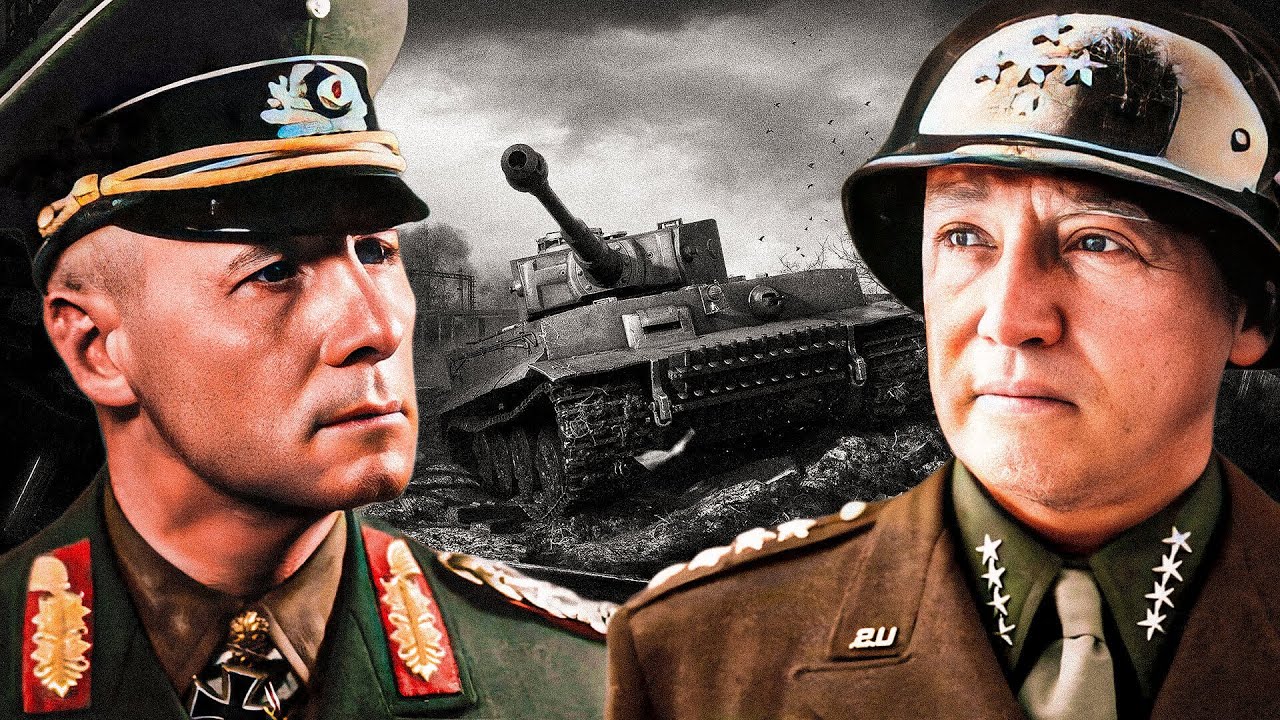
The strangest compliment George S. Patton ever received may have come from the men whose armies he was trying to destroy.
To German officers trained in a military tradition that worshipped speed, initiative, encirclement, and relentless offensive movement, Patton sometimes looked disturbingly familiar.
He was American.
But he fought in a way they understood.
He pushed armored columns forward before exhausted headquarters staffs were ready. He hated giving an enemy time to recover. He accepted risks that made more cautious commanders uncomfortable. He believed that a confused enemy should be made more confused, that a retreating enemy should never be allowed to breathe, and that momentum could sometimes accomplish what perfect planning could not.
Years later, German General Günther Blumentritt would describe Patton as an Allied commander who came unusually close to the German conception of the aggressive, classical battlefield leader. Alfred Jodl reportedly compared him to Heinz Guderian, the German armored-warfare pioneer: bold, willing to make great movements, willing to take great risks for great results.
But here is where the story becomes more complicated.
The Germans did not admire every Allied commander.
They did not even agree about the ones they feared.
Some British leaders were considered dangerously professional but maddeningly cautious. Soviet commanders were initially dismissed through a toxic mixture of arrogance, ideological hatred, and racist fantasy—only to become the architects of disasters that shattered entire German armies.
And Patton?
Even Patton divided opinion.
Some Germans saw a commander who understood mobile warfare instinctively.
Others saw something less flattering: a brilliant battlefield accelerator whose appetite for movement occasionally outran the larger strategic purpose.
The difference matters.
Because when you study what German commanders said about their Allied opponents, you discover that their judgments reveal almost as much about Germany as they do about the Allies.
They reveal what German officers valued.
What they underestimated.
 What frightened them.
And eventually, what destroyed them.
In the beginning, however, many of those judgments were dangerously confident.
Germany had watched Poland collapse in weeks.
It had watched France—a nation with one of the largest armies in Europe—fall with breathtaking speed in 1940.
German armored formations had broken through positions that many Allied officers believed could contain them. Tanks, infantry, artillery, engineers, aircraft, radio communications and aggressive lower-level initiative were combined into operational blows whose psychological effect sometimes exceeded their physical strength.
The image of unstoppable German “Blitzkrieg” was born.
And success created something more dangerous than confidence.
It created certainty.
Inside Germany’s military leadership grew the belief that many enemies simply did not think quickly enough.
They waited.
They coordinated.
They requested permission.
They built elaborate plans.
German commanders maneuvered.
That distinction was never as absolute as postwar mythology would make it appear, but on the battlefields of 1939 and 1940, it seemed convincing enough.
Then an American cavalryman turned tank commander appeared.
George Smith Patton Jr. was not subtle.
He carried himself like a man who believed every room was already a battlefield.
 His uniforms were immaculate. His pistols were conspicuous. His language was profane. His speeches were theatrical. His belief in offensive action bordered on obsession.
He wanted soldiers moving.
Vehicles moving.
Fuel moving.
Headquarters moving.
Everything moving.
Patton detested the psychology of the foxhole because, to him, a foxhole symbolized surrendering initiative to the enemy.
Stories accumulated around that belief, some reliable, some polished by legend.
One image in particular captured his attitude better than any staff memorandum could.
Patton treated static defensive positions with almost comic contempt.
A hole in the ground was useful, perhaps, for surviving shellfire.
But wars were not won by remaining inside holes.
They were won, in Patton’s worldview, by making the other man abandon his.
That attitude sounded strangely familiar to German officers.
Their own military education had long emphasized initiative, movement and the exploitation of opportunity. A commander who waited for perfect information might discover that the opportunity had already disappeared.
Patton believed almost the same thing.
That was why some German officers recognized something in him.
Not nationality.
Not politics.
Temperament.
He was, in the memorable shorthand later attached to him, something like a German-style commander wearing an American uniform.
Yet admiration did not mean agreement.
And that is the first mistake people make when they repeat the legend of Patton.
They imagine the Germans sitting in command posts whispering his name like frightened children hearing about a monster in the dark.
Reality was more interesting.
 German officers could respect Patton’s aggression while questioning whether aggression alone made a great strategist.
The distinction between tactical brilliance and strategic wisdom haunted Patton’s entire reputation.
On the battlefield, his strengths were obvious.
He could generate momentum.
He could restore confidence.
He could make formations move farther and faster than exhausted men believed possible.
He understood that mechanized warfare punished hesitation.
But strategic command required something else.
Coalition politics.
Logistics.
National objectives.
Prioritization across entire theaters.
The ability to know not only how to attack—but whether the attack served the larger war.
Patton occasionally struggled with that boundary.
Sicily exposed both versions of the man.
In 1943, American and British forces invaded the island.
The campaign contained difficult terrain, stiff resistance, arguments over priorities and a rivalry between commanders that history has never completely separated from personality.
Patton drove aggressively toward Palermo and later Messina.
His advance produced dramatic results.
It also produced questions.
Was every movement operationally necessary?
Or had competition, prestige and Patton’s obsession with forward motion influenced decisions that should have been evaluated more coldly?
That criticism mattered because the German military tradition Patton resembled had its own fatal weakness.
Movement could become intoxicating.
Operational brilliance could hide strategic emptiness.
A commander could win remarkable battles while his country lost the war.
Germany was about to prove that on a continental scale.
Patton would come dangerously close to proving it on smaller ones.
And then came the moment when his enemies’ respect became a weapon against them.
Not metaphorically.
Literally.
Before the Allied invasion of France in 1944, German intelligence desperately tried to answer one question:
Where would the main blow fall?
Normandy was possible.
But Pas-de-Calais was closer to England, geographically logical and heavily defended precisely because German planners considered it an obvious invasion route.
The Allies decided to nourish that belief.
They created an imaginary formation: the First United States Army Group.
Fake units.
Controlled radio traffic.
Deception networks.
Visual activity.
An army that existed largely in the minds of German intelligence officers.
And then the Allies gave that imaginary army a commander the Germans could believe would lead the decisive attack.
George Patton.
That was the trap.
Patton’s reputation—partly earned through battlefield performance, partly amplified by his enormous personality—made the deception more convincing.
If the Allies were preparing their most important invasion, German analysts could reason, why wouldn’t they involve one of their most aggressive armored commanders?
When Allied troops landed in Normandy on June 6, 1944, German commanders therefore faced an agonizing possibility.
What if Normandy was only the first move?
What if the real invasion was still coming?
What if Patton was waiting across the Channel?
The deception helped sustain German concern about Pas-de-Calais after the Normandy landings, contributing to the retention of forces that might otherwise have been committed elsewhere.
Think about the irony.
Patton did not need to attack.
His reputation attacked for him.
The Germans feared what he might do so much that the Allies could exploit the possibility of his presence.
The man became a phantom army.
And the phantom helped protect a real one.
But Patton was only one part of the German psychological map of its enemies.
The British occupied an entirely different place.
German assessments of British soldiers and British commanders were frequently contradictory.
There was grudging respect for professionalism.
Respect for discipline.
Respect for the ability of British formations to continue functioning under pressure.
But German officers also complained about what they considered excessive caution in British command.
Later popular culture would compress this attitude into the famous phrase “lions led by donkeys.”
It is a magnificent phrase.
It is also historically dangerous.
The expression is primarily associated with arguments about British leadership during the First World War, and its precise origins and fairness have long been disputed. It should not simply be placed in Erwin Rommel’s mouth as though he delivered a neat verdict on British commanders during the Second World War.
Yet the broader tension behind the cliché was real enough to matter.
German officers could respect the British fighting man while criticizing what they perceived as methodical or cautious leadership.
In North Africa, that perception became part of the mythology surrounding Rommel.
The desert campaign seemed designed to reward audacity.
Long distances.
Open flanks.
Supply columns stretched across enormous spaces.
Armor appearing where intelligence reports insisted it could not possibly be.
Rommel became famous for exploiting uncertainty.
British command, by contrast, sometimes appeared to German observers more deliberate.
But here came another trap.
Caution is not the same as weakness.
Method is not the same as cowardice.
And professionalism becomes particularly dangerous when it belongs to an enemy who refuses to collapse.
The Germans learned that Britain’s greatest strategic strength was not always brilliance in one spectacular battle.
It was continuity.
Britain survived 1940.
Its government did not negotiate surrender after France fell.
The Royal Air Force resisted the Luftwaffe.
The Royal Navy remained a global instrument of power.
The British Empire and Commonwealth provided manpower, bases, resources and strategic depth.
Then the United States entered the war.
Now Germany faced something more dangerous than a single aggressive commander.
It faced a coalition capable of absorbing mistakes.
That was something Germany could not do indefinitely.
Hitler himself repeatedly misunderstood Britain because his assessment was polluted by ideology.
Nazi racial doctrine encouraged fantasies about supposed racial hierarchies and imagined kinships among “Germanic” peoples. At the same time, Nazi antisemitism blamed Jews for political events through conspiracy theories that had no basis in reality. Nazi racial ideology was not a scientific analysis of power; it was a system of prejudice that distorted Germany’s understanding of both enemies and the world.
That distinction became strategically catastrophic.
If you believe your enemies are controlled by hidden racial conspiracies instead of responding to understandable political interests, you stop analyzing them accurately.
You begin arguing with a fantasy.
Hitler repeatedly hoped Britain might eventually accept a German-dominated Europe.
Britain did not.
The longer the war continued, the more disastrous that miscalculation became.
But compared with Germany’s judgment of the Soviet Union, the British misunderstanding was almost modest.
Because before Operation Barbarossa, German arrogance reached its most lethal form.
The Soviet Union was not merely considered an opponent.
Nazi ideology described entire populations in the East as racially inferior. Slavic peoples were targeted within a broader imperial vision in which Germans would dominate enormous conquered territories. Ideology transformed invasion into a racial war of annihilation.
Military assumptions became entangled with that racism.
The Red Army had performed badly in parts of the Winter War against Finland.
Stalin’s purges had devastated sections of the Soviet officer corps.
German intelligence underestimated Soviet reserves and industrial potential.
German commanders who had just defeated Poland, Norway, the Low Countries, France, Yugoslavia and Greece had powerful psychological reasons to believe another rapid campaign was possible.
On June 22, 1941, Germany invaded the Soviet Union.
At first, reality appeared to confirm every German prejudice.
Entire Soviet formations were encircled.
Hundreds of thousands of prisoners were captured.
German panzer groups drove extraordinary distances.
Maps in command headquarters showed arrows plunging deeper and deeper into Soviet territory.
The Soviet Union seemed to be disintegrating.
And then something happened that German planning had not adequately accounted for.
The Soviet Union kept producing armies.
Destroy one formation.
Another appeared.
Destroy that one.
Another appeared behind it.
German units advanced farther from their supply bases.
Roads deteriorated.
Railway gauges had to be converted.
Vehicles broke down.
Fuel disappeared into distances that looked harmless on maps.
Dust became mud.
Mud became frozen ground.
German planners had known Russia was large.
Knowing the number was not the same as understanding what the number meant.
A rapid-war doctrine that had worked brilliantly across smaller European theaters was now being tested against continental depth.
The deeper Germany advanced, the more victory seemed simultaneously closer and farther away.
Moscow remained unconquered.
Leningrad did not fall.
Soviet industry moved east.
Factories were dismantled, transported and rebuilt.
New tanks emerged.
New soldiers appeared.
New commanders learned.
Germany had assumed it was attacking a structure.
It discovered it was attacking a system capable of regeneration.
Even Hitler later acknowledged that Soviet war potential had been underestimated. U.S. Army historical studies based partly on German wartime experience explicitly noted the surprise produced by the scale of Soviet military capacity.
That was the second great twist of the war.
Germany had believed speed would compensate for Soviet size.
Instead, Soviet size gradually began consuming German speed.
Then came Stalingrad.
By 1942, Germany still possessed enormous offensive power.
The Wehrmacht pushed deep into southern Russia toward the Caucasus and the Volga.
Stalingrad became both a military objective and a symbol.
The name alone made the battle politically charged.
Hitler wanted it.
Stalin would not surrender it.
What followed became one of history’s most brutal urban battles.
Buildings became fortresses.
Factories became killing grounds.
Rooms changed hands.
Staircases became front lines.
A wall could separate two armies.
German forces proved terrifyingly effective.
But Soviet resistance did not disappear.
It hardened.
And while German attention focused on the city, Soviet planners prepared something much larger.
In November 1942, Soviet forces struck the weaker Axis armies guarding the German flanks.
The attacks broke through.
Soviet spearheads drove behind the German Sixth Army.
Then they met.
The ring closed.
For years German warfare had been associated with encirclement.
Now a German field army was inside one.
That was the recognition moment.
Not one theatrical second.
Not one general dropping a cigar onto a map.
Something worse.
A gradual realization spreading through headquarters, radio rooms, command posts and frozen positions.
The roads west were closing.
Fuel was insufficient.
Supplies were shrinking.
The Luftwaffe could not sustain the army at the necessary scale.
Relief was uncertain.
Hitler forbade withdrawal.
The army that had mastered movement had been ordered to remain still.
The civilization that had mocked Soviet military competence was watching Soviet armies coordinate an operation large enough to trap hundreds of thousands of Axis personnel in and around Stalingrad.
German soldiers had entered the Soviet Union believing they were participating in a short campaign.
Now they were eating reduced rations in frozen ruins while Soviet loudspeakers announced their isolation.
Imagine the psychological violence of that reversal.
For eighteen months, German propaganda had described the enemy as inferior.
Yet this supposedly inferior enemy had absorbed catastrophic losses, moved industries, rebuilt armies, learned from defeats and surrounded one of Germany’s most famous formations.
The prejudice did not disappear.
Many Nazis retained their racism until the end.
But battlefield reality forced professional soldiers to recognize qualities ideology said should not exist.
Endurance.
Adaptability.
Operational deception.
Camouflage.
Mass.
Artillery.
Increasingly sophisticated combined operations.
And above all, the ability to suffer losses that would have destroyed many other armies and still return to the battlefield.
Stalingrad was not the only cause of changing German perceptions.
But it made denial increasingly difficult.
The Sixth Army surrendered in early 1943.
Germany had lost more than troops.
It had lost the assumption that every crisis could be solved by another aggressive maneuver.
From that point onward, Soviet offensive power became increasingly impossible to dismiss.
Kursk followed.
Then the enormous Soviet offensives of 1944.
German units that once measured success by kilometers gained now measured survival by whether they could escape another encirclement.
U.S. Army studies of German experience in the East later emphasized how frequently German formations themselves ended up fighting while encircled as the strategic balance changed.
That reversal should be remembered because it reveals the central paradox of German military judgment.
German officers were often exceptionally skilled at identifying battlefield competence.
But recognizing competence was not the same as understanding the war.
They could look at Patton and see aggression.
They could look at British forces and see discipline.
They could look at Soviet soldiers and eventually see extraordinary resilience.
Yet Germany’s larger political and strategic system repeatedly failed to transform observation into rational policy.
Why?
Because Germany’s war was not being fought by professional soldiers in a political vacuum.
It was a Nazi war.
The regime’s ideology determined enemies, objectives and methods.
It encouraged contempt where sober analysis was necessary.
It transformed occupation into mass murder.
It turned potentially exploitable anti-Soviet sentiment in parts of Eastern Europe into hatred against German rule.
It created enemies faster than military victories could eliminate them.
And it pushed Germany into a coalition war against powers whose combined resources dwarfed its own.
That brings us back to Patton.
By the summer of 1944, he finally received the kind of battlefield Patton wanted.
After Allied forces broke out of Normandy, Patton’s Third Army raced across France.
The advance was spectacular.
German formations collapsed, retreated or tried desperately to escape encirclement.
Patton pushed.
Then pushed again.
His headquarters constantly fought the arithmetic of fuel.
Tanks without gasoline were simply expensive bunkers.
Trucks burned fuel to deliver fuel.
Every kilometer east stretched the supply system.
And Patton’s appetite for movement was almost limitless.
Here his greatest strength collided with the unromantic reality of industrial war.
Logistics.
Patton could demand speed.
He could inspire speed.
He could exploit speed.
He could not manufacture gasoline by force of personality.
That fact is crucial to understanding why the popular image of the solitary genius general is misleading.
No commander wins modern mechanized war alone.
Behind every armored thrust stands an invisible army.
Mechanics.
Truck drivers.
Engineers.
Railroad troops.
Quartermasters.
Signal personnel.
Depot workers.
Intelligence analysts.
Artillery crews.
Medical teams.
Factories thousands of miles from the battlefield.
Patton looked like the embodiment of individual will.
His victories were powered by an industrial civilization.
That was something Germany increasingly lacked.
The German army of 1944 still contained dangerous commanders and experienced troops.
Its armored vehicles could be formidable.
Its defensive tactics could impose terrible casualties.
But Germany was bleeding aircraft, fuel, trained crews, trucks and strategic freedom.
The Allies could lose a tank and replace it.
Germany increasingly could not.
The Soviet Union could destroy a German formation and return with another army.
Germany increasingly could not.
This is why German respect for Patton, however fascinating, should never distract from the deeper lesson.
Patton mattered.
But the coalition behind Patton mattered more.
Then December 1944 delivered one final surprise.
Germany launched a massive offensive through the Ardennes.
American lines were penetrated.
Confusion spread.
The town of Bastogne became a focal point as German forces attempted to exploit the breakthrough.
At Allied headquarters, commanders needed options.
Patton already had one.
He had ordered his staff to consider possible responses before the crisis discussion was complete.
Third Army turned north.
Armored and infantry formations disengaged, changed direction and moved toward Bastogne under brutal winter conditions.
This was exactly the quality German officers associated with Patton.
Not simply aggression.
Mental mobility.
The ability to shift from one operational problem to another without psychologically becoming attached to yesterday’s plan.
The irony was now complete.
Germany had spent years demonstrating the value of fast operational adaptation.
One of the Allied commanders who most visibly absorbed that lesson was using it against Germany.
Yet Patton was not some perfect military machine.
That myth collapses the moment one looks outside his best battlefield performances.
His personal behavior repeatedly caused controversy.
His treatment of hospitalized soldiers in Sicily created a scandal and threatened his career.
His impulsiveness could become recklessness.
He was politically clumsy.
He made statements that created problems far beyond the battlefield.
He could be magnificent when the mission demanded aggressive operational execution and far less comfortable when strategy required coalition sensitivity and political restraint.
Even his German admirers were often praising a very specific Patton.
The armored commander.
The man in motion.
The commander they understood.
That distinction is important because defeated generals frequently write history through the lens of their own professional values.
After 1945, some German officers emphasized operational skill while distancing the military profession from the criminal Nazi system it had served.
The myth of the politically innocent Wehrmacht would influence public memory for decades.
So when a German general praised Patton for resembling a German commander, the compliment should not simply be accepted as a universal certificate of military greatness.
It tells us what that German officer valued.
Bold movement.
Initiative.
Risk.
Operational decisiveness.
Those qualities can win battles.
They cannot rescue a disastrous national strategy.
Germany itself was the proof.
By 1945, the situation had reversed completely.
American, British, Canadian and other Western Allied forces pushed into Germany from the west.
Soviet armies drove toward Berlin from the east.
German cities were devastated.
Fuel supplies collapsed.
The Luftwaffe could barely contest Allied air superiority.
Young boys and older men were drawn into desperate formations.
Commanders who once discussed campaigns in terms of sweeping advances now discussed bridges, escape corridors and how long isolated units could survive.
The officers who had begun the war judging everyone else were now being judged by history.
And that may be the greatest plot twist of all.
Germany’s generals had spent years asking:
Which Allied commander is dangerous?
Which army is weak?
Which nation lacks courage?
Which enemy thinks too slowly?
But those questions were too narrow.
The question that mattered was:
Which system can continue fighting after the first plan fails?
Britain could.
The Soviet Union could.
The United States could.
Nazi Germany ultimately could not.
Britain survived catastrophe in 1940 and remained in the war.
The Soviet Union survived catastrophe in 1941 and rebuilt its military power on a staggering scale.
The United States possessed industrial and logistical resources capable of supporting operations across oceans.
And the Western Allies created a coalition command structure in which competing personalities—Patton, Montgomery, Bradley, Eisenhower and others—were forced, however imperfectly, to serve a larger strategy.
That was not glamorous.
It did not produce the same dramatic image as a tank commander standing beside a map.
But wars are not decided by dramatic images.
They are decided by systems that survive pressure.
And this is why the German opinions of Allied commanders still matter today.
Not because generals should imitate Patton’s personality.
Not because British caution or Soviet mass can be reduced to stereotypes.
And certainly not because Nazi racial judgments contained any legitimate insight.
They did not.
The valuable lesson is almost the opposite.
Know your enemy without needing to despise him.
Respect capability before the battlefield forces you to.
Separate ideology from intelligence.
Understand that an opponent may possess strengths your own military culture does not naturally value.
The Germans admired aggressiveness because aggressiveness belonged to their professional tradition.
Patton therefore looked recognizable.
British strategic persistence was less theatrical, and consequently easier to underestimate.
Soviet regenerative capacity was almost incomprehensible to planners expecting a short campaign.
Each enemy forced Germany to confront a different form of power.
Patton represented tempo.
Britain represented endurance.
The Soviet Union represented depth, sacrifice and eventually overwhelming offensive power.
The Allied coalition combined those qualities with industrial production and strategic coordination.
That combination proved fatal.
Modern militaries still wrestle with the same fundamental problem.
Speed versus sustainability.
Decentralized initiative versus centralized coordination.
Technological superiority versus numerical depth.
Tactical victory versus strategic purpose.
An army can possess brilliant equipment and still misunderstand the war it is entering.
It can win the opening campaign and lose the conflict.
It can dismiss an opponent because of doctrine, culture, equipment or past performance—and discover too late that enemies learn.
That is what happened in the East.
The Red Army of 1944 was not the Red Army Germany had attacked in June 1941.
It had learned at an almost unimaginable cost.
Commanders improved.
Operational methods changed.
Coordination strengthened.
Germany was no longer fighting the enemy it thought it understood.
And military history repeatedly punishes armies that continue fighting yesterday’s opponent.
The same principle applies to Patton.
The reason his style still attracts military attention is not the ivory-handled pistols, the polished helmet or the profanity.
Those are theater.
The deeper lesson is tempo.
Patton understood that warfare contains psychological time.
A defeated enemy may not actually be destroyed.
Give him twelve hours and he reorganizes.
Give him a day and artillery arrives.
Give him two days and engineers create defenses.
Give him three days and reserves appear.
Speed denies recovery.
But speed without logistics becomes exhaustion.
Aggression without strategic purpose becomes waste.
Risk without calculation becomes gambling.
Patton’s career contains all four truths.
That makes him more interesting than the legend.
And it explains why German officers could admire him without necessarily proving that he was the greatest Allied strategist.
He was exceptionally suited to certain problems.
History rarely rewards commanders who believe suitability for one problem means mastery of every problem.
The British story offers the opposite warning.
An enemy does not have to impress you aesthetically to defeat you.
German officers might prefer the elegance of rapid maneuver.
But Britain’s refusal to leave the war after 1940 mattered more than whether every German officer admired British operational style.
Persistence is a weapon.
Coalition management is a weapon.
Sea power is a weapon.
Economic endurance is a weapon.
Time itself can become a weapon.
The Soviet story delivers the darkest lesson.
Contempt is expensive.
Germany’s invasion planning rested on military calculations contaminated by ideology and gross underestimation. The scale of Soviet territory, manpower and potential reserves imposed problems that early German victories concealed rather than solved. Even the planning of the eastern campaign struggled with the immense logistical and geographic difficulties inherent in operations across Soviet space.
By the time those errors became undeniable, millions were already dead.
There was no brilliant maneuver capable of undoing the decision to wage that war.
That is the boundary between tactics and strategy.
Tactics asks:
How do we win this battle?
Operations asks:
How do we connect battles?
Strategy asks:
What political condition are these battles supposed to create?
And history asks one final question:
Was the war itself built on reality?
Nazi Germany failed that final test catastrophically.
Its leaders could sometimes recognize a talented enemy general.
They could sometimes produce astonishing operational victories.
They could sometimes identify weaknesses with impressive precision.
Yet the regime itself was trapped inside fantasies—racial fantasies, ideological fantasies, fantasies about Britain, fantasies about Soviet collapse, fantasies about Germany’s ability to wage an expanding war against an increasingly powerful coalition.
No battlefield genius could compensate forever.
That is why the image of German commanders discussing George Patton is so compelling.
At first it sounds like a story about one extraordinary American.
Look deeper and it becomes a story about Germany.
They admired in Patton the qualities they admired in themselves.
Speed.
Audacity.
Aggression.
Large movements.
Calculated danger.
But the Allies defeated Germany not merely by producing their own version of German operational warfare.
They defeated Germany by combining things Germany could not match.
American industry.
British endurance and global infrastructure.
Soviet manpower, industrial recovery and battlefield adaptation.
Air power.
Sea power.
Logistics.
Intelligence.
Deception.
Coalition warfare.
Patton was one blade in a much larger machine.
And perhaps nothing illustrates that better than the strangest victory associated with his name.
Before D-Day, the Germans expected Patton to lead a major invasion.
So the Allies gave him an army that did not exist.
Fake formations.
False signals.
A phantom threat.
German respect helped make the lie believable.
Then, after Normandy, Patton eventually received a real army and drove it across France.
First his reputation helped freeze German attention.
Then his tanks helped tear through what remained.
The man the Germans thought fought like one of them became part of the coalition that destroyed their ability to fight at all.
Meanwhile, in the East, the army Nazi ideology had declared inferior was preparing the final assault on Berlin.
And Britain—the country Hitler had repeatedly hoped might come to terms—was still at war.
Three enemies.
Three catastrophic misreadings.
Patton was not merely reckless.
British caution was not weakness.
Soviet losses were not proof of inevitable Soviet collapse.
Behind each German judgment stood an assumption.
Behind each assumption stood a potential strategic error.
And by 1945, those errors had accumulated into ruins.
That is why understanding your opponent remains one of warfare’s most unforgiving disciplines.
You do not study an enemy to flatter him.
You do not respect him because respect sounds noble.
You study him because reality does not care what you prefer to believe.
The moment arrogance enters intelligence, intelligence begins turning into propaganda.
The moment propaganda replaces reality, soldiers begin paying for fantasies created far from the battlefield.
German generals eventually learned to respect many things they had once underestimated.
British persistence.
American mobility.
Soviet resilience.
But war is a brutal teacher.
It usually delivers the lesson only after charging the tuition in blood.
So when people ask which Allied general frightened the Germans most, George Patton will always be one of the most fascinating names in the conversation.
But the deeper answer is more uncomfortable.
Germany was not defeated by one terrifying general.
It was defeated by enemies it repeatedly misunderstood, underestimated, caricatured—and finally learned to respect only after those enemies had become strong enough to close in from both directions.
A brilliant commander can recover from a bad day.
A great army can recover from a lost battle.
But when a nation builds its strategy around contempt for its enemies, reality eventually arrives with an army of its own.
And by the time Germany finally understood the men it had been fighting, those men were already coming through the gates.