The sound of gunfire erupted outside a federal halfway house in Brooklyn’s upscale Dumbo neighborhood just after 9 a. m. on September 19, 2024, as four armed men jumped from a white Mazda and opened fire on Atlanta rapper Ola Runt, who was stepping out to go to work at a recording studio.
The rapper, whose legal name is Jarid De Leon Jackson, fled on foot through a housing development and escaped unharmed, but the assassination attempt set off a chain of events that would land him back in federal custody with an additional 18 months in prison.
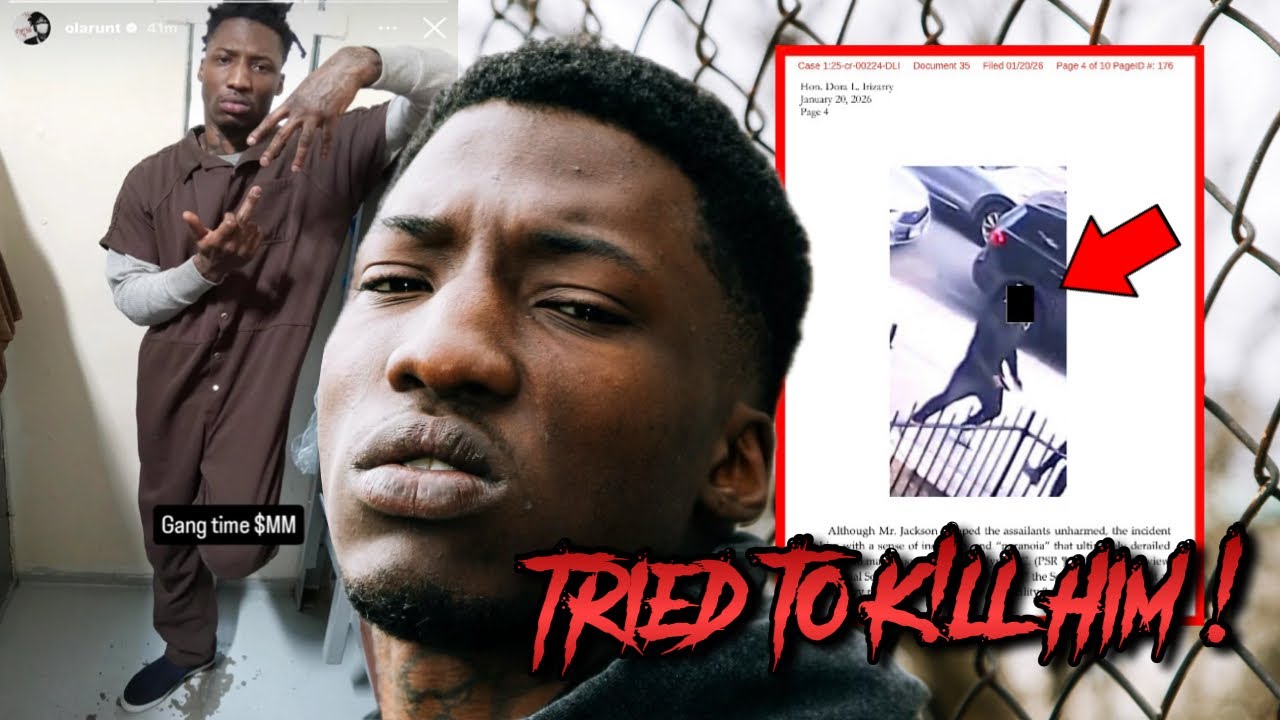 According to court documents obtained by this outlet, Ola Runt was serving a 57-month sentence for being a felon in possession of an FN 57 pistol when the Bureau of Prisons transferred him from FCI Beckley in West Virginia to the Brooklyn House RRC, a residential re-entry center, on July 31, 2024. He was nearing the end of his sentence, projected to expire on April 12, 2025, and had secured a job as a music producer at a Brooklyn-based label called GoodTalk. Every weekday morning, a driver would pick him up outside the facility to take him to the studio.
That routine turned deadly on September 19.
Surveillance footage captured one of the assailants moments after the shooting, and the image shows a man in dark clothing holding a firearm. The attackers fired several rounds at Ola Runt and his associates as he sprinted away. Police later recovered shell casings from the scene, but no arrests have been made in connection with the attempted murder.
The rapper’s lawyer, in a letter to the judge, stated that the incident left his client with “a sense of insecurity and paranoia that ultimately derailed his efforts to make a success at the halfway house.”
Two months later, in November 2024, Ola Runt walked out of the Brooklyn halfway house without authorization and vanished. He remained on the run until February 5, 2025, when Tennessee State Police stopped a vehicle he was in after a pursuit. Officers disabled the car and took him and two passengers into custody.
A search of the vehicle turned up two ounces of marijuana, digital scales, and handgun ammunition. Tennessee authorities charged him with drug possession, drug paraphernalia, evading arrest, and reckless endangerment.
He spent four months in Coffee County custody before being transferred back to federal authorities on June 4, 2025. He was housed at the Metropolitan Detention Center in Brooklyn, where he remained until his sentencing on the escape charge. The government initially sought a sentence of 27 to 33 months, arguing that Ola Runt had fled to avoid a remand based on a failed drug test.
But the rapper’s defense team countered that he did not know about any remand decision and that his primary motivation was fear for his life after the shooting.
 In a detailed submission to the court, Ola Runt’s lawyer wrote, “Although his crime was undisputably serious, Mr. Jackson does not deserve an exceptional punishment. A meaningful sentence analysis must balance the gravity of his crime against the unusual adversity he has faced, taking into consideration his impoverished background and struggles with mental illness.”
The lawyer also noted that Ola Runt is a sought-after music producer and recording artist who could lift his two young children out of poverty if given the chance to return to his career.
The judge ultimately sentenced Ola Runt to 18 months in prison for the escape, significantly less than the government’s request. He will serve no supervised release after that term, meaning when he finishes the 18 months, he will go home without any further restrictions. His original sentence had already been extended due to loss of good time credit, but the new term runs consecutively.
He is currently incarcerated and expected to be released in early 2027.
This case has drawn attention not only for the dramatic escape but also for Ola Runt’s prior allegations against Florida rapper Glock 9. In September 2023, while both were incarcerated at FCI Beckley, Ola Runt tweeted, “Damn Glock 9, you went out bad,” followed by rat emojis, accusing the Orlando rapper of cooperating with authorities. Glock 9 was facing a federal RICO charge tied to a gang war in Orlando and had allegedly shot up his own cousin’s house.
The accusation went viral, and subsequent reports confirmed that Glock 9 was indeed cooperating in multiple murder investigations.
Ola Runt’s own legal troubles began in 2020 when he was arrested as part of Operation Phoenix, an FBI takedown of 12 of Atlanta’s most violent offenders. He was indicted for possession of a firearm by a convicted felon after police found an FN 57 pistol loaded with 21 rounds. He pleaded guilty and received 57 months, a sentence that matched the caliber of the gun.
 The irony was not lost on observers, but the rapper’s time in prison took a dangerous turn when he was transferred to Brooklyn.
The halfway house where he was housed sits in a neighborhood known for its high-end amenities, including an Equinox gym and the One Hotel, with the Brooklyn Bridge just steps away. It was meant to be a stepping stone back into society, but instead became a target zone. The four assailants, who have not been identified, clearly knew his schedule.
They waited for him to exit the facility and opened fire in broad daylight, a brazen attack that suggests either a personal vendetta or a contract hit.
Ola Runt’s decision to flee, while illegal, appears to have been driven by a rational fear. He told pretrial services that the September 19 incident was the primary reason he left. His lawyer argued that the Bureau of Prisons should have transferred him to a safer location after the shooting, but instead left him in the same facility with the same routine.
“Send me somewhere else,” Ola Runt reportedly said. “Send me to LA or Hawaii. I don’t think I’m going to get shot at in Hawaii.”
The escape itself was not violent—he simply walked out an exit without permission—but it triggered a multi-state manhunt. He made his way to Tennessee, where he was eventually caught. The fact that he was armed with ammunition and drug paraphernalia at the time of his arrest suggests he was not living a law-abiding life on the run, but his defense team emphasized that he was in survival mode.
The case raises troubling questions about the safety of federal re-entry facilities. If a halfway house cannot protect its residents from assassination attempts, what recourse do they have? Ola Runt’s lawyer pointed out that the government’s own submission to the court incorrectly suggested he left to avoid a failed drug test, ignoring the shooting entirely.
 The judge, however, appeared to take the threat seriously, handing down a sentence that was less than half of what prosecutors wanted.
For now, Ola Runt remains behind bars, but his story has resonated with many who see him as a victim of a system that failed to protect him. His music career, which includes production credits and a growing fan base, is on hold. He has two young children who have been without their father for years.
The additional 18 months, while significant, is a fraction of what it could have been.
As of this writing, no suspects have been charged in the September 19 shooting. The NYPD is investigating, but leads are scarce. The white Mazda used in the attack has not been recovered, and the four assailants remain at large.
It is unclear whether they were connected to any gang or if the attack was related to Ola Runt’s past accusations against Glock 9 or other figures in the Atlanta rap scene.
Ola Runt’s case is a stark reminder that even within the federal justice system, danger can follow. His escape was not an act of defiance against the law, but a desperate attempt to stay alive. The courts have acknowledged that, at least in part, by giving him a sentence that allows him to eventually walk free without further supervision.
But the trauma of that morning in Brooklyn will likely stay with him for life.
The rapper’s supporters have taken to social media to express outrage that he was punished for trying to save his own life. Some have called for an investigation into the Bureau of Prisons’ handling of the situation. Others have pointed out that Ola Runt’s original 57-month sentence for a nonviolent firearm offense was already harsh, and that the escape charge added insult to injury.
Regardless of the debate, the facts are clear: Ola Runt was shot at while in federal custody, he fled in fear, and he is now serving 18 more months for that decision. The question that remains is whether the system will learn from this incident and take better measures to protect inmates who face credible threats. For now, the rapper will have to wait until 2027 to see freedom again.