The two generals arrived shortly after noon.
There was no firing squad waiting outside Erwin Rommel’s home in Herrlingen. No black-uniformed Gestapo men smashed through the door. No warrant was unfolded beneath a naked lightbulb.
That would have been simpler.
Instead, on October 14, 1944, a government car stopped near the house where Germany’s most famous field marshal was recovering from severe injuries. Two senior officers had come from Adolf Hitler’s headquarters.
They brought a choice.
And, according to the accounts that emerged later, they brought poison.
Inside the house were Rommel’s wife, Lucie, and their fifteen-year-old son, Manfred.
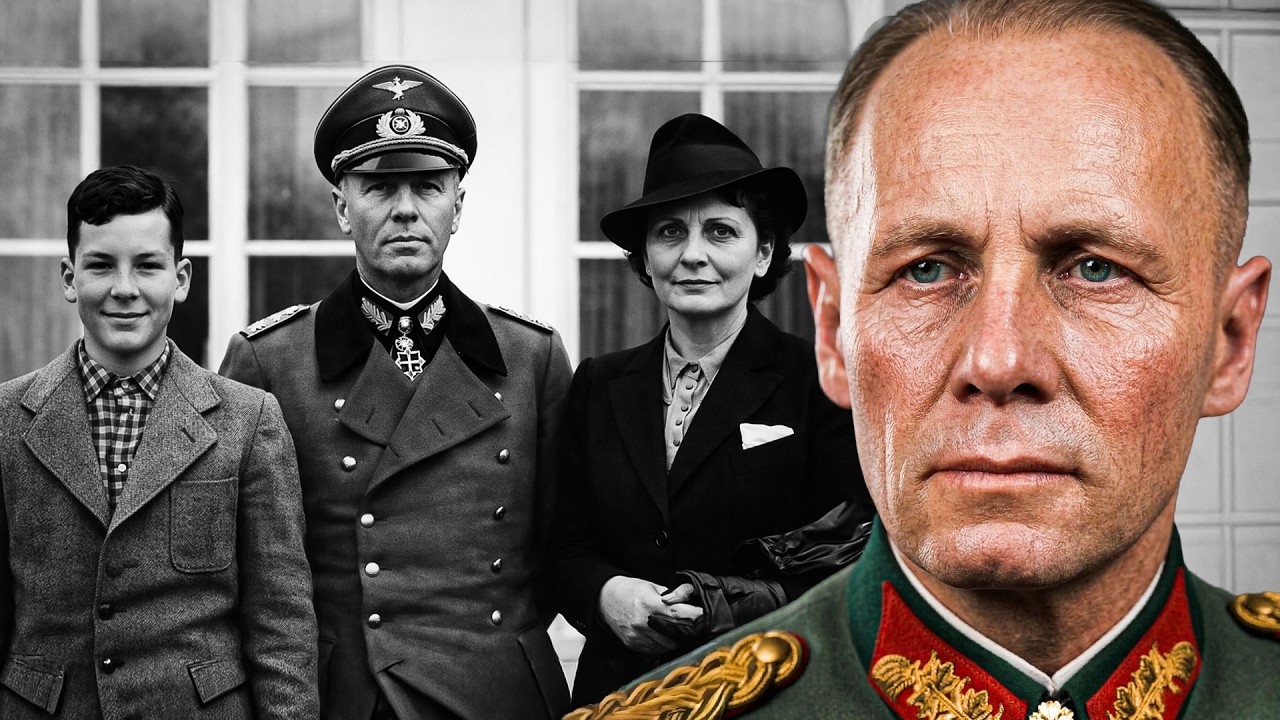
Within hours, one member of that family would be dead.
Within days, Germany would be told a lie about how he died.
Within months, the Reich itself would collapse.
But the strangest part of the story came afterward.
Because Lucie and Manfred Rommel did not merely survive the war.
They inherited something more dangerous than money, property, or political enemies.
They inherited a legend.
And for the rest of their lives, they would be forced to decide what to do with it.
1. The Men at the Door
By October 1944, Field Marshal Erwin Rommel no longer looked like the man whose face had filled German newspapers.
The transformation was physical.
Months earlier, on July 17, an Allied aircraft attack in Normandy had left his staff car wrecked and Rommel badly injured. His skull had been fractured. His face was wounded. Recovery was slow.
The man Nazi propaganda had presented as almost superhuman now spent his days recuperating at home.
Outside, Germany was contracting.
Allied armies were pushing from the west. Soviet forces were crushing their way forward in the east. Cities burned beneath bombing raids. The confidence of previous years had been replaced by something harder to print in newspapers:
fear.
Rommel had also become increasingly critical of Hitler’s military decisions.
That alone was dangerous.
But after the failed attempt to assassinate Hitler on July 20, 1944, danger became something else entirely.
The regime began tearing through the officer corps, political circles, families and acquaintances connected—sometimes directly, sometimes remotely—to the conspiracy.
Men disappeared into interrogation rooms.
Others were brought before the notorious People’s Court.
Many were executed.
And names began to surface.
One of them was Erwin Rommel.
Exactly how deeply Rommel was involved in the July 20 conspiracy remains disputed by historians. The documentary record is incomplete, many of the central participants died, and later testimony was inevitably shaped by survival, memory and postwar politics. What is clear is that Rommel had become disillusioned with Hitler and that the regime came to believe he was sufficiently connected to the conspirators to require elimination. The German Historical Museum records that two generals arrived at Rommel’s Herrlingen home on October 14 to accuse him of involvement in the plot. (Deutsches Historisches Museum (DHM))
The visitors were General Wilhelm Burgdorf and General Ernst Maisel.
They did not need to shout.
Their authority was already in the room.
One can imagine the peculiar silence inside the house: the muted sounds of an autumn afternoon beyond the windows, the weight of footsteps on the floor, the unbearable politeness of men discussing murder as administrative procedure.
Rommel met with them privately.
What followed was not a conventional arrest.
It was an ultimatum designed by a regime that understood the value of appearances.
Rommel could fight the accusation and face the consequences.
That meant the People’s Court.
The outcome was hardly in doubt.
A public treason trial of the celebrated Desert Fox would humiliate him before the nation. The machinery of collective punishment also placed his family in danger. After the July plot, Nazi authorities had used the principle of Sippenhaft—punishment extending to the relatives of accused conspirators—as an instrument of intimidation. (JSTOR)
Or Rommel could die quietly.
If he chose suicide, the regime would protect his public reputation.
His family would be spared the immediate catastrophe attached to a treason conviction.
The country would be told that its famous field marshal had died from the effects of his wartime injuries.
He would receive military honors.
The myth would remain intact.
The bargain was monstrous precisely because it was logical.
Hitler could not easily drag Rommel through a public show trial without asking ordinary Germans an awkward question:
If even the Desert Fox had turned against the Führer, what did that say about the Führer?
Rommel’s popularity had been cultivated for years. Nazi propaganda had made him a national star, celebrating his victories and turning his image into political capital. The Haus der Geschichte Baden-Württemberg later concluded that the “Rommel myth” was substantially a product of Nazi propaganda—and that Rommel had willingly participated in that public image. (Haus der Geschichte Baden-Württemberg)
Now the machinery that had manufactured the legend needed to preserve it.
Even while killing the man.
When Rommel finally emerged from the meeting, his family could read the answer before he spoke.
Lucie had lived through enough military departures to recognize the posture of a man preparing to leave.
But this departure was different.
There was no campaign map waiting at the end of the journey.
No headquarters.
No army.
Rommel explained what was going to happen.
Manfred listened.
Fifteen years old.
Old enough to understand death.
Young enough to still believe a father should somehow be able to escape it.
Rommel changed into his uniform.
That detail matters.
He would go to his death dressed as the man Germany believed him to be.
Before leaving, he said goodbye to his wife.
Then to his son.
The precise wording survives through later family accounts in varying forms, but the meaning is unmistakable: dying at the hands of his own government was bitter, and he believed accepting death was the best chance to protect those remaining in the house.
A few minutes later, Erwin Rommel stepped outside.
His son watched him go.
The car pulled away.
And the family secret began before the body was even cold.
2. The Funeral That Lied
Rommel did not die in battle.
He did not die beneath Allied bombs.
He did not succumb naturally to the head wounds that had nearly killed him in Normandy.
He entered the government car alive.
He died after taking poison.
The men who had come to enforce Hitler’s decision were still nearby.
The German Historical Museum describes Rommel’s death as suicide with a poison capsule after the two generals confronted him. Four days later, the regime staged an elaborate state ceremony in Ulm. (Deutsches Historisches Museum (DHM))
And that is where the story became almost surreal.
The same state that had forced him to die now mourned him publicly.
Flags.
Uniforms.
Wreaths.
Military ceremony.
Thousands lining streets.
A coffin carried through Ulm.
Field Marshal Gerd von Rundstedt delivered the official eulogy and placed a wreath on Hitler’s behalf. Archival Bundesarchiv material from October 18 records the state funeral and the crowds who watched Rommel’s coffin pass through the city. (Bundesarchiv Bild)
Think about what Lucie Rommel had to endure.
Somewhere in the crowd, people mourned sincerely.
Soldiers saluted.
Citizens watched from windows.
Officials spoke of service, courage and sacrifice.
The public story required everyone to believe that Erwin Rommel had died as one of Hitler’s faithful commanders.
His widow knew something else.
She knew the Führer whose wreath lay beside the coffin had effectively signed her husband’s death sentence.
Yet she could not simply stand up and announce it.
Not in October 1944.
Not while Hitler still ruled Germany.
Not while families connected to the July conspirators were being hunted.
Not while her son was still alive.
The funeral therefore created a grotesque reversal.
The dead man was free from Hitler.
His surviving family was not.
Every expression Lucie made could be watched.
Every sentence mattered.
Every visitor might ask one question too many.
The regime had not merely demanded Rommel’s death.
It had demanded his family participate in the silence afterward.
And fifteen-year-old Manfred now possessed information that could endanger both himself and his mother.
Imagine carrying that through adolescence.
Most boys his age were trying to understand who they were becoming.
Manfred had to understand why his father had been praised in public by the same government that had privately destroyed him.
That contradiction would become the central inheritance of his life.
But before he could decide what the Rommel name meant, he had to survive the destruction of the country that had created it.
Germany staggered into the winter of 1944.
Then came 1945.
The regime that had seemed permanent began disintegrating at extraordinary speed.
Manfred had already been drawn into wartime service while still a teenager. He had served as a Luftwaffe auxiliary, part of the desperate mobilization of German youth as the war turned against the Reich.
His father had once occupied the highest levels of military fame.
The son now entered the final months of the war as one more German teenager in a collapsing system.
According to later biographical accounts, Manfred eventually deserted and surrendered to French forces as the war ended. (The Guardian)
It was an extraordinary reversal.
A few years earlier, posters, newsreels and newspapers had presented his father as the brilliant commander who humiliated Britain and threatened Egypt.
Now Erwin Rommel was dead.
Hitler would soon be dead.
German cities were shattered.
The son of the Desert Fox became a prisoner.
And for perhaps the first time, the secret surrounding his father’s death could leave the family house.
The question was no longer whether the Third Reich could punish Manfred for telling the truth.
The Reich was dying.
A different question replaced it.
Would anyone believe him?
3. The Widow, the Son, and the Ruins
When wars end, the dead become strangely useful.
The living argue over them.
Governments turn them into symbols.
Enemies reinterpret them.
Families defend them.
Biographers simplify them.
And Erwin Rommel was unusually valuable.
To Nazi Germany, he had been the glamorous field marshal—the commander whose battlefield image helped sell confidence to a population that increasingly had little reason for confidence.
To the British, he had become an enemy worthy of respect, partly because describing Rommel as exceptional also helped explain British setbacks in North Africa.
After 1945, another version emerged.
Rommel the professional soldier.
Rommel the honorable German.
Rommel the officer supposedly separate from Nazi crimes.
Rommel the potential resister.
Rommel the man Hitler had killed.
Each version contained pieces of truth.
None contained all of it.
For Lucie and Manfred, however, the debate was not initially academic.
They had lost a husband and father.
And the manner of his death had been hidden behind an official fiction.
They possessed letters, recollections and documents.
They also possessed memories nobody else could own.
That gave them power.
It also gave them a temptation.
Because postwar Germany was full of people desperate for stories that made the past easier to bear.
The country had to confront destruction on a scale almost impossible to absorb. Cities had become fields of brick. Millions were dead. Prisoners had not returned. Refugees moved across borders. Families waited for men who would never come home.
And then the deeper crimes of the regime came fully into view.
The camps.
The deportations.
Mass murder.
The Holocaust.
The organized destruction of European Jewry.
The myth of a purely professional German military, untouched by Hitler’s ideological war, would become enormously attractive in the West during the early Cold War.
Rommel fit that narrative almost perfectly.
But there was a problem.
History refused to stay simple.
The German Historical Museum notes that Rommel welcomed the Nazi takeover in 1933 because he hoped Hitler would overturn the Versailles settlement. He later served in Hitler’s military escort, benefited from rapid advancement, appeared at propaganda events and became one of the regime’s most recognizable military personalities. (Deutsches Historisches Museum (DHM))
That did not make him identical to Hitler.
It did not erase his later opposition.
It did not make his forced suicide less brutal.
But it complicated the comforting picture of Rommel as a man who had always stood outside the system.
The greatest secret the family inherited was therefore not simply:
Hitler killed him.
That secret eventually became public.
The harder truth was this:
The victim and the regime had not always been enemies.
Rommel’s fame had grown inside the Nazi system before that system turned on him.
Lucie knew the private husband.
Manfred knew the father.
The world knew the field marshal.
Those were not the same man.
In the years after the war, the family worked with British military historian and theorist B. H. Liddell Hart and others on the collection of Rommel’s wartime papers. Published in 1953 as The Rommel Papers, the volume appeared with assistance from Lucie-Maria Rommel, Manfred Rommel and General Fritz Bayerlein. Its contents included a section by Manfred on his father’s final days. (NDU Library)
The lie imposed in 1944 could finally be dismantled in public.
Readers could learn that the great state funeral had concealed a political killing.
But exposing the circumstances of Rommel’s death created a second consequence.
It strengthened his postwar legend.
A general already admired for battlefield skill now became something more compelling:
a victim of Hitler.
That distinction mattered enormously.
The narrative had everything history remembers well.
A famous commander.
A dictator.
A conspiracy.
A private ultimatum.
A cyanide capsule.
A grieving family forced into silence.
A funeral built on a lie.
It was almost too perfect.
And perfection should make any historical investigator suspicious.
Because real lives are rarely that clean.
The Rommel family had recovered the truth about how Erwin died.
But the larger argument over who Erwin Rommel had actually been was only beginning.
And Manfred would soon discover that there was one way to escape his father’s shadow.
He could stop arguing about the name.
And change what the name represented.
4. Manfred Refuses to Become His Father
After captivity, Manfred Rommel went back to school.
That decision appears ordinary only if you ignore the name attached to it.
Imagine being nineteen years old in postwar Germany and writing:
Rommel
on an examination paper.
Some teachers would know immediately.
Some classmates would know.
Some strangers would stare.
The surname entered the room before the young man did.
He completed his secondary education and went on to study law and political science at the University of Tübingen. In 1956, he entered the civil service in Baden-Württemberg. (The Guardian)
There is something revealing in that choice.
His father had commanded armies.
Manfred chose administration.
His father’s world had been built around rank, orders, movement, victory and defeat.
Manfred moved toward law, institutions, budgets and government.
The transformation was not dramatic enough for a battlefield film.
That was precisely why it mattered.
Postwar Germany did not need more romantic warriors.
It needed people willing to make boring systems function.
Permits.
Housing.
Transit.
Budgets.
Schools.
Municipal government.
Democracy lives or dies in places that rarely make heroic newsreels.
Manfred joined the Christian Democratic Union.
He developed a style strikingly different from the military legend surrounding his father.
Dry humor.
Pragmatism.
A willingness to irritate his own political allies.
A suspicion of theatrical politics.
By 1974, almost thirty years after watching his father leave home for the final time, Manfred Rommel ran for mayor of Stuttgart.
The campaign placed the family name before the public again.
But now voters were not being asked what Erwin Rommel had done in Africa.
They were being asked whether Manfred Rommel could run a city.
He won.
Then he kept winning.
He would serve as Stuttgart’s Lord Mayor for twenty-two years, from 1974 until 1996. The city later remembered him as an advocate of a liberal policy toward foreign residents, international understanding and disciplined municipal finances. (Landeshauptstadt Stuttgart)
That alone would have made an unusual second act.
But Manfred repeatedly made choices that revealed how deeply the war’s legacy had shaped him.
During the violent era of the Red Army Faction, Germany was again confronted by political extremism, terrorism and public rage.
Several imprisoned members of the group died at Stuttgart-Stammheim prison.
The atmosphere was poisonous.
Many Germans saw them simply as murderers.
Others feared that burial sites would become political shrines.
Manfred Rommel supported giving the dead proper burial.
It was not sentimental approval.
It was a statement about limits.
A democratic state could condemn violence without imitating the moral absolutism of violent people.
Death, in his view, had to end something.
For a man whose father had been condemned without a fair public process and then buried beneath an official lie, the principle carried an almost unbearable historical echo.
Manfred also defended fair treatment for immigrants arriving in Stuttgart during the city’s economic growth. His stance was not always convenient within conservative politics, but Stuttgart later credited him with helping establish a liberal approach toward foreign residents. (Landeshauptstadt Stuttgart)
The son of one of Nazi Germany’s most famous generals was slowly attaching the Rommel name to something the Third Reich had despised:
pluralism.
Not perfectly.
Not theatrically.
Not through speeches about cleansing the family reputation.
Through municipal decisions.
That may be the most important detail of Manfred Rommel’s life.
He did not spend decades demanding that strangers admire his father.
He built his own public record.
But history was not finished with him.
Because eventually he would stand face to face with men who carried surnames almost as heavy as his own.
And those names had once belonged to his father’s enemies.
5. The Sons of the Enemy
There are photographs history seems to arrange deliberately.
Men smiling together.
Hands extended.
No battlefield.
No tanks.
No uniforms of opposing armies.
Just sons.
Manfred Rommel eventually became friendly with descendants of two commanders forever linked to his father’s military story: George Patton and Bernard Montgomery.
During the war, the names Rommel, Patton and Montgomery had carried enormous symbolic weight.
They appeared in newspapers.
Briefing rooms.
Maps.
Propaganda.
They represented armies trying to destroy one another.
Decades later, their sons could meet without artillery between them.
Manfred developed friendships with Major General George Patton IV and David Montgomery, the son of Field Marshal Bernard Montgomery. Contemporary accounts later treated those relationships as symbols of postwar reconciliation. (The Guardian)
The symbolism was almost embarrassingly cinematic.
But unlike the funeral in Ulm, nobody needed to manufacture it.
The fathers’ generation had settled arguments with tanks.
The sons could share meals.
That does not erase history.
Reconciliation that depends on forgetting is merely amnesia.
The more difficult version allows memory to remain in the room.
Manfred understood this instinctively.
He had been fifteen when political violence entered his family home wearing a general’s uniform.
He had watched the Nazi state praise his father and kill him almost simultaneously.
He had lived through the collapse that followed.
By adulthood, certainty itself may have looked suspicious.
His humor, often remarked upon by those who knew him publicly, functioned almost like armor against grandiosity.
That was another rebellion against the mythology surrounding his surname.
Erwin Rommel had become larger than life.
Manfred seemed determined to remain human-sized.
Yet even he could not control how the past continued to evolve.
By the late twentieth and early twenty-first centuries, historians were examining the Rommel legend more critically.
The easy version—brilliant, apolitical soldier, essentially untouched by Nazism until Hitler murdered him—became increasingly difficult to sustain.
The Haus der Geschichte Baden-Württemberg eventually devoted a major exhibition to the Mythos Rommel, emphasizing the role of Nazi propaganda in creating his iconic status and Rommel’s own participation in that process. (Haus der Geschichte Baden-Württemberg)
That was the uncomfortable revelation beneath the family legend.
Erwin Rommel had indeed been forced to kill himself.
That part was real.
His family really had faced terrible danger.
The funeral really had concealed the truth.
But the story did not transform him automatically into a lifelong anti-Nazi resister.
History is not a courtroom where one final piece of evidence turns a complicated defendant into either saint or monster.
Rommel had benefited from Hitler’s rise.
He had enjoyed privileged access.
He had become a propaganda icon.
Later, he clashed with Hitler and lost faith in Germany’s chances of winning.
His precise relationship to the July 20 conspirators remains historically debated.
Then the regime killed him.
All of those things can exist in the same biography.
And this may explain something profound about what happened to his family after the war.
Lucie and Manfred could preserve his papers.
They could reveal the circumstances of his death.
They could defend the man they had known privately.
But they could not freeze history.
Every generation would reopen the file.
Every generation would ask a slightly different question.
Was Rommel a hero?
A collaborator?
A military genius?
A beneficiary of propaganda?
A late opponent of Hitler?
A symbol of the supposedly “clean” Wehrmacht?
A victim?
The evidence refuses to fit comfortably inside one word.
And perhaps Manfred’s greatest achievement was that he eventually stopped requiring the answer to determine who he himself would become.
6. What Lucie Had Actually Saved
Lucie Rommel rarely receives the attention given to her husband or son.
That is almost predictable.
History loves the general.
Then it loves the politician.
The widow becomes scenery.
But without Lucie, much of what the world later learned about Erwin Rommel’s private writings and final days might have reached the public differently.
She survived the regime that killed her husband.
Then survived the war that destroyed the regime.
Afterward, she participated with Manfred and others in preserving and publishing Erwin’s documents.
There is an intimate violence in that kind of archival work.
A widow opens drawers.
Unfolds letters.
Recognizes handwriting.
Reads sentences written by a man who expected to return home.
A document a historian calls a “primary source” may have once been something she held in her hands while waiting for him to come back from Africa.
That is the difference between an archive and a marriage.
Historians need distance.
Families rarely have it.
Lucie had also experienced the most surreal contradiction in her husband’s biography from only a few feet away.
The state funeral said:
Hero.
The private ultimatum said:
Traitor.
Postwar admirers said:
Resistance figure.
Later historians said:
Not so fast.
She lived inside the gap between those labels.
Perhaps that is why the family’s preservation of Rommel’s writings matters so much.
Documents are stubborn.
They do not automatically prove innocence or guilt.
But they complicate myths.
They show ambition.
Frustration.
Military judgment.
Loyalty.
Vanity.
Affection.
Anger.
Contradiction.
The preserved Rommel papers ultimately allowed later readers to encounter something more useful than a marble statue.
A man.
That did not prevent mythmaking.
In some ways, publication strengthened it. Postwar books and popular culture helped turn Rommel into the archetype of the “good German general”—the honorable opponent whose military professionalism could be detached from the regime he served.
That image was attractive in Western countries entering the Cold War.
West Germany was becoming an ally.
Former enemies were being incorporated into a new security order.
A figure like Rommel could serve as a bridge.
The Desert Fox was recognizable.
Respected by old opponents.
Dead before the final collapse.
Killed by Hitler.
Perfect material for rehabilitation.
Except history has a habit of presenting invoices long after everyone thinks the bill has been paid.
Researchers returned to the record.
Museums revisited the propaganda.
The role of the Wehrmacht in Nazi warfare came under greater scrutiny.
Rommel’s political attitudes were reassessed.
The ambiguity of his connection to the resistance became harder to ignore.
And suddenly the question was no longer:
Was the official account of Rommel’s death a lie?
Everyone knew it was.
The deeper question became:
What other simplifications had grown around that lie?
That is the real twist in the Rommel family story.
For decades, exposing Hitler’s role in Rommel’s death felt like the final revelation.
It was not.
It was only the first layer.
Because proving that a dictatorship murdered a man does not prove that the man had never served that dictatorship enthusiastically.
Being victimized by a regime at the end of one’s life does not erase every compromise that came before.
Neither does earlier cooperation make the final act less coercive.
The truth is harder because it refuses emotional convenience.
Lucie’s husband could be both.
Manfred’s father could be both.
A beneficiary of the Nazi system.
And ultimately one of its victims.
The family’s task after the war was not to solve that contradiction.
No family could.
Their task was to live after it.
7. The Name Changes Meaning
In 1996, Manfred Rommel left office after twenty-two years as mayor of Stuttgart.
The city made him an honorary citizen.
Its official remembrance emphasized his work for international understanding, his approach toward immigrants and his reputation as a political figure who reached beyond party lines. (Landeshauptstadt Stuttgart)
Look at those words beside the imagery attached to his father.
International understanding.
Integration.
Civic government.
Financial responsibility.
The transformation is almost startling.
The name “Rommel” had once crossed Europe attached to armored columns.
Now it was attached to buses, budgets, immigrant policy and municipal compromise.
This was not glamorous history.
It was better.
Glory is easy to photograph.
Reconciliation takes decades.
Manfred continued writing after leaving office. Parkinson’s disease increasingly affected him, but he remained a recognizable public figure until his death in 2013 at the age of eighty-four. He received honors from Germany and foreign countries, including Britain and France—the nations whose soldiers had once fought armies commanded by his father. (The Guardian)
There is no cleaner image of inherited history being transformed.
But transformation is not absolution.
That distinction matters.
Manfred Rommel did not erase the Third Reich by becoming a respected mayor.
His friendships with the sons of former Allied commanders did not cancel the dead.
Lucie’s preservation of her husband’s papers did not settle every historical dispute about Erwin Rommel.
Nothing can make the twentieth century tidy.
That may be why this family story remains so compelling.
It begins with one of history’s most recognizable generals.
But it ends with an argument about inheritance.
Not financial inheritance.
Moral inheritance.
What do children owe the reputations of their parents?
What does a widow owe the public truth when the truth threatens the man she loved?
What happens when your family name means one thing at the dinner table and another thing to millions of strangers?
And what do you do when new evidence complicates the story that kept you standing?
Manfred’s answer was not delivered in one grand speech.
It appeared gradually in the life he built.
He became a lawyer instead of a soldier.
A civil servant instead of a commander.
A mayor instead of a field marshal.
He defended immigrants.
He supported reconciliation.
He befriended the families of former enemies.
He worked inside democratic institutions whose slowness and compromise represented the opposite of the political culture that had destroyed his father.
That does not mean every decision Manfred made was secretly about October 14, 1944.
Human beings are not symbols.
But it is difficult to look at the shape of his life without seeing the shadow of that afternoon in Herrlingen.
The government car.
The two generals.
The closed room.
The uniform.
The goodbye.
A fifteen-year-old boy standing in a house while his father walked toward a death arranged to protect him.
For decades, people asked what happened to Rommel after North Africa.
Perhaps the more revealing question was always:
What happened to the boy who watched him leave?
The answer is that the boy grew old.
And instead of inheriting his father’s war, he spent much of his public life building relationships across the lines that war had created.
8. The Last Secret
There is one final detail in the story that changes how the entire thing looks.
Return to October 18, 1944.
Ulm.
The coffin.
The enormous crowd.
The military procession.
Rundstedt speaking.
Hitler’s wreath.
Thousands of Germans witnessing what appeared to be the honorable burial of a national hero. Bundesarchiv records preserve the spectacle: the coffin, the state ceremony, the streets lined with mourners. (Bundesarchiv Bild)
At first glance, the humiliation belonged to Rommel.
A powerful field marshal had been cornered.
A dictator had forced him to choose poison.
A family had been silenced.
But look again.
Who was actually afraid of whom?
Hitler controlled the courts.
The police.
The Gestapo.
The army.
The prisons.
The executioners.
Rommel was injured, politically isolated and trapped inside his own home.
Yet Hitler still did not want to put him openly on trial.
The regime feared the meaning of his name.
That is why it required the disguise.
That is why the poison had to become an honorable death.
That is why the coffin required ceremony.
That is why the dictator who ordered his destruction sent a wreath.
The state possessed almost unlimited power.
And still it needed a lie.
That may be the most revealing fact of all.
Dictatorships do not manufacture legends because they are confident.
They manufacture legends because reality is dangerous.
For years, Nazi propaganda had helped elevate Rommel into a national hero. When he became politically inconvenient, the regime discovered it could not destroy the hero without risking damage to itself. (Haus der Geschichte Baden-Württemberg)
So it destroyed the man and preserved the image.
Lucie and Manfred survived inside that contradiction.
After the war, they helped expose the manner of Erwin Rommel’s death.
Then history did something the Nazi regime never allowed:
it kept asking questions.
Questions about Rommel’s loyalty.
Questions about his ambition.
Questions about propaganda.
Questions about resistance.
Questions about the Wehrmacht.
Questions about why postwar societies were so eager to create a version of the “good German general.”
No final verdict has made all of those questions disappear.
And that is exactly as it should be.
Because serious history is not the search for comforting heroes.
It is the refusal to stop looking when a story becomes comfortable.
Erwin Rommel was neither the flawless knight of postwar legend nor a figure who can be understood simply by reversing the myth and making him its opposite.
He was a talented and ambitious German officer who rose spectacularly under Hitler, participated in the propaganda surrounding his reputation, increasingly clashed with Hitler’s conduct of the war, became associated—however ambiguously—with opposition circles, and was ultimately forced to die by the dictatorship he had once served. The historical institutions that preserve his record today emphasize precisely that complexity.
Lucie Rommel inherited the memories.
Manfred inherited the name.
Neither could control what future generations would decide about Erwin.
But Manfred could control what future generations would associate with him.
That is what makes the ending so much stranger—and, perhaps, more powerful—than the legend of the Desert Fox.
The father became famous by fighting enemies.
The son became respected by befriending their sons.
The father lived in an age that worshiped military strength.
The son built his reputation through democratic compromise.
The father’s final public ceremony was a lie manufactured by a dictatorship.
The son spent twenty-two years holding an office whose legitimacy depended on voters being free to remove him.
That was the inheritance nobody in Hitler’s headquarters could have predicted when the government car arrived in Herrlingen on October 14, 1944.
They believed they were controlling the Rommel name.
They believed that by killing the man and preserving the legend, they could decide what Germany would remember.
They were wrong.
Erwin Rommel died that afternoon.
The Third Reich died months later.
Lucie survived both.
Manfred survived both.
And the family name outlived the dictatorship that once believed it owned it.
Because the most dangerous truth about history is also the reason dictators fear it:
You can force a man to die, you can order his family to remain silent, and you can even stage the funeral—but you cannot control what the next generation chooses to do with the truth.