A few hours before the hangman was supposed to come for Hermann Göring, the most powerful surviving Nazi in Allied custody made one final decision.
He would not let his enemies choose the manner of his death.
On the night of October 15, 1946, inside a guarded cell at Nuremberg, Göring bit into a hidden cyanide capsule.
The effect was swift.
The man who had once commanded the Luftwaffe, accumulated palaces and stolen art, stood beside Hitler at the summit of Nazi power, and helped build the machinery that devastated Europe was dead before the sentence could be carried out.
The next morning, there would be no execution.
No trapdoor.
No final walk beneath Allied guards.
For Göring, it was a last act of control.
But outside those prison walls, two people remained who could not escape so easily.
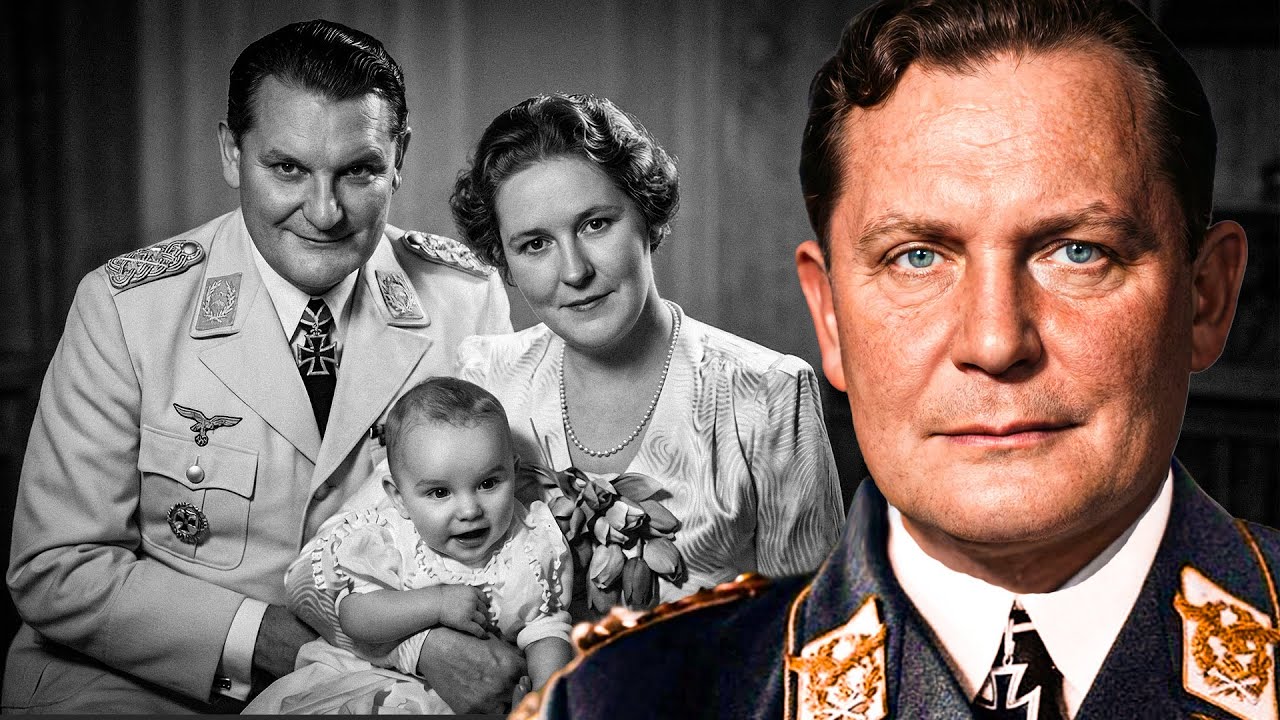
His wife, Emmy.
And his eight-year-old daughter, Edda.
They inherited no command.
No army.
No political power.
What they inherited was something harder to surrender.
His name.
And for the next seven decades, that name would follow the women of Hermann Göring’s family through confiscated property, courtrooms, public humiliation, family denial, bitter legal battles, and one extraordinary decision by a later relative who concluded that the Göring bloodline should end with her.
The Third Reich had collapsed.
But inside one family, its afterlife was only beginning.
The Woman Who Had Lived Beside Power
Before the war ended, Emmy Göring knew what it meant to live close to a man whom almost nobody dared refuse.
She had not been born into politics.
She had been an actress.
Before Hermann Göring, she knew dressing rooms, rehearsals, stage entrances, applause.
Then she married one of Hitler’s closest lieutenants.
Everything changed.
Their wedding in 1935 was not treated as a quiet personal ceremony. Göring was already one of the most visible men in Nazi Germany, and his marriage carried the atmosphere of a state occasion.
Power entered Emmy’s life through every door.
Staff waited on her.
Cars arrived when needed.
Officials stood when she entered rooms.
Guests measured their words.
Photographers documented the family.
The Görings entertained on a scale few ordinary Germans could imagine.
And behind the grandeur stood Hermann’s position inside the dictatorship.
He was more than a military commander.
More than an air force chief.
More than a decorated veteran who had turned politics into personal spectacle.
He occupied the top ranks of a state that increasingly blurred government, theft, terror, privilege, and ideology.
He acquired vast collections of art.
He lived with a level of extravagance that became notorious even among senior Nazis.
At Carinhall, his enormous country estate northeast of Berlin, paintings covered walls while sculptures, tapestries, furniture, weapons, hunting trophies, and gifts accumulated around him.
Some had been purchased.
Others had traveled into German hands through coercion, confiscation, forced sales, or the systematic looting of occupied Europe.
To visitors, the rooms glittered.
To investigators after the war, they would become evidence.
But in the late 1930s, the Göring household projected a different image.
Domestic happiness.
The regime understood the value of such pictures.
When Emmy gave birth to a daughter in June 1938, the child became a public sensation.
Her name was Edda.
She was born into a world already constructed around her father’s power.
Adolf Hitler became her godfather.
Photographs showed the Nazi leader near the baby and her parents, transforming the Göring family into something almost royal in the propaganda imagination.
A powerful father.
A glamorous mother.
A blond little girl.
The image was carefully comforting.
And that was precisely what made it useful.
Because dictatorships rarely present themselves to their supporters as horror.
They present themselves as order.
Achievement.
Family.
Pride.
Normal life.
The terror is placed somewhere outside the photograph.
By the time Edda was old enough to form memories, Germany was at war.
By the time she was seven, her father’s world had collapsed.
When the Palace Became Evidence
In the spring of 1945, the geography of Nazi power disintegrated with astonishing speed.
American troops advanced from the west.
Soviet forces closed from the east.
German towns overflowed with soldiers, refugees, displaced civilians, prisoners, deserters, and officials trying to disappear into the chaos.
Berlin fell.
Hitler killed himself.
The regime that had promised a thousand-year Reich had survived barely twelve.
Hermann Göring had spent years surrounding himself with symbols of permanence.
Now he understood that enemy troops would soon reach them.
Carinhall could not be allowed to fall intact.
The vast estate was destroyed on his orders.
Walls collapsed.
Rooms disappeared.
What could not be removed was buried under rubble.
It was as though the architecture of his private empire had been blown apart to match the political one.
But destruction could not erase the paper trail.
Nor could it erase what the Allied forces knew about the man who had lived there.
Göring was captured.
The medals came off.
The uniforms disappeared.
The motorcades stopped.
He entered Allied custody as a prisoner.
Emmy and Edda entered another kind of reality.
One of the strangest images from the immediate aftermath of the war came not from a courtroom but from the road.
In June 1945, Emmy Göring arrived near Nuremberg with her daughter in a Mercedes-Benz.
A truck accompanied them carrying luggage, food, clothing, jewelry, and personal belongings.
Germany lay shattered around them.
Cities had been reduced to skeletal rows of brick.
Millions of people were homeless.
Rail stations were crowded with families carrying whatever they had left in sacks.
Yet the widow-in-waiting of one of the Reich’s most powerful men still moved with remnants of the old life around her.
For a brief moment, the machinery of privilege had not fully understood that it was dead.
American soldiers even helped the family settle temporarily at a Göring property after receiving orders to assist them.
The scene could almost have belonged to the old Germany.
A car.
Luggage.
Attendants.
A famous name.
Then the illusion ended.
Allied authorities began separating personal hardship from political responsibility.
Emmy was detained.
The family was investigated.
Assets were scrutinized.
Property became contested.
And Edda, who had once lived behind guards assigned to protect her father’s world, now found armed men watching because that world had become a crime scene.
She was seven years old.
She could not possibly understand what her surname meant to the soldiers.
To her, Hermann Göring was not an exhibit at Nuremberg.
He was Papa.
That emotional difference would shape the rest of her life.
The Man in the Defendant’s Dock
At Nuremberg, Hermann Göring quickly demonstrated why he had survived so long near Hitler.
He was intelligent.
Aggressive.
Theatrical.
He understood audiences.
Even as a prisoner, he tried to control rooms.
The defendants entered the courtroom stripped of the visual language that had once made them intimidating. No flags. No polished uniforms. No cheering crowds. No orchestras playing martial music.
They sat behind wooden barriers wearing headphones.
Their empire had been reduced to translation devices and legal documents.
Göring still fought.
He challenged prosecutors.
He defended his political career.
He attempted to turn military defeat into the central story and minimize the criminal nature of the regime he had helped build.
But the prosecutors did not need to depend on memory alone.
The Nazis had documented themselves.
Orders survived.
Minutes survived.
Signatures survived.
Official correspondence survived.
The regime had created records of decisions that would later be used against its own leaders.
The tribunal found Göring guilty on all four counts.
The sentence was death.
For an adult reading the judgment, the meaning was unmistakable.
For Edda, it was different.
Children do not experience history as a legal brief.
They experience faces.
Hands.
Voices.
Absences.
A father who had helped build one of the most murderous governments in modern history could also have lifted his daughter into his arms.
That is not a contradiction that redeems him.
It is a contradiction that makes the story more disturbing.
People capable of affection at home are still capable of brutality elsewhere.
The ability to love one child does not prove concern for another.
The ability to be generous to friends does not cancel participation in persecution.
Evil becomes easier to misunderstand when people expect it to look evil every hour of every day.
Göring did not need to frighten his daughter in order to devastate other families.
Edda was allowed to visit him during his imprisonment.
The meetings were controlled.
Short.
Watched.
Her father was no longer surrounded by staff or insignia.
There were guards between them and a death sentence above him.
For Edda, however, the man behind the prison walls remained emotionally connected to the father of her earliest memories.
Then came October 15, 1946.
Cyanide.
A body on the cell floor.
And a final separation no appeal could change.
Hermann Göring escaped the executioner.
His daughter spent the rest of her life living with the man he had been before she was old enough to understand him.
Then Germany Judged His Wife
The trial of the leading Nazis answered only part of the postwar problem.
Hitler’s dictatorship had not operated through two dozen men.
Millions of Germans had interacted with it in different ways.
Some murdered.
Some administered.
Some profited.
Some informed.
Some joined organizations for advancement.
Some embraced the ideology enthusiastically.
Some followed the crowd.
Some claimed afterward that they had known nothing.
Occupation authorities therefore launched the vast and imperfect process known as denazification.
People were questioned.
Party memberships were examined.
Employment histories were reviewed.
Assets were investigated.
Individuals could be classified according to degrees of involvement in the former regime.
Emmy Göring presented a difficult case.
She had not commanded an army.
She had not sat at military planning tables.
She was not being prosecuted for her husband’s crimes.
But neither was she an anonymous spouse who had lived far from political power.
She had been one of the most visible women in the Third Reich.
She had enjoyed extraordinary privilege.
She had moved inside the highest circle of Nazi society.
Her marriage placed her beside a man whose wealth and status were inseparable from dictatorship.
In July 1948, Emmy stood before a denazification tribunal in Bavaria.
The visual reversal was severe.
The actress who had once moved through ceremonial Germany beneath flashes from photographers now faced officials deciding what consequences should follow her association with the fallen regime.
The tribunal imposed a year of imprisonment.
Because she had already spent more than that in detention, she did not return to prison.
But the other penalties struck directly at the life she had known.
Thirty percent of her property was confiscated.
She was prohibited from appearing onstage for five years.
For Emmy, that ban had a particular sting.
Acting had existed before Göring.
The stage belonged to a version of herself that predated Nazi power.
Now even that profession was restricted because of what she had become beside her husband.
The old world contracted.
The huge homes were gone.
The ceremonial privileges disappeared.
The entourage vanished.
Eventually Emmy lived far more modestly in Munich.
Yet there was one possession the tribunal could not seize.
Her interpretation of Hermann Göring.
The Story Emmy Refused to Surrender
Years passed.
West Germany rebuilt.
Ruins disappeared beneath new apartment blocks.
Roads were repaired.
Factories reopened.
The country moved toward prosperity while arguments about memory continued inside families, courts, schools, newspapers, and private homes.
Some Germans confronted what had happened.
Others avoided it.
Some said they had known nothing.
Some blamed only Hitler.
Some insisted they had merely followed orders.
Some remembered lost homes and bombing raids more readily than they remembered the people deported from their own streets.
Inside the Göring family, memory remained intimate.
Emmy’s husband was now internationally remembered as a convicted Nazi leader.
But she had known him across a breakfast table.
She had traveled beside him.
She had watched him play with their daughter.
Those private memories created a powerful psychological defense.
In 1967, more than two decades after his death, Emmy published a memoir about her life with Göring.
The title translated as At My Husband’s Side.
It was an almost perfect description of the emotional position she had never fully abandoned.
Still beside him.
Still seeing history from the household outward.
Still beginning with the husband rather than the victims.
For outsiders, Göring’s responsibility could be examined through documents.
For Emmy, those documents collided with the man she remembered.
And she was not alone in that struggle.
Edda had inherited it.
The Child Became the Keeper of a Memory
Edda Göring grew into adulthood carrying one of the most recognizable surnames in postwar Germany.
She could not walk through life as a blank page.
People knew.
Some stared.
Some judged.
Some were curious.
Some expected explanations from a woman whose father had died before her ninth birthday.
That created an impossible emotional equation.
She bore no criminal responsibility for Hermann Göring’s actions.
A child does not inherit guilt.
But she had inherited privilege from the world he created around himself.
And some of that privilege survived in physical form.
One object would become especially important.
A painting of the Madonna and Child by Lucas Cranach the Elder.
The city of Cologne had presented the painting to Edda when she was an infant.
During the Third Reich, the gift could be displayed as a gesture of civic honor toward the daughter of an immensely powerful man.
After 1945, the same object looked different.
Why had the city given such a valuable artwork to a baby?
Was it genuine generosity?
Was it political submission?
Could a municipal institution truly refuse a family like the Görings during a dictatorship?
When the power structure changed, the meaning of the gift changed with it.
The question reached the courts.
Edda fought to keep the painting.
The dispute continued for years.
At first glance, it might have seemed like an ordinary inheritance argument.
It was not.
The Cranach painting contained the entire moral problem of the Göring fortune in miniature.
Under dictatorship, paperwork can survive even when free consent does not.
A document may say “gift.”
A signature may appear voluntary.
A transfer may be legally recorded.
But what happens when the person receiving the gift belongs to a family capable of destroying careers, confiscating property, and commanding state institutions?
The courts had to decide whether formal ownership could be separated from the atmosphere in which the transfer occurred.
Edda persisted.
Eventually, the painting returned to Cologne.
Her father had been dead for decades.
His political power had vanished.
Yet one artifact from her infancy was still being untangled from the gravitational field he had created.
And through the dispute, a larger pattern became visible.
Edda was not trying to destroy the memory of Hermann Göring.
She was trying to preserve parts of the world connected to him.
“My Father”
As Edda grew older, journalists occasionally sought her out.
They wanted the question that followed every child of a notorious parent.
What do you believe about him now?
The historical evidence around Hermann Göring had only become more extensive with time.
Archives opened.
Collections were catalogued.
Looted art was traced.
Holocaust scholarship expanded.
Documents connected senior Nazi leaders to decisions involving forced labor, economic exploitation, persecution, deportation, and murder.
For historians, the record became clearer.
For Edda, the emotional picture remained rooted in childhood.
When she spoke publicly, she repeatedly distinguished the father she remembered from the political figure condemned by history.
Her memories were loving.
That was the central problem.
She was not lying when she remembered affection.
But affection is not an acquittal.
A daughter can remember her father kissing her goodnight while history records what he signed the next morning.
Both can be true.
Only one tells us whether he was responsible for crimes committed by the state he helped lead.
This distinction is brutally difficult inside families.
Because condemning a political figure is abstract when the person is a name in a book.
It becomes psychologically violent when the name belongs to the man who once carried you on his shoulders.
For Edda, accepting the full public image of Hermann Göring may have felt like betraying the private father preserved inside her.
So she protected that memory.
And over time, protection hardened into position.
The Petition Nobody Expected
By the twenty-first century, almost everyone directly involved in the Nazi leadership was dead.
Germany had reunified.
The Soviet Union was gone.
The Berlin Wall had become a tourist destination.
Teenagers studied the Third Reich as something belonging to the distant past.
But the Göring family’s legal relationship with that past was not finished.
In 2015, Edda was seventy-six years old.
Nearly seven decades had passed since her father’s death.
She submitted a petition to the Bavarian parliament involving property confiscated from Hermann Göring’s estate.
The claim stunned people who encountered it.
Why would the daughter of one of the most powerful convicted Nazi leaders still pursue property connected to him after so many years?
For Edda, the issue could be framed in legal terms.
Inheritance.
Confiscation.
Ownership.
For the state, however, the history surrounding those assets could not simply be removed from the discussion.
A parliamentary committee examined the petition.
The answer was decisive.
Rejected.
Unanimously.
There was no grand confrontation.
No shouting crowd.
No dramatic speech.
That almost made the moment more powerful.
The daughter of a man who had once bent institutions around his will appealed to an elected democratic body.
The institution considered her request.
Then every member said no.
The imbalance of power had completely reversed.
Hermann Göring’s name no longer opened doors.
It closed the argument.
And yet, even this was not the most dramatic response to his legacy within the family.
Because another relative had already reached a conclusion Edda never did.
She did not want a painting.
She did not want an inheritance.
She did not want the family line continued at all.
The Göring Who Wanted the Bloodline to End
Bettina Göring belonged to a later generation.
Hermann Göring was her great-uncle.
She had never met him.
She had not grown up inside Carinhall.
She had never experienced the Third Reich firsthand.
By the normal rules of moral responsibility, she owed nothing for his crimes.
But families do not transmit only genes.
They transmit stories.
Silences.
Photographs.
Defenses.
Shame.
Myths.
Unanswered questions.
Bettina grew up inside the shadow of a surname everyone recognized.
The problem became even more unsettling because she believed she physically resembled Hermann Göring.
The face in old photographs did not remain safely inside history books.
She could see echoes of it in herself.
For some descendants, resemblance to a dead relative brings comfort.
For Bettina, it became disturbing.
She also encountered denial inside her family.
When television documentaries showed the Holocaust, she remembered older relatives resisting what they were seeing.
The conflict between public evidence and private family mythology entered the living room.
Bettina rebelled.
She ran away as a teenager.
Her life moved through counterculture, travel, drugs, psychological upheaval, spiritual searching, and long attempts to create distance from the identity she had inherited.
She left Germany.
She built another life.
But geography did not erase the name inside her head.
Eventually, Bettina made a decision so extreme that it would follow her through every article and documentary about the family.
She chose sterilization.
Her brother made the same choice.
They did not want to produce another generation carrying the Göring line.
The decision is shocking.
But what makes it truly disturbing is the historical echo.
Hermann Göring had served a regime obsessed with blood.
Nazi ideology claimed ancestry determined human worth.
The state classified people by descent.
It enacted racial laws.
It forced sterilization on those it deemed biologically undesirable.
It turned fantasies of hereditary purity into bureaucracy, persecution, and death.
Decades later, a descendant of the Göring family voluntarily decided that her own line should stop.
History had twisted back on itself.
But there was a trap hidden inside Bettina’s decision.
And eventually she saw it.
The Twist Wasn’t in the Blood
For years, Bettina treated the family legacy almost like contamination.
If the line ended, perhaps something ended with it.
But moral guilt does not live in chromosomes.
There is no inherited Nazi gene.
Hermann Göring’s crimes could not pass biologically into a grandniece who had never met him.
The desire to erase “bad blood” risked reproducing, in inverted form, the very idea that had made Nazi racial ideology so monstrous.
The real inheritance was not genetic.
It was psychological.
And that meant sterilization could not solve it.
Neither could changing countries.
Neither could avoiding photographs.
Neither could hating the resemblance she saw in the mirror.
The only path left was confrontation.
That became clearer when Bettina participated in projects that forced descendants of perpetrators into direct contact with the history their families had tried to contain.
One of the most significant involved Ruth Rich, a Jewish Australian artist whose family had suffered under the Holocaust.
There could be no comfortable moral equivalence between them.
Bettina carried the burden of being related to a perpetrator.
Ruth’s family carried the consequences of persecution.
Those were not equal forms of suffering.
Pretending otherwise would have been another way to center the perpetrator’s family.
So the encounter required something more difficult.
Listening.
Bettina had spent years afraid of what the Göring name meant inside herself.
Now she had to confront what that name meant to people outside the family.
Not as genetics.
Not as identity.
As history.
That distinction changed everything.
The darkness did not need to be removed from her body.
It needed to be named accurately.
For the first time, the solution was not escape.
It was recognition.
And suddenly the two most famous younger women associated with the Göring family stood on opposite ends of the same psychological spectrum.
Edda protected the father she remembered.
Bettina rejected the family legacy so completely that she tried to prevent descendants from existing.
One held onto blood.
The other feared it.
Both were responding to the same historical shadow.
But only one eventually recognized that blood was never the real issue.
Memory was.
The Family’s Most Dangerous Inheritance
This is where the Göring story becomes larger than Hermann Göring.
Because after mass violence, descendants face questions the original perpetrators often avoided.
What did Grandfather do?
What did Grandmother know?
Where did this painting come from?
Why was our family rich?
Why does nobody talk about 1942?
Why is there a photograph of Hitler in the old album?
Why does the official history say one thing while our relatives insist on another?
Those questions can split families.
The first generation may protect itself through silence.
The second senses something is wrong.
The third begins opening boxes.
By then, the original people may be dead.
The documents remain.
Emmy’s response had been loyalty.
She remembered her husband through marriage.
Edda’s response was attachment.
She remembered her father through childhood.
Bettina’s first response was rejection.
She tried to create such distance from the Göring line that it would biologically end.
Three women.
Three different relationships with one dead man’s reputation.
And none of them could change the record.
That may be the most frightening thing about documented history.
It does not need family permission.
Emmy’s Last Years
Emmy Göring survived her husband by nearly twenty-seven years.
By the time she died in 1973, Germany was almost unrecognizable compared with the country in which she had married Hermann.
The swastika banners were gone.
The Luftwaffe he had once commanded belonged to another political order.
The dictatorship had become a national wound examined by courts, historians, journalists, students, survivors, and eventually younger Germans who asked why their parents’ generation had remained silent.
Emmy never regained the world she had known before 1945.
But neither did she publicly reinvent herself as a fierce critic of the man she had married.
Her memoir preserved the perspective implied by its title.
At his side.
When she died, Edda lost the person who most deeply shared her private version of the past.
After that, the daughter lived with the memory largely alone.
Hermann Göring had been dead since Edda was eight.
Her mother had now disappeared too.
The palaces were gone.
The paintings had been scattered, seized, returned, sold, contested, or placed in museums.
All that remained was memory.
And memory can become stronger when everything else is lost.
Edda Outlived the Reich by Seventy-Three Years
Edda’s life stretched far beyond the era that defined her name.
She watched Germany divide.
She watched the Berlin Wall rise.
She watched the Cold War harden.
She watched the Wall fall again.
She saw a reunified Germany become one of the central democratic powers of Europe.
She lived through new war-crimes investigations, Holocaust memorial projects, restitution cases, historical documentaries, books, archives, and public debates that repeatedly returned to the generation of her father.
The world changed.
The evidence expanded.
Her childhood memory remained remarkably stable.
There is something tragic in that.
Not because a daughter should be forbidden to remember that a father loved her.
But because private love can become a shelter from public truth.
“My father was kind to me” is a memory.
“My father therefore cannot be judged by what he did to others” is something else.
One is emotional truth.
The other can become denial.
For decades, Edda seemed unable or unwilling to cross fully from the first sentence to the second.
She never married.
She had no children.
In December 2018, she died in Munich at the age of eighty.
The burial was quiet.
The exact location of her grave was not publicly emphasized.
It was almost the opposite of her entrance into life eighty years earlier.
At her birth, the family had been photographed beside the highest figures of Nazi Germany.
At her death, there was no spectacle.
No state attention.
No grand procession.
No symbolic ceremony.
The girl once celebrated as the daughter of the Reichsmarschall left the world privately.
The direct line of Hermann Göring ended with her.
And the contrast with Bettina’s story became impossible to miss.
Edda never had children.
Bettina deliberately ensured that she would not.
Two branches approaching the same silence for entirely different reasons.
Did Justice Reach the Family?
There is a tempting way to tell this story.
Hermann Göring helped build a criminal regime.
Germany lost the war.
He was convicted.
His family lost wealth.
His wife suffered public disgrace.
His daughter spent decades fighting over property.
A later relative rejected the bloodline.
Justice completed itself across generations.
But that conclusion would be too easy.
Children are not punishments for their parents.
Descendants are not extensions of perpetrators.
Edda was responsible for Edda’s choices, not Hermann’s crimes.
Bettina was responsible for Bettina’s choices, not her great-uncle’s.
The purpose of examining what happened to them is not to celebrate inherited suffering.
It is to understand inherited memory.
Because legal justice has boundaries.
A court can sentence a criminal.
It can seize property.
It can determine ownership.
It can ban someone from a profession.
It can preserve evidence.
It can reject a petition.
What it cannot do is enter a family and order everyone to understand the past in the same way.
That struggle happens privately.
Across dinner tables.
Inside letters.
During arguments.
While looking at old photographs.
While watching documentary footage beside a relative who insists the images are lies.
While standing in front of a mirror and seeing the face of a man history remembers for horror.
The Moment the Power Finally Reversed
There was never a satisfying final scene in which Hermann Göring confessed.
No last-minute moral awakening.
No recorded moment when the magnitude of his victims’ suffering broke through his self-image and transformed him.
Instead, he took cyanide.
He denied the hangman.
In cinematic terms, he stole the ending.
But history is longer than one man’s life.
And perhaps the real reversal came slowly.
A widow standing before a denazification court.
A priceless painting being removed from the family’s control.
A daughter asking the democratic state to reconsider the loss of her father’s property—and being rejected unanimously.
A grandniece discovering that the shame she feared was not biological.
The man who had once commanded thousands could no longer command how his descendants interpreted him.
That is where his power finally ended.
Not in the prison cell.
Not with the cyanide.
In the generations he could no longer control.
The Göring Name After Göring
Today, Hermann Göring remains one of the most recognizable figures of the Nazi leadership.
His name appears in trials, documentaries, museum exhibitions, art restitution cases, war histories, Holocaust scholarship, and studies of authoritarian power.
But the private story surrounding that name tells us something the familiar photographs cannot.
The people closest to historical criminals do not always experience them as history experiences them.
That distance can become dangerous.
A dictator may be somebody’s father.
A camp commandant may return home for Christmas.
A political extremist may make his grandchildren laugh.
A thief may love music.
A man who signs cruel orders may be gentle with a dog.
None of those private details reduce responsibility.
They reveal how easily people can divide the world into moral compartments.
Family inside one compartment.
Victims inside another.
Love here.
Violence there.
Beauty hanging on the wall.
Theft hidden in the story of how it arrived.
Hermann Göring lived comfortably inside those divisions.
After his death, the walls between them collapsed.
The art acquired provenance records.
The properties acquired legal histories.
The photographs acquired captions.
The family stories encountered archives.
And suddenly what had once been called a gift could be examined as political pressure.
What had once been called patriotism could be examined as aggression.
What had once been described privately as success could be examined publicly as complicity.
That is what the women around Göring inherited.
Not his crimes.
The collision between family memory and historical fact.
One Name. Three Choices.
Emmy chose loyalty.
She continued to view Hermann through the marriage they had shared.
Edda chose preservation.
She held onto the father of her childhood and repeatedly defended elements of his personal legacy.
Bettina first chose escape.
Then she chose something more difficult.
Confrontation.
None of the three responses can be reduced to a single neat moral category.
Emmy had lost a husband.
Edda had lost a father.
Bettina was trying to understand why a dead great-uncle had become psychologically present in a life begun after the war.
Their personal emotions were real.
So were the crimes.
The mistake comes when one is used to erase the other.
That is why the Göring family’s story remains unsettling.
It asks a question that extends far beyond Nazi Germany:
What happens when the person your family taught you to love becomes someone history has every reason to condemn?
There is no painless answer.
Some people protect the family story.
Some attack it.
Some flee.
Some become obsessed.
Some open the archives.
Some refuse.
And some spend decades discovering that telling the truth about an ancestor is not the same thing as inheriting his guilt.
The Inheritance Cyanide Could Not Destroy
On October 15, 1946, Hermann Göring believed he had taken control of his final moment.
The poison worked.
The executioner never touched him.
For a few hours, perhaps, it looked as though he had succeeded in writing the final line himself.
He had not.
His story continued inside a Munich apartment where his widow remembered him.
It continued in the mind of a daughter who could not reconcile the father she loved with the Nazi leader described in historical records.
It continued in courtrooms where property linked to the Göring world was contested.
It continued in a Bavarian parliamentary committee seventy years later.
It continued in Bettina Göring’s decision never to have children.
And it continued when she eventually understood that the deepest legacy was never located in blood.
That is the truth authoritarian families often discover too late.
Power can build estates.
Power can fill rooms with art.
Power can make officials bow.
Power can convince a child that her father is untouchable.
But once power collapses, everything it protected becomes vulnerable to questions.
Where did this come from?
Who paid the price?
Who disappeared so someone else could live comfortably?
Who remained silent?
Who benefited?
Who still refuses to look?
Hermann Göring could destroy Carinhall.
He could hide poison from his guards.
He could avoid the rope.
What he could not destroy was the record.
And what his family could never fully escape was the choice that record placed before them.
Defend it.
Run from it.
Or face it.
Because guilt does not pass from parent to child.
But lies can.
Silence can.
Denial can.
And so can courage.
Hermann Göring escaped the hangman in a single night—but it took his family generations to discover that some inheritances cannot be buried, sold, sterilized away, or carried quietly to the grave.