The war was over.
The submarine was already a prisoner.
And yet, on a freezing morning in November 1945, Allied sailors took it into the North Atlantic to kill it.
No convoy was running.
No destroyer was hunting it.
No German captain stood at the periscope.
There was no battle left to win.
A towline stretched through the gray water as the captured U-boat rolled behind an Allied warship, its black hull rising and falling beneath a sky the color of dirty steel. Spray struck the conning tower. Wind screamed through empty fittings. Inside, machinery that had once vibrated with diesel power sat cold and silent.
The German flag was gone.
The crew was gone.
Germany itself had surrendered almost seven months earlier.
Still, someone had decided this submarine could not be allowed to survive.
At the appointed position northwest of Ireland, the tow was released.
The warship moved away.
Its guns turned.
Then the shooting began.
Shells punched into the German hull.
Steel plates split.
Seawater rushed through compartments where men had once slept inches from torpedoes.
The submarine listed.
For several seconds, its bow remained above the surface like the last visible bone of some enormous dead animal.
Then it disappeared.
The Atlantic closed over it.
One U-boat gone.
There were many more waiting.
At the end of World War II, roughly 156 German submarines surrendered to the victorious Allies.
Some were battered veterans of the Battle of the Atlantic.
Others were nearly new.
A few represented the most advanced submarine technology Germany had ever produced—machines so revolutionary that Allied engineers immediately understood something uncomfortable.
These boats had arrived too late to save Hitler.
But they had not arrived too late to change the future.
That realization created a problem.
The Allies had spent nearly six years trying to destroy German U-boats.
Now they suddenly owned them.
And the question was no longer how to defeat them.
It was what to do with them.
The official answer would become one of the strangest naval operations of the twentieth century.
Most of the surrendered submarines were condemned.
They were stripped, towed into deep water, blasted apart and deliberately sunk during a massive disposal program called Operation Deadlight.
It sounded clinical.
Almost peaceful.
It was anything but.
Because while dozens of U-boats were being dragged toward their graves, other submarines were quietly being removed from the execution list.
Those boats were photographed.
Measured.
Tested.
Disassembled.
Studied.
And eventually copied.
The victors were burying Hitler’s submarine fleet with one hand—
and stealing its secrets with the other.
That is where the real story begins.
1. WHEN THE HUNTERS SURFACED
In the first days of May 1945, Allied sailors began seeing something they had spent years dreading.
German U-boats were surfacing.
But this time, they were not attacking.
They were surrendering.
Across European waters, submarines emerged from the sea carrying black flags, white flags, or improvised surrender signals.
Some appeared off British ports.
Others arrived from Norway.
Some entered Allied-controlled waters after long, tense journeys made under strict orders not to fire.
The sight was surreal.
For years, Allied sailors had learned to fear even the suggestion of a periscope.
One narrow shape on the horizon could mean a torpedo was already in the water.
Merchant sailors had crossed the Atlantic sleeping in their clothes because they knew a ship might be hit without warning.
Destroyer crews spent endless nights listening through headphones for the faint mechanical noise of an enemy hidden somewhere below.
Aircraft pilots scanned enormous stretches of ocean searching for the tiny silhouette of a surfaced U-boat charging batteries before diving again.
Now those same submarines were entering harbor in daylight.
Unarmed.
Escorted.
Defeated.
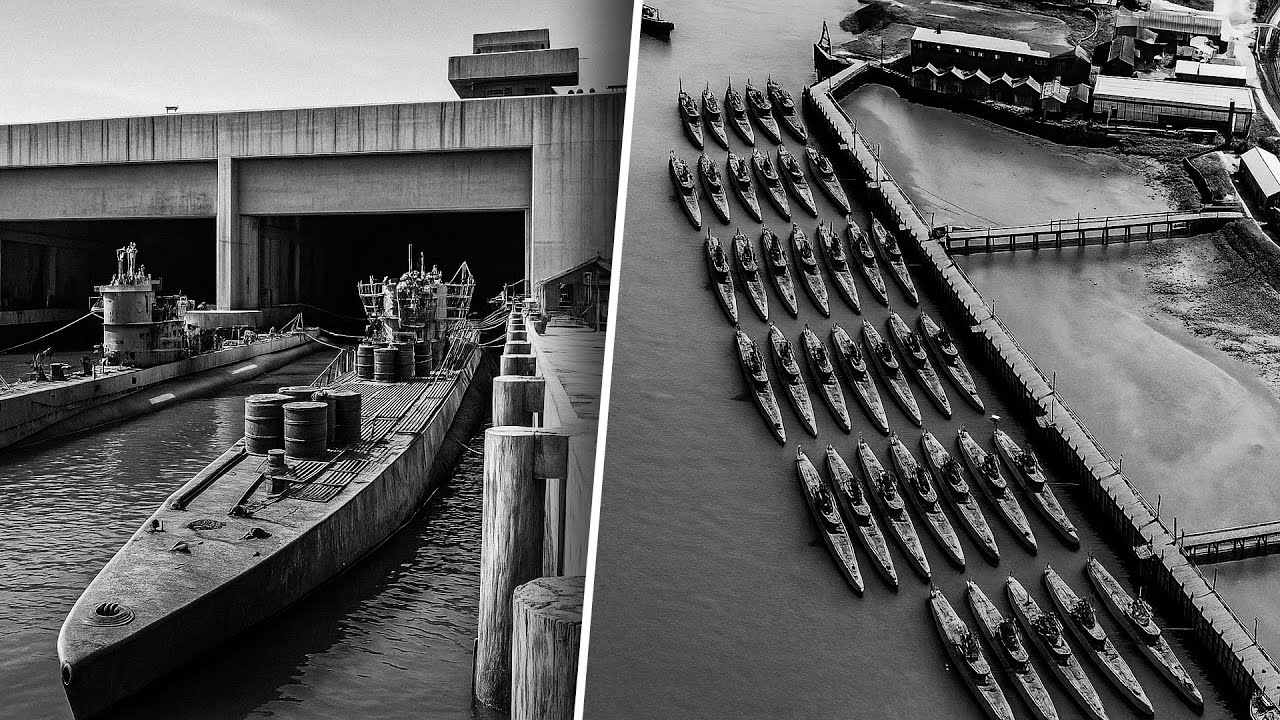
At Lisahally in Northern Ireland and Loch Ryan in Scotland, surrendered boats were packed together in long lines.
Type VII submarines sat beside Type IXs.
Smaller coastal boats waited beside advanced late-war designs.
Their once-secret hulls could suddenly be touched, photographed and boarded.
Allied sailors walked across German decks without bullets flying.
British officers climbed into conning towers where German commanders had once ordered torpedo attacks.
Technicians opened compartments that Allied intelligence officers had spent years trying to understand from captured documents and prisoner interrogations.
The psychological reversal was enormous.
During the darkest periods of the Battle of the Atlantic, German U-boats had threatened the survival of Britain itself.
Britain depended on ships.
Food came by ship.
Oil came by ship.
Weapons came by ship.
American troops came by ship.
If enough merchant vessels had been sunk, Britain could have been slowly strangled.
And for a time, that possibility did not seem impossible.
German submarines hunted in groups.
They attacked at night.
They struck convoys across thousands of miles of ocean.
When the United States entered the war, U-boats prowled American coastal waters with devastating success.
Tankers burned within sight of beaches.
Merchant ships vanished along routes civilians had considered safe.
Survivors sometimes described seeing the glow of coastal cities behind them while their ships were torpedoed offshore.
The sea had become a crime scene without walls.
Now the machines responsible were tied up neatly in Allied harbors.
Victory should have felt complete.
Instead, the surrendered fleet created a new danger.
Because Germany had not merely lost a collection of weapons.
It had lost a library of technology.
And every victorious nation wanted to read it.
2. THE FLEET NOBODY WANTED—AND EVERYONE WANTED
Germany surrendered in May 1945, but the alliance that had defeated Hitler was already cracking.
The United States and Britain looked toward the Soviet Union with growing suspicion.
The Soviet Union viewed Western intentions with equal distrust.
Millions of German weapons, factories, scientists, ships and documents now sat inside occupied territory.
Everything had potential value.
Aircraft engines.
Rocket technology.
Chemical research.
Guidance systems.
Radar.
Jet propulsion.
Submarines.
The German U-boat fleet was therefore both an asset and a liability.
There were too many boats to keep.
Maintaining them required fuel, crews, spare parts, dock space and security.
Europe was shattered.
Cities lay in ruins.
Ports were damaged.
Transportation networks had been bombed into fragments.
Millions of displaced civilians were moving across the continent.
Keeping more than a hundred former enemy submarines in working condition was absurd.
But simply sinking every boat immediately would have been equally foolish.
Some contained technology that the Allies badly wanted.
So committees were formed.
Inspections began.
Lists were created.
The surrendered fleet was turned into paperwork.
On paper, the process looked orderly.
In reality, the Allies were deciding which pieces of Germany’s military future were too dangerous to survive—and which were too useful to destroy.
Representatives from Britain, the United States and the Soviet Union examined the surviving naval fleet.
Ships were categorized.
Condition was assessed.
Repair requirements were calculated.
Then the submarines were divided.
Each of the three major Allied powers received a small number of U-boats for evaluation.
The rest were marked for destruction.
It was an extraordinary transformation.
Only months earlier, each submarine had possessed a crew, a commander, a patrol schedule, an assigned base and a military mission.
Now a line typed on a document could determine its fate.
One boat might be transferred to American engineers.
Another might enter Soviet hands.
A third might be examined by the British.
A nearly identical submarine beside it could be sentenced to the bottom of the Atlantic.
The difference was not moral.
It was technical.
The Allies were not asking which submarines deserved to survive.
They were asking which submarines contained something worth stealing.
And one design kept drawing their attention.
The Type XXI.
3. THE U-BOAT THAT CAME FROM THE FUTURE
To understand why the Type XXI frightened postwar naval engineers, it helps to understand what most submarines really were during World War II.
They were not true underwater vessels in the modern sense.
They were surface ships that could dive.
A typical German Type VII could remain underwater when necessary, but its best performance came on the surface.
Its diesel engines operated there.
Its batteries recharged there.
Its speed was better there.
Much of its long-distance travel took place there.
A U-boat commander often preferred darkness and bad weather, not deep water, as his greatest protection.
That worked—until Allied technology improved.
Radar became more effective.
Aircraft patrols expanded.
Escort carriers brought planes into areas previously beyond land-based air cover.
Destroyers coordinated attacks.
Direction finding exposed radio transmissions.
Sonar improved.
Anti-submarine tactics became brutally efficient.
The surface, once a place of relative freedom, became a trap.
A U-boat caught charging batteries could suddenly find an aircraft diving toward it before the crew had enough time to submerge.
Germany needed something different.
A submarine designed from the beginning to remain beneath the surface.
The Type XXI was the answer.
Its shape alone looked unusual.
Earlier U-boats carried deck guns, railings and superstructures that made sense for a vessel spending significant time above water.
The Type XXI was smoother.
Cleaner.
More streamlined.
Its designers tried to reduce drag underwater.
Its battery capacity was dramatically increased.
Its submerged speed was far higher than that of earlier German boats.
A snorkel allowed diesel engines to draw air while the submarine remained at shallow depth, meaning it could recharge batteries without fully exposing itself on the surface.
Inside, new systems were intended to make torpedo handling faster.
Sensors were improved.
The entire concept reflected a new philosophy.
The submarine should not visit the underwater world.
It should belong there.
Had Germany introduced hundreds of reliable Type XXIs several years earlier, Allied anti-submarine strategy would have faced a far more difficult problem.
But Germany did not.
By the time the design entered production, the Third Reich was collapsing.
Factories were being bombed.
Supply lines were breaking.
Skilled labor was disappearing.
Raw materials were scarce.
The German government demanded speed.
Instead of constructing each submarine in one location from beginning to end, Type XXI hull sections were prefabricated at different factories and later transported for final assembly.
In theory, it was an industrial shortcut.
In practice, late-war German manufacturing was chaos.
Sections arrived with defects.
Measurements did not always match.
Welding quality varied.
Systems failed.
Completed boats required additional work.
Crews had little time to train.
The submarine that looked like the future had been built inside a country running out of time.
Only a tiny number of Type XXI boats ever reached operational patrol status before surrender.
Their combat impact was effectively insignificant.
And that should have been the end of their story.
Instead, defeat made them more important.
Because the moment the war stopped, Allied engineers could finally inspect them without being shot at.
They crawled through pressure hulls.
Measured machinery.
Examined batteries.
Studied propellers.
Photographed control rooms.
Analyzed hull shapes.
Investigated snorkels.
Recorded performance data.
The submarine Germany had failed to use effectively became an engineering textbook for the countries that defeated it.
And while technicians studied the chosen boats, the condemned fleet was being prepared for something very different.
4. OPERATION DEADLIGHT
The name almost sounds beautiful.
Operation Deadlight.
In reality, it was an execution schedule.
The Allies did not want the majority of Germany’s surrendered U-boats preserved.
They were expensive.
Politically inconvenient.
Militarily unnecessary.
And potentially dangerous.
There was also something deeper.
Britain had lived under the threat of submarine warfare for years.
Thousands of sailors had died in the Atlantic.
Merchant crews had watched friends freeze in open water.
Families had received telegrams containing a few official sentences explaining that a husband, father or son would not be returning.
The U-boats were not neutral machines in British memory.
They were the physical instruments of an attempted blockade.
No British government in 1945 was going to argue passionately for keeping an enormous German submarine fleet intact.
So dozens of boats were prepared for destruction.
The plan was simple.
Tow them northwest of Ireland.
Sink them in deep water.
Repeat until the fleet was gone.
But the winter Atlantic turned a bureaucratic operation into something darker.
Many submarines had been sitting idle for months.
Maintenance was poor.
Some were damaged.
Others had systems that no one considered worth repairing because they were destined to be destroyed anyway.
Towlines snapped.
Boats flooded unexpectedly.
Bad weather scattered formations.
Some submarines sank before reaching their planned disposal positions.
The ocean began choosing its own grave sites.
Imagine the scene from the deck of an escorting vessel.
December wind cuts through wool clothing.
The sky hangs low.
Behind the ship, an abandoned German submarine bucks through black water.
No one stands on its bridge.
Its deck is empty.
Its steel bow rises on a swell, hangs for a second, then crashes downward.
The towline tightens violently.
A sailor watches the cable.
If it breaks, the boat may drift.
If the submarine takes on enough water, it may sink where it is.
Eventually, the convoy reaches the designated area.
The condemned boat is released.
Then the destruction begins.
Gunfire.
Explosive charges.
Naval weapons.
One submarine after another disappears beneath the surface.
Some roll violently.
Some sink stern-first.
Others resist longer than expected.
Water enters torpedo rooms.
Battery compartments flood.
Control rooms disappear.
Air trapped inside escapes in bubbling bursts.
Then nothing remains except debris and oil.
Operation Deadlight ultimately sent 116 surrendered German U-boats to the bottom.
One hundred and sixteen.
That number is easy to read.
It is harder to picture.
Imagine an entire submarine fleet lined bow to stern.
Imagine walking past one black hull after another.
Ten boats.
Twenty.
Fifty.
A hundred.
Each one containing hundreds of thousands of individual components.
Miles of wiring.
Valves.
Pipes.
Pressure gauges.
Engines.
Bunks.
Torpedo tubes.
Emergency equipment.
Navigation instruments.
Then imagine sinking nearly all of them deliberately.
For the Allies, it was disposal.
For historians, it became an accidental underwater archive.
Because the submarines did not vanish.
They settled into darkness.
And decades later, many of them would still be there.
But at the same moment these boats were being killed, several of their sisters were experiencing a radically different fate.
They were crossing the ocean under new ownership.
5. THE U-BOATS THAT BECAME AMERICAN
U-3008 had been built for Nazi Germany.
After surrender, it became useful to the United States.
That sentence alone reveals the strange moral geometry of the postwar world.
The submarine had not changed.
Its engineering had not changed.
Only the flag had.
American sailors and engineers examined the Type XXI with enormous interest.
The United States Navy had every reason to be confident.
Its own submarines had devastated Japanese shipping across the Pacific.
American boats possessed excellent range, powerful weapons and experienced crews.
But when U.S. engineers looked inside the Type XXI, they saw a different answer to the future.
American wartime submarines had been designed for enormous ocean distances.
The German Type XXI had been designed around remaining submerged.
Neither approach was foolish.
But the next war might reward the German philosophy more heavily.
That mattered because by 1945 radar was already transforming naval combat.
Aircraft could search farther.
Sonar could improve.
Future anti-submarine forces would make prolonged surface operations increasingly dangerous.
A submarine that depended on spending hours exposed to recharge batteries would eventually become too vulnerable.
The Americans began testing.
U-2513, another Type XXI, became one of the most famous captured German submarines in U.S. hands.
Its performance was studied carefully.
Its machinery was examined.
Its underwater characteristics were evaluated.
In 1947, something happened that would have been almost unimaginable two years earlier.
President Harry Truman went aboard U-2513.
The President of the United States entered a submarine designed for Hitler’s navy.
That single image captures the bizarre speed with which history had turned.
In 1945, German submarines had represented an enemy threat.
By 1947, one had become a research platform valuable enough to interest the Commander in Chief.
The Americans were not preparing to build exact copies of Type XXI.
They did not need to.
Instead, they absorbed the ideas.
Existing U.S. submarines were modified.
Deck guns disappeared.
Superstructures were streamlined.
Battery capacity increased.
Snorkels were introduced.
Hull forms were cleaned up to improve underwater performance.
The Navy’s GUPPY modernization program pushed American submarines closer toward a vessel that lived beneath the sea instead of constantly returning to the surface.
The transformation was visible.
A World War II American submarine looked like a surface vessel with the ability to dive.
A modernized postwar submarine began to look like a creature shaped by water.
This was not because the Germans had invented every concept involved.
They had not.
Submarine technology had been evolving internationally for decades.
American, British, Soviet and other engineers contributed their own innovations.
But the Type XXI compressed several important ideas into a single operational design.
It gave the Allies something invaluable.
Evidence.
Not a drawing.
Not intelligence speculation.
Not an interrogation report.
A real submarine.
They could push it.
Test it.
Break it.
Measure it.
And once engineers understand a concept, destroying the original machine no longer destroys the knowledge.
That is the first great irony of Operation Deadlight.
The Allies could sink one hundred submarines.
But they could not sink what they had already learned.
6. THE SOVIETS WERE LOOKING TOO
The Western Allies were not alone.
The Soviet Union wanted German submarine technology just as badly.
Perhaps more.
The coming Cold War was already visible on the horizon.
By 1946, the wartime friendship between Moscow, Washington and London was rapidly becoming a strategic confrontation.
Europe was divided into zones of influence.
Germany itself was divided.
Political distrust hardened.
Military planners began imagining another war.
And submarines would play an enormous role in it.
The Soviet Navy faced a fundamental challenge.
If war came against the West, NATO depended heavily on transatlantic shipping.
Once again, ships would carry troops, fuel, equipment and supplies between North America and Europe.
The same ocean Germany had tried to choke during World War II would become central to any future conflict.
The Soviet Union needed submarines capable of threatening those routes.
German experience was therefore intensely valuable.
Captured technology, technical documents, shipyard knowledge and the physical U-boats themselves became part of the postwar intelligence race.
The Soviets studied advanced German designs.
They studied propulsion.
Hull form.
Sensors.
Construction techniques.
Just as the Americans extracted useful ideas, Soviet designers absorbed what could help them.
Within years, the world began seeing new generations of submarines optimized increasingly for underwater performance.
The Type XXI did not simply survive through museum preservation.
It survived through imitation.
Not exact duplication.
Influence.
That distinction matters.
History is rarely as simple as one invention being copied directly into another machine.
Technology moves through layers.
A captured boat proves an idea.
Engineers study the idea.
They modify it.
Combine it with domestic research.
Improve weak systems.
Discard failures.
Then something new appears.
The original disappears, but its DNA remains.
That process was happening simultaneously on both sides of the emerging Iron Curtain.
Which creates an uncomfortable historical image.
In 1945, German submarines were being dragged into the North Atlantic and blasted apart because the Allies considered them dangerous remnants of Nazi military power.
At roughly the same time, American and Soviet engineers were studying German submarine technology because both sides were preparing for the possibility of fighting each other.
The weapons of one war had become textbooks for the next.
7. THE BOAT THAT REFUSED TO STAY DEAD
Then there was U-2540.
If the history of the postwar U-boats were fiction, its fate might feel too obvious.
U-2540 was a Type XXI.
It never became the terrifying Atlantic predator German planners had once imagined.
Germany collapsed before the submarine could play a meaningful combat role.
In the final days of the war, its own crew scuttled it.
The boat sank in shallow northern waters.
Its story appeared finished.
Steel on the bottom.
War over.
Crew gone.
Twelve years passed.
The world changed completely.
Nazi Germany ceased to exist.
Germany was divided into East and West.
The United States and Soviet Union became nuclear rivals.
NATO was created.
West Germany was gradually integrated into the Western defense system.
Then, in 1957, U-2540 returned from the dead.
The submarine was raised.
Mud and seawater had invaded compartments that once contained machinery and men.
Corrosion scarred its hull.
But the basic structure survived.
The boat was repaired.
Three years later, the former Nazi submarine entered service again.
Not with the Kriegsmarine.
With the navy of West Germany.
Its new name was Wilhelm Bauer.
Think about the political transformation contained in that hull.
The submarine had been constructed under Hitler.
Scuttled during the destruction of the Third Reich.
Raised during the Cold War.
Reactivated by a democratic West German government.
And used within a strategic system aligned with countries Germany had recently fought.
The machine had not moved through history.
History had moved around the machine.
Wilhelm Bauer became a test and research vessel.
The same advanced underwater characteristics that made Type XXI so interesting to the victorious Allies remained useful.
Years later, the submarine became a museum ship.
Today, visitors can walk through spaces originally designed for a completely different world.
Stand inside one of those compartments long enough and the timeline becomes difficult to ignore.
You are inside a machine designed when Hitler still controlled Germany.
A machine built to fight a war Germany lost.
A machine later salvaged by the Germany that rose from the ruins of that regime.
A machine now preserved not as a weapon, but as evidence.
There may be no better symbol of what happened to the U-boats after 1945.
Some were destroyed.
Some were repurposed.
Some were transformed into lessons.
And some carried the past into the future whether anyone wanted them to or not.
8. WHAT THE MUSEUMS DON’T LET YOU FORGET
A handful of German U-boats survived long enough to become museum exhibits.
That sounds almost peaceful until you walk inside one.
U-995, preserved at Laboe in Germany, is one of the best-known survivors.
The narrow interior immediately destroys the romantic image of submarine warfare.
There is almost no personal space.
Pipes run overhead.
Valves cover bulkheads.
Bunks crowd machinery.
Equipment consumes every available surface.
Torpedo rooms doubled as living spaces.
Men slept near weapons filled with explosives.
The air during patrols would have carried diesel fumes, sweat, damp clothing, cooking smells, battery odors and the constant metallic scent of machinery.
Privacy barely existed.
Silence could mean survival.
Noise could mean death.
A sailor might lie in his bunk listening to depth charges explode outside the pressure hull, knowing there was nothing he could do except wait.
U-505, preserved in Chicago, tells another part of the story.
Unlike the boats surrendered in 1945, U-505 was captured at sea in 1944 after American forces forced it to the surface.
U.S. sailors boarded the sinking submarine under extraordinary danger.
They seized documents and equipment.
They prevented the boat from disappearing.
Then they kept the capture secret because the intelligence value was so sensitive.
Today, families walk beside U-505 beneath museum lights.
Children stare into the torpedo room.
Visitors read plaques.
They take photographs.
It is easy to forget what the object once meant.
A U-boat was not merely an engineering achievement.
It was a weapon.
Its success was measured in ships destroyed.
Tonnage sunk.
Convoys disrupted.
Lives taken.
That distinction is important because military technology is seductive.
Polished steel can become beautiful.
Complex machinery can seem heroic.
Visitors can admire the cleverness of a design without thinking about what that design was created to accomplish.
The surviving U-boats force both truths into the same room.
The engineering was remarkable.
The mission was lethal.
The sailors were human.
The regime they served was criminal.
None of those facts cancel the others.
History becomes dangerous when we simplify it enough to make ourselves comfortable.
9. THE GRAVEYARD BENEATH THE WAVES
Most German U-boats did not become museums.
They received darkness instead.
The wrecks from Operation Deadlight remain scattered beneath the North Atlantic.
Some lie where planners intended.
Others sank early after tow cables failed.
They have been underwater for more than eight decades.
Saltwater has been eating them slowly.
Steel corrodes.
Sections collapse.
Deck structures disappear.
Fishing nets snag on jagged metal.
Marine growth covers identification markings.
Fish pass through hatches that sailors once slammed shut during emergency dives.
The ocean is dismantling the fleet one molecule at a time.
Yet the wrecks still matter.
To a maritime archaeologist, a sunken submarine is evidence.
Its position may reveal where a tow failed.
Damage patterns may show how it was destroyed.
Hull configuration can identify the type.
Serial numbers, machinery and construction details can sometimes connect a wreck to historical records.
What the Allies intended as disposal became a massive archaeological field.
The ships were meant to disappear.
Instead, they became time capsules.
That transformation raises another uncomfortable question.
When does a weapon stop being a weapon and become a grave?
Many Operation Deadlight boats were surrendered without crews aboard when they were sunk.
But the broader history of German submarine warfare rests on extraordinary loss.
Thousands of U-boat sailors died during the war.
Entire crews vanished.
Many submarines remain war graves elsewhere in the Atlantic, still containing men who never escaped.
The Deadlight wrecks are different.
They were deliberately sunk after the fighting ended.
But visually, they resemble the wartime dead.
Broken pressure hulls.
Flooded compartments.
Torpedo tubes pointing into darkness.
Conning towers half buried in sediment.
From the seabed, the distinction between battle loss and postwar execution can almost disappear.
Only the records explain why one submarine died in combat and another was killed after surrender.
That is why the history matters.
Without it, the wrecks are just metal.
With it, they become evidence of a decision.
The Allies did not accidentally lose these submarines.
They chose to erase them.
10. WHY DESTROY THEM AT ALL?
The easiest explanation is military security.
Germany had been defeated.
The Allies wanted to ensure it could not quickly rebuild the weapons that had threatened them.
Destroying the submarine fleet was part of a much larger demilitarization process.
Factories were dismantled.
Weapons were seized.
Naval facilities were occupied.
The German armed forces ceased to exist in their wartime form.
Leaving more than a hundred U-boats intact would have made little strategic sense.
But there were additional reasons.
Cost was one.
Storage was another.
Political symbolism mattered too.
The submarine campaign had left deep scars.
For Britain especially, the U-boat was connected to years of fear.
The Battle of the Atlantic was not an abstract naval contest.
It touched food supplies.
Fuel.
Military reinforcements.
Civilian confidence.
The sight of German submarines being destroyed was therefore more than disposal.
It was proof that the threat had ended.
A weapon that once forced merchant sailors to scan every patch of sea was now helpless under Allied guns.
The hunter had become prey.
Yet the destruction also protected Allied secrets.
Once the best boats had been selected for technical study, maintaining dozens of additional examples served little purpose.
If rival states or black-market networks obtained equipment, documents or components, the situation could become complicated.
The safest unwanted U-boat was one sitting under hundreds of feet of seawater.
So the fleet was reduced.
But the selection process reveals the contradiction.
If all U-boats had truly been worthless, the Allies would have sunk all of them.
They did not.
They kept the ones that frightened their engineers.
11. THE SECRET VICTORY GERMANY NEVER LIVED TO SEE
This is the strangest conclusion of all.
Germany lost the submarine war.
Completely.
By 1945, Allied anti-submarine warfare had become devastating.
German U-boat crews faced horrifying casualty rates.
New boats could no longer reverse the strategic situation.
Shipyards were bombed.
Training deteriorated.
Fuel shortages grew.
The Type XXI entered service too late and with too many production problems to change the outcome.
Militarily, it failed.
Technologically, it won something much more complicated.
Its underlying philosophy survived.
The future submarine would spend less time on the surface.
It would move faster underwater.
Its shape would prioritize submerged hydrodynamics.
Its systems would be designed around remaining hidden.
Its ability to operate beneath the sea would increasingly define its value.
Within a decade, submarine design around the world was moving decisively in that direction.
Then nuclear power arrived.
USS Nautilus went to sea under nuclear propulsion in the 1950s, changing submarine warfare more radically than any diesel-electric development before it.
A nuclear submarine did not need to surface regularly to recharge batteries.
Its endurance underwater was measured not merely in hours or days.
A new era had begun.
The Type XXI suddenly looked primitive again.
But it also looked like a bridge.
Behind it stood the World War II U-boat.
Ahead stood the modern submarine.
One hunted convoys while repeatedly returning to the surface.
The other could cross oceans beneath the water.
The Type XXI existed between those realities.
It was Germany’s attempt to escape the technological trap Allied anti-submarine warfare had created.
Germany failed to exploit it.
Its enemies did not.
That may be the darkest irony in the entire story.
The Third Reich invested enormous resources in building a submarine that might restore German power in the Atlantic.
Instead, when the Reich collapsed, the surviving examples became gifts to the navies Germany had fought.
The weapon intended to help Hitler’s war became research material for the postwar world.
12. WHAT REALLY HAPPENED TO HITLER’S U-BOATS?
So what happened to the German submarines after World War II?
The short answer is simple.
They surrendered.
The Allies divided a small number for study.
Most of the unwanted boats in British custody were destroyed during Operation Deadlight.
Others entered foreign service, became research platforms, were later scrapped, sank in accidents, or survived as museum ships.
But the short answer misses the real story.
Because the U-boat fleet did not experience one ending.
It experienced several.
There was the military ending.
German submarines that had once hunted Allied shipping surfaced under surrender orders.
There was the political ending.
Their country vanished beneath occupation, division and reconstruction.
There was the physical ending.
More than a hundred surrendered boats were towed toward the open Atlantic and deliberately sent to the bottom.
And then there was the ending nobody planned.
The technology escaped.
Not through secret Nazi bases.
Not through hidden fleets.
Not through conspiracy.
Through the victors themselves.
They photographed it.
Measured it.
Tested it.
Improved it.
The best ideas moved into American, British, Soviet and other submarine programs.
The U-boats that mattered most did not need to remain afloat to survive.
Their concepts survived inside different hulls flying different flags.
That is why the final photographs of Operation Deadlight feel almost misleading.
They show submarines sinking.
They suggest an ending.
A gray sea.
A damaged hull.
A bow disappearing.
A patch of foam closing behind it.
But below decks, engineers had already taken the measurements.
The secrets were already on paper.
The future had already escaped.
Decades later, a visitor can stand beside Wilhelm Bauer in Bremerhaven and see the shape of that future frozen in steel.
Or walk through U-995 and feel the claustrophobic reality of the Atlantic war.
Or enter the museum surrounding U-505 in Chicago and see a weapon transformed into evidence.
Far away, beneath the cold waters northwest of Ireland, many of their sister boats remain where Allied guns sent them.
No flags.
No crews.
No engines.
Only rusting hulls in darkness.
The Third Reich wanted those submarines to decide the war.
They failed.
The Allies wanted most of them erased.
They failed at that too.
Because destroying a machine is easy.
You flood it.
Burn it.
Break it.
Sink it.
But once an enemy has understood how it works, the most important part is already gone.
Not into the ocean.
Into the future.
And that may be the most unsettling fate of Hitler’s U-boats of all:
The Allies buried the fleet at sea—but the ideas inside it refused to stay dead.