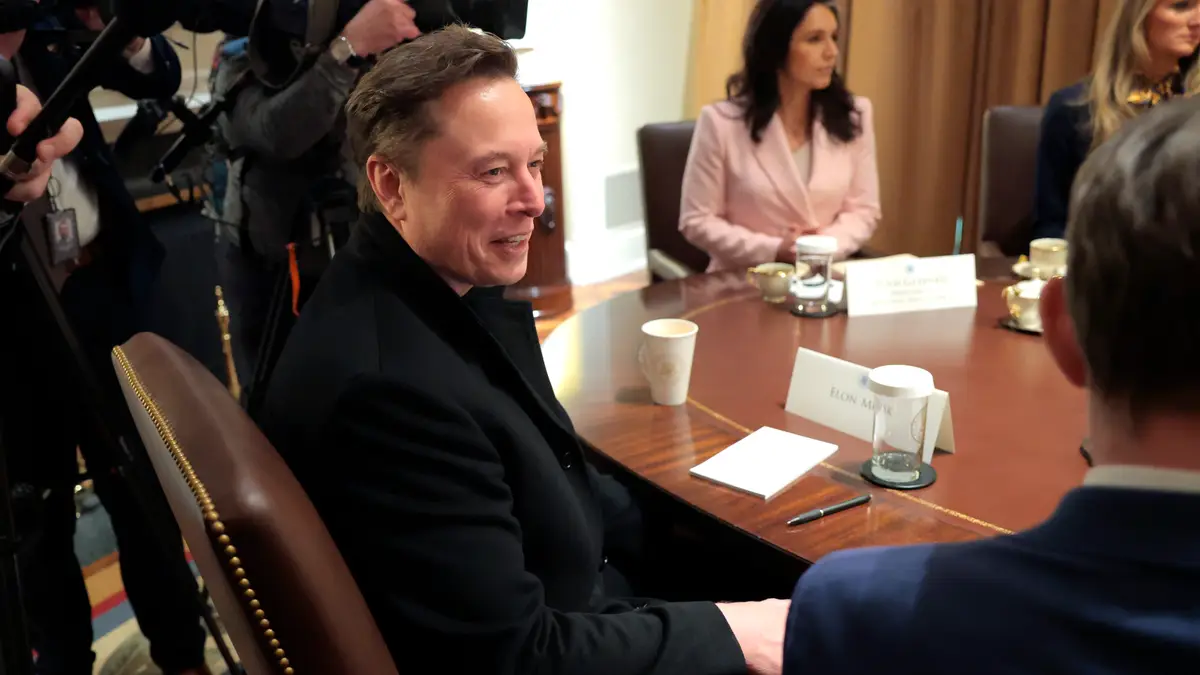
For most of the meeting, Elon Musk wasn’t the loudest person in the room.
He didn’t need to be.
Sitting inside the White House alongside some of the most powerful figures in the Trump administration, Musk appeared unusually relaxed as cameras captured the cabinet gathering from multiple angles.
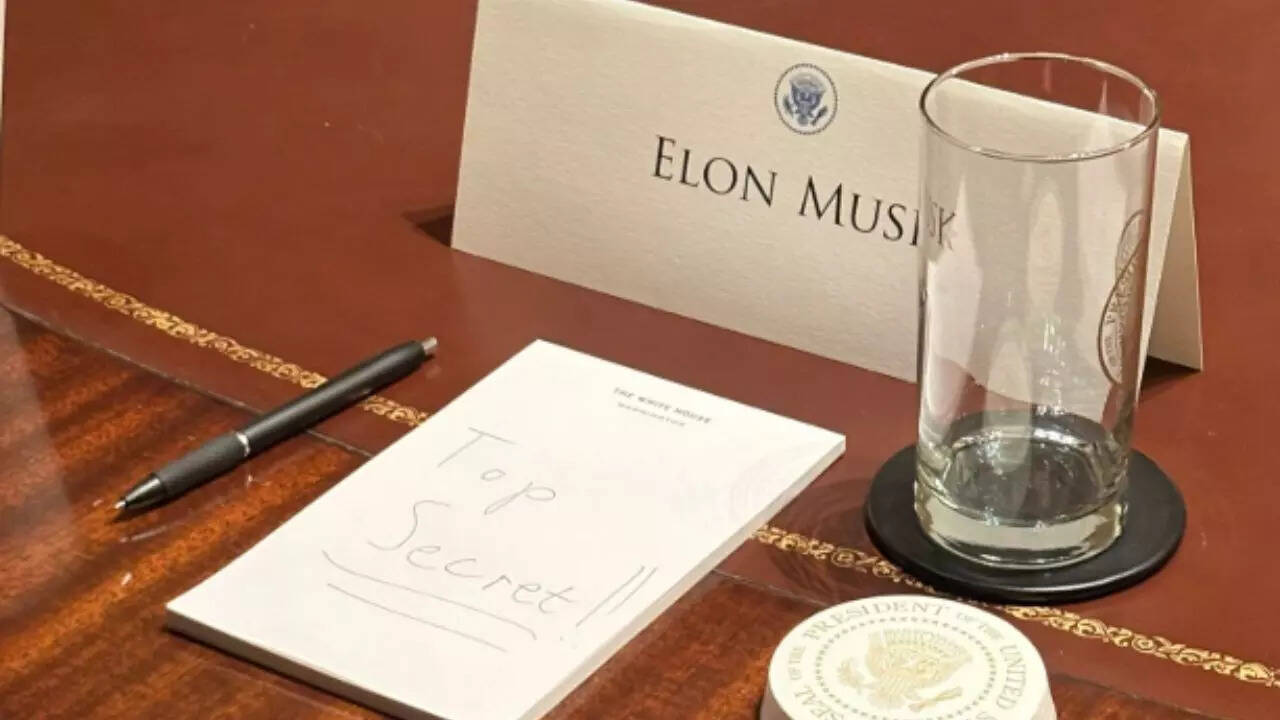
Then someone zoomed in on the notepad in front of him.
Two words were visible.
“TOP SECRET.”
Within minutes, the photograph began circulating online.
And suddenly, people weren’t talking about the cabinet meeting anymore.
They were talking about Elon Musk’s notes.
What made the image even stranger was everything surrounding it.
President Donald Trump sat at the center of an administration that had already attracted intense scrutiny over Musk’s unusually prominent role in Washington.
Cabinet officials around the table had formal nameplates identifying both their names and positions.
Secretary.
Attorney General.
Administrator.
Director.
Then there was Musk.
His placard simply read:
ELON MUSK.
No department.
No title.
No explanation.
For critics who had already questioned how much influence the billionaire entrepreneur held inside the administration, the image was irresistible.
Some immediately treated the nameplate as symbolic.
Musk, they argued, apparently didn’t need a title.
His name itself was enough.
And sitting only feet away from officials who had spent decades building political careers, the world’s most recognizable technology executive looked less like an outside adviser and more like someone who belonged at the center of government.
That perception had been building for months.
Musk had become one of Trump’s most visible allies, appearing repeatedly alongside the president and taking a central role in the administration’s government-efficiency campaign.
Officially, his arrangement with the government carried the designation of a special government employee.
Unofficially, the relationship was much harder to define.
People close to Trump had jokingly referred to Musk as the president’s “First Buddy.”
The nickname stuck because it captured something everyone could see.
Musk wasn’t behaving like a traditional cabinet secretary.
And Trump wasn’t treating him like one.
He moved between the worlds of technology, business and government with an access few private citizens had ever enjoyed.
Every public appearance therefore became an invitation for speculation.
How much power did Musk actually have?
Who answered to whom?
Would the alliance last?
For months, political observers had predicted the relationship would eventually collapse under the weight of two enormous personalities.
Trump was accustomed to being the most dominant figure in any room.
Musk had built his public identity around ignoring conventional authority.
Surely, people argued, something would eventually give.
But that cabinet meeting offered the opposite image.
There was Musk, surrounded by senior administration officials, seemingly comfortable inside one of the most formal settings in American government.
No visible tension.
No public disagreement.
No indication that the expected breakup was approaching.
If anything, his presence reinforced the impression that Trump and Musk remained firmly aligned.
That alone would have generated headlines.
Then came the notepad.
At first, people treated it seriously.
After all, this was a cabinet meeting.
These were government officials.
And the words printed across Musk’s page appeared to suggest exactly the kind of thing journalists are trained to notice.
TOP SECRET.
The timing made the image even more provocative.
Washington was already intensely sensitive to questions surrounding the handling of confidential government communications.
Recent controversies involving officials discussing sensitive matters through private messaging channels had renewed public debate over security, classified information and basic discipline inside government.
Against that backdrop, seeing Musk sitting in a cabinet meeting with something apparently labeled “Top Secret” was almost too perfect.
Screenshots spread.
People enlarged the photo.
Users began studying every visible mark on the page.
Some wondered whether Musk had accidentally exposed something important.
Others speculated about economic policy.
The Trump administration’s aggressive trade agenda had already generated uncertainty around tariffs, markets and relationships with major global competitors.
Could Musk be sketching out some new economic strategy?
Could the page contain plans involving China?
Could it relate to government spending cuts?
Technology?
Artificial intelligence?
Defense?
Federal restructuring?
The fact that almost nothing could actually be read made the speculation worse.
People filled the empty space themselves.
And Musk, perhaps more than almost anyone in public life, understood exactly what happens when the internet is given a mystery.
He had watched it happen countless times.
A cryptic post.
A strange photograph.
A single unexplained comment.
Millions of people would do the rest.
By the time commentators started debating the photograph, the notepad had become more interesting than anything Musk might actually have written on it.
That was when critics began connecting it to a broader concern.
Musk had never behaved like a normal political operator.
For years, he had cultivated a public persona built around unpredictability.
He joked with followers online.
He mocked institutions.
He posted memes.
He turned corporate announcements into internet events.
Sometimes the strategy created enormous publicity.
Sometimes it created controversy.
But it almost always created attention.
That approach had followed him into Washington.
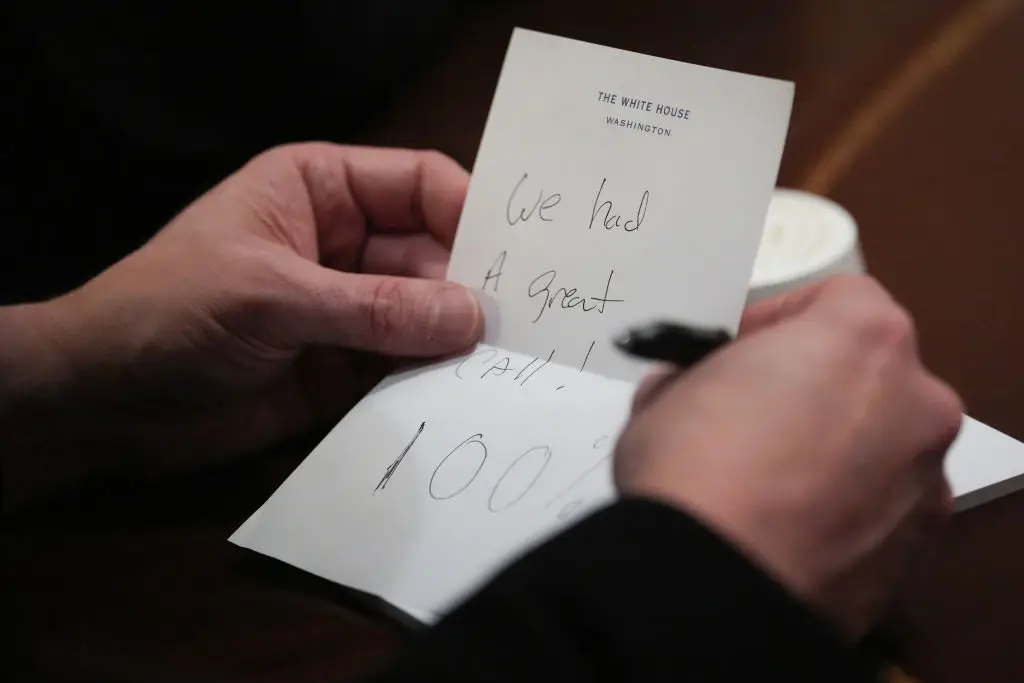
When speculation emerged about tensions between Musk and Transportation Secretary Sean Duffy, cameras later captured Duffy passing Musk a handwritten message dismissing the idea that the two men were feuding.
It was another oddly public moment involving something that normally would have remained private.
A note.
A camera.
A room full of powerful people.
Then the internet.
Now it was happening again.
Only this time, Musk appeared to have raised the stakes.
People began questioning whether someone with significant government access should be treating a cabinet meeting like another opportunity for viral content.
One critic’s reaction captured the frustration spreading online:
This was government, not entertainment.
The responsibilities were real.
The consequences were real.
There were moments, critics argued, when trolling the media stopped being funny.
And after recent concerns about government communications, a page labeled “Top Secret” was exactly the sort of joke many people believed should not be made casually.
For a while, that criticism seemed to be winning.
The image became evidence for whatever people already believed about Musk.
Supporters saw confidence.
Critics saw arrogance.
Some saw an unelected billionaire becoming too comfortable inside government.
Others saw an entrepreneur helping a president challenge a bureaucracy they both considered bloated and ineffective.
Every side had an interpretation.
And the photograph seemed perfectly designed to feed all of them.
Then people looked closer.
That was when the entire story changed.
Because the supposedly mysterious “Top Secret” page didn’t look much like a genuine secret government document.
It looked almost theatrical.
The words were conspicuous.
The markings were exaggerated.
There were dramatic underlines.
There were multiple exclamation points.
Everything about the page seemed designed not to hide information from the cameras…
but to make sure the cameras noticed it.
The realization spread quickly.
Musk may not have accidentally allowed photographers to capture something sensitive at all.
He may have put the words there precisely because he knew photographers would capture them.
In other words, while thousands of people were asking what secret Elon Musk had exposed…
the real possibility was that there had never been a secret to expose.
The media hadn’t caught Musk.
Musk had baited the media.
That interpretation suddenly made the photograph look completely different.
Think about the sequence.
Musk enters one of the most photographed rooms in American politics.
He knows cameras will be pointed toward the table.
He knows every detail surrounding him will be examined because his role inside the administration is already controversial.
He places a notebook where photographers can see it.
Then, in letters large enough to become visible in a zoomed photograph, he writes words guaranteed to make journalists and social-media users curious.
TOP SECRET.
Not subtle.
Not hidden.
Not even particularly believable once examined closely.
But irresistible.
And everyone reacted exactly as expected.
The picture was enlarged.
Theories appeared.
Arguments started.
Posts went viral.
Commentators debated whether the content might involve China, tariffs, government restructuring or something else entirely.
The trap required no complicated strategy.
It only required understanding one simple fact:
Tell people not to look, and they will look.
Tell journalists something is secret, and they will immediately want to know why.
Online, the reaction shifted.
Supporters began laughing at the idea that Musk had deliberately created a media feeding frenzy over what may have been nothing more than a joke.
One user described it as classic Musk: he understood exactly how journalists operated and gave them something impossible to resist.
Another called him a master troll.
Even people who disliked Musk had to acknowledge the mechanics of what had happened.
A photograph of a notebook had generated more curiosity than a carefully prepared press statement ever could.
The same people who had spent hours analyzing whether Musk’s government role gave him too much influence were now helping distribute an image that strengthened his public image as the unpredictable outsider inside Washington.
For his supporters, the episode reinforced exactly what they liked about him.
He wasn’t behaving according to Washington’s usual rules.
He knew the press wanted drama.
So he gave them drama.
Then he watched them amplify it.
For his critics, however, the reveal didn’t erase the original concern.
It made it worse.
They argued that cabinet meetings were supposed to be places where serious government decisions were discussed, not stages for internet jokes.
Musk’s supporters could call it trolling.
His critics could call it juvenile.
Both sides, strangely enough, were reacting to the same fact:
He had successfully taken control of the conversation.
And that may have been the most revealing part of the entire episode.
Look again at that nameplate.
Every other official needed a title because the title explained why that person was in the room.
Musk’s nameplate simply said “Elon Musk.”
At first, critics interpreted that as evidence of status.
Maybe it was.
But there was another explanation.
Musk already carried something many cabinet officials spend their careers trying to build.
A brand.
Millions of people who could never name most cabinet secretaries recognized him instantly.
Put his name on a table and no additional explanation was required.
The strange part wasn’t that the White House gave him a simple placard.
The strange part was how perfectly the entire scene reflected his new position.
He was simultaneously inside the government and outside its traditions.
Official enough to sit in the room.
Unconventional enough to joke about the room.
Close enough to the president to become part of major policy conversations.
Independent enough to keep behaving like Elon Musk.
That combination guarantees attention.
It also guarantees criticism.
And the moment when people realized they may have spent hours speculating about a notebook deliberately created to provoke speculation was visible in the change of tone online.
The certainty disappeared.
People who had confidently treated the page as a clue suddenly began reconsidering what they were looking at.
Comment threads shifted.
Some users laughed.
Others became irritated.
A few simply admitted they had taken the bait.
That is the strange power of a successful troll.
The moment you recognize it, there is almost nothing left to argue about.
You either laugh because you saw the trick…
or become annoyed because you were part of it.
Musk has built much of his public life around understanding that dynamic.
He has provoked regulators, competitors, journalists, politicians and even users of his own platforms.
He has stepped into controversies surrounding artificial intelligence, government spending, geopolitical competition and even questions about America’s gold reserves.
His own AI system, Grok, has at times produced responses challenging claims associated with Musk himself.
Controversy follows him partly because he enters controversial subjects.
But attention follows him because he understands how to keep people watching.
The “Top Secret” notebook was a tiny example of that larger skill.
No major announcement was required.
No press conference.
No television interview.
Just two words on a piece of paper.
By the end of the day, those two words had traveled far beyond the cabinet room.
And whatever else people believed about the stunt, one result was impossible to deny:
Musk had once again made himself the center of a conversation without needing to say very much at all.
That doesn’t mean the criticism was meaningless.
Government is serious.
Security is serious.
Public officials and advisers should expect scrutiny, particularly when sensitive information is involved.
And joking about secrecy at a moment when Washington is already facing questions about information handling will understandably strike some people as reckless rather than clever.
But that tension is precisely why the photograph worked.
If Musk had written something obviously harmless, nobody would have cared.
If he had hidden the page completely, nobody would have seen it.
Instead, he chose the two words most likely to create curiosity in a room filled with cameras.
Then the cameras did the rest.
Perhaps that is the real lesson buried inside one strangely labeled notebook.
Power isn’t only about holding the highest title in the room.
Sometimes it is about understanding what everyone in the room will do before they do it.
The photographers looked.
The internet zoomed in.
The commentators speculated.
The critics reacted.
The supporters laughed.
And Musk barely had to say a word.
Whether you consider that clever media manipulation or exactly the kind of behavior government should avoid probably depends on what you already think of Elon Musk.
But the episode revealed something much bigger than a joke written on paper:
In the modern attention economy, the person who controls everyone’s curiosity can sometimes control the entire room.