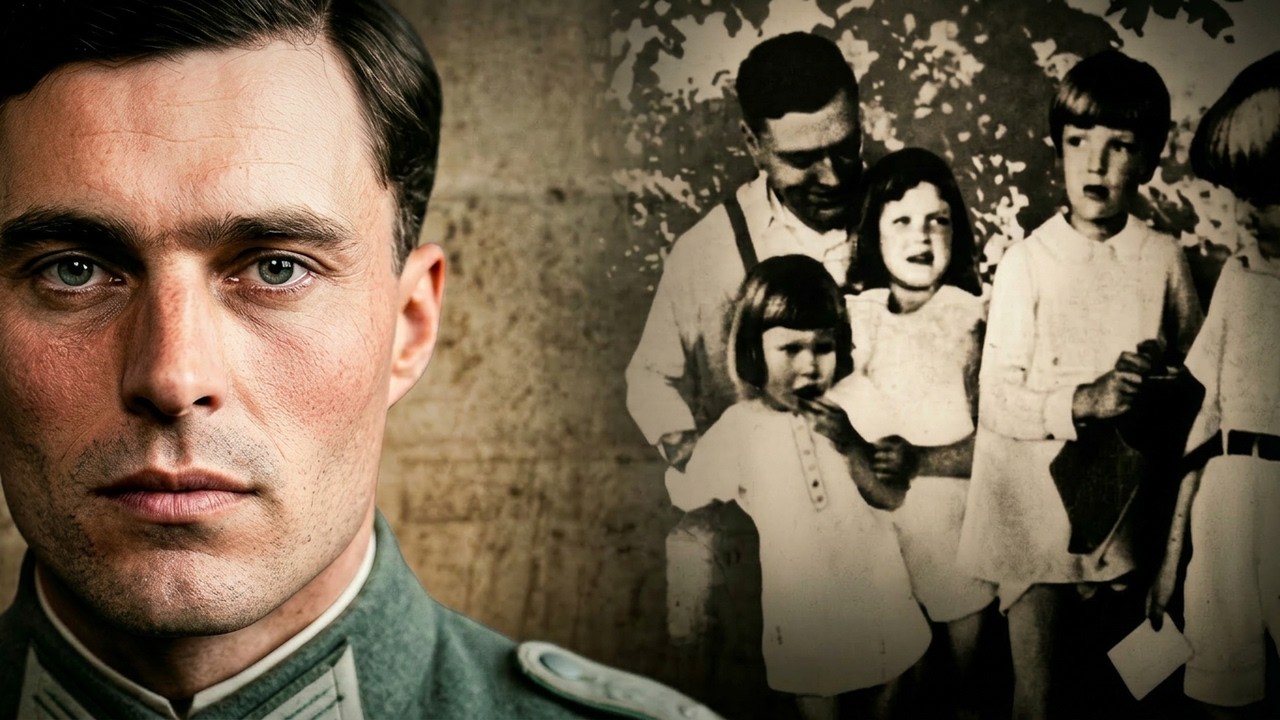
On the morning after Claus von Stauffenberg tried to kill Adolf Hitler, his children woke up carrying one of the most dangerous surnames in Germany.
By the end of the summer, the Nazis had taken that surname away.
Their father was dead.
Their mother had disappeared into the prison system.
Their relatives were being arrested one after another.
And four children—none older than ten—were transported hundreds of kilometers from home and told, in effect, that they were no longer Stauffenbergs.
They were now called Meister.
The regime had failed to kill Hitler’s would-be assassin before he planted his bomb.
So it decided to punish his bloodline instead.
What happened next is one of the strangest and least-known aftermaths of the July 20 plot: a pregnant widow imprisoned while carrying the dead conspirator’s unborn child, four children hidden inside a Nazi home under false identities, relatives marked for collective punishment—and a family name that Hitler’s government intended to wipe away.
The most remarkable part?
The family survived.
And decades later, one of those supposedly disgraced children would become a general in the democratic German army.
Another would sit in Germany’s parliament and later in the European Parliament.
The daughter born while her mother was still a Nazi prisoner would grow up to write about the woman who had somehow kept the family alive.
The men who tried to erase the name disappeared with the Third Reich.
The name remained.
But in July 1944, none of them knew that yet.
All they knew was that Claus von Stauffenberg had just failed.
And failure in Hitler’s Germany did not end with the man who pulled the trigger.
It spread to everyone he loved.
On July 20, 1944, Colonel Claus Schenk Graf von Stauffenberg entered a conference at Hitler’s Wolf’s Lair headquarters carrying a briefcase.
Inside was an explosive.
Stauffenberg had already lost an eye, his right hand, and fingers from his left hand while serving in North Africa. Yet by 1944, he had become one of the central figures in a military conspiracy to assassinate Hitler and use the army’s Operation Valkyrie machinery to seize control of Germany.
The bomb exploded.
Stauffenberg believed Hitler was dead.
He flew back to Berlin.
For several hours, everything depended on that assumption.
But Hitler had survived.
The coup unraveled with astonishing speed.
Orders contradicted one another. Commanders hesitated. Loyalists recovered control. By late evening, the conspirators inside the Bendlerblock in Berlin were trapped.
That night, Stauffenberg was taken into the courtyard.
He was shot by firing squad.
His wife Nina was suddenly a widow.
His four children had suddenly lost their father.
And there was one fact the regime did not yet fully appreciate.
Nina was pregnant.
She was carrying Claus von Stauffenberg’s fifth child.
The revenge machinery was already moving.
The Nazi state had long embraced the idea that punishment could extend beyond an individual offender. After July 20, that logic became brutally personal.
Heinrich Himmler spoke of imposing collective punishment on the families of the conspirators. Members of the wider Stauffenberg family were arrested; Nazi leaders talked in terms of destroying the family to its last members.
The crime, as the regime saw it, was no longer merely what Claus had done.
The crime was being related to him.
Nina had last spoken with her husband only days earlier.
She knew he was involved in plans against the regime, although later family accounts indicate she did not know until very late that Claus himself would carry out the bombing.
Now he was dead, and she had four children looking to her for an explanation.
Berthold was ten.
Heimeran was eight.
Franz-Ludwig was six.
Valerie was three.
Their father, whom they knew as a decorated army officer, had suddenly become the central villain in Nazi broadcasts.
The propaganda language was immediate: traitor, criminal, assassin.
Berthold would later remember the shock of becoming, almost overnight, a “traitor’s child.” His later account described the atmosphere of fear, uncertainty and forced separation that followed the failed coup.
Imagine what that meant at ten years old.
One day, your father wears the uniform of the German army.
The next, the government announces that he tried to murder the Führer.
Then adults begin disappearing.
Doors open unexpectedly.
Strangers arrive.
People stop answering questions.
And your mother has to tell you that your father is dead.
Nina did not have long to grieve.
On July 23, three days after the assassination attempt, the Gestapo arrested her.
She was in the early months of pregnancy.
There would be no funeral to attend, no body to bury, no quiet period in which to explain anything to the children.
Instead, she entered a chain of detention facilities.
Rottweil prison.
The Gestapo headquarters in Berlin’s Prinz-Albrecht-Strasse.
A prison near Alexanderplatz.
And eventually Ravensbrück, the notorious concentration camp for women.
She spent months in isolation.
Pregnant.
Widowed.
Separated from her children.
Unsure who in the extended family was alive.
And aware that the regime arresting her had publicly threatened vengeance against families like hers.
The interrogators wanted information.
Nina understood something essential: every name she unnecessarily gave them could endanger another person.
Accounts of her imprisonment describe a woman who answered what could no longer be concealed while refusing to hand investigators anything useful beyond what they already knew.
Then came a second blow.
The children were taken too.
On August 17, the four Stauffenberg children were removed from their family and transported to a children’s home at Bad Sachsa, in the Harz region.
They were not alone.
Dozens of children connected to members of the July 20 resistance were eventually held there.
Some were babies.
Others were teenagers.
They had something terrifying in common.
Their fathers, mothers or relatives had become enemies of the state.
And the children were paying for it.
The facility in Bad Sachsa became part orphanage, part detention site, part identity-erasure experiment.
The children were told not to use their true names.
The Stauffenberg children were given the surname Meister.
That detail sounds almost bureaucratic.
It was not.
A surname is one of the first things a child learns about himself.
It connects him to parents, grandparents, siblings, stories, property, belonging.
Now imagine a government taking it away because your father committed an act of resistance.
Berthold was no longer supposed to be Berthold von Stauffenberg.
Franz-Ludwig was no longer supposed to be Franz-Ludwig von Stauffenberg.
The name that had existed before Hitler was now treated as if the state had the authority to delete it.
The children were warned not to reveal who they really were.
Elsewhere in the system of Sippenhaft—collective family punishment—adult relatives were transported among prisons and concentration camps.
The regime wanted the conspirators to understand that resistance could destroy more than themselves.
It could consume their wives.
Their mothers.
Their brothers.
Their children.
That was the point.
Terror worked best when the punishment survived the victim.
But there was a problem with the Nazi plan.
Children remember.
They whisper.
They compare stories.
They understand more than adults sometimes expect.
And even when the government gives a child a new surname, it cannot necessarily make him believe it.
At Bad Sachsa, children from different resistance families gradually discovered one another’s identities.
One former child prisoner later recalled the absurdity of being ordered to conceal real names while the children themselves found ways around the rule. The institution could control the records.
It could not completely control memory.
Still, nobody could tell the Stauffenberg children what mattered most.
Where was their mother?
Was she alive?
Would she ever return?
What would happen to them if Germany won?
The answer to that last question may have been the most frightening of all.
Evidence from the period indicates that Nazi authorities considered placing younger children from resistance families with politically reliable families, effectively severing them from their origins.
The war ended before such plans could fully determine the Stauffenberg children’s fate.
Think about the implication.
Killing Claus would not have been enough.
Imprisoning Nina would not have been enough.
Changing the children’s surname would not have been enough.
The final act would have been to raise the next generation somewhere else, perhaps under another identity, with another story about who their father had been.
It was not simply revenge.
It was an attempt to control memory.
And while the children waited in Bad Sachsa, their mother was fighting a different battle.
Not with weapons.
With endurance.
Ravensbrück was a place designed to destroy people.
Nina entered it pregnant.
She had reasons to believe she might never leave.
According to biographical accounts, during confinement she prepared a will.
She forced herself into routines.
She recalled literature and music from memory.
She played cards alone.
She relied on faith.
Most of all, she concentrated on the unborn child.
There was something almost defiant about the pregnancy itself.
Her husband had been shot.
The regime had declared his name poisonous.
His existing children had been stripped of that name.
And yet another Stauffenberg was still coming.
Every week the pregnancy continued was, in the most literal sense, evidence that the family had not been extinguished.
By January 1945, Germany was collapsing.
The Red Army was advancing rapidly from the east.
Cities were being bombed.
Railways were breaking down.
Millions of people were moving through a country whose institutions still had enough power to imprison and kill, but increasingly lacked the power to control what came next.
Nina was transferred out of Ravensbrück to give birth.
On January 27, 1945, in Frankfurt an der Oder, she delivered a daughter.
A baby girl.
She named her Konstanze.
Claus von Stauffenberg had been dead for more than six months.
He would never see her.
Konstanze would never meet him.
She entered the world while her mother remained a prisoner of the regime her father had tried to overthrow.
There is an extraordinary symmetry in the timing.
That same day—January 27, 1945—the Soviet army liberated Auschwitz.
Across Europe, one of the central killing sites of Nazi Germany was being opened to the outside world.
Meanwhile, in a maternity facility inside the collapsing Reich, the child of Hitler’s would-be assassin was taking her first breath.
The regime had wanted the family erased.
Instead, another member had just been born.
But survival was not yet victory.
Nina still did not know when she would see her other children.
The infant was fragile.
Transportation was chaotic.
The front was closing in.
Nina and Konstanze were moved again, at one point receiving medical care in Potsdam while living under another altered name.
The woman who had once been Nina Schenk Gräfin von Stauffenberg—wife of an aristocratic army officer, mother in a respected German family—was now crossing the disintegrating Reich like a person whose identity itself had become contraband.
And then the family received another terrible blow.
Nina’s mother, Anna, had also been imprisoned.
She died in detention during the final months of the war.
Nina had lost her husband.
Her children had been taken.
Now her mother was gone too.
Yet she still had the newborn beside her.
There was no time to collapse.
The war was reaching its final weeks.
And the Nazis began moving prisoners.
By April 1945, the map of Germany was shrinking by the day.
Allied armies approached from the west.
Soviet forces came from the east.
The regime that had once stretched across much of Europe was retreating toward fragments of territory.
But even now, SS and security officials were moving prisoners around as bargaining chips, hostages or burdens they did not know what to do with.
Members of resistance families were among them.
Some adult Stauffenberg relatives were transferred through the concentration-camp system and eventually moved toward the Alpine region with other prominent prisoners. American forces later liberated groups of such hostages in South Tyrol.
Nina’s route with the infant was different.
She was transported under guard through southern Germany.
At some point, the machinery began to fail in the most mundane way possible.
Orders became unclear.
Destinations shifted.
The men tasked with guarding prisoners were watching a state disintegrate around them.
And then came one of the strangest reversals in the entire story.
After months in which the Nazi government seemed omnipotent—able to seize a woman, remove her children, rename them and move relatives across a network of prisons—the authority holding Nina effectively began to evaporate.
Her guard had no coherent future for her.
The regime could still issue commands.
But increasingly, nobody knew which commands mattered.
Nina eventually reached the area around Trogen in Bavaria.
There, exhausted and with a baby, she refused to continue.
Her guard let her remain behind.
The woman whom Hitler’s government had treated as the dangerous widow of its greatest internal enemy simply ceased, in practical terms, to be its prisoner.
No dramatic prison assault freed her.
No commando unit broke through a gate.
The Third Reich had weakened so badly that it could no longer reliably maintain custody of the woman it had spent months punishing.
That was the first great reversal.
But there was still one question.
Where were her four children?
At Bad Sachsa, the children had watched the war come closer too.
By then, their false identities had become part of everyday life.
The home contained children with different stories but the same wound: they had been separated from families because of what adults had done against Hitler.
Then, in April 1945, American forces entered the area.
The political universe of the children changed almost overnight.
The government that had told them their fathers were criminals was disappearing.
The adults representing that government no longer controlled the future.
One account from Bad Sachsa preserves a remarkable moment.
After liberation, the children were told they could once again use their real names.
A former detainee recorded the message in his diary: they did not have to be ashamed of those names or of their fathers.
The fathers had been called traitors.
Now someone was telling the children they had been heroes.
That was a sentence larger than it appeared.
For months, the children had lived inside a system built on one assumption:
Hitler represented Germany.
Therefore anyone who tried to kill Hitler had betrayed Germany.
But once Hitler’s regime collapsed, another possibility emerged.
Perhaps betrayal and loyalty had been reversed.
Perhaps the men branded traitors had actually been attempting to save their country from catastrophe.
Perhaps the shame belonged somewhere else.
The Stauffenberg children could reclaim their surname.
But they still did not have their mother.
Liberation did not magically repair transport routes.
It did not reunite families instantly.
Germany was a landscape of bombed stations, broken communications, displaced civilians, liberated prisoners and refugees trying to discover who was still alive.
Weeks passed.
The children remained at Bad Sachsa.
Then, in June, a relative arrived.
Their great-aunt was able to organize transport.
On June 11, the remaining Stauffenberg children were taken away from the institution and brought back toward Lautlingen, the Stauffenberg family seat in southern Germany.
They had entered Bad Sachsa as “Meister.”
They left as Stauffenbergs.
Yet one person was missing from the reunion.
Nina.
Her children were free.
Their mother was free.
But neither side had been able to simply telephone the other and arrange a meeting.
For a little longer, the family remained scattered across the ruins of Germany.
Then, finally, Nina returned.
She arrived not alone, but carrying the sister the four older children had never met.
Konstanze.
The baby born after their father’s execution.
The baby born while their mother was still in Nazi custody.
The child who had spent her first months moving through a collapsing dictatorship.
The family was together again.
Five children.
One mother.
No father.
But the name was still there.
And that should have been the end of the nightmare.
It wasn’t.
Because the fall of Hitler did not immediately transform Claus von Stauffenberg from “traitor” into national symbol.
That change would take decades.
The Stauffenberg children grew up in a Germany that did not know what to do with their father.
Today, ceremonies honor the July 20 conspirators.
German military recruits have taken solemn oaths at the Bendlerblock on anniversaries of the assassination attempt.
Streets bear Stauffenberg’s name.
Films portray the plot.
The German resistance is part of the Federal Republic’s public memory.
But postwar Germany did not begin there.
Nazi propaganda had spent years glorifying absolute loyalty and condemning resistance as treason.
Those ideas did not disappear on May 8, 1945.
Many Germans had served in the Wehrmacht.
Many had sworn personal oaths to Hitler.
Many had lost sons, husbands and fathers in the war.
To them, an officer who planted a bomb under his commander’s table could still look like an oath-breaker, even after the dictatorship was gone.
Public-opinion research from the early Federal Republic shows how contested the July 20 legacy remained.
In 1951, fewer than half of surveyed Germans viewed the “men of July 20” positively.
In 1956, when respondents were asked about naming a school after Claus von Stauffenberg or civilian resistance leader Carl Goerdeler, only a minority supported the idea.
For years, the word traitor remained close to the family.
So the children entered adulthood carrying an inheritance that was both famous and suspect.
Berthold, the oldest, remembered the transformation vividly.
At ten, he had gone from being an officer’s son to a “traitor’s child.”
After the war, he had to watch the meaning of his father’s act be argued over by a society rebuilding itself from dictatorship.
Then Berthold made a choice that, at first glance, seems almost impossible.
He became a soldier.
Not in Hitler’s army.
In the new Bundeswehr, the armed forces of democratic West Germany.
The son whose father had been executed by German officers after trying to overthrow Hitler entered military service under a new constitutional order.
And he stayed.
He rose through the ranks.
Eventually, Berthold Schenk Graf von Stauffenberg became a major general.
The child whom the Nazis had renamed because “Stauffenberg” was supposed to disappear became one of the highest-ranking officers carrying that same surname in the postwar German military.
There is almost no way Hitler’s officials could have imagined the irony.
They had tried to make the children forget who they were.
One of those children later wore a German general’s uniform under a democratic constitution in which obedience to criminal orders was no longer supposed to be the highest military virtue.
And the symbolic reversal became even deeper.
The Bundeswehr eventually came to treat the July 20 resistance as part of its own moral tradition.
The Bendlerblock—the site where Claus von Stauffenberg had been executed—became part of Germany’s official military landscape.
German leaders have repeatedly used July 20 to emphasize that soldiers are responsible not merely for obedience, but for the defense of constitutional democracy.
For more than two decades, Bundeswehr recruits have taken ceremonial vows on July 20, the anniversary of the failed coup.
Read that again.
Claus von Stauffenberg was shot in a German military courtyard as a traitor.
His son became a German general.
And generations of German soldiers later stood at that same historic complex while the state publicly honored the moral meaning of resistance to dictatorship.
The name had not merely survived.
The institution that once executed the father had changed the meaning attached to his act.
But Berthold was not the only child whose life produced an extraordinary reversal.
Franz-Ludwig—the six-year-old who had also been taken to Bad Sachsa and given the surname Meister—grew up to study law.
Then he entered politics.
In 1972, he became a member of the Bundestag, the parliament of West Germany.
He served there until 1984.
After that, he entered the European Parliament, serving from 1984 to 1992 and later chairing its Committee on Legal Affairs and Citizens’ Rights.
That transformation is difficult to exaggerate.
The Nazis had treated him as a child guilty by blood.
The democratic state later treated him as a citizen elected to make laws.
A regime based on inherited guilt had tried to erase his identity.
He later served in institutions built around individual rights, elections and constitutional government.
Then there was Konstanze.
The child Claus never knew existed outside the womb.
The daughter born in Frankfurt an der Oder while her mother was still under Nazi control.
She grew up, married, lived in Switzerland and eventually became an author.
In 2008, she published a biography of Nina.
The baby whose arrival the Nazis could not prevent became one of the people responsible for preserving her mother’s story.
That may be the most elegant reversal of all.
The regime tried to control the family’s identity.
The youngest child grew up and helped write it down herself.
Nina, meanwhile, lived a long life.
Long enough to watch Germany become something almost unimaginable from a Ravensbrück prison cell.
She saw Hitler’s dictatorship collapse.
She saw two German states emerge.
She saw West Germany build a parliamentary democracy.
She saw the Bundeswehr created.
She saw her son become one of its generals.
She saw another son become a parliamentarian.
She saw the July 20 conspirators move slowly from the margins of postwar memory toward official commemoration.
She saw the Berlin Wall rise.
She saw it fall.
She saw Germany reunified.
And she lived until 2006.
She was 92 years old when she died.
But the family did not pass through the postwar years untouched.
Survival is not the same thing as escaping loss.
Valerie, the daughter who had been only three when her father was executed, died of leukemia in 1966 at just 25.
Other family members carried memories of imprisonment and upheaval for the rest of their lives.
The July 20 legacy itself remained complicated.
Historical scholarship has never reduced Claus von Stauffenberg to a simple modern democrat.
He came from an aristocratic, conservative military environment.
His political thinking changed over time.
Like many members of the German military resistance, he did not begin as an opponent of every aspect of National Socialism, nor did his vision of Germany necessarily resemble the liberal democratic Federal Republic that emerged after 1949.
Modern historians continue to debate his motives, his earlier attitudes and the political order that conspirators might have created had the coup succeeded.
That complexity matters.
Because courage does not require a flawless protagonist.
It requires a moment in which a person understands what obedience has become and decides that continuing to obey is worse than resisting.
By 1944, Stauffenberg and the conspirators around him had reached that point.
They knew the war was catastrophic.
They knew mass murder had been carried out.
They knew killing Hitler could mean their own deaths.
And they knew failure could endanger everyone connected to them.
The terrible proof came after the bomb went off.
The children.
The wives.
The brothers.
The parents.
The confiscated property.
The interrogations.
The prisons.
The concentration camps.
The false names.
The policy of Sippenhaft made clear exactly what sort of regime they had challenged.
Hitler demanded not only obedience from individuals.
He demanded that fear extend through generations.
And that is why what happened to the Stauffenberg family after July 20 matters almost as much as what happened inside the Wolf’s Lair.
The bomb failed.
But the revenge revealed the regime.
There is one image that captures the entire story.
Not the famous photograph of Claus in uniform.
Not the devastated conference room after the explosion.
Not the Bendlerblock courtyard.
Imagine instead four children sitting in a Nazi-controlled home hundreds of kilometers from their mother.
They have been told to answer to another surname.
Somewhere far away, their pregnant mother is in custody.
Their father is dead.
The government says he was a traitor.
The government says their real name is dangerous.
The government assumes it will decide who those children become.
Then move the scene forward.
The regime collapses.
The doors open.
The children reclaim their names.
Their mother survives.
A baby sister appears whom they have never met.
Years pass.
One boy puts on the uniform of democratic Germany and becomes a general.
Another walks into parliament as an elected legislator.
The baby grows up and writes the story of the woman who carried her through the ruins.
And back at the Bendlerblock, the place where their father had been shot, representatives of a new Germany gather to honor resistance to tyranny.
That is the plot twist history wrote better than fiction could.
Hitler survived Stauffenberg’s bomb.
Claus did not.
For a few terrible months, that looked like the only outcome that mattered.
But dictatorships often misunderstand time.
They measure victory by who controls tonight’s prison cells.
Who signs tomorrow’s execution orders.
Whose name can be removed from a document.
Whose children can be frightened into silence.
History measures differently.
Hitler’s state survived the July 20 bomb by less than ten months.
The family it tried to erase survived for generations.
And the surname it tried to turn into a mark of disgrace became permanently linked to the question every dictatorship fears:
What does a person owe his conscience when obedience itself becomes a crime?
The Nazis had tried to answer that question by terrorizing the children.
Postwar Germany eventually answered it in another way.
Not perfectly.
Not immediately.
But unmistakably.
In the democratic Bundeswehr, obedience would no longer be treated as an unlimited virtue.
German soldiers would be citizens in uniform.
The constitution, not one leader’s will, would stand above personal loyalty.
And July 20 would become a warning embedded in the identity of the new armed forces.
This is why Berthold’s later career carried such extraordinary symbolic weight.
His father had been executed for refusing to obey a criminal regime to the end.
The son served a state that eventually built the right—and duty—to resist unlawful authority into its democratic understanding of military service.
The Nazis had wanted the boy to inherit shame.
Instead, he inherited a question.
And he spent his adult life in an institution forced to confront it.
Perhaps the cruelest part of Sippenhaft was its assumption that a family is merely an extension of one man.
Punish the husband, punish the wife.
Punish the father, punish the child.
Erase the surname, erase the memory.
But families are not administrative files.
Memory travels through people.
Through photographs.
Through stories told at dinner tables.
Through children asking why their father never came home.
Through mothers who survive long enough to tell them.
Through books written decades later.
Through public ceremonies.
Through arguments about guilt.
Through names that reappear where a dictatorship once forbade them.
Nina could not save Claus.
She could not stop the firing squad.
She could not prevent the Gestapo from arresting her.
She could not prevent officials from taking her four children away.
For months, she could not even guarantee that her unborn baby would be born into a world where either of them would survive.
Yet she did one thing the regime could not reverse.
She endured.
And because she endured, the Stauffenberg family story did not end in a Berlin courtyard on July 20, 1944.
It continued in a prison cell.
In Ravensbrück.
In a maternity ward in Frankfurt an der Oder.
In Bad Sachsa under the false name Meister.
On ruined German roads in the spring of 1945.
At Lautlingen when a scattered family finally came together.
Inside the Bundeswehr.
Inside the Bundestag.
Inside the European Parliament.
And inside the memory of a country that took decades to decide whether the men of July 20 had been traitors or something far more uncomfortable:
Germans who recognized, before the regime collapsed, that loyalty to a nation could require disobedience to its dictator.
There is a final irony.
Hitler’s government possessed enormous power in 1944.
It controlled armies.
Police.
Prisons.
Courts.
Radio.
Schools.
Newspapers.
Identity papers.
It could arrest a pregnant widow.
It could place children in custody.
It could order them to forget their surname.
But it could not control what that surname would mean eighty years later.
Stauffenberg survived Hitler not because the bomb succeeded, but because the people Hitler tried to erase lived long enough to take their names back.