Nobody texted to ask if Molly Allen made her connection. Nobody called to see if she was hungry. Eleven hours on a Greyhound from Nashville, and her welcome home was a dark house, a frozen chicken casserole, and a Post-it note in her mother’s handwriting: “Heat at 350. ”
The seating chart taped to the fridge did the rest of the talking.
Gemma’s name sat at the sweetheart table in gold accents. Molly’s name sat at table nine, tucked by the venue’s restroom doors, between a second cousin who drank too much and a stranger nobody could name. She pressed her thumb into the black ink of her name and rubbed it until it smeared. Below the chart, a new line had been slashed onto the itinerary in red pen—Gemma’s handwriting, aggressive, underlined twice: “After suit fitting, steam the dresses and jackets.
”
Not a request. A mandate from management to the hired help. Molly folded the paper into a rigid square and shoved it in her pocket. She knew her place in this house.
She’d known it for eighteen years. It started at her father’s hardware store when she was nine. Gemma, age six, rode a lumber cart down aisle four and slammed into an end cap. Screws scattered across the concrete in a silver flood.
Her father chuckled, hoisted Gemma onto his shoulders, and handed her candy. Then he looked at Molly and jutted his chin at the mess. She spent three hours on her hands and knees sorting Phillips heads from flatheads while her sister ate candy in the air-conditioned office. The child who caused the disaster got rewarded.
The child who cleaned it up got nothing. That was the family philosophy in action. Nobody praises the load-bearing wall. Nobody thanks the beam holding up the ceiling.
The wall holds weight, gets painted over, and is expected not to complain. When the hardware store drowned under corporate competition, Molly’s college acceptance letter sat on the kitchen table. Partial scholarship, not enough to cover the gap. Gemma, fourteen, scraped cereal and said, “You’re smart.
You can figure it out. ” Her father stared at his supplier invoices and said nothing at all. The silence was the answer. Molly crushed the acceptance letter in her fist and dropped it in the trash.
Then she drove to a strip mall and signed an enlistment contract with the Army. She lied to them that night. Told them she lost the scholarship, took a data entry job out west. Her father’s shoulders physically dropped with relief.
He didn’t have to pay for her. The lie made him comfortable, so she let it become the family legend. Two years later, she set up automatic transfers from her military pay to cover the property taxes on the Ohio house. The homeowners insurance came out of her hazard pay.
The foreclosure notices stopped. Nobody asked how. They used the breathing room to send Gemma to private college, and Gemma used every holiday phone call to mock her sister’s failures. “I just bought Mom a new dishwasher.
Since you can’t contribute anything, someone has to step up. ”
Molly let her talk. The girl standing on her shoulders had no idea what those shoulders had cost. July 2014.
Afghanistan. A dry ditch, eleven men pinned behind a crumbling wall, an IED blocking the extraction route. Molly worked forward on her belly, cleared the sand with her fingertips, found the primary trigger. A secondary device detonated beneath her, and fire latched onto her left arm, melting the uniform into her skin.
She couldn’t drop. She couldn’t roll. The primary was still live and eleven men were behind her. She slammed her burning arm against the earth and drove her knee into the flames.
For ninety seconds she worked with her arm cooking, her right hand steady, cutting the command wire with a pair of cutters. The detonator went dead. So did she. Eleven months in a burn unit in San Antonio.
Twice-weekly debridement, a metal tool scraping dead tissue and infection from her arm while she bit down on a plastic block. She called home every Sunday from a concrete bench in the courtyard, hiding the pain in her voice. Her mother spent twenty minutes complaining that the church roof had been painted charcoal instead of slate. Molly said she was sure they’d fix it.
Her mother never asked where she was calling from. She came home on medical leave that summer, sixteen pounds lighter, hollowed out, wearing long sleeves in July. Gemma walked in from a weekend at the lake, tanned and designer-clad, and sneered: “God, you look like trash. ”
Molly adjusted her cuff, making sure the button covered the grafts, and said she was recovering from a busy season at work.
Friday night of the wedding week, she moved through the living room like furniture, clearing empty bottles while Gemma held court. William, the groom, stood at the kitchen island watching the chaos. When Molly reached for the empty bourbon glass near his elbow, he clamped his hand over the base and held it still. He looked at her, looked at the trash bag, looked at his future wife laughing in the other room.
He didn’t say a word. He slid the glass toward her and let go. An engineer, calculating load distribution. He was starting to see the cracks.
Saturday morning, Gemma threw a garment steamer at her feet. “Nine a. m. , Mercer tailor shop.
Declan’s suit is linen. Don’t burn it. ”
She left without waiting for a response. Molly buttoned her flannel tight over her wrist bone and drove into town.
The tailor shop smelled of cedar blocks. Molly stood in the back corner running steam over linen jackets while Gemma held court by the mirrors. Declan, the best man, stood rigid as a board. Former Army Ranger, two tours in Kandahar.
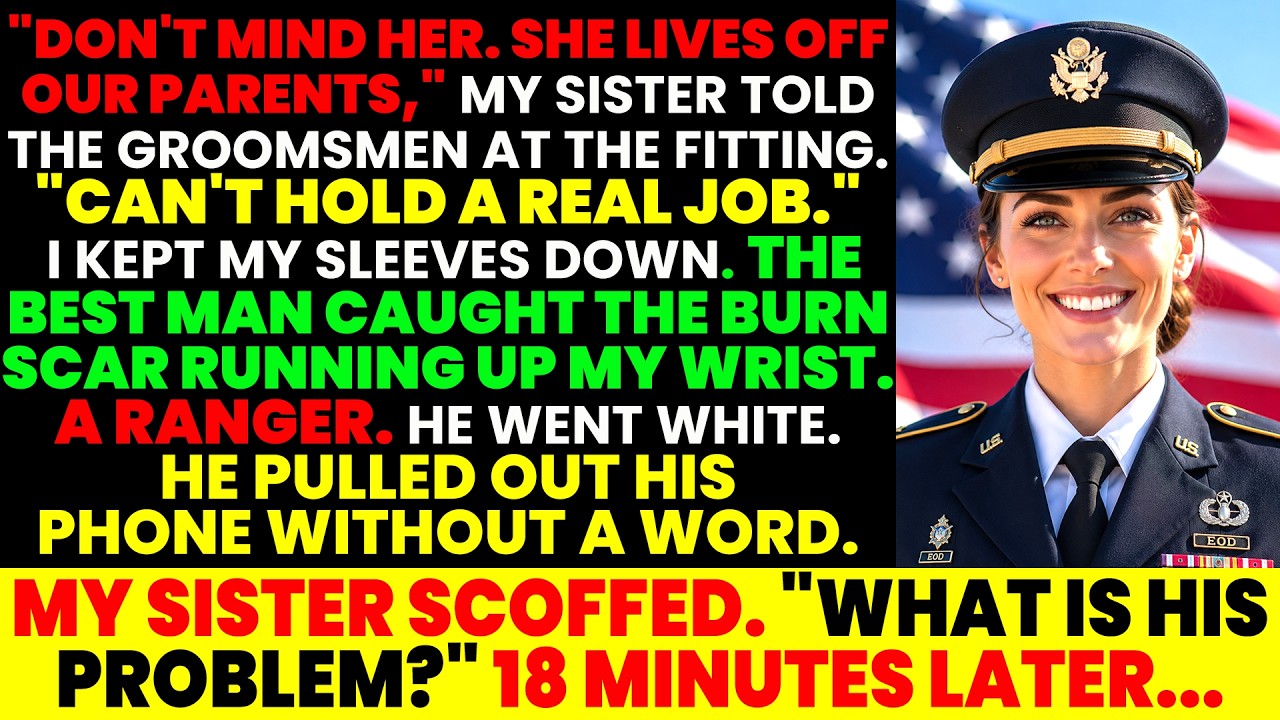
He watched Gemma with exhausted tolerance. One of William’s college buddies leaned in and asked Molly what she did for work. The old lie was almost out of her mouth when Gemma’s voice cut across the room, smooth and lethal. “Don’t bother asking her.
She just leeches off Mom and Dad. Can’t hold down a real job to save her life. ”
Jude barked out a laugh. A few other groomsmen chuckled.
Then Molly’s father set down his coffee mug and let out a soft, agreeing laugh. “Every family has a late bloomer, right? At least she stays out of the way. ”
The air left Molly’s lungs.
He knew. The man on that sofa knew whose money paid his mortgage, knew about the thrown-away scholarship, and he still threw her under the bus to save face with a group of yuppies. She reached up to hang a jacket on the top rack, stretching through the left sleeve. The old flannel shifted.
Snap. The button split off the cuff. The fabric rolled back four inches, and the harsh lights hit the scar. The thick, melted webbing wrapped around her wrist and crawled up her forearm.
Across the room, Declan Carter went white. He crossed the floor in three strides and grabbed her wrist with a tactical hold. “Where did you get that? ”
“Old workplace accident.
Chemical fire. ”
He stared at her and saw through it. The man had spent two tours in Kandahar. He knew exactly what an IED blast did to human tissue.
He let go, pulled out his phone, and walked outside. Eighteen minutes later, a Ford F-150 slammed into the curb. Two big men in work boots pushed past Gemma without acknowledging her and stopped ten feet from Molly. Brody stared at her arm and swallowed.
Asher, a former combat medic, spoke two words. “Hazard 21. ”
Declan stepped back in behind them. The polite groomsman was gone.
The ranger was back. His voice cracked when he spoke. “Tell me I’m wrong, Master Sergeant. Look me in the eye and tell me you’re not the one.
”
Molly squared her shoulders and dropped into a rigid military posture. “I can’t do that, Sergeant. ”
Declan turned to her father, who had risen from the leather sofa, his coffee cup rattling. Gemma froze, mimosa spilling over the edge of her plastic flute.
“July 2014,” Declan said. “An EOD specialist pinned her burning arm against a live explosive so eleven of us could walk out alive. I carried her to the medevac. I held her down while she went into shock.
”
He stepped toward Gemma. “You just called a hero a leech. With money she probably bled for. ”
The lie was dead.
William met Molly behind the shop that afternoon. “I’ve eaten eleven dinners at your parents’ house. They’ve asked you zero questions about your life. I’m marrying into this family tomorrow.
I need to know the structural integrity of the house I’m walking into. No more ghost stories. ”
“Come to the house Sunday night. After the wedding.
”
The reception ended. Molly sat her parents down on the porch and laid out the inventory: the crushed scholarship paper, the recruiting office, the ninety-second fire in the dry ditch, the eleven months in the burn unit, the steel tools scraping her arm. Her mother’s face crumbled. Her father stared at the floorboards.
She pulled out her phone and opened the county assessor’s portal. “You haven’t paid property tax on this house in nine years. The money came from my hazard pay. The leech you laughed at is the only reason the bank didn’t take this porch out from under you.
”
Gemma arrived hours later, still raging, humiliated that Declan wouldn’t look at her. “You could have just told me. ”
“You were never upset about what happened to me,” Molly said. “You were upset that it made you look bad.
I let you be wrong, Gemma. But you chose how loud and cruel it was going to be. I’m not your maid anymore. ”
At two in the morning, Molly watched from the garage loft as Gemma’s laptop screen glowed through her bedroom window.
She was digging through military archives, reading the official commendation. The words she didn’t want to face. By eight, Gemma stood at the loft door in a baggy sweatshirt with two cups of gas-station coffee. Her face was raw from crying.
“Why didn’t you tell us? Why did you let us treat you like that? ”
“Because the guilt would have crushed you,” Molly said. “So I took the hit.
It was the only way to keep the structure standing. ”
Gemma sobbed into her arms on the table, waiting for Molly to fix it, to absorb the impact like she’d absorbed the blast. Molly stayed in her chair. No tissue.
No comfort. People need to feel their own pain. If you cushion the blow, they’ll just drop the heavy object again tomorrow. Gemma eventually stood, took her cup to the sink, and tried to wash it.
The job was clumsy—soap film on the outside, coffee grounds pooling inside. Every instinct screamed at Molly to get up and fix it. She didn’t move. The wedding took place under a white tent the next night.
At the entrance, a new seating chart had been handwritten on parchment. Molly was at table two, front and center, next to the immediate family. William’s parents stopped at their table to greet Molly’s mother, who stood up straight, pulled her shoulders back, and said, “I want you to meet my oldest daughter. Master Sergeant Molly Allen, Army Explosive Ordnance Disposal.
”
On Molly’s dinner plate sat a heavy card. “Hazard 21” printed on the front. Inside, eleven names written in Declan’s block lettering. Every man she’d pressed her burning arm into the dirt for.
She closed the card and slid it into her breast pocket. At the head table, Gemma tapped a fork against her glass. Her toast was short. “To the people who always show up early and do the heavy lifting in the dark.
Thank you. ”
Then she looked at Molly, just for a second, and raised her glass. The dance floor filled. Molly walked to table four, where Brody, Asher, and Declan sat nursing beers.
No speeches. Brody lifted his bottle an inch. Asher and Declan did the same. Molly raised her bourbon, drank, and set the glass down.
She reached for her left cuff. Snapped the button. Folded the fabric back, past her elbow, until the scar was fully exposed to the cool Ohio air. Nobody stared.
Brody said, “So you think Cleveland has a shot this year? ” Asher told him the pitching rotation was garbage. That ordinary, boring normalcy was the greatest victory of her life. The next morning, she threw her duffel into her truck and climbed in.
She rolled down the window and rested her scarred arm on the metal door frame, sleeve still rolled up, nothing left to hide. She pulled out onto the asphalt and drove west.