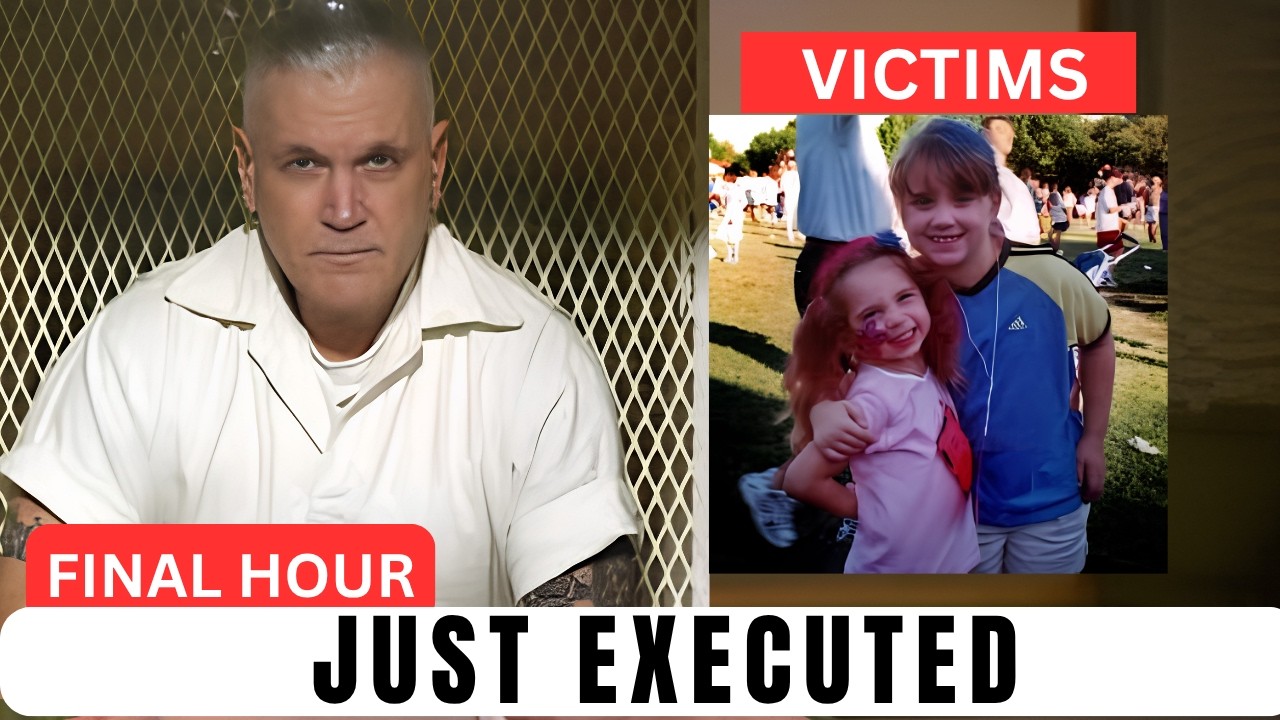
The state of Texas executed John Battaglia by lethal injection on the evening of February 1, 2018, for the murders of his two young daughters, Faith and Liberty, in a crime designed as the ultimate act of revenge against his estranged wife. In his final hours, the 62-year-old former certified public accountant showed no remorse, choosing instead to greet the mother of his victims with a casual, almost friendly remark as she watched through the execution chamber glass.
Battaglia’s last meal request reflected a man still in control of his own narrative. According to prison officials, he declined the traditional final meal offered by the state, instead ordering a single meal of pizza and a Pepsi. He ate calmly, as he had done for years on death row, while advocates and legal teams mounted their final appeals.
All were denied.
The final 24 hours began with Battaglia being moved from his cell on death row to a holding cell near the execution chamber at the Huntsville Unit. He spent the morning with his spiritual adviser and spoke briefly with his attorneys. No family members visited him.
The only person who had any connection to him in the outside world was Mary Jean Pearl, the woman whose life he had destroyed sixteen years earlier, and she was there not to say goodbye but to witness the state carry out his sentence.
Battaglia’s last words were delivered at 6:05 p. m. Central Time.
As the executioner prepared the lethal injection, he looked directly at Mary Jean behind the glass and said, “Well, hi Mary Jean.” Witnesses reported that his tone was calm, almost conversational, as though the two were meeting for coffee rather than standing on opposite sides of an execution chamber. He offered no apology, no acknowledgment of the two little girls he shot to death while their mother listened helplessly on the phone.
He then turned his head away and closed his eyes. The drugs began to flow. Within minutes, he was pronounced dead.
The execution was one of the most controversial in Texas history, not because of the guilt of the condemned, but because of the years of legal maneuvering he employed to delay it.
Battaglia had been convicted in 2002 for the capital murders of his daughters, nine-year-old Faith and six-year-old Liberty. The crime itself was chilling enough: on May 2, 2001, after learning a warrant for his arrest on probation violations was imminent, he picked up the girls for a scheduled visitation at his Deep Ellum loft apartment. He then called their mother, Mary Jean Pearl, and forced Faith to ask, “Mommy, why do you want daddy to go to jail?”
 While Mary Jean was still on the line, he shot Faith three times and Liberty five times, leaving the phone open so their mother could hear their screams and then the silence.
After the murders, Battaglia did not flee or break down. He walked calmly to a tattoo parlor and had red roses inked on his body, one for each daughter. He was arrested outside the shop within hours.
Police found a loaded revolver in his possession.
During his trial, the jury deliberated for just 19 minutes before returning a guilty verdict and then a death sentence. The prosecution argued that Battaglia was not mentally ill but rather a manipulative, controlling man who could not tolerate losing custody of his children. They pointed to the calculated nature of the murders, the phone call, the tattoos, and his lack of any visible grief.
Battaglia spent the next 16 years on death row filing appeals. His defense team argued that he suffered from bipolar disorder and was legally incompetent to be executed. Multiple competency hearings were held.
But evidence emerged that Battaglia had been using the prison law library to research the exact legal standards for competency, effectively learning how to appear mentally ill. Courts eventually found that he was malingering, feigning symptoms to avoid execution.
In the final 24 hours, Battaglia showed the same composure he had displayed at his arrest. He did not ask for a last-minute stay. He did not request to speak with his attorneys at length.
He ate his pizza, watched television in his holding cell, and made small talk with guards. When asked if he wanted to say anything to Mary Jean before the execution, he declined.
 Mary Jean Pearl later told reporters that she came to the execution not for vengeance but for closure. She said she wanted Battaglia to see her face one last time and know that he had not won. She sat in the witness room, less than ten feet away from the man who had killed her children, and watched him die.
She said his final words were exactly what she expected: a reminder that he still held no remorse, that he still saw her as an object of his manipulation.
The execution drew media attention from across the country. Faith and Liberty’s names were spoken on news broadcasts for the first time in years. Families of victims of domestic violence used the case as a warning about the failures of the family court system, which had granted Battaglia unsupervised visitation despite a documented history of harassment, stalking, and a violent physical assault against Mary Jean just two years before the murders.
In the hours after the execution, Mary Jean held a press conference. She described the emptiness that remains after losing two children to a father who should never have been allowed near them. She thanked the prosecutors and the Texas Department of Criminal Justice for seeing the case through.
But she also called for systemic change, for courts to take threats of domestic violence seriously before the harm becomes irreversible.
John Battaglia’s body was claimed by a family member. He was buried in an unmarked grave in a private ceremony. No one from his family attended the execution.
The only person who watched him die was the woman he had spent his final years trying to control from behind bars.
The case of Faith and Liberty Battaglia remains one of the most disturbing examples of filicide in modern American crime history. The final 24 hours of John Battaglia’s life were unremarkable in their mundane details, a final meal, a casual greeting, a quiet death, but they were surrounded by the weight of two small lives cut short by a man who saw his daughters not as children but as weapons.
 For Mary Jean Pearl, the execution closed a legal chapter that had stretched over half of her life. But the emotional chapter will never truly close. She carries the memory of that phone call, those screams, that silence, every day.
She said in her statement that she hopes her story will help other mothers recognize the warning signs and get out before it is too late.
As the lethal injection took effect, Battaglia’s body went still. The prison officials pronounced the time of death as 6:21 p. m.
In that moment, for the first time in 16 years, John Battaglia had lost control. He could no longer manipulate, no longer charm, no longer delay. Justice, at last, was final.
But for those who knew Faith and Liberty, the only true justice would have been watching them grow up, graduate, marry, and have children of their own. Instead, they remain frozen in time, two little girls in a photograph, remembered not for their potential but for the violence that stole them.
The state of Texas has executed 556 people since reinstating the death penalty in 1976. John Battaglia was one of them. His name will fade from headlines, but the story of Faith and Liberty must not.
It is a story of what happens when the system fails, when control goes unchecked, when a man decides that if he cannot have his children, no one will.
In his final 24 hours, Battaglia gave no indication that he understood the enormity of what he had done. He did not weep. He did not apologize.
He did not ask for forgiveness. He ate pizza, he watched television, and then he said a casual hello to the mother of his children. That was the sum total of his last words.
It was, perhaps, the most honest thing he ever said.