“Your employment at Riverside Children’s Medical Center is terminated effective immediately. Your badge. ”
The security guard reached forward and unclipped it. Keziah Malone stood in her teal scrubs, the ones with the ink stain on the right cuff, and watched 11 years disappear into his palm.
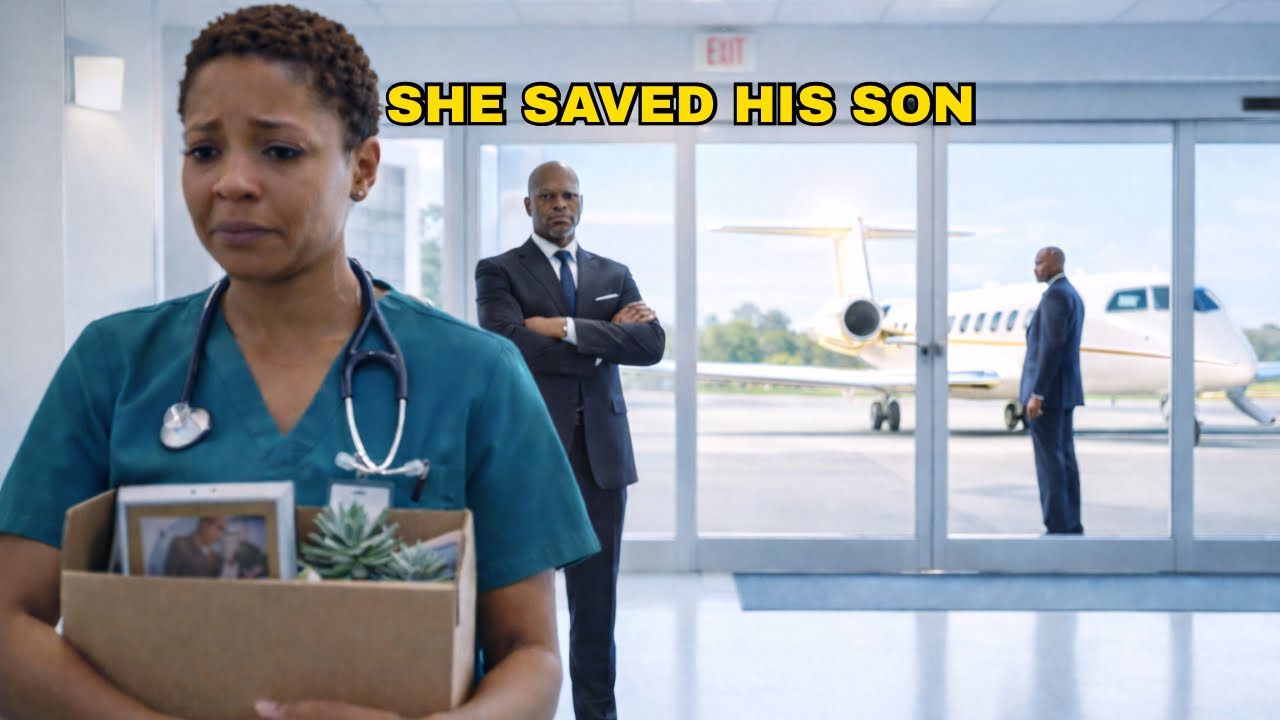
Preston Holt stood behind the guard with a manila folder and eyes that calculated everything and felt nothing. “You violated three separate protocols,” he said. “Unauthorized treatment. Unauthorized use of hospital resources.
Direct disobedience of a transfer order. ”
“I saved a child’s life,” Keziah said. “You overstepped your authority. ”
“He was 6 years old, Mr.
Holt. He was dying. ”
“He was not your patient to save. ”
She looked down the hallway to room 811.
Behind that closed door, a 6-year-old boy was breathing because of her. Forty feet away, pressed flat against the wall like he was trying to vanish into it, the boy’s father watched. Darius Wynn wore the dark green coveralls of janitorial staff. He held a mop handle like it was the only thing keeping him standing.
Keziah didn’t look at him. If she did, she would break. “11 years,” she said. “You’re throwing me away for doing my job.
”
“Your job is to follow orders, not play hero. ”
He turned and walked down the hallway. His polished shoes clicked on the linoleum like a countdown. The security guard handed Keziah a cardboard box, the kind they give you when they don’t want you coming back.
She took it. She walked past room 811. She didn’t stop, but her fingers brushed the door as she passed. Inside, a 6-year-old boy named Theo Wynn was sleeping, alive, because she had refused to follow the order.
But this story didn’t start there. It started 15 hours earlier, in the rain, at the back entrance of the hospital. Darius Wynn ran five blocks through an Atlanta downpour with Theo wrapped in a blanket. The boy had been sick for four days.
Cool cloths, children’s medicine, prayers whispered at 3 a. m. Nothing broke the fever. Then Theo stopped eating.
Then he stopped talking. Then he started shaking. Darius had no car. He picked up his son and ran.
The emergency room was chaos. A highway accident had filled every bed. Darius stood in the middle of it, soaked, holding his boy, and said the only words he could find. “Please.
My son. He can’t breathe right. Please help. ”
The triage nurse saw the coveralls.
The rain. No insurance card. No paperwork. She hesitated.
Then she called for a bed. A doctor came within minutes. He listened to Theo’s chest and frowned. “Pneumonia, both lungs.
He needs four antibiotics, imaging, ICU monitoring. ”
He looked at the chart. “No insurance? ”
“No,” Darius said.
“I’ll get him started. ”
Keziah Malone had been a nurse at Riverside for 11 years. She was the lead night nurse on the eighth floor. At 11:30, the call came from the ER: a 6-year-old boy with bilateral pneumonia, being transferred for IV antibiotics and monitoring.
She prepped room 811 herself. She set the IV line, adjusted the monitors, dimmed the lights so they wouldn’t be harsh on a scared child’s eyes. When the orderlies wheeled Theo in, his eyes fluttered open. He saw her face.
His small hand reached out from under the blanket and grabbed the hem of her scrub top. He didn’t let go for 25 minutes. Darius walked behind the stretcher, still wet, shaking not from cold but from fear. “I’m his father.
Darius. His name is Theo. ”
“Mr. Wynn,” Keziah said gently, “Theo is going to be okay.
I’m going to take care of him. I promise. ”
She worked through the night. Checked his oxygen every 15 minutes.
Adjusted the IV when his small veins struggled. Held his hand when he cried in his sleep. She hummed a melody her mother used to sing when the world felt too big. By 4:30, his breathing had steadied.
By 5:45, his eyes opened. “Thirsty,” he whispered. She held the cup while he drank. Darius was asleep in the chair beside the bed, his mop propped against the wall.
She draped a blanket over his shoulders without waking him. Preston Holt arrived at 7:30. He had been hospital administrator for three years, and his entire career was built on one principle: a hospital that loses money closes. It was a reasonable principle.
It also made it easy to stop seeing patients as people. At 8:20, the admissions log crossed his desk. Wynn, Theodore, age 6. Bilateral pneumonia.
Insurance: none. He pulled up numbers. Antibiotics, monitoring, imaging, bed occupation, nursing hours. $11,000 and climbing for a patient with no way to pay.
He drafted a transfer order. Theo Wynn would be moved to Grady Memorial, the county hospital, 51 minutes away by ambulance. Moving a 6-year-old with bilateral pneumonia mid-treatment was not risk-free. Preston didn’t think about the risk.
He thought about the $11,000. At 9:22, the charge nurse showed Keziah the transfer order. “He’s on his second round of IV antibiotics,” Keziah said. “His oxygen stabilized three hours ago.
You cannot move him mid-treatment. ”
“Order came from Preston’s desk. ”
“The order is wrong. ”
She found the only pediatric specialist on call that morning.
Dr. Adeze Obi examined Theo, listened to his lungs, checked his oxygen saturation. “This child is not stable for transfer. ” She signed his chart as attending physician.
“I’m ordering continued treatment. ”
Fifteen minutes later, Preston called. “Dr. Obi, I see you’ve added yourself to the chart for room 811.
”
“Yes. ”
“That patient has no financial clearance. I issued a transfer order. ”
“And I’ve countermanded it on medical grounds.
Mr. Holt, the day you have a medical degree, you can make medical decisions. Until then, my patient stays. ”
She hung up.
Preston sat for a full minute. Then he typed one line to HR: “Pull the employment file for Kezia Malone, pediatric unit, night shift. ”
At 1:17, Preston pushed open the door to room 811. Behind him stood a charge nurse and a security guard.
Keziah was changing Theo’s IV bag. She saw the guard and knew. “Miss Malone, step into the hallway. ”
“I’m in the middle of—”
“Now.
”
She looked at Theo. The boy was watching with wide, scared eyes. She touched his forehead. “I’ll be right back, sweetheart.
”
In the hallway, Preston recited the violations. Keziah said, “Theo Wynn would be dead right now if I had followed your protocol. He would have crashed in an ambulance because you wanted to save $11,000. ”
“That is not your determination to make.
”
“Because you’re not a doctor. You’re not a nurse. You don’t sit with kids at 3 in the morning when they can’t breathe. You sit in an office moving numbers on a spreadsheet and call it health care.
”
Preston’s jaw tightened. “Your badge. ”
She walked out at 1:30 carrying a cardboard box. A photo of her parents.
A mug from the kids. A succulent. Her stethoscope, bought with her first paycheck. She sat in her Honda and cried until there was nothing left.
Then she drove home. Darius Wynn had been invisible for two years. The night janitor on the eighth floor. Before the coveralls and the mop, he had been the founder and majority owner of Wynn Logistics.
By 31, he was worth nearly $800 million. Then his wife died, and he took their 3-year-old son and walked away from the glass buildings. He wanted to know what the world looked like when you had nothing. He found out.
The world treated him like furniture. There were exceptions: a cafeteria worker who saved him a plate after midnight, a security guard who called him by his first name. And there was the nurse who said “Good evening, Mr. Wynn” every single night.
Not because she had to. Because she saw him. When Theo’s fever turned dangerous, there was no question where Darius would go. He went to the hospital where Keziah worked, because she was the only person in the city he trusted with his son’s life.
Now, in room 811, he heard the whispers in the hallway. “She’s done. Holt is going to fire her. ”
He looked at his son’s chest rising and falling.
Then he looked at the mop in the corner. He thought about the accounts in Atlanta, Chicago, London. The phone in his locker in the matte black case. The one with four contacts.
He opened his locker, reached past the clean coveralls and the cracked old phone, and pulled out the other one. “Trey. I need you to listen. ”
His younger brother, the current CEO of Wynn Logistics, excused himself from a meeting.
“My son was dying. A nurse stayed and saved him. They fired her for it. The man who runs this hospital treats it like a warehouse.
”
“How much are you willing to spend? ”
“Whatever it takes to put someone new in that chair by Friday. ”
“And the nurse? ”
Darius looked at the mop.
The coveralls. The badge that had made him invisible. “The nurse is the only person in this building who ever called me by my name. ”
He hung up and went back to room 811.
Theo opened his eyes. “Dad. Is the nice nurse coming back? ”
Darius looked at the door.
“Yes. She’s coming back. ”
Keziah didn’t sleep that night. At 6:22 a.
m. , her phone buzzed with an unknown number. “Miss Malone, please don’t go anywhere this morning. Someone is coming to you.
A friend. ”
At 7:50, a black Suburban pulled into her parking lot. A driver in a dark suit took her to DeKalb-Peachtree Airport. On the tarmac stood a Gulfstream G700, white with a thin gold stripe, gleaming in the morning light.
And at the bottom of the stairs, in a perfectly tailored navy suit, was Darius Wynn. Same face. Same deep-set eyes. Same gray at the temples.
But he stood differently now. Shoulders back. Chin level. He looked like someone who built things.
Keziah stepped out of the Suburban. “Mr. Wynn. ”
“Miss Malone.
”
“Kezia. ”
“I need to tell you something I should have told you two years ago. My name is Darius Wynn. I am the founder and majority owner of Wynn Logistics.
I’m worth more money than I know how to spend. For the past two years, I’ve mopped floors and emptied trash cans because I needed to remember what the world looks like when you have nothing. For two years, you were the only person in that hospital who said my name. You said, ‘Good evening, Mr.
Wynn. ’ Every single night. Not because you had to. Because you saw me.
”
Keziah’s eyes filled. “And when my son was dying, you stayed. You held his hand. You risked everything you had built to keep him alive when a man in a suit told you to let him go.
I can never repay you for my son’s life. But I can do this. ”
He turned to the woman beside him. “As of 5:30 this morning, Mr.
Wynn has acquired a controlling interest in Riverside Children’s Medical Center. The board has been reconstituted. Preston Holt’s contract has been terminated. ”
Keziah grabbed the side of the Suburban.
“You bought the hospital. ”
“I bought the hospital. Because they tried to let my son die. And the only person who stood in the way was a nurse who makes $54,000 a year and drives a Honda with a cracked mirror.
”
He reached into his jacket and handed her a small white card. Keziah Malone, RN. Director of Nursing, Pediatric Services. Riverside Children’s Medical Center.
“The position reports directly to the new board,” Darius said. “No administrator can override your medical decisions. Ever. ”
Keziah looked at the card.
Then at him. Then she started laughing, the kind that comes when you’ve been holding so much for so long that letting go is the only thing left. “Your son asked me last night if the nice nurse was coming back. ”
“What did you tell him?
”
“I didn’t know the answer. ”
She pressed the card against her chest. “But now I do. ”
Preston Holt arrived at his desk at 7:30 the next morning.
At 7:36, the phone rang. The call lasted 87 seconds. When it ended, he sat very still. The hospital had been sold overnight.
His position eliminated. He had 30 minutes to collect his belongings and leave. He left the mug. He took the briefcase.
He walked out of Riverside Children’s Medical Center for the last time. Nobody said goodbye. Six weeks later, the pediatric wing on the eighth floor was named the Theo Wynn Pediatric Wing. A plaque went up beside the elevator: “Every child deserves someone who stays.
”
Keziah stood in front of it with her old stethoscope around her neck. Beside her stood Dr. Obi, newly named chief of pediatric medicine. Behind them, Darius in a simple gray suit, holding Theo’s hand.
Theo was healthy now, full cheeks, bright eyes. He wore a blazer that was slightly too big and kept tugging at the sleeves. The staff lined the hallway, clapping. Theo tugged on Darius’s hand.
“Dad, is this our hospital? ”
Darius looked at Keziah. She looked back. Something passed between them.
Not words. Not a promise. An understanding. “No,” Darius said.
“This is her hospital. ”


