Sally Field has broken her silence on the tumultuous behind-the-scenes reality of her four-film partnership with Burt Reynolds, revealing that the legendary Hollywood romance was overshadowed by a struggle for control that nearly cost her the role that would win her first Oscar. In a series of candid interviews in 2026, the two-time Academy Award winner detailed a relationship that began with professional generosity but quickly soured into what she now describes as a systematic effort to diminish her independence.
Field, now 79, told the TCM and HBO Max podcast “Talking Pictures” that only the first of their four films together, the 1977 blockbuster “Smokey and the Bandit,” felt like a genuine collaboration. In the three that followed, she said, she felt reduced to “just a girl” standing inside his movies, her own creative voice slowly erased by Reynolds’ overwhelming star power and personal control.
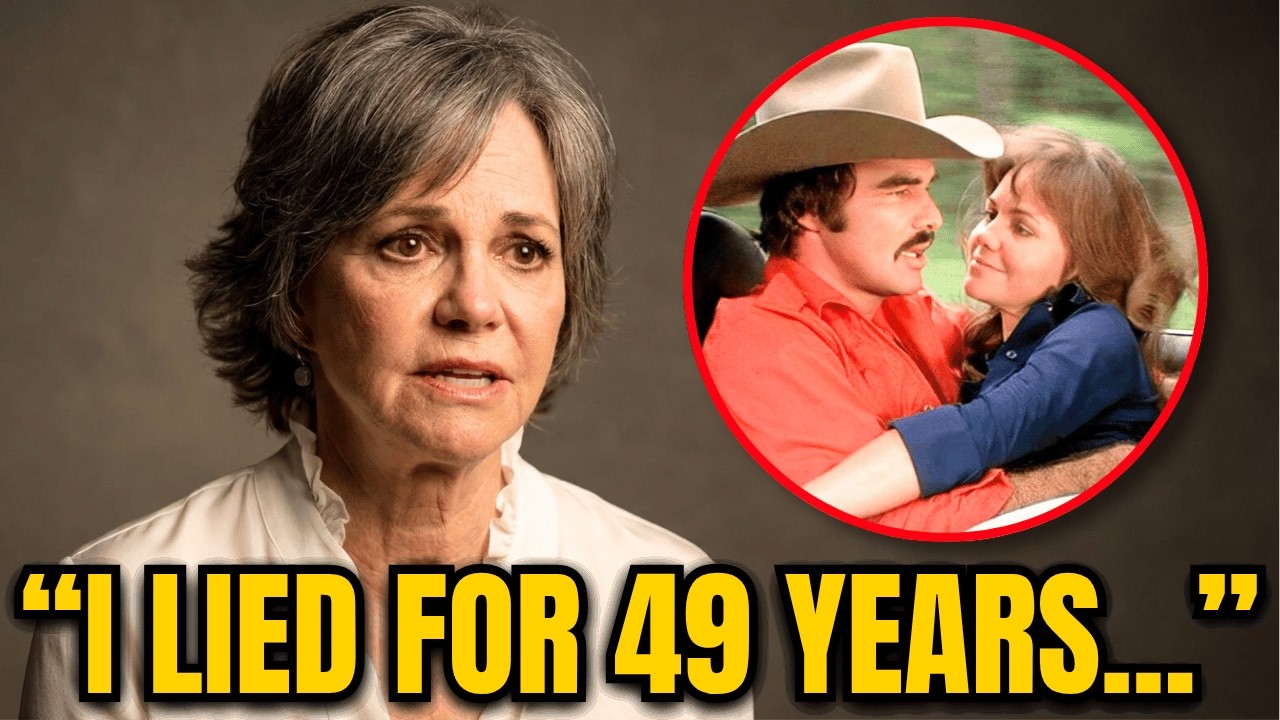 The revelations come more than four decades after the couple’s on-again, off-again romance ended and nearly a decade after Reynolds’ death in 2018. Field’s account rewrites the popular narrative that Reynolds—who often called her the love of his life—was simply a charming rogue who let the perfect woman slip away.
According to Field, the first film was built on improvisation and mutual invention. Cameras were mounted inside the Trans Am, and the two actors created their dialogue while driving, producing the electric chemistry that made the movie a cultural phenomenon grossing over 126 million dollars domestically. But that magic, she explained, was fragile.
“I felt like I made only one movie with him,” Field said on the podcast, referencing the original “Smokey and the Bandit.” In the subsequent films—”The End,” “Hooper,” and “Smokey and the Bandit II”—she said she no longer felt like the quick, unpredictable woman matching him line for line. Instead, she occupied a supporting role in stories that revolved entirely around Reynolds.
The most dramatic turning point, Field revealed, came when she received the script for “Norma Rae.” The 1979 film, directed by Martin Ritt, follows a textile worker who becomes involved in union organizing. Field immediately recognized the character as something she needed to play, but Reynolds, she said, did not want her to accept the role.
According to Field’s account in a 2026 interview, Reynolds objected to Norma’s sexual history and used a degrading label for the character. During an argument, she recalled, he threw the screenplay at her. When he suggested her ambition was getting the better of her, Field said she replied with six words: “This is the better of me.”
That sentence, she said, marked a break from the frightened woman who had entered their first date feeling like a clown. Field accepted the role despite Reynolds’ opposition, and the performance earned her the Best Actress award at the 1979 Cannes Film Festival—a festival Reynolds had discouraged her from attending.
“He asked whether I honestly thought I would win anything,” Field recalled. She went anyway, accompanied by director Martin Ritt and members of the filmmaking team. When the audience responded to the screening, she cried.
The award that followed validated everything Reynolds had tried to undermine.
 The pattern continued as the Academy Awards approached. Field was nominated for Best Actress for “Norma Rae,” but Reynolds refused to attend the ceremony with her. According to Field’s account in Dave Karger’s 2024 book “50 Oscar Nights,” he was unhappy with the attention surrounding her and reportedly behaved unkindly during that period.
Instead of sitting alone, Field attended with comedian David Steinberg and his then-wife, Judy Marcione, who filled her limousine with champagne and celebrated her achievement. When Dustin Hoffman opened the envelope, Field walked onto the stage and accepted her first Oscar. Reynolds’ seat remained empty.
Field’s 2026 interviews add emotional depth to these long-rumored tensions. She does not paint Reynolds as entirely monstrous, describing him as capable of warmth, vulnerability, and genuine affection. But she also connects his behavior to a deeper pattern rooted in her own childhood trauma.
In her 2018 memoir “In Pieces,” Field wrote that her stepfather, actor and stuntman Jock Mahoney, sexually and emotionally abused her during childhood. Yet she also remembered him as magnetic and playful. That contradiction, she explained, shaped her understanding of love: a person could feel wonderful and dangerous at the same time.
Field believes her relationship with Reynolds repeated that emotional structure. She was trying to make an old pattern end differently by winning the love of another charismatic, powerful man whose approval could suddenly become disapproval. His enormous stardom, she wrote, became a tool for controlling those around him.
The memoir also described her concerns about Reynolds’ use of Percodan, Valium, and barbiturates during the making of “Smokey and the Bandit.” She arranged a discreet medical examination at the Miami Heart Institute, which found no heart problem, but she said Reynolds dismissed suggestions that he seek psychological help for anxiety.
For years, Reynolds publicly framed the relationship as his greatest regret. In his 2015 memoir “But Enough About Me,” he called Field the love of his life and blamed himself for destroying the relationship. That romantic narrative resonated with audiences, casting him as the flawed man who realized too late that he had lost the perfect woman.
 Field rejected that framing in a 2022 interview, saying she was not someone he could safely remain around. In her view, he reconstructed the relationship after the fact, making her more important in his memory because she was something he could no longer possess. The two had been estranged for decades by the time Reynolds began publicly calling her his greatest love.
Her timing added another layer of complexity. Reynolds died only days before “In Pieces” was published in 2018, meaning he could not respond directly to its detailed portrayal. Field acknowledged that reality and expressed relief mixed with sadness, stating she did not want to punish him after death but needed to tell the truth about her own life.
Now, with her 2026 interviews, Field has clarified the central irony of their partnership. Reynolds helped place her inside a blockbuster and defended her against executives who underestimated her talent. Yet when that talent began carrying her beyond his movies, his support turned into resistance.
“Support that lasts only while someone remains within your control is not complete support,” Field said during the podcast. Her journey from “Smokey and the Bandit” to “Norma Rae” was therefore larger than a change in genre. In the first movie, Reynolds gave her an opportunity, and she proved she belonged.
In the second, she accepted an opportunity he did not want her to take.
Field also offered a lighter revelation during the 2026 podcast, calling Reynolds her worst on-screen kisser because of excessive drooling. The comment became a viral joke, but it underscored her broader point: audiences believed they had watched a love story begin during “Smokey and the Bandit,” but the reality was far more complicated.
The four films they made together in four years—from 1977 to 1980—represent one of the most sustained collaborations of either actor’s career. Yet Field’s emotional record contains a sharp dividing line. She remembers only one of them as a real collaboration.
 In the others, she was present because she had become trapped in the larger situation surrounding Reynolds.
Her revelations have reignited debates about power dynamics in Hollywood relationships, particularly those involving age gaps and status differences. Field was around 30 and newly divorced with two sons when she met Reynolds, who was approximately 40 and at the height of his stardom. His fame gave him authority on every production, from creative decisions to casting choices.
The impact of Field’s account extends beyond her own story. It challenges the tendency to romanticize on-screen chemistry as evidence of a healthy off-screen relationship. The laughter inside the speeding Trans Am that the world remembers was real, but so was the struggle that followed.
For Field, the most important outcome of speaking out is not vindication. It is accuracy. She wants her legacy to reflect the full truth of her experience, not the sanitized version that Hollywood prefers.
The woman who climbed onto a table in a textile mill and raised a sign reading “UNION” was already learning how to stand up long before the cameras rolled.
As she told the podcast, “The first film captured a moment when I felt creatively alive beside him. What followed looked like more of the same from the outside, but my memory of those productions is strikingly different.” Those words now stand as a final, authoritative account of one of cinema’s most electric—and troubled—partnerships.


