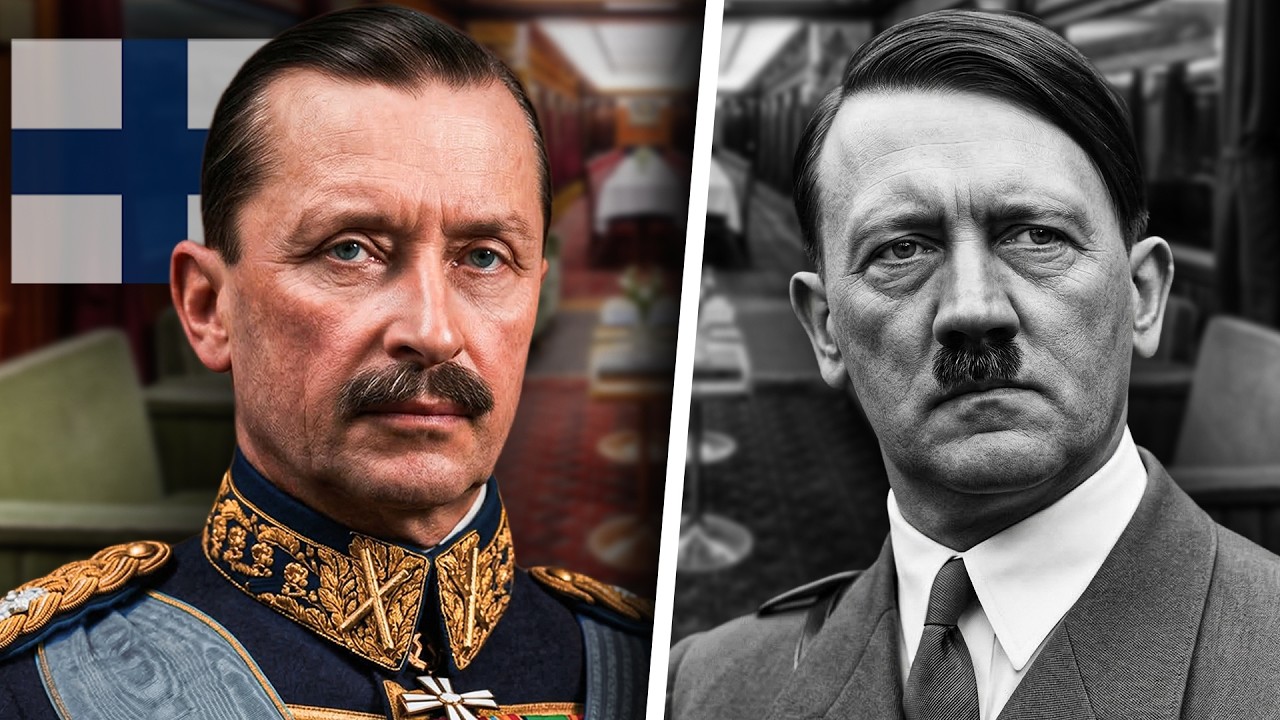
The Day Mannerheim Caught Hitler on Tape: The Silent Man Who Outsmarted a Dictator
The microphones were never supposed to exist.
On June 4, 1942, Adolf Hitler arrived in Finland with a mission that seemed impossible to hide. The most feared dictator in Europe had traveled hundreds of miles away from his headquarters to a quiet corner of the battlefield, hoping to persuade one man to commit completely to his war.
That man was not impressed.
He was not intimidated.
And he was not about to let history decide Finland’s fate through someone else’s ambition.
His name was Carl Gustaf Emil Mannerheim, the aging Finnish Field Marshal who had spent decades watching empires rise, collapse, and destroy themselves. A man who had served under the Russian Tsars, fought against revolutionary forces, defended his homeland against overwhelming odds, and somehow managed to stand between two dangerous giants: Joseph Stalin’s Soviet Union and Adolf Hitler’s Germany.
But on that summer day in 1942, something happened that would expose one of the most powerful men in history.
Hidden microphones captured Hitler speaking freely.
For eleven minutes, the world heard something Hitler almost never revealed in public.
Fear.
Doubt.
Frustration.
The man who claimed absolute confidence in victory admitted that the Soviet Union was far stronger than he had expected.
And standing across from him was Mannerheim, listening quietly.
No dramatic speeches.
No angry confrontation.
No attempt to humiliate Hitler.
Just silence.
A silence that would become one of the most powerful weapons in modern history.
Because Mannerheim understood something Hitler never did:
The loudest person in the room is not always the one with the most power.
In 1942, Europe was burning.
The German army had conquered much of the continent. France had fallen. Poland had been crushed. The Netherlands and Belgium had been overwhelmed. The Nazi war machine appeared unstoppable.
But in the frozen forests of Finland, the situation was different.
Finland was not Germany.
Finland was not a Nazi state.
Finland was a small nation fighting for survival.
Its struggle began in 1939 when the Soviet Union invaded during what became known as the Winter War.
The numbers were terrifying.
The Soviet Union had millions of soldiers, thousands of tanks, and an enormous industrial base.
Finland had a fraction of that.
Many foreign observers believed the war would end within weeks.
They were wrong.
At the center of Finland’s resistance stood Mannerheim.
He was already an unusual figure.
Born into a Swedish-speaking noble family in Finland, he entered the military service of the Russian Empire when Finland was still part of it. He became an officer in the Imperial Russian Army, fought in wars across Asia and Europe, and rose through the ranks.
He was not a revolutionary.
He was not a nationalist firebrand.
He was a soldier shaped by discipline, patience, and experience.
When the Russian Empire collapsed in 1917 and Finland declared independence, Mannerheim returned home.
The country he found was divided.
Civil war threatened to destroy the young nation before it could even begin.
Many Finns viewed him with suspicion because of his long service under Russia.
Others saw him as the only person capable of creating order.
Mannerheim did not seek popularity.
He sought survival.
That would become the defining pattern of his life.
When Soviet forces crossed into Finland in November 1939, the world expected a quick victory for Moscow.
Instead, Soviet troops entered a nightmare.
The Finnish army used the land itself as a weapon.
Dense forests.
Frozen lakes.
Extreme cold.
Hidden positions.
Small mobile units that appeared and disappeared like ghosts.
The Soviets had more men.
The Finns had better preparation.
Mannerheim understood that Finland could never defeat the Soviet Union in a traditional war.
The goal was not conquest.
The goal was to make the cost unbearable.
For months, Finland resisted.
The world watched in amazement as a small country embarrassed one of the largest armies on Earth.
Newspapers around the world praised Finnish courage.
But behind closed doors, Mannerheim knew the truth.
Courage alone would not be enough.
Eventually, Soviet pressure became overwhelming.
Finland was forced to sign the Moscow Peace Treaty in March 1940.
The country lost territory.
Thousands of homes were abandoned.
Families became refugees.
The victory Finland wanted never came.
But something important remained.
Finland survived.
Its independence survived.
And Mannerheim became a symbol of national endurance.
Then came the dangerous choice.
After the Winter War, Finland found itself trapped between enemies.
The Soviet Union was still a threat.
Germany offered military cooperation.
For Finland’s leaders, the situation was brutally complicated.
Many believed Germany was the only force capable of helping them recover lost territory.
When Germany launched Operation Barbarossa against the Soviet Union in 1941, Finland entered what became known as the Continuation War.
But there was a difference.
Hitler believed Finland was now a partner in his grand ideological war.
Mannerheim did not.
That misunderstanding would become one of the most important hidden battles of World War II.
Hitler wanted loyalty.
Mannerheim wanted independence.
Those two goals could never truly exist together.
When Hitler arrived in Finland in 1942, it was his first and only visit to the country.
The official reason was simple:
To celebrate Mannerheim’s 75th birthday.
But beneath the ceremony was a political calculation.
Hitler wanted to strengthen the relationship.
He wanted Mannerheim to understand that Germany was winning.
He wanted Finland committed completely.
The meeting took place near Mannerheim’s headquarters.
Cameras captured the handshake.
Officials stood nearby.
The atmosphere appeared formal.
But there was one detail Hitler did not know.
A Finnish engineer named Thor Damen had secretly placed a recording device nearby.
The original purpose was not to spy on Hitler.
It was simply to preserve a historical recording of the conversation.
But the microphone captured something extraordinary.
Hitler, believing he was speaking privately, lowered his guard.
And suddenly, the world heard the dictator without his carefully prepared speeches.
Hitler began by talking about the Soviet Union.
But the confidence he displayed in public disappeared.
He admitted that Germany had underestimated Soviet military capability.
He described the unexpected strength of Soviet production and resistance.
The man who had promised his followers a quick victory against Moscow revealed frustration.
He was not speaking like an unstoppable conqueror.
He was speaking like a commander facing a problem he could not solve.
Across from him sat Mannerheim.
Listening.
Observing.
Remembering every word.
The contrast was remarkable.
Hitler filled the air with explanations.
Mannerheim controlled the room through restraint.
He understood that information was power.
Every sentence revealed something.
Every hesitation mattered.
Every admission was valuable.
While Hitler believed he was persuading an ally, Mannerheim was learning exactly how desperate the situation had become.
The dictator came to Finland expecting to demonstrate strength.
Instead, he accidentally revealed weakness.
The recording created another problem.
The Germans could never know that Hitler had been recorded.
If they discovered it, the consequences could have been dangerous.
The Finnish government carefully protected the recording.
The original tape was preserved.
Later, a copy was provided to German authorities.
But before that could happen, Finnish officials had to edit out parts of the conversation where Hitler’s private comments could create diplomatic problems.
Even after decades, the recording remained one of the rare moments when historians could hear Hitler speaking naturally instead of performing for an audience.
And what it revealed was shocking.
The man who demanded obedience from everyone else was not always certain himself.
But the greatest lesson from that meeting was not about Hitler.
It was about Mannerheim.
Many leaders in history are remembered because they shouted the loudest.
Mannerheim was remembered because he knew when not to speak.
He understood that small nations survive differently from powerful ones.
They cannot always win through force.
Sometimes they win through patience.
Through negotiation.
Through knowing exactly when to resist and exactly when to compromise.
This strategy became crucial as World War II continued.
As Germany’s position weakened, Finland faced another impossible decision.
The country could not afford to remain tied to a collapsing Nazi Germany.
Mannerheim recognized the changing reality.
He understood that Finland’s future depended on separating itself from Hitler before it was too late.
In 1944, Finland negotiated an armistice with the Soviet Union.
The decision was controversial.
Some viewed it as betrayal.
Others saw it as survival.
But once again, Mannerheim chose the path that protected Finland’s independence.
Germany became an enemy.
Finnish forces were ordered to remove German troops from Finnish territory, leading to the Lapland War.
The alliance that Hitler believed was permanent had disappeared.
Finland had escaped.
The final twist of Mannerheim’s story came after the war.
The man who had spent his life as a military commander became President of Finland.
But he did not seek revenge.
He did not attempt to build a new empire.
He focused on stabilizing the country.
The same qualities that had guided him through war guided him through peace.
Caution.
Patience.
Practical judgment.
Many powerful men of his era chased glory.
Mannerheim chased survival.
And that difference changed everything.
Years later, people who studied the famous recording often focused on Hitler’s words.
They analyzed his admissions.
They examined his mistakes.
They studied the moment when the dictator’s confidence cracked.
But perhaps the most important part of the recording was the silence between the words.
Because in that silence was Mannerheim’s strategy.
He did not need to defeat Hitler in an argument.
He did not need to expose him publicly.
He simply needed to understand him.
And understanding your opponent is sometimes more powerful than defeating them.
The microphone captured Hitler’s voice.
But history remembered Mannerheim’s silence.
The dictator arrived believing he was the strongest man in the room.
He left having unknowingly revealed his weaknesses to the one person who understood the value of patience.
That eleven-minute recording became more than an audio file.
It became a lesson in leadership.
A reminder that courage is not always found in dramatic moments.
Sometimes courage is sitting quietly across from power, knowing exactly who you are, knowing what you must protect, and refusing to let someone else decide your future.
Because history is not only shaped by the people who speak.
Sometimes it is shaped by the people who listen.