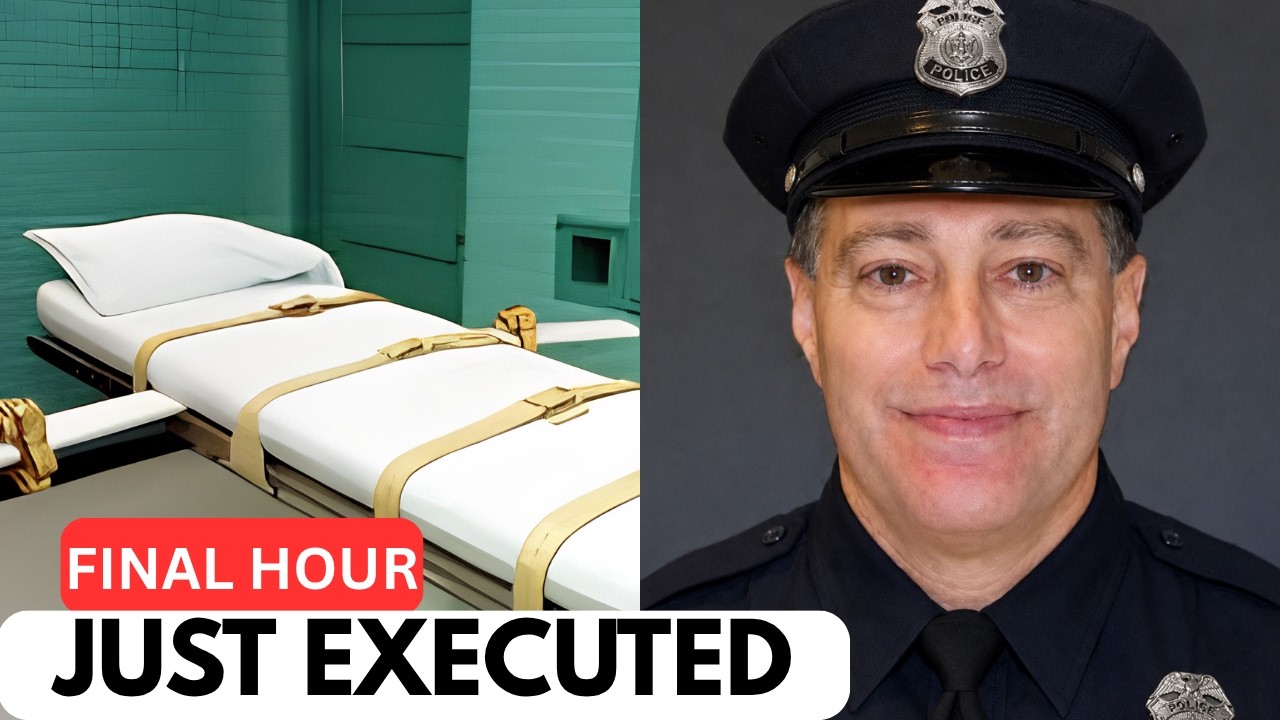
HUNTSVILLE, Texas — The silence that defined Robert Alan Fratta’s final years was broken only by the hiss of the lethal injection tube. At 7:49 p. m.
local time, the former Missouri City police officer was pronounced dead, ending a nearly three-decade legal odyssey that began with a single gunshot in a suburban garage and ended with a man who once swore to protect and serve being executed for ordering the murder of his own wife.
 Fratta, 65, offered no final words. No apology. No declaration of innocence.
No acknowledgment of the son who sat in the witness room, the same child who had been in a church pew on the night his mother was killed. Instead, the man who had spent 28 years on death row maintaining his innocence let the silence speak for itself. But in the days before his execution, Fratta had described his impending death as “enlightening,” a cryptic phrase that left even seasoned observers grasping for meaning.
The execution at the Huntsville Unit proceeded after a frantic legal battle that reached the U. S. Supreme Court.
Fratta’s attorneys argued that Texas planned to use expired lethal injection drugs, raising the specter of unconstitutional suffering. A lower court granted a temporary stay, but higher courts, including the Texas Court of Criminal Appeals and the Supreme Court, swiftly overturned it. The final appeal was denied without comment.
The crime that sent Fratta to death row was as calculated as it was cold. On the night of November 9, 1994, Farah Fratta, 33, pulled into her garage in the quiet Atascocita neighborhood outside Houston. She had filed for divorce and was fighting for custody of their three children.
Her husband, a trained law enforcement officer, had built an alibi: he was in church with those children, calm and accounted for. But while he sat in a pew, Howard Guidry was waiting in the shadows. One shot to the head ended Farah’s life in seconds.
 Investigators quickly discovered that Fratta had not acted in a moment of rage. He had spent months soliciting murder, approaching acquaintances, discussing prices, and treating his wife’s death like a business transaction. He found two men willing to help: Kenneth “Bo” Pristash, who coordinated the hit, and Guidry, who pulled the trigger.
Fratta’s law enforcement background, far from protecting him, became his undoing. He had spoken openly about his intentions, and multiple witnesses came forward.
In 1996, a jury convicted Fratta of capital murder and sentenced him to death. But in 2009, an appeals court overturned the sentence on procedural grounds: a witness had undergone hypnosis, and the testimony had not been properly handled. The retrial in 2011 produced the same result: guilty, death sentence.
Two juries, two convictions, two death sentences. Yet Fratta never wavered from his claim of innocence.
Throughout his decades on death row at the Polunsky Unit, Fratta filed exhaustive appeals challenging witness credibility, prosecutorial misconduct, and constitutional violations. Each was denied. He never spoke publicly about Farah, never addressed the loss his children suffered, and never offered any reflection that suggested internal reckoning.
 His silence was a wall that prosecutors, juries, and appeals courts could not breach.
The execution itself was swift. Fratta was pronounced dead after receiving a single dose of pentobarbital. He was 65.
The man who had once worn a badge and carried a gun, who had sworn to uphold the law, died by the hand of the state he had betrayed.
The case has drawn national attention, featured on programs like 48 Hours, and remains a stark example of how domestic violence can escalate into murder when control is mistaken for love. Farah Fratta’s family and friends have long said that her decision to leave an abusive marriage was the catalyst for her death. Her children grew up without her, a reality no execution can remedy.
The legal aftermath continues. Kenneth Pristash remains on death row, awaiting his own fate. Howard Guidry, the triggerman, received a life sentence, a disparity that has sparked debate about justice in conspiracy cases.
 For the community of Atascocita, the execution closes a chapter but does not erase the loss.
What did Fratta mean when he called his death sentence “enlightening”? Some interpret it as a moment of clarity, a man finally confronting the weight of his actions. Others see it as a final act of defiance, a refusal to admit guilt even as the needle went in.
The silence that followed his final words, or lack thereof, leaves the question unanswered.
For Farah Fratta, the story ends not with a verdict or an execution, but with a reminder that control is not love, that isolation is dangerous, and that words spoken in anger can be a warning. Her life was cut short at 33, but her story continues to echo through courtrooms, documentaries, and the hearts of those who knew her.
The state of Texas has carried out its sentence. The man who ordered the shot is gone. But the silence he maintained for nearly three decades will linger long after the last legal filing is closed.