The United States Army has moved to execute Major Nidal Hasan, the convicted Fort Hood shooter, after the Supreme Court refused to hear his final appeal, closing the last standard legal door for the man who killed 13 people and wounded more than 30 others on a Texas military base in 2009.
The execution warrant is being prepared at the United States Disciplinary Barracks at Fort Leavenworth, Kansas, where Hasan has been held since his 2013 conviction. Military officials confirmed that the Department of Defense is now moving toward carrying out the death sentence, a process that has taken more than 15 years.
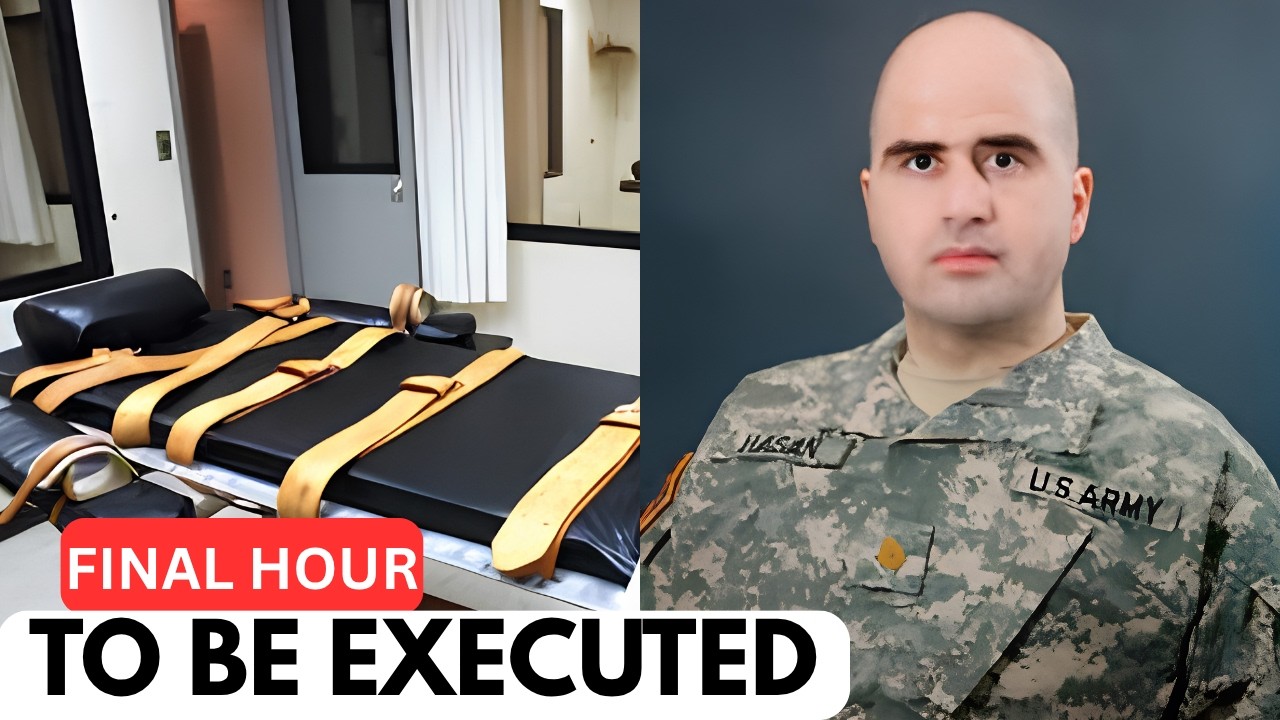 Hasan, a former Army psychiatrist, opened fire inside the Soldier Readiness Processing Center at Fort Hood on November 5, 2009. The attack lasted approximately 10 minutes. When it ended, 13 soldiers and civilians were dead, and dozens more were catastrophically wounded.
The victims included Private First Class Francesca Velez, who was 21 years old and pregnant. Specialist Jason Dean Hunt, Private First Class Aaron Thomas Nemelka, Private First Class Michael Pearson, Specialist Frederick Greene, Staff Sergeant Justin DeCrow, Captain John Gaffaney, Chief Warrant Officer Michael Cahill, Sergeant First Class Gary Wayne Ambrosino, Staff Sergeant Amy Krueger, Private First Class Kham Xiong, Lieutenant Colonel Juanita Warman, and Specialist Russell Seager.
What makes this case so devastating is that the warning signs were not hidden. They were documented, reviewed, and ignored by multiple federal institutions long before the shooting began.
Hasan’s colleagues at Walter Reed Army Medical Center raised alarms repeatedly. They reported that he made statements defending suicide bombings, argued that Muslims faced an impossible conflict between faith and military service, and expressed sympathy for America’s enemies. Supervisors documented these concerns in performance evaluations.
Despite this, the Army promoted him. He continued to serve as a psychiatrist treating soldiers returning from combat in Iraq and Afghanistan, the very people he would later target.
Between 2008 and 2009, Hasan exchanged a series of emails with Anwar al-Awlaki, a radical cleric with direct ties to al-Qaeda. The FBI’s Joint Terrorism Task Force intercepted those emails. Analysts read them, reviewed them, and concluded they were consistent with Hasan’s academic research.
The case was closed.
Thirteen people were still alive when that decision was made.
In the months before the attack, Hasan began giving away his possessions, purchased an FN 5. 7 semi-automatic pistol with high-capacity magazines, and practiced at a shooting range repeatedly. He studied the layout of the processing center and planned his entry points.
He was methodical, not impulsive.
 On the morning of November 5, 2009, he drove to Fort Hood in his Army Combat Uniform. At 1:34 p. m.
, he stood up inside the processing center, shouted “Allahu Akbar,” and opened fire.
The shooting lasted 10 minutes. Soldiers who had survived combat deployments were cut down on their own base. Many were unarmed.
Military police officers Sergeant Mark Todd and Sergeant Kimberly Munley confronted Hasan outside the building. Todd shot him multiple times, leaving him paralyzed from the waist down.
Hasan survived. He was charged with 13 counts of premeditated murder and 32 counts of attempted premeditated murder under the Uniform Code of Military Justice.
The military initially classified the attack as workplace violence, not terrorism. That classification denied victims and their families access to combat-related benefits, including the Purple Heart and enhanced medical coverage. It took six years of advocacy and a congressional act to reverse that decision.
A later U.S. Senate report described the Fort Hood shooting as the worst terrorist attack on American soil since September 11, 2001.
Hasan’s court-martial began in August 2013, nearly four years after the massacre. He fired his lawyers and represented himself. In his opening statement, he admitted he was the shooter but argued his actions were justified retaliation against U.
S. military operations in Muslim countries.
 The jury rejected that defense. They convicted him unanimously on all 45 charges and sentenced him to death.
Prosecutors argued that Hasan viewed execution as martyrdom. Lead prosecutor Colonel Michael Mulligan told the court that Hasan was not a martyr but a man who owed a debt to the people he destroyed.
The death sentence triggered an automatic appeals process that stretched for more than a decade. The U. S.
Army Court of Criminal Appeals upheld the sentence in 2020. The U. S.
Court of Appeals for the Armed Forces upheld it in 2023. In March 2025, the Supreme Court declined to hear his final appeal.
Now, the Department of Defense is moving toward an execution warrant. No U. S.
military execution has been carried out since 1961.
For the families of the 13 victims, this moment has been agonizingly slow. They have waited 15 years for finality. Many have spent that time fighting not only for justice but for recognition that what happened to their loved ones was an act of terrorism, not a workplace incident.
The institutional failures that allowed Hasan to carry out his attack remain a painful chapter in American security history. The Army saw the warning signs. The FBI saw them.
 Both institutions chose inaction.
Colleagues who reported concerns were ignored. Supervisors who documented troubling behavior filed reports that went nowhere. Analysts who reviewed emails with a known terrorist called them academic.
The silence inside those institutions was not neutral. It was a choice. And that choice cost 13 lives.
Now, the man responsible is set to be executed. But the questions raised by this case will not die with him. How many more warnings will be ignored before the next attack?
How many more institutions will choose paperwork over action?
The families of the Fort Hood victims have demanded accountability for years. They have testified before Congress. They have pushed for policy changes.
They have watched the man who killed their loved ones sit in a prison cell while appeals dragged on.
Now, the execution is imminent. But for many, the wound will never fully heal.
The names of the 13 people who walked into the Soldier Readiness Processing Center on November 5, 2009, and never walked out are Francesca Velez, Aaron Nemelka, Michael Pearson, Jason Hunt, Frederick Greene, Justin DeCrow, John Gaffaney, Michael Cahill, Gary Ambrosino, Amy Krueger, Kham Xiong, Juanita Warman, and Russell Seager.
They were not a statistic. They were people with families, futures, and lives that were deliberately destroyed.
The United States Army is now preparing to carry out the execution of the man who killed them. The legal process is nearly over. The moral and institutional reckoning is not.