The microphone was hidden inside the private railway car, and no one had any idea it was there. The date was June 4th, 1942, and one of the men seated inside was Adolf Hitler. The other was a 75-year-old Finnish general named Carl Gustaf Emil Mannerheim. For exactly 11 minutes, Hitler spoke freely, unguarded, revealing more about himself in that brief window than he ever did in public.
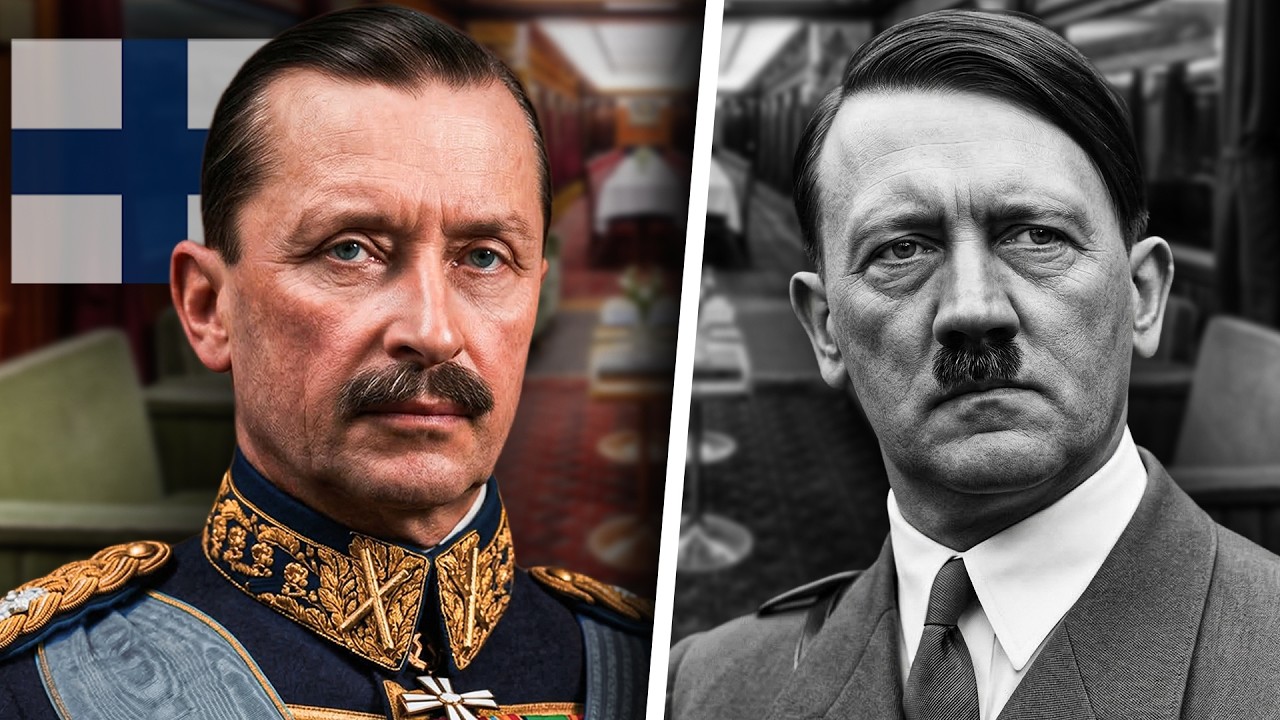
Then an SS bodyguard noticed the equipment, and the recording stopped. But the most revealing detail was not what Hitler said. It was what Mannerheim didn’t say. To understand why a Finnish general sat silently across from the most dangerous man in Europe, you have to go back decades.
In the summer of 1886, a 19-year-old cadet was expelled from the military academy in Finland for breaking curfew. His name was Carl Gustaf Emil Mannerheim. Rather than accept the setback, he spent the next year in Ukraine perfecting his Russian and then applied to a prestigious cavalry school in St. Petersburg.
He graduated in 1889 and entered the Imperial Russian Army, beginning a career that lasted nearly three decades in service to the Tsar. He was Finnish by birth, Swedish in language and culture, and Russian by profession. He moved comfortably inside the Imperial world without ever truly belonging to it. Through the 1890s, he rose steadily, eventually securing a place in the elite Chevalier Guards Regiment and gaining access to the Imperial Court.
At the coronation of Tsar Nicholas II in 1896, Mannerheim stood motionless in full dress uniform for four and a half hours. He later described the ceremony as indescribably magnificent. It was the closest he would ever come to the center of the empire he served. The Russo-Japanese War of 1904–05 gave him his first real experience with combat command, and he returned with his reputation intact.
Two years later, the Russian General Staff sent him on a mission across Central Asia to Beijing. His official cover was that of an ethnographer. His actual task was military intelligence—mapping routes, assessing Chinese forces, and filing detailed reports for Russian planners. Over the next two years, he covered roughly 14,000 kilometers on horseback, from Russian Turkestan through Xinjiang and across northern China.
He took photographs, collected artifacts, filed the reports his superiors expected, and kept everything else to himself. By late 1908, he was back in St. Petersburg and formally presented the expedition’s results to the Tsar. The First World War took him to the Eastern Front, where he reached the rank of Lieutenant General by 1917.
When the October Revolution dismantled the empire he had served for three decades, Mannerheim read the situation quickly and left. In December 1917, weeks after Finland declared independence from Russia, he returned home. That independence came at a price. Within weeks, a civil war erupted between the socialist Red Guards and the conservative White forces.
Mannerheim commanded the Whites, secured victory by May 1918, and entered Helsinki as a national hero. Within a year, he had served as regent, lost Finland’s first presidential election, and stepped back without public complaint. He spent the next decade largely out of public life, watching from a distance. On May 19th, 1933, he received the title of Field Marshal.
Through those years, he quietly pressed for the fortification of the Karelian Isthmus, often against government reluctance and tight budgets. The defensive line that eventually bore his name was built piece by piece across the 1930s. When the Soviets came, it was ready. In October 1939, the Soviet Union presented Finland with territorial demands: border adjustments on the Karelian Isthmus, several islands in the Gulf of Finland, and a 30-year lease on the Hanko Peninsula for a naval base.
In exchange, it offered Finnish territory elsewhere. The Finnish government refused. On November 30th, 1939, more than 450,000 Soviet troops crossed the border on multiple fronts. Stalin’s planners expected the campaign to last two weeks.
Mannerheim established his headquarters in Mikkeli, a small city in central Finland, and began what he had spent the previous decade preparing for. His forces numbered approximately 300,000, had almost no tanks, and were outgunned at every level. What they had was terrain, weather, and a commander who understood both. Mannerheim organized his defense around Finland’s lakes, forests, and roads, channeling Soviet columns into narrow corridors where numbers mattered less.
His troops moved on skis. The Red Army was not prepared for temperatures that dropped below minus 40 degrees Celsius. In December 1939, Soviet forces pushing toward the Gulf of Bothnia committed two divisions to an advance through the wilderness around Suomussalmi. A Finnish colonel, Hjalmar Siilasvuo, outnumbered and lightly armored, encircled both columns and destroyed them systematically.
Soviet casualties reached between 22,500 and 27,000. Finnish losses were fewer than 900. The battle became a case study in how a smaller force, properly led on familiar ground, could dismantle a larger one piece by piece. Moscow drew its own conclusions.
In January 1940, Stalin replaced his front commanders with Marshal Semyon Timoshenko, reorganized his forces, and massed 600,000 troops against the Karelian Isthmus. On February 1st, they opened with a massive artillery bombardment. The Mannerheim Line held for weeks, then gave way. By early March, Soviet forces were entering the suburbs of Viipuri, Finland’s second city, and Mannerheim’s army was exhausted.
The Moscow Peace Treaty was signed on March 12th, 1940. Finland ceded approximately 11 percent of its territory, including Viipuri, and evacuated around 422,000 civilians from the lost regions. It kept its government, its army, and its independence. In Berlin, Adolf Hitler watched the war closely and drew a conclusion that suited him: the Red Army was slow, poorly led, and fragile under pressure.
It was the most consequential misreading of the entire war. Eighteen months later, that misreading brought German forces to Finland’s border and handed Mannerheim the most difficult decision of his career. On June 5th, 1941, three days after Germany invaded the Soviet Union, Soviet aircraft bombed Finnish cities. Finland declared itself at war.
What followed was not, in Mannerheim’s careful framing, an alliance with Nazi Germany. It was a continuation of the conflict the Soviet Union had started in 1939—a chance to recover what the Moscow Peace Treaty had taken. The distinction mattered enormously to him, and he enforced it through a series of refusals. When German commanders proposed unified control over Finnish forces, Mannerheim declined.
When they asked him to cut the railway line running from Leningrad to Murmansk, he declined again. When pressure came to advance on Leningrad itself, he refused a third time. Finnish forces halted at the old pre-Winter War border and held their position. Mannerheim had recovered the lost territory.
He had no intention of fighting Germany’s war beyond it. By September 1941, the front had stabilized into something close to a stalemate. Finland occupied its recovered lands and waited. In Berlin, the requests kept coming.
In Mikkeli, they kept being deflected. Then came June 4th, 1942, Mannerheim’s 75th birthday. Hitler flew to Immola airfield that morning, ostensibly to offer his congratulations. It was an unusual gesture.
Mannerheim had made clear he did not want the meeting in Helsinki, where it would resemble a state visit, nor at a headquarters. A railway siding near the airfield was agreed upon. When Hitler stepped off the plane and saw Mannerheim waiting, he ran toward him across the tarmac. Those who knew Mannerheim recorded his reaction.
“An officer does not run,” he is said to have remarked quietly to those beside him. “Only corporals do that. ”
What neither man knew was that a Finnish engineer named Thor Damen had placed a hidden microphone inside the railway car. For 11 minutes, Hitler spoke as he never spoke in public—unguarded, unscripted, unaware anyone was capturing his words.
Then an SS bodyguard noticed the equipment, and the recording stopped. Those 11 minutes remain the only audio document of Hitler in private conversation, speaking as he actually was when he believed no one was listening. The recording captured a man accounting for himself. Hitler told Mannerheim he had not suspected the scale of Soviet armament: 35,000 tanks, industrial plants employing tens of thousands of workers, a capacity he had thought impossible.
“Had he known,” he said, “the decision would have weighed even more heavily on him. He would have made it anyway. ”
Mannerheim said very little in return. During the meal that followed, Mannerheim lit a large cigar, fully aware that his guest could not tolerate the smoke.
Hitler left Finland five hours later, receiving nothing he came for. That same day, the Finnish government created a new title specifically for Mannerheim: Marshal of Finland. He remains the only person ever to hold it. In the early hours of June 9th, 1944, Mannerheim sat at his headquarters and read the reports coming in from the Karelian Isthmus.
The Soviet offensive he had quietly anticipated for two years had arrived. It was larger than expected. The Finnish front broke within 24 hours. By June 20th, Soviet forces had taken Viipuri—the city Finland had already lost once in 1940 and spent three years recovering.
The situation was serious enough that German support suddenly became essential. For a brief moment in late 1944, it was not clear that Finland would survive as an independent state. The front had broken, the second city had fallen, and the country was dependent on an ally it had spent three years carefully avoiding. On June 26th, 1944, German Foreign Minister Joachim von Ribbentrop arrived in Helsinki and demanded a formal pledge that Finland would not seek a separate peace.
It was the price of continued German arms supplies. President Risto Ryti agreed and gave his personal commitment. The document became known as the Ryti-Ribbentrop Agreement. Mannerheim did not sign it.
That detail would prove decisive. At Tali-Ihantala, between June 25th and July 9th, 1944, Finnish forces fought the largest battle in Nordic history across 100 square kilometers of the Karelian Isthmus. The Soviet 21st Army, supported by hundreds of tanks and aircraft, pressed against a Finnish line that refused to break. By July 9th, with the 21st Army having suffered between 18,000 and 22,000 casualties and the offensive stalled, Soviet commanders began transferring forces south toward Estonia.
The front held. Germany had provided the arms, and Finland had stopped the offensive. The debt was noted and then carefully set aside. On August 1st, 1944, Ryti resigned as president.
Four days later, the Finnish Parliament unanimously elected Mannerheim to replace him. On August 17th, Mannerheim annulled the Ryti-Ribbentrop Agreement. His reasoning was straightforward. The pledge had been Ryti’s personal commitment, not Finland’s.
Mannerheim had never signed it. Therefore, it was not binding on him. Germany protested. Finland ignored the protest.
The ceasefire with the Soviet Union came into effect on September 4th, 1944. The Moscow Armistice, signed on September 19th, required Finland to cede Petsamo, restore the 1940 Karelian border, lease the Porkkala Peninsula for 50 years, and pay $300 million in reparations. It also required the expulsion of all German forces. The Lapland War that followed pushed approximately 200,000 German troops north into Norway.
The last German soldier left Finnish soil on April 27th, 1945. Finland emerged from the war as the only German co-belligerent that preserved its democracy, its sovereignty, and its freedom from occupation. Mannerheim resigned the presidency on March 4th, 1946, and died in Lausanne, Switzerland, on January 27th, 1951. The recording Thor Damen made was held by Finnish state censors for years.
Yle, the national broadcaster, recovered the tape in 1957. When it was eventually made public, audiences heard 11 minutes of history’s most guarded man speaking as if no one was listening. What they also heard, in the silences and the careful non-answers on the other side of the conversation, was Mannerheim.