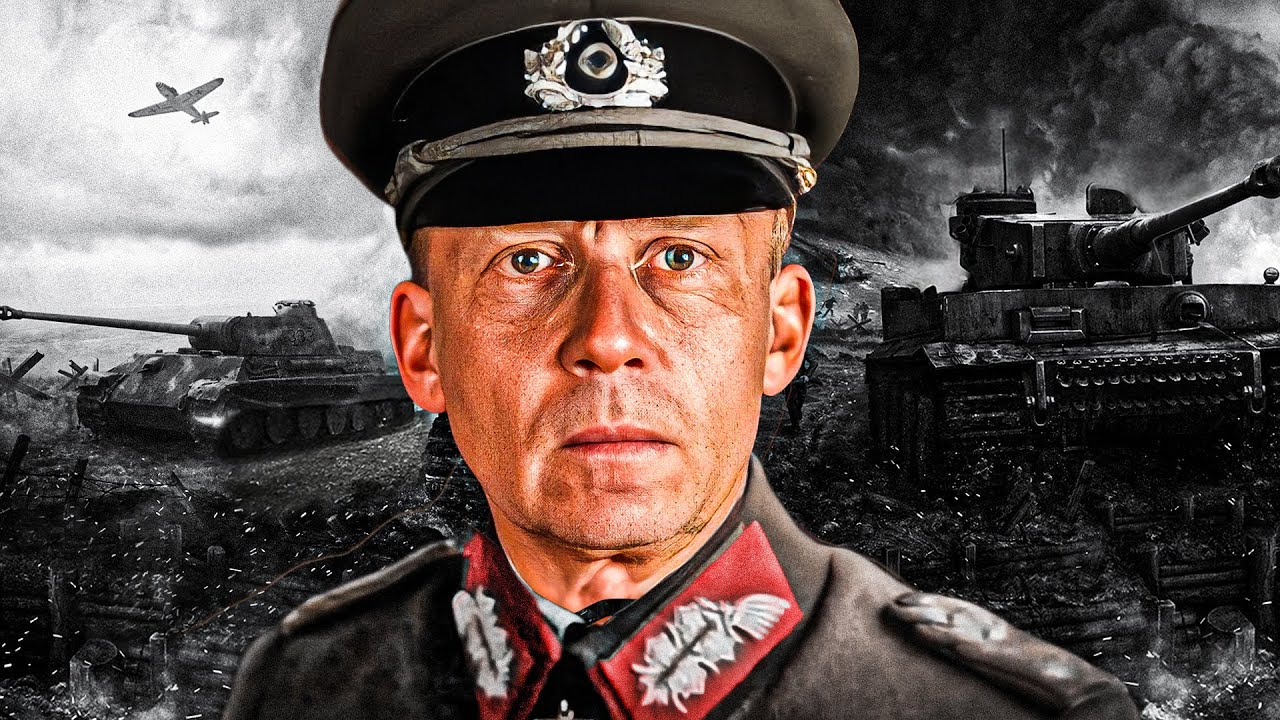
The General Hitler Needed—Until He Refused to Die for Him
Historical narrative based on documented events. Some scene-level dialogue and reactions are reconstructed for narrative continuity. The viral sentence “I cannot sacrifice my soldiers for a madman’s fantasy” is best treated as a thematic paraphrase of Heinrici’s conduct rather than a securely verified verbatim quotation.
On April 28, 1945, Field Marshal Wilhelm Keitel was driving through the chaos north of Berlin when he saw something that should not have been happening.
German soldiers were moving away from the capital.
Not a handful of stragglers. Not wounded men searching for hospitals. Organized formations were heading in the wrong direction—away from the city Adolf Hitler had ordered them to defend to the last man.
Keitel’s car stopped.
The chief of the German Armed Forces High Command had spent years carrying Hitler’s orders to generals who knew those orders made no military sense. By now, the ritual was familiar: hold the line, surrender nothing, retreat nowhere, fight until ammunition was gone, then fight until the soldiers were gone.
Berlin was surrounded.
Soviet artillery could already be heard in the distance.
Yet Hitler was still issuing commands to units that barely existed.
And somewhere ahead of Keitel was the man responsible for moving these troops away from the Führer’s final battlefield.
Colonel General Gotthard Heinrici.
Keitel found him near the road, accompanied by General Hasso von Manteuffel.
Heinrici did not look like the kind of man around whom legends were normally built. He was short, thin, nearly sixty years old, often seen in an old sheepskin coat rather than the immaculate uniform expected of a senior German commander. His soldiers had given him a nickname that roughly translated as “our poisonous dwarf.”
But the unremarkable-looking officer standing beside that road had spent years acquiring another reputation.
He was one of the Wehrmacht’s most formidable defensive commanders.
And now, at the moment Hitler needed obedience more desperately than ever, Heinrici had decided obedience had become indistinguishable from suicide.
Keitel demanded to know why troops ordered toward Berlin were withdrawing.
Heinrici did not pretend there had been a misunderstanding.
The front was collapsing.
The forces being ordered to attack were too weak.
The formations Hitler imagined moving across his maps no longer possessed the strength Hitler imagined they possessed.
If Heinrici obeyed literally, thousands of soldiers would march into destruction for no meaningful military purpose.
So he had allowed them to retreat.
For years, generals around Hitler had muttered privately that his orders were impossible.
Heinrici had finally reached the point where he was willing to act on it.
And the confrontation on that road was not really about a few divisions.
It was about a question that had haunted the German officer corps for years:
When does military obedience become complicity in madness?
The answer had taken Heinrici almost six years of war to reach.
And by the time he reached it, Germany was already burning.
Five weeks earlier, Hitler had summoned Heinrici to perform what amounted to a military miracle.
The date was March 20, 1945.
The Red Army had smashed through Poland and stood along the Oder, less than eighty kilometers from Berlin in places. Germany had lost enormous territory in the east. Its cities were being bombed from the air. Fuel was scarce. Trained replacements were scarce. Tanks were scarce.
Hope was scarcer still.
The man previously responsible for Army Group Vistula—the force guarding the approaches to Berlin—had been Heinrich Himmler.
Himmler commanded the SS.
He controlled police organizations and had been one of the central architects of Nazi terror.
But commanding armies against experienced Soviet marshals was another matter.
His tenure ended disastrously.
Germany needed an actual battlefield commander.
Someone who understood how to make exhausted, outnumbered troops survive against overwhelming firepower.
The choice was Gotthard Heinrici.
That decision contained one of the bitterest ironies of the final months of the Third Reich.
Hitler was handing the defense of Berlin to a general he had repeatedly found difficult, politically unreliable and frustratingly unwilling to confuse ideology with military reality.
Heinrici was not a member of the Nazi Party.
He was a deeply religious Protestant.
His wife, Gertrude, had one Jewish parent, which placed her and their children in danger under the racial laws of the very government her husband served. Hitler himself eventually approved a “German Blood Certificate” that protected the family’s status. Heinrici refused pressure to divorce her.
That fact has sometimes been used to turn Heinrici into something simpler than he really was.
A secret anti-Nazi hero.
He was not.
His own wartime writings included antisemitic attitudes, and he spent years commanding German formations in a war of annihilation in the Soviet Union. He knew that terrible crimes were being committed around him. He remained a senior officer of Hitler’s military machine.
His story cannot honestly be told as the story of an innocent man trapped inside an evil system.
The truth is harder.
And that is precisely what makes what happened in April 1945 so disturbing.
Because Heinrici did not begin the war as a resistance figure.
He was a professional soldier who kept serving.
What changed was that, year after year, Hitler kept asking the army to replace military judgment with faith.
And Heinrici had spent enough time watching soldiers die to understand what happened when generals obeyed fantasy.
He had learned defensive warfare in the worst possible classroom.
The Eastern Front.
There, victories measured in kilometers could become disasters in days.
A unit could advance too far, lose its fuel, have its supply roads cut, and find Soviet formations appearing on both flanks. Winter turned roads into ice. Spring turned them into mud. Artillery pulverized positions that commanders had spent weeks preparing.
Heinrici learned something simple.
The obvious place to defend was often the worst place to stand.
Soviet attacks were frequently preceded by enormous artillery bombardments intended to destroy the German front line before infantry and tanks moved forward.
So Heinrici developed a method.
His patrols listened for signs that an offensive was approaching. Prisoners were questioned. Artillery movements were tracked. Radio traffic was studied. If Heinrici believed an attack was imminent, troops could quietly withdraw from exposed forward trenches shortly before the bombardment.
Enemy shells would fall.
The earth would explode.
Positions would disappear beneath smoke and fire.
But many of the men who were supposed to be killed there would already be farther back.
Then, when the artillery lifted and attacking troops moved forward expecting shattered resistance, German forces could reoccupy prepared positions or counterattack from deeper defensive lines.
It was defense built around a principle Hitler increasingly hated:
Ground was expendable.
Soldiers were not.
Heinrici became known for his ability to preserve formations under pressure and impose heavy costs on stronger attacking forces.
But there was another principle in Heinrici’s way of war.
When a position could no longer be held, leave it before the enemy closes the trap.
To Hitler, that sounded dangerously like defeatism.
To Heinrici, it was arithmetic.
If ten thousand men escaped an impossible position today, they could fight tomorrow.
If they died defending a village because someone hundreds of kilometers away had drawn a line on a map, the village would still be lost.
And the ten thousand men would be gone with it.
The difference between those two ideas would eventually destroy their relationship.
Years before Berlin, there had already been warnings.
During the German retreat from Smolensk, Heinrici resisted orders associated with destroying the city as German forces withdrew. His opposition to scorched-earth practices and other conflicts with superiors contributed to periods when he was removed from command.
Then came 1944.
Heinrici repeatedly warned that Army Group Center’s position had become dangerously exposed.
He wanted the front shortened.
He wanted room to maneuver.
Hitler refused.
He wanted fixed positions.
He wanted strongpoints.
He wanted German soldiers to demonstrate willpower.
Heinrici eventually left command.
Then, on June 22, 1944, the Soviets launched Operation Bagration.
Army Group Center was shattered.
The 4th Army, which Heinrici had previously commanded, was caught in the catastrophe around Minsk.
Thousands of men disappeared into encirclements Heinrici had feared.
The lesson should have been obvious.
Instead, less than a year later, Hitler was preparing to repeat it on the approaches to Berlin.
Only this time Heinrici would still be in command when the order came.
When Heinrici inspected Army Group Vistula in March 1945, he discovered that its title sounded far more impressive than its actual strength.
On paper, it consisted principally of the 3rd Panzer Army under Manteuffel and the 9th Army under General Theodor Busse.
On Hitler’s maps, divisions still had names.
Names created comforting rectangles.
Rectangles could be moved.
A unit labeled “Panzer Division” looked powerful when represented by a neat military symbol.
But rectangles did not show exhausted crews.
They did not show tanks waiting for fuel.
They did not show companies reduced to fractions of their authorized strength.
They did not show boys.
They did not show older men.
They did not show soldiers who had been retreating across Eastern Europe for months, sleeping whenever artillery fire stopped long enough to close their eyes.
Across the Oder stood the Red Army.
Marshal Georgy Zhukov’s 1st Belorussian Front was preparing to drive directly toward Berlin. To the south was Marshal Ivan Konev’s 1st Ukrainian Front. To the north, Konstantin Rokossovsky’s forces threatened another axis.
The Germans were not preparing to defeat the Soviet Union.
That possibility had vanished.
They were preparing to delay it.
Every hour mattered.
Behind the front, columns of refugees moved west.
Families pushed carts loaded with blankets, photographs and whatever food they could carry.
Children walked beside mothers who had no idea where they would sleep that night.
Rumors moved faster than armies.
The Russians are coming.
Berlin will be defended street by street.
The bridges will be destroyed.
No one will be allowed to leave.
No one knew which rumor would become true first.
At Heinrici’s headquarters, officers spread maps across tables and studied the Oder.
There was one important advantage.
Terrain.
Between the Soviet bridgeheads and Berlin stood the Seelow Heights, rising above low, wet ground along the river.
If Heinrici had to delay Zhukov, this was where he intended to do it.
Three defensive zones were prepared.
Artillery was positioned.
Reserves were held farther back where possible.
Observation posts watched the Soviet lines.
And slowly, the evidence accumulated.
More guns.
More vehicles.
More movement.
More radio activity.
Something enormous was coming.
No experienced officer needed Hitler to tell him what it meant.
The battle for Berlin was about to begin.
By April 15, Heinrici believed the Soviet offensive was imminent.
That evening, German troops quietly began leaving parts of the most exposed forward positions.
They did not abandon the battlefield.
They moved backward.
That distinction would soon save lives.
In the darkness, soldiers climbed from trenches and moved into deeper defensive positions.
Some probably wondered whether the order made sense.
Soldiers had been told for years that yielding ground was weakness.
Now they were voluntarily leaving trenches they had spent days strengthening.
Behind them, the empty positions waited.
Across the Oder, Soviet artillery crews waited too.
Then the night ended.
At roughly 3 a.m. German time on April 16, the eastern horizon erupted.
The Soviet bombardment began.
Thousands upon thousands of guns, mortars and rocket launchers opened fire.
The earth shook.
Explosions merged until individual detonations could no longer be distinguished.
Entire stretches of the front disappeared beneath smoke.
Telephone lines vanished.
Trees splintered.
Dirt rained into trenches.
Where a man had been standing moments earlier, there could suddenly be a crater.
It was exactly the kind of bombardment designed to annihilate the first German defensive belt.
Except much of the first belt had been emptied.
Heinrici had seen the hammer coming.
So he had moved the head.
German accounts of the battle emphasize that the mass withdrawal from the most exposed forward positions took place before the bombardment, allowing many defenders to survive what otherwise might have destroyed them.
Then came the next shock.
Soviet searchlights illuminated the battlefield as Zhukov’s forces advanced.
The idea was dramatic: blind defenders, light the way forward, overwhelm the Germans after the barrage.
But the battlefield refused to behave according to theory.
Smoke and dust reflected the light.
Visibility became confused.
The low ground below the heights had been churned by shellfire and was difficult for vehicles.
German guns that had survived began firing.
For a moment, Zhukov’s overwhelming assault had run into exactly the kind of battlefield Heinrici had designed.
The Germans had not stopped the Red Army.
But they had survived the opening blow.
And that changed everything.
A Soviet offensive expected to smash forward suddenly had to fight.
Hill by hill.
Position by position.
Gun against gun.
Tank against concealed anti-tank weapon.
Hour after hour.
Men at Heinrici’s headquarters watched telephone reports arrive.
Some positions were gone.
Others were holding.
Reserves were requested.
Ammunition was disappearing.
But the front had not collapsed.
Not yet.
For one day, an army that should have been swept aside had forced one of the largest military forces on earth to struggle for the heights outside Berlin.
For exhausted German troops, that could feel like a miracle.
For Heinrici, it was something more dangerous.
It was temporary.
That difference mattered.
Hitler heard reports of resistance and saw possibility.
Heinrici heard the same reports and saw a clock.
The Soviet Union had more men.
More tanks.
More artillery.
More ammunition.
More fuel.
More reserves.
More everything.
A defensive trick could disrupt a bombardment.
Terrain could slow tanks.
A veteran commander could make an attacker pay dearly for every kilometer.
None of those things could manufacture divisions.
Heinrici knew that every successful hour at Seelow consumed ammunition he could not replace and men he could not resurrect.
Zhukov, under enormous pressure to reach Berlin, continued attacking.
The Soviets adapted.
They pushed harder.
The German positions bent.
Then cracked.
Then began to open.
By April 18 and 19, Soviet forces were breaking through the Seelow defenses.
The road to Berlin was opening.
That should have been the moment for the German command to accept reality.
Instead, reality became the enemy.
Hitler continued issuing hold-at-all-costs orders.
No withdrawal without authorization.
No surrender of positions.
Units that no longer existed on the battlefield continued to appear in discussions as though they might somehow reassemble themselves through determination.
Counterattacks were ordered with forces too weak to execute them.
Armies were expected to move through spaces already occupied by Soviet formations.
Berlin was becoming a city defended partly by military units, partly by fragments of destroyed formations, Volkssturm militia and young men who had grown up under a regime now demanding their lives as its final payment.
Heinrici faced a choice.
He could obey.
No one could legally blame a German general in Hitler’s system for obeying a direct order from the Führer.
His career would remain intact for the remaining days of the Reich.
His oath would remain technically unbroken.
His superiors could not accuse him of retreating without permission.
And thousands more men would be trapped.
Or he could retreat.
He chose retreat.
Not because the war could still be won.
Because it could not.
That was the point.
Here lies the first great contradiction in Heinrici’s story.
The man famous for defense recognized that the most important defensive decision of his career was to stop defending positions that had become meaningless.
He began pulling surviving forces westward.
The objective was no longer victory.
It was survival.
Soldiers moved through villages clogged with refugees.
Wounded men filled vehicles.
Horse carts rolled beside military trucks.
Civilian families tried to stay out of the way of columns retreating from a front that no longer resembled a coherent line.
Every kilometer west brought people closer to the American and British armies.
Every hour the Germans delayed the Soviets gave more civilians and soldiers a chance to move.
It would be misleading to turn this into a fairy tale in which Heinrici personally “saved Germany’s civilians.” No reliable number can be attached to the lives affected by his decisions.
But the strategic direction was unmistakable.
He did not intend to feed every surviving formation into Berlin simply because Hitler demanded a final spectacle of resistance.
By late April, Heinrici was pulling what remained of his forces away from the Oder and allowing withdrawals Hitler had forbidden.
And something else was happening.
The military genius Hitler had appointed to save Berlin was now using his military judgment to make Hitler’s orders less effective.
It was an extraordinary reversal.
Hitler had chosen Heinrici because Heinrici knew how to preserve armies under pressure.
Now that same skill was being used to preserve soldiers from Hitler.
But there is an uncomfortable temptation in stories like this.
We want the moment of defiance to erase everything that came before it.
It does not.
Heinrici had served Hitler’s armies through Poland, France and years of brutal war in the Soviet Union.
He had witnessed the radicalization of warfare in the east.
His writings show that he could criticize destruction while also expressing prejudices that belonged inside the ideological world around him. Historians have therefore warned against turning him into a simple moral counterpoint to the Nazi regime.
That is the second twist.
Heinrici’s story is not powerful because a spotless hero suddenly appeared inside Hitler’s army.
It is powerful because he was not spotless.
He had obeyed for years.
Then the orders became so detached from reality that obedience meant knowingly feeding men into destruction.
His moral awakening—if that is what one chooses to call it—was incomplete and terribly late.
But late decisions still have consequences.
And on April 28, that consequence was waiting on a road north of Berlin.
In the form of Field Marshal Wilhelm Keitel.
Keitel represented nearly everything Heinrici had come to despise about Hitler’s final military command.
The distance between maps and men.
The belief that obedience could replace fuel.
The insistence that units destroyed yesterday could attack tomorrow.
The willingness to convert military defeat into ritual sacrifice.
Driving through the area, Keitel saw formations moving away from Berlin and understood that this was not confusion.
Someone had authorized it.
He found Heinrici.
Accounts of the confrontation differ in their scene-level details, but its meaning is clear: Keitel challenged the withdrawals, Heinrici defended his military decision, and their clash ended Heinrici’s command.
Imagine the absurdity of the situation.
The capital was already being encircled.
Soviet armies were tearing through the remaining German front.
Hitler’s regime could be measured in days.
And two of Germany’s most senior officers were arguing over whether shattered troops should be sent toward a city that could no longer be saved.
Keitel wanted obedience.
Heinrici wanted permission to acknowledge reality.
There was no compromise left.
In reconstructed accounts of the encounter, the tension becomes almost physical.
Keitel’s posture hardens.
Heinrici does not retreat from the argument.
Manteuffel stands nearby, watching one commander speak for Hitler’s orders and another speak for the condition of the men actually trying to carry them out.
For years, the hierarchy had worked because everyone understood what happened next.
Hitler ordered.
The High Command transmitted.
The field commander protested.
Hitler refused.
The field commander obeyed.
This time, the sequence broke at the final step.
Heinrici would not send the troops back into the trap merely to satisfy an order from a bunker.
And that was the moment of recognition.
Not necessarily recognition that Heinrici was morally right.
Something more immediate.
Keitel understood that Heinrici was no longer persuadable.
The small general in the worn coat had crossed the line separating disagreement from disobedience.
The argument was over.
So was his command.
Heinrici was relieved.
The defensive expert Hitler had selected barely five weeks earlier to protect the capital was removed because, in the decisive moment, he refused to treat annihilation as strategy.
Berlin would have to face its ending without him.
There was one final danger.
A dismissed German general in April 1945 did not automatically go home.
Heinrici was ordered to report.
That could have taken him toward the collapsing center of the regime at precisely the moment when paranoia was consuming it.
Officers suspected of betrayal had already discovered what Hitler’s fury could mean.
According to later accounts, Captain Hellmuth Lang urged Heinrici not to hurry toward Berlin, warning him of the danger. Heinrici instead moved north and eventually surrendered to British forces in late May.
The machinery of the Reich was breaking too quickly to settle every score.
Two days after the roadside confrontation, on April 30, Hitler killed himself in his bunker.
Berlin surrendered soon afterward.
On May 7, Germany signed the act of unconditional military surrender at Reims, with hostilities ordered to cease the following night.
The thousand-year Reich had lasted twelve years.
Its final military fantasies had lasted slightly longer than its ability to execute them.
And that is when Heinrici’s story acquires its final, most uncomfortable reversal.
He had been right.
Berlin could not be saved.
The Soviet offensive could not be stopped.
Destroyed formations could not be restored by orders.
The Oder line could delay defeat but not prevent it.
Yet being right did not make Heinrici innocent.
It only made Hitler wrong.
There is a difference.
After the war, the mythology surrounding German generals often became cleaner than reality.
Military professionalism was separated from politics.
Battlefield skill was discussed as though armies operated outside the regimes that created their objectives.
Some commanders presented themselves as professionals who had simply done their duty while politicians committed crimes around them.
History has made that separation much harder to defend.
The Wehrmacht fought Hitler’s war.
Its commanders operated inside a conflict defined in the east by racial ideology, occupation, mass killing and extraordinary brutality.
Heinrici cannot be lifted out of that context simply because he quarreled with Nazi leaders or refused several destructive orders.
Yet neither should the opposite mistake be made.
Moral responsibility is not clarified by pretending every decision is identical.
A commander who refuses to burn a city has made a different choice from one who burns it.
A commander who extracts soldiers from an impossible position has made a different choice from one who sacrifices them for symbolism.
A man who obeys a criminal regime for years and then finally says no presents history with a deeply uncomfortable question:
Why did it take so long?
Perhaps that is the question people should ask about Gotthard Heinrici.
Not, “Was he a hero?”
That is too easy.
Not, “Was he a villain?”
That is too easy too.
The more frightening question is what happens to competent, disciplined people when loyalty becomes a habit stronger than judgment.
Because Hitler did not personally defend Seelow.
He did not personally carry ammunition through mud.
He did not personally sit inside burning tanks.
He did not personally walk west with wounded soldiers while Soviet artillery followed behind.
Other people paid for his refusal to acknowledge defeat.
That is why the conflict between Hitler and Heinrici mattered.
One man saw soldiers primarily as instruments necessary to fulfill a political vision.
The other, after years serving that vision, increasingly saw the soldiers in front of him as finite human beings who could not be recreated once wasted.
The first demanded sacrifice to preserve the illusion.
The second finally began sacrificing the illusion to preserve the men.
There is a detail worth remembering from the Seelow Heights.
Before the Soviet bombardment, Heinrici could have left his soldiers exactly where Hitler’s philosophy said they belonged.
At the front.
Holding every meter.
Demonstrating resolve.
Instead, he moved many of them backward.
Then the shells arrived.
That single decision captures the difference between leadership as performance and leadership as responsibility.
Performance says never give ground.
Responsibility asks what the ground is worth.
Performance says obey because the order came from above.
Responsibility asks who will die when the order reaches below.
Performance survives in speeches.
Responsibility survives in people.
For Heinrici, that understanding came after too much war, too much obedience and too much destruction.
But when the last test came, he acted on it.
The Soviets broke through.
Berlin fell.
Hitler died.
Keitel’s orders became meaningless pieces of paper belonging to a government that no longer existed.
But some of the soldiers ordered toward destruction instead continued west.
Some reached captivity rather than graves.
Some eventually returned home.
And somewhere among the civilian columns moving away from the final battlefield were families who gained hours—perhaps days—because the defense east of Berlin had delayed the Soviet advance and because commanders like Heinrici refused to transform every remaining road, bridge and formation into material for Hitler’s last stand.
No monument can calculate what those hours were worth.
To a family on a road west, an hour could be twenty kilometers.
To a wounded soldier, it could mean reaching another vehicle.
To a frightened teenager in uniform, it could mean surviving long enough to become an old man.
That is why the famous line attached to Heinrici—“I cannot sacrifice my soldiers for a madman’s fantasy”—continues to circulate, even though it should not be treated as a securely authenticated quotation.
Because whether or not he spoke those exact words, the events of April 1945 gave them their power.
By then, fantasy really was directing armies.
Hitler imagined counteroffensives by forces that could barely move.
He imagined Berlin saved by willpower.
He imagined defeat reversed if enough men demonstrated fanaticism.
He imagined loyalty measured by willingness to die.
Heinrici had spent decades studying war.
He understood something his dictator never accepted.
Courage and waste are not the same thing.
Refusing to retreat can be brave.
It can also be stupid.
Following an order can be honorable.
It can also be cowardice disguised as discipline.
And disobedience can be dangerous without being wrong.
The most unsettling part is that Heinrici did not discover these truths as an outsider.
He discovered them from inside the machine.
He saw what happened when professional officers allowed a political leader to substitute loyalty for competence.
He saw what happened when military setbacks became tests of ideological faith.
He saw divisions disappear because maps mattered more than men.
He saw commanders punished for retreating and then summoned again when the regime needed their expertise.
He watched Hitler reject withdrawals before catastrophes and demand impossible stands after them.
And finally, in the spring of 1945, Hitler brought the contradiction to Heinrici’s own headquarters.
Save the army—or obey the Führer.
He could no longer do both.
So the loyal general became disobedient.
The defensive master abandoned positions.
The commander chosen to save Berlin refused to die for Berlin.
And the regime that demanded loyalty above everything rewarded him exactly as such regimes eventually reward competent people who tell them the truth.
It removed him.
Days before it destroyed itself.
There is no clean redemption in this story.
There should not be.
One correct decision does not erase years spent serving a dictatorship.
Refusing one destructive order does not absolve a commander of everything done before it.
Heinrici’s resistance to Hitler’s final fantasies must exist beside the darker record of the war he helped conduct.
That complexity is not a weakness in the story.
It is the reason the story matters.
Because history rarely gives us perfect people standing at perfect moral crossroads.
More often, it gives us compromised people who suddenly discover that the next order asks for something they can no longer justify.
Then comes the moment that reveals them.
Do they say what everyone wants to hear?
Do they protect their position?
Do they hide behind procedure?
Do they tell themselves that responsibility belongs to the person who issued the order?
Or do they accept that carrying out an order also makes them responsible for what the order does?
On that road north of Berlin, Gotthard Heinrici finally answered.
His answer cost him his command.
But Hitler no longer had enough time left to make it cost him his life.
Keitel drove on.
The German armies continued collapsing.
Soviet forces closed around Berlin.
The bunker issued its final messages.
And the map room where impossible armies had been moved back and forth finally became irrelevant.
Reality had reached the door.
For years, Hitler had demanded that reality obey him.
In April 1945, one of his most capable generals stopped pretending that it could.
Heinrici was not absolved by that decision, and history should never manufacture innocence where none existed.
But his final command left behind a lesson far larger than the battlefield he could not save:
When loyalty requires the pointless destruction of the people entrusted to you, continuing to obey is no longer loyalty—it is surrendering your conscience to someone else’s madness.