The village had been shredded before they even arrived, the ground churned into a moonscape of craters and splintered timber. For the Australians, this was their first real taste of the Western Front, a place forever named the Somme. The strategy was new, called “bite and hold. ” The objective was close, not distant: take Pozières Ridge, dig in, and hold it against whatever the Germans threw back.
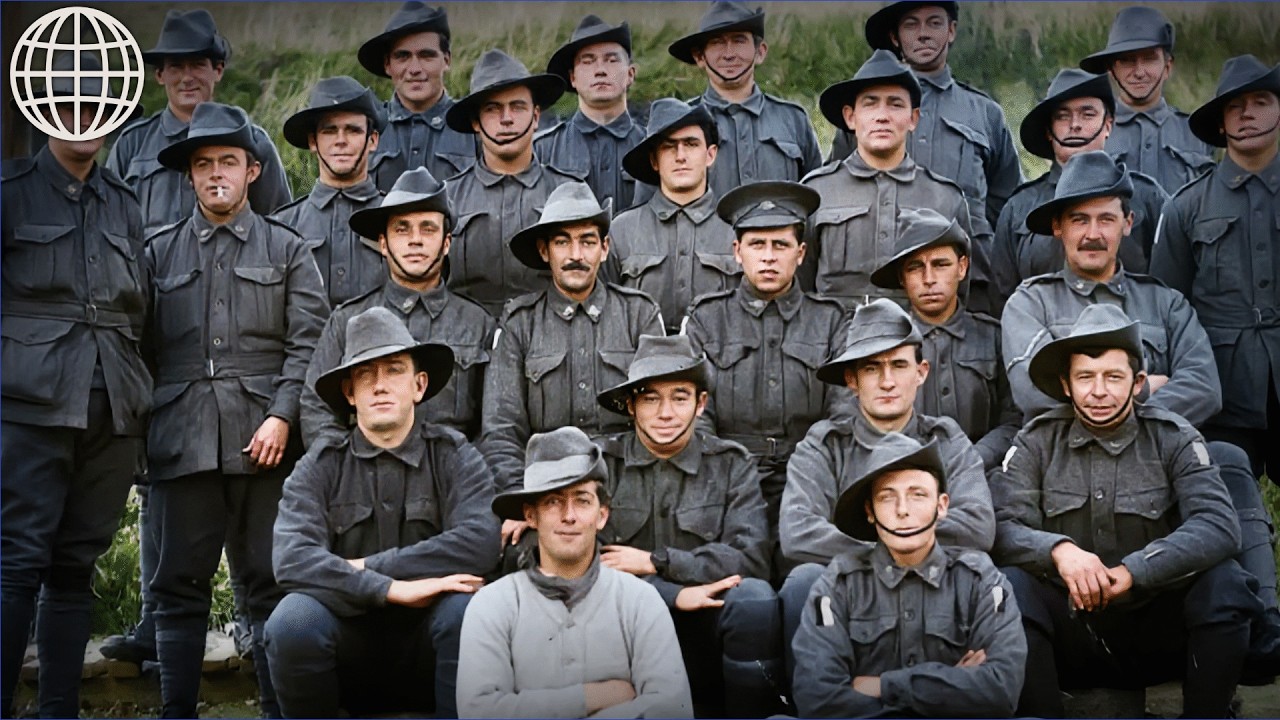
The night before the assault, the bombardment was a spectacle of terrifying power. An 18-year-old private from Albury, Edgar Cuttleford, was stunned by the sheer density of the artillery. Guns were placed nearly touching one another, a wall of fire that roared all night. The first waves met little resistance, the trenches flattened by the relentless shelling.
They captured most of the village with relative ease, but on the right flank, at a position called Munster Alley, the Germans fought back hard. It was there that Private John Leak and Lieutenant Arthur Blackburn earned their Victoria Crosses, Blackburn later calling it the biggest bastard of a job he’d ever struck. Holding the village proved more savage than taking it. The German counterattack began with a merciless bombardment on July 24th.
Arthur Foxcroft, a 23-year-old from Melbourne, wrote that consolidating their gains was terrible because the enemy knew to a nicety exactly where to shell them. When the German infantry finally advanced, they were met with a hail of fire from five Lewis machine guns and fifty rifles. The citation for Private Thomas Cook, a 34-year-old builder killed in the fighting, was stark: he did fine work, but when assistance arrived, he was found dead beside his gun. Having failed to retake Pozières, the Germans simply obliterated it.
The pretty village surrounded by orchards became a pile of debris. Corporal A. G. Thomas described it as playing tag with death for seven days and seven nights.
In just seven days, the 1st Division had suffered more than 5,000 casualties. One memory from Pozières haunted Private Earn Morton for the rest of his life. He found a young German officer, mortally wounded, who spoke English flawlessly. The man prayed for Morton to kill him, to put him out of his misery.
In that moment, Morton’s ingrained belief that they were fighting heathens shattered. From that time on, he turned against war. The next phase of the battle focused on the windmill at the summit of the ridge, a key observation point. A rushed and poorly planned attack on the night of July 29th failed disastrously.
The second attempt on August 2nd succeeded, aided by jump-off trenches dug to shorten the assault. The digging was a horror in itself. Lieutenant John Rows wrote to his family that the ground was covered in bodies in all stages of decay, his tunic rotten with other men’s blood and spattered with a comrade’s brains. Why should the people at home not know?
During the ensuing counterattack, 21-year-old Lieutenant Percy Cherry found himself trading shots with a German officer. Cherry mortally wounded him, and as he closed in, the dying German produced letters for his family and asked Cherry to promise to post them. Cherry agreed, and the German handed them over with the words, “And now it ends. ” Cherry kept his promise.
By the time the 4th Division replaced the exhausted 2nd, the fighting around the windmill had already cost almost 7,000 casualties. Almost immediately, the Germans struck again on August 7th. Among the killed was Major Duncan Chapman, reputedly the first man ashore at Anzac Cove. The battle dissolved into desperate, small-scale actions.
In one dugout was Lieutenant Albert Jacka, already Australia’s first VC winner of the war. Climbing out, he saw Germans marching 40 Australian prisoners to the rear. He attacked single-handedly. Half the Germans fled, others fought, and the prisoners joined in, driving the Germans off.
Seeing the scattered fights across the ridge, one soldier recalled it was the queerest sight: Aussies and Huns fighting their own individual wars, with the issue never in doubt. Cruelty seemed to be the rule. The 48th Battalion, already bloodied at the windmill, suffered a further tragedy when a shell fell among men waiting for a cup of tea behind the line, killing 26 and injuring 16. The constant shelling from multiple sides made the salient feel like waiting for your turn at the bar.
In one failed attack, the barbed wire was found intact. Men clawed at it, tried to bash a path through with their rifles, or lift the stakes, only to get caught. Hanging there, knowing you had only seconds before the machine gun traversed, was a living nightmare. The long-term psychological effect was profound.
It was the first time the Australians had faced industrial warfare on a colossal scale. One man said that hell, as imagined by the ancients, was a picnic compared to this. Having taken Pozières Ridge, the Australians advanced toward their next objective, a farm that had become part of Anzac folklore: Mouquet Farm, or “Moo Cow Farm” to the men. The Germans defended it in great strength.
The 15th Battalion took most of Park Lane Trench but had to pull back when the British Suffolks on their flank were held up and decimated. Over the next two nights, the 15th and 16th Battalions regained the lost ground and advanced another 100 meters under a storm of fire. It was just a few hundred meters from Mouquet Farm that Martin O’Meara earned his VC, repeatedly carrying out the wounded and bringing in supplies under heavy fire. His health broke down not long after the war, and he spent the rest of his life in a psychiatric institution, a victim of what was then called shell shock.
The uncounted casualties of the war. The Australians gained 500 meters and were poised to attack the farm, but then the British were driven out of their section of trench, leaving the Australians exposed to enfilading fire. They were forced to withdraw, left holding only a quarry below the farm. After losing over 4,500 men, the 4th Division left the line.
“I have been in hell,” wrote 20-year-old Harold Armitage, “and have had the luck to get back again. ”
Each division was then sent back in for a second tour, losing another 2,600 men, then over 1,200 more, before heavy rain turned the battlefield to liquid mud. In early September, the Canadians finally took over. Australian involvement had lasted 45 days, involved 19 attacks, and resulted in 23,000 casualties.
One of them was Captain Ivor Margetts, a Gallipoli legend and one of the first ashore, killed by shrapnel. A fellow soldier said he was the best man going, and he cried like a kid when he found him dead. He believed Margetts went because he was too good for the beastliness of war. When the Australians left the line, the Somme campaign was barely halfway through.
It was time for the New Zealand Division to fight its first set-piece battle, an action that would cost almost 7,000 casualties in 23 consecutive days, the longest unbroken stint of any division that fought there. It began at 6:20 on the morning of September 15th, a perfect autumn day. Haig ordered a resumption of the wider offensive, introducing a new and untried weapon: the tank. The New Zealand Division was to advance 3 kilometers along a 900-meter front to a point beyond the village of Flers, supported by a creeping barrage that moved forward just ahead of the infantry.
The tanks were delayed by old shell craters, but the barrage was effective, and the New Zealand battalions made good progress. As they passed the village toward their third objective, the tanks finally appeared, just as resistance stiffened. A small piece of history was made when Lieutenant C. E.
Butcher scribbled a note asking a tank, D12, if it could assist against enemy machine guns. It was the first-ever communication to a tank in action. Another famous message went back: “A tank is walking up the High Street of Flers with the British Army cheering behind. ”
The Kiwis pushed on, but the British divisions were held up, leaving the New Zealanders alone in a salient, raked by fire and heavily counterattacked.
They were forced to withdraw to the outskirts of Flers, having advanced 2. 3 kilometers for the loss of 2,000 men. Flers was low-lying, destined to turn to mud and ice in the approaching winter, so the costly advance had to continue to higher ground. The next objective was the Germans’ fourth defensive line, anchored at Le Transloy.
Heavy rain hampered everything. Sergeant Major Cecil Malthus wrote of being reduced to a miserable condition with no greatcoats, no blankets, and heavy mud everywhere. On October 1st, a well-sited machine gun held up the advance. Sergeant Donald Brown silenced it, as he had done before.
One of his men said the platoon would have followed him anywhere because he’d never ask a man to do what he wouldn’t do himself. Towards the end of the advance, Donald Brown was killed by a sniper and posthumously awarded the Victoria Cross. By the time the Somme campaign was closed due to bad weather on November 18th, 1916, casualties on both sides totaled more than a million. The Allies had gained just 12 kilometers of ground.
The locals still call the shrapnel and munitions that the plows turn up “the iron harvest. ”
The Australians moved back up the line in the worst winter for 40 years, with temperatures dropping to minus 15 degrees Celsius. Then the rain came in bucketfuls, turning the torn-up ground into a quagmire. Their first action was an attack on Bayonet Trench, which failed when the wire was found intact, and they were forced to withdraw.
Another assault was a fiasco when its commanding officer held the battalion back to wait for rations. Other actions literally bogged down in the mud, with attackers and defenders stuck waist-deep, only a stone’s throw apart. After nearly a year on the front, with the incredible losses of 1916, morale was at its lowest point ever. Corporal George Mitchell later wrote that in their darkest moments, they thought they were condemned to stay in this hell forever.
When the weather improved, fighting resumed. On February 1st, the 15th Battalion attacked and took Stormy Trench but couldn’t hold it. Three nights later, the 13th Battalion attacked and took it under the leadership of Captain Harry Murray, one of the most extraordinary soldiers of the war. Murray, a timber cutter from Tasmania, received a VC for his part in the success, cementing his reputation as the most highly decorated infantryman in all the Empire armies.
He would later write that his only wish was that he would not have to kill a man, but that wish went at the sight of their own dead and wounded. In the year that was just beginning, 1917, the world would dramatically change. Russia would be torn by revolution and seek peace, allowing more than 30 German divisions to be transferred to the Western Front.
And 1917 would also become the costliest year in Anzac military history, as they added the names of Bullecourt, Messines, and Ypres to their battle honors.