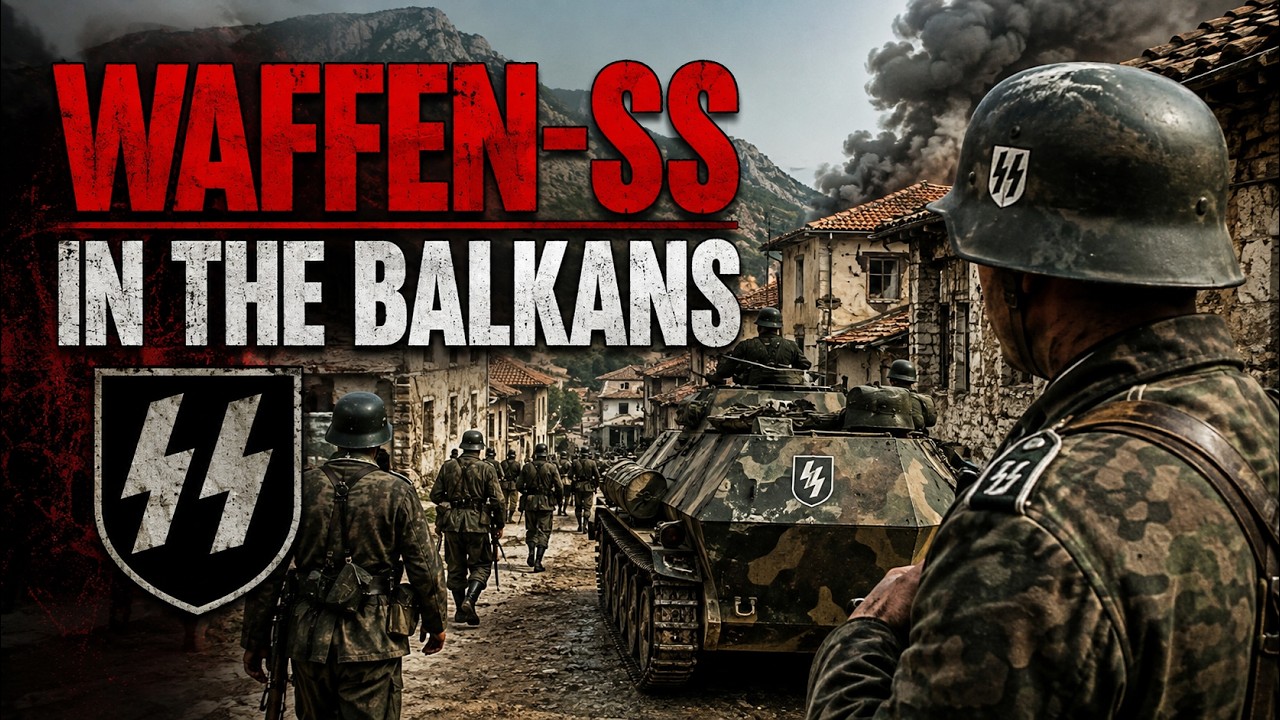
The mountain landscape of the southern Balkans lay in a strange, golden peace that April of 1941. The stone villages, the ancient churches, the valleys that had held the same rhythms for centuries—all of it was about to be shattered by the arrival of mechanized warfare. The Balkans were not a unified place, despite the existence of the Kingdom of Yugoslavia. They were a fractured mosaic of peoples—Serbian Orthodox, Catholic Croats, Muslims, Slovenes—each carrying their own grievances, their own narratives about who should govern.
The Kingdom was held together by a fragile consensus, with Serbian political and military power dominating a structure that satisfied neither those who wanted greater Serbian control nor those who resented it. Croats, in particular, felt historically disadvantaged, dreaming of their own independent state. The government in Belgrade attempted national cohesion, but the regent Prince Paul was navigating impossible circumstances, squeezed between Nazi Germany and the Western powers. The terrain itself—those carved mountains, the gorges, the villages reachable only by passes—made unified governance difficult and would make resistance possible.
The Balkans also held strategic resources that Germany desperately needed: chrome, bauxite, copper, agricultural products. On April 6th, the bombers came. They fell upon Belgrade in waves, and the city’s anti-aircraft defenses proved almost useless. Ground invasion followed from multiple directions—German columns from Austria and Hungary, Italian forces from the west, Hungarian and Bulgarian contingents from their borders.
The Yugoslav army, more than a million men on paper, crumbled with a speed that surprised even the German High Command. The officer corps was fragmented along ethnic lines; Serbs held the highest ranks while Croats and Slovenes harbored deep resentments. When the invasion came, this internal fracture became fatal. Some units fought with desperate bravery, but they fought in isolation, cut off by the rapid German breakthrough.
Within days, tanks had penetrated far into the interior. Greece fell even faster. By late April, both Yugoslavia and Greece lay under Axis occupation. The territory was carved up among competing powers—Italy took the Dalmatian coast, Hungary received northern regions, Bulgaria gained Macedonia.
And then there was the creation of the Independent State of Croatia, a puppet regime led by Ante Pavelić, a nationalist forged in exile who brought with him the ideology of the Ustasha movement. The Ustasha drew on racial and religious exclusivity, a vision of a state purified of those who did not belong—Serbs as ancient enemies, Jews, Roma, all undesirable. From the beginning, there was a paramilitary dimension, a violence driven by ideological fervor. Ustasha units began to carry out pogroms against Serbian civilians.
The Germans supported the Ustasha’s repressive apparatus, although some within the Wehrmacht found the violence excessive and counterproductive, fearing it would drive the population into the arms of resistance. To understand the machinery of occupation, one must understand the Waffen SS. What had begun as Hitler’s small protection detail had, under Himmler, been transformed into something resembling a modern knightly order, with ritual, genealogical examinations, and a rigid code of conduct. The Waffen SS, its military arm, was distinct from conventional forces precisely because of its ideological foundation.
Recruits were subjected to intense indoctrination in Nazi racial ideology. Mercy toward certain categories of enemy was not merely discouraged but trained against. As Germany expanded, the need for occupation forces grew, and the SS began to relax its strict racial requirements. First came ethnic Germans, then Scandinavian volunteers, then, as the demands of occupation multiplied, soldiers from conquered lands—Ukrainians, Latvians, and eventually, Croatians and Bosnian Muslims.
Ideology bent to accommodate material necessity. When the German army crossed into Yugoslavia, the Waffen SS initially arrived in smaller contingents, as liaison officers and security advisers. But as resistance emerged—the Chetniks, royalist Serbian nationalists, and the communist Partisans—the character of SS involvement shifted. The language in internal documents changed from “administrative order” to “security operations” and “necessary countermeasures.
” The SS positioned itself as the appropriate instrument for this deepening conflict. The machinery for recruiting local men into SS service began to turn. Two very different movements emerged to challenge the occupiers. The Chetniks, formed first under a surviving Yugoslav army colonel named Draža Mihailović, took their name from an old tradition of guerrilla fighters.
Mihailović was a monarchist whose strategy was to conserve strength and wait for the inevitable clash between Germany and the Soviet Union, after which he believed the Western Allies would arrive. He feared that premature rebellion would bring terrible reprisals upon Serbian civilians. And he may have been right. But many Chetnik commanders began to see the occupation as an opportunity to assert Serbian dominance over the region’s Muslim and Croat populations, and some units found themselves drawn into agreements with German and Italian forces when it served their nationalist interests.
The communist Partisans burst onto the scene with different energy. Led by Josip Broz Tito, the Partisans launched their first armed uprising in the summer of 1941. Tito’s vision was fundamentally different. He believed in immediate aggressive resistance, and more profoundly, he believed the struggle could become the crucible for a new multiethnic Yugoslavia—where Serbs, Croats, Slovenes, and Muslims would fight together as equals.
In a region torn by centuries of ethnic tension, Tito offered a unifying banner. The Partisans accepted recruits from all backgrounds and operated under strict military discipline. They grew with remarkable speed. By late 1941 and into 1942, skirmishes between Chetnik and Partisan units began to occur with increasing frequency, and the occupiers watched this internal conflict with satisfaction.
For ordinary people, the occupation was woven into the texture of daily existence. Curfews reshaped the evenings. People spoke in lower voices than before. The black market was widespread and dangerous.
The question of informants was perhaps the most corrosive element. In every community, it was understood that some people were reporting to authorities, creating a constant background hum of suspicion. The occupation was not monolithic; a village in Italian-controlled zones experienced it differently from one under direct German administration. By late 1942, as partisan activity intensified and German manpower stretched thinner, Berlin began to look toward the Muslims of Bosnia and Herzegovina.
The formation of what would become the 13th Waffen Division, Handschar, began in the spring of 1943. The recruitment appeal was constructed carefully—German authorities emphasized the protection such service would offer against communist partisans and Serb Chetniks, who harbored deep hostilities toward Muslim populations. Joining was presented as a way to defend one’s village, one’s family, one’s mosque. There were also coercive mechanisms at work; families that cooperated received favors, while those who resisted found their movements restricted.
By autumn of 1943, the division numbered around 8,000 troops. The soldiers wore the field gray and SS runes, but many also wore fezzes. Religious services were permitted, imams brought in to minister to the troops. The division was deployed to Bosnia, the very regions from which its recruits had been drawn, and used as shock troops for counterinsurgency campaigns.
The German command had arrived at a conclusion that would reshape policy: they would make an example of entire communities in the hope that terror itself might succeed. This doctrine, collective reprisal, had a brutal clarity. For every German casualty, dozens of civilians might be executed. For a suspected partisan hiding place, an entire village might be raised.
The mathematics of terror created a grim feedback loop—partisans would attack, the occupying forces would respond with sweeps that killed civilians, the killings would drive more young men into the partisan ranks, the insurgency would grow, and the reprisals would intensify. In the summer of 1942, one of the most systematic sweeps unfolded around the Kozara mountain range in northwestern Bosnia. Tens of thousands of civilians—women, children, the elderly—were driven from their villages into detention camps. The operation accomplished its stated military objective by reducing partisan activity, but the cost was the destruction of communities that had existed for centuries.
The Partisans, meanwhile, had grown into a genuine military force. Where the Chetniks looked backward to a Serbian kingdom that no longer existed, Tito’s forces looked forward. The Partisans were built on communist organizational principles—a hierarchical chain of command, unified strategy, centralized discipline. They began to establish “liberated areas,” zones where a new social order was being practiced in miniature, where women fought alongside men, a radical departure from Balkan tradition.
By 1943, the movement had swelled to perhaps 50,000 fighters. In London and Washington, Allied leaders began to ask which movement could deliver results. In the beginning, the choice seemed simpler; Mihailović, a Serbian officer fighting against the Germans with nationalist conviction, emerged naturally as the face of resistance. British intelligence found him first, and through the BBC his reputation was amplified as a symbol of defiance.
But on the ground, something more complicated was unfolding. The Chetniks were not mounting the kind of sustained insurgency that would make a dent in Axis control; they were defensive, cautious, and there were moments of ambiguity where they collaborated locally with occupiers. Meanwhile, reports from British officers embedded with the Partisans painted a picture of an organization that was genuinely threatening Axis control, tying down German forces, growing stronger month by month. Churchill, despite his skepticism of communism, possessed a ruthless pragmatism.
By late 1943, the mathematics of military necessity overrode ideological preferences. Supply drops were redirected from Chetniks to Partisans. Mihailović felt abandoned, his struggle rendered invisible. In 1944, another formation was active—the 7th SS Volunteer Mountain Division, Prinz Eugen, drawing its strength from ethnic German populations scattered throughout the Balkans.
These men spoke Serbian and other local languages; they understood the customs, the feuds, the careful social mathematics of Balkan villages. This made them immensely valuable as a bridge between the occupation’s ideological mission and the complex human terrain. The division became notorious for the intensity of its antipartisan operations. They moved through the highlands in sweeping formations, burning villages, executing suspected guerrillas, displacing whole populations.
Because they could communicate directly with local inhabitants, the violence carried an additional weight of betrayal. The counterinsurgency response grew more desperate, more indiscriminate. For every German soldier killed, a hundred locals. For every act of resistance, the erasure of villages.
By the autumn of 1944, the maps on German headquarters walls told a story of contraction. The Soviet Red Army was drawing closer. The Partisans had grown into a genuine army that could no longer be contained. The 7th SS Division found itself increasingly committed to rear-guard operations, and the 13th Division, Handschar, having suffered enormous casualties and morale problems, was tasked with covering retreat routes and protecting the evacuation of collaborators who faced certain execution under partisan rule.
In October 1944, Soviet armies approached Belgrade and German garrison forces withdrew. The partisans entered the city, and Belgrade’s liberation was less a moment of Western Allied forces arriving to overthrow tyranny, and more a moment of Soviet-aligned forces taking possession. By the winter of 1944, most German and Waffen SS formations had withdrawn from the Balkans entirely. The retreat was not a simple orderly withdrawal, but a prolonged unraveling, leaving behind a landscape transformed by war.
When the guns fell silent in the spring of 1945, the question settled over the landscape: how does a people reckon with what they have endured? In Yugoslavia, the process of accounting was bound up with nation-building. There were high-profile prosecutions; members of the Ustasha regime were captured, judged, and sentenced to death. But the vast apparatus of collaboration remained largely unexamined.
Thousands who had worn Waffen SS uniforms vanished into a fog of amnesty, flight, or administrative forgetting. The Tito regime promoted a narrative of unified multiethnic partisan triumph, which contained considerable truth but also served to obscure the deeper communal violence. Monuments rose to partisan fighters across the Balkans, creating a landscape of memory that was itself contested. There was a kind of negotiated amnesia maintained by state power.
This had both positive and troubling consequences—it maintained stability and allowed multiethnic coexistence, but it meant many questions remained unexamined, many victims unacknowledged. The stone villages have slowly, over decades, settled into a different kind of quietude. Physical reminders are present—the pockmarks of gunfire on walls, the carefully maintained memorials, the names carved into stone. But they exist alongside the evidence of ordinary life resumed.
The Balkans chose in many ways to build forward rather than backward. The memorials became a conversation between past and present, insisting, “This happened here. Do not forget. ” Oral memory proved to be a form of resistance against forgetting; grandmothers in particular became keepers of stories that might otherwise have been lost.
The land heals. Time does its work not by erasing but by transformation.