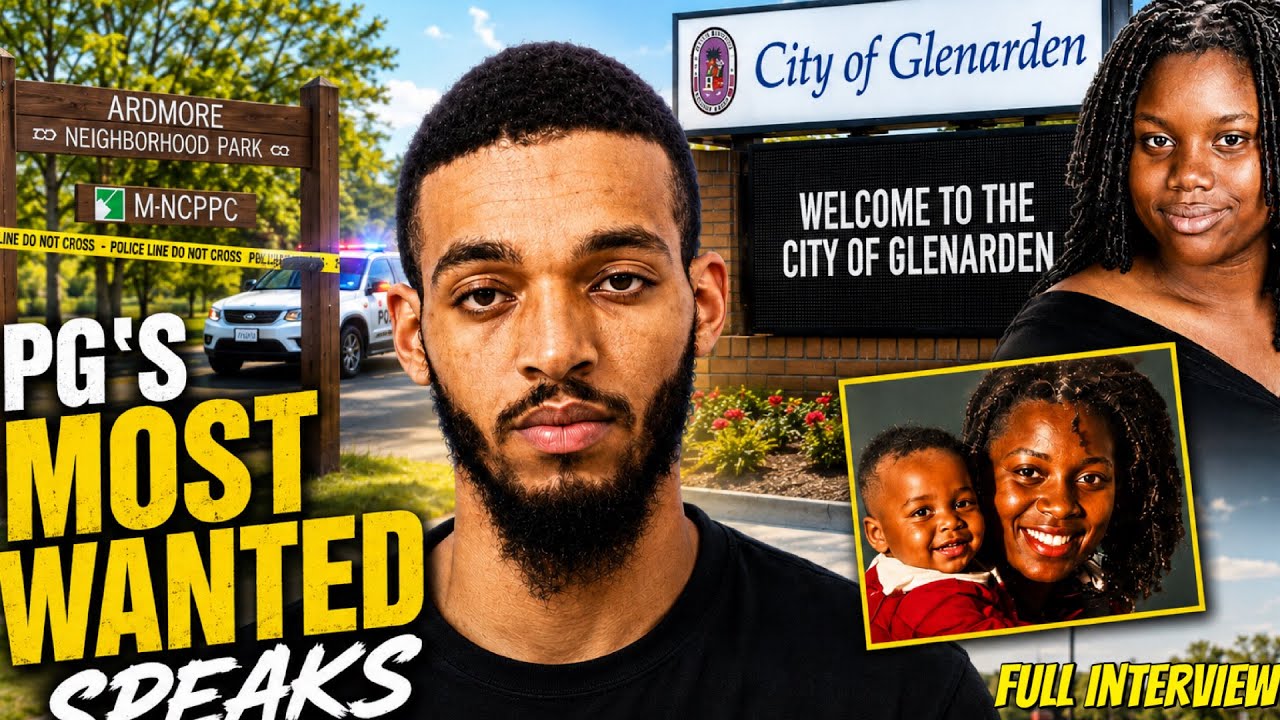
The man at the center of one of the most violent and deadly street conflicts in Prince George’s County history has broken his silence, offering a chilling and unflinching account of a life consumed by violence, retaliation, and a desperate fight for survival. Larry Reio, a 34-year-old former aspiring boxer known as the “Cuban Assassin,” sat down for an exclusive interview, detailing the events that led to a years-long war between rival neighborhoods, a war that left multiple innocent people dead and forever scarred the community.
Reio’s story is a tragic tapestry woven with threads of loss, anger, and a descent into a world where the streets dictated every move. He was born into a world without a father, a fact that he says fueled a deep-seated anger from the very beginning. “My father passed away on the day I was supposed to be born,” Reio stated, his voice carrying the weight of a lifetime of pain.
 “I came into this world not even knowing my father. That was an anger problem for me.”
From a promising young boxer with a national ranking, Reio’s life took a sharp turn at the age of 16 when his mother, trying to keep him on the straight path, kicked him out of the house. This single event, he explains, was the catalyst that pushed him fully into the streets. “I had no childhood,” he said, describing the grueling schedule of training and tournaments that left him isolated from his peers.
“I wanted to be a kid, ride my bike. My mother said no. That was my job.”
Homeless and desperate, Reio was taken in by an older figure from the neighborhood who introduced him to the drug trade. But it wasn’t long before the young man’s ambition and ruthlessness took over. “I started tricking people, robbing drug dealers,” he admitted without hesitation.
“I ain’t always have to use a pistol, but I tricked a dude. I gave a dude a brick one time in a book bag.” This was the beginning of his life as a predator in the streets, a life that would soon escalate into a full-blown war.
The conflict, which Reio identifies as the “Armor versus Glennard” beef, was not a random act of violence. It was a deeply rooted neighborhood rivalry that had simmered for years, erupting into a cycle of shootings and retaliations that would claim the lives of innocent bystanders. The first major flashpoint came in 2008, when a drive-by shooting near Charles Herbert Flowers High School killed 18-year-old Sharice Richardson, a senior who was simply walking home from school.
“She was not the intended target,” Reio explained, his tone somber. “It was a stray bullet. That’s when things went to a whole other level.”
 Reio was present at the scene that day, and the memory of seeing the young girl’s body is one he cannot shake. “I saw her laying on her face. I thought she was faking,” he recalled.
“That taught me this is real. It was a wake-up call.” But instead of pulling back, the violence only intensified.
Reio admits to seeking revenge, and he got it. “I caught five of them one night,” he said, describing a retaliatory shooting. “I hit five of them.
One of them I hit six times.”
The cycle of violence was relentless. The man he shot six times, Reio revealed, later came back to shoot him five times. “A year later, same dude hit me,” he said, describing the brutal reality of the street code.
“That’s just how it goes.” This first shooting left him wounded but alive. The second, however, was far more severe.
 In May 2015, Reio was shot eight times, including a bullet to the head, during a confrontation at a local park. He was in a coma for 25 days. “I woke up and thought it was the same day,” he said.
“They told me I’d been asleep for 25 days.”
The shooting that nearly killed him was not a random act of violence from a rival gang. It was a personal dispute with a man Reio had dismissed as a “squid,” a DJ who sold weed but was not a hardened street figure. “I took him for bad,” Reio admitted, showing a rare moment of self-reflection.
“I thought he was a sucker. I treated him less of a man. That’s where I went wrong.”
The DJ, feeling disrespected, returned to the park and opened fire, hitting Reio multiple times. The incident also led to the death of the DJ, who was shot by Reio’s friend in what was later deemed self-defense.
While Reio was in the hospital, handcuffed to his bed, the police began to build a case against him. He was charged with being a felon in possession of a firearm, a charge stemming from a separate incident a week before the shooting. He was also accused of a cold case murder from 2009, the death of 19-year-old Shay Caldwell, a young mother who was killed at a graduation party.
 “They put the blame on me because I’m the wildest one out the bunch,” Reio claimed, vehemently denying any involvement in Caldwell’s death. “I had nothing to do with it. They ran with the story with no evidence.”
The murder charge, which was later dropped after prosecutors failed to appear in court, became a defining moment for Reio. “It changed my whole thought pattern,” he said. “They were putting a body on me that I didn’t do.
I can’t let them get me. I have to do right.” After serving seven and a half years in prison for the federal gun charge, Reio was released in 2023.
He is now trying to rebuild his life, focusing on his boxing career and his YouTube channel, where he tells his story and offers motivation to others.
The war between the neighborhoods, which Reio describes as one of the deadliest in PG County’s history, has left a trail of broken families and lost lives. “Nobody wins,” he said, reflecting on the senseless violence. “It’s a lot of people that were involved in this that were good men.
We just were lost. We were viciously lost.” Reio’s story is a stark reminder of the consequences of a life lived on the streets, a life where the line between victim and perpetrator is often blurred by the very environment that created it.
He now speaks openly about his past, hoping that his story can serve as a warning to others. “Take your pain and get paid for it,” he urged. “Don’t take it out on people in the streets.”