The arrow struck with surgical precision, guided by the gods themselves, finding the one spot on Achilles’ body that had never touched the sacred waters of the River Styx—his heel. The greatest Greek warrior fell, and with him fell the hope of the entire Greek army. But I’m getting ahead of the story. For centuries, the tale of Troy has captivated the world.
A beautiful woman, Helen, flees with her Trojan lover Paris, sparking a war that lasts a decade. The Greeks lay siege to the mighty city, heroes clash on the blood-soaked plains, and ultimately, a giant wooden horse brings about Troy’s destruction. But how much of this epic legend is true? Was there ever really a city called Troy?
Did Helen, the most beautiful woman in the world, truly exist? And could an army really have been fooled by a giant wooden horse? Most of what we know about the siege of Troy comes from Homer’s masterpiece, *The Iliad*, Europe’s oldest surviving work of literature. The title itself comes from Ilion, the Latin name for Troy.
For ages, scholars dismissed the entire story as pure fantasy, believing Troy was nothing more than a figment of a poet’s imagination. Then in the 1870s, an archaeologist named Heinrich Schliemann changed everything. He studied the ancient clues and began digging at a mound in northwest Turkey called Hisarlik. What he found matched the description of Troy remarkably well.
Homer, the epic poet himself, remains a mystery. Some scholars question whether he even existed, suggesting the *Iliad* might have been the work of multiple poets. But the poem’s singular brilliance and coherence point to one creative genius. If Homer did live, it was likely in the second half of the 8th century BC, about 500 years after the Trojan War supposedly took place.
One tradition says he was blind, though modern scholars consider this a fanciful addition to his legendary status. So, let’s travel back more than 3,000 years to a wealthy metropolis on the coast of Asia Minor, near the straits leading from the Aegean to the Black Sea. Archaeologists place the Trojan War in the 13th century BC, likely between 1250 and 1200. At that time, the Mycenaean civilization centered on Mycenae was powerful enough to mount a major expedition.
This date fits well with the earlier of the two dates given in Greek tradition. For over a century, experts debated Schliemann’s claim. Critics pointed out that the mound he excavated was far too small to hold the massive Trojan army described in the legend. But recent excavations have revealed a far larger lower town surrounding the citadel, making the Homeric description plausible.
The site’s later history also supports the identification. Romans and Greeks of later periods called it New Ilium, New Troy, recognizing the ruins as the legendary city. Following Schliemann, other major excavations took place in 1893 and 1932, and then again in 1988 with an international team led by Professor Korfmann, who brought a new framework of understanding to the site. The legend says the war began with a love affair.
Helen, daughter of the king of Sparta, fell for Paris, son of Priam, king of Troy. She was already married to Menelaus, brother of Agamemnon, the ruler of Argos. Their first meeting is said to have been love at first sight. Smitten by the handsome Trojan prince, Helen fled with him to Troy, leaving her husband bitter and humiliated.
To avenge his honor, Menelaus gathered a mighty army, with Agamemnon as its commander. But as always, the gods had their say. The deities of Mount Olympus looked down, toying with mortal lives. The sea god Nereus warned Paris that his affair would spell disaster, but it was too late.
The couple was already an item. Helen was said to be the most beautiful woman in the world, a celebrated figure. She was so beautiful that her father made all her suitors swear an oath: they would accept her choice of husband, and if anything disrupted her marriage, they would come to her aid. This oath was what the Greeks used to justify their great expedition.
But some, like the actor Brian Blessed, question the romantic motive. He suggests that the Greeks weren’t truly fighting for Helen’s honor. Troy was fabulously wealthy, rich in gold, bronze, and silver. Blessed believes the Greek states were jealous of Troy’s wealth and trade and simply wanted to plunder it.
The Greek army that set sail was a collection of legendary heroes: Achilles and his companion Patroclus, Diomedes, Odysseus, King Nestor, and the giant Ajax. They landed at a place called Sigeum, looking out over the Scamander and Simoeis rivers, with the magnificent city of Troy visible in the distance. They built palisades to protect their ships. A prophecy had promised the Greeks that after nine years of fighting, they would be victorious in the tenth.
For nine years, the siege dragged on, with battles raging back and forth across the plain. Even the gods were divided in their support. Aphrodite and Ares sided with the Trojans, while Hera and Athena hoped for a Greek victory. Zeus himself shifted his favor from one side to the other.
Was such a prolonged siege even possible? Historians point out that there’s no evidence of any siege lasting ten years in the ancient world. Typically, sieges lasted months, were usually won by starving the enemy, and rarely involved direct assaults. An army of the size Homer describes couldn’t have been provisioned on the plain for even two years, let alone ten.
At best, this is a dramatic exaggeration. The *Iliad* focuses on just the final year of the siege. During those years, a terrible quarrel erupted between Achilles and Agamemnon. Agamemnon took Achilles’ captive, a young woman named Briseis, for himself.
His greed was so offensive that Achilles and his men retreated to their ships and refused to fight. Briseis was also the daughter of a priest of Apollo, and the god was so angered by Agamemnon that he unleashed a plague of arrows upon the Greek camp. The prophets warned Agamemnon that unless he returned Briseis, the Greek suffering would never end. But the damage was done.
Deprived of their greatest hero, the Greeks were soon confronted by the awesome strength of Paris’s brother, the mighty Hector. This hand-to-hand combat was brutal and savage. Soldiers aimed for the inner thigh, a vulnerable spot that would pour blood dramatically when struck. Neither side gave or expected mercy.
The plain grew red with blood, and at night, truces were called to collect and cremate the dead. Men wept at the sight of their shattered comrades. The *Iliad* is primarily a story of single combat between heroes. And its climax is the epic struggle between Hector and Achilles.
The weapons and armor Homer describes—shields as tall as towers—match remarkably well with the Mycenaean relics of the 13th century BC, lending credibility to the story. As the battle continued, the Trojans, aided by Zeus, began to drive the Greeks back. Only darkness saved them from annihilation. That night, the confident Trojans camped on the plain, and the Greeks, facing defeat, pleaded with Achilles to rejoin the fight.
Their pleas fell on deaf ears. Achilles continued to brood in his tent over his stolen prize. The next day, the Greeks held on for grim death. Agamemnon and Odysseus were wounded.
Victory for the Trojans seemed inevitable. Then Patroclus, Achilles’ beloved companion, stepped forward. Achilles allowed him to go into battle, but warned him not to pursue the Trojans all the way back to the city. As a disguise, Patroclus wore Achilles’ magnificent armor.
Seeing the armor of the great warrior, the Trojans panicked, believing Achilles had returned. The battle swung in favor of the Greeks. But Patroclus didn’t heed Achilles’ warning. Carried away in the heat of battle, he was killed.
The gods intervened, with Apollo removing his armor, leaving him vulnerable. Hector and the Trojans killed him. Ajax had to fight off Hector three times just to recover Patroclus’s body. Achilles was grief-stricken.
He mourned his friend through the long night, then, fueled by rage, he rejoined the battle. Dead Trojans fell at his feet like sheaves of wheat at harvest. But there was one Trojan he wanted above all: Hector. Old King Priam watched from the city walls as Achilles charged.
The Trojans fled through the gates, but Hector remained outside to face him. Yet at the sight of the enraged Achilles, Hector’s courage failed, and he fled. Three times they circled the city before the goddess Athena, disguised as Hector’s brother, persuaded him to stand and fight. The confrontation was inevitable.
Achilles killed Hector, and then revealed his dark side. He tied Hector’s body to his chariot and dragged it around the walls of Troy, as Hector’s family watched in horror from the battlements. With Hector gone, victory seemed within the Greeks’ grasp. Convinced Troy was about to fall, they surged toward the sea gate.
But in the midst of battle, Paris, his aim guided by Apollo, shot an arrow at Achilles. It struck the only vulnerable spot on his body—his heel. The mighty Achilles fell, mortally wounded. His mother, Thetis, had learned that Achilles could become immortal if dipped in the waters of the River Styx.
She did this, but held him by his heel, which never touched the water. That one spot remained mortal. Ever since, we use the phrase “Achilles’ heel” to describe a hidden weakness. With both heroes dead, the fighting degenerated into a bloody stalemate.
Neither side could gain the upper hand. It would take more than brute force to break the walls of Troy. It would take guile. The idea for deceiving the Trojans came from Odysseus.
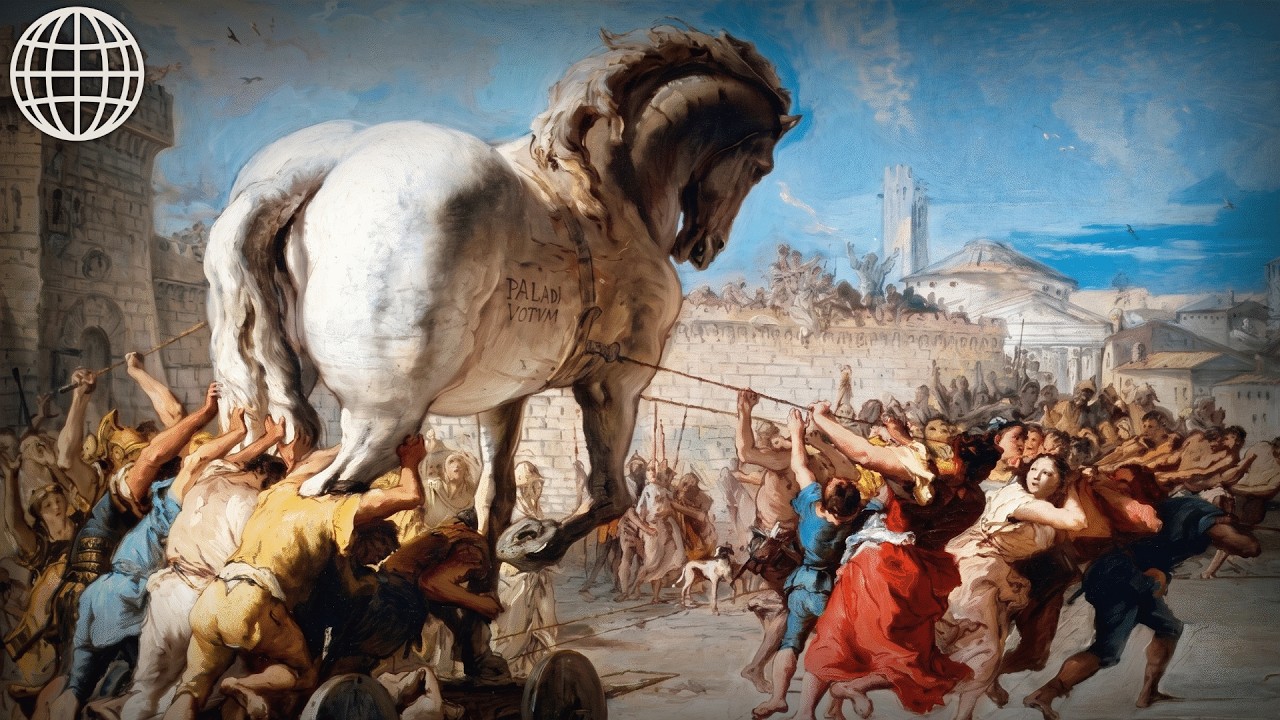
The wooden horse of Troy is one of the most memorable episodes in all of ancient legend, and simultaneously, the one that seems most fantastical. The idea of hiding warriors inside a giant horse and tricking the enemy into bringing it inside their walls sounds like pure poetic invention. But some historians find it quite conceivable. In the late Bronze Age, the Hittites in Anatolia created large, life-sized animal-shaped vessels on wheels, used as libation vessels in religious ceremonies.
These are depicted in ancient sculptures. It’s possible some enterprising military leader might have used such a structure to sneak warriors into a besieged city. According to the legend, the Greeks labored for three days to build the wooden horse. It was exquisitely carved, large enough to hold twenty warriors inside its hollow body.
Among those who climbed in were Odysseus, Diomedes, and Menelaus. Meanwhile, the Greek army abandoned their camps and withdrew, feigning defeat. The Trojans were ecstatic. They gathered around the colossal horse in wonder.
A Greek soldier named Sinon, pretending to be a deserter, convinced them the horse was a sacred offering. He claimed that as long as it stayed within the city walls, Troy would never be captured. The Trojans dragged the horse through a breach in their own city wall. There were warnings.
Laocoön, a priest of Apollo, spoke out against it, saying, “No, this is dangerous. ” But Apollo was on the side of the Greeks, so he sent serpents to kill the priest, silencing his warnings. Helen herself was suspicious. She wandered around the horse, calling out the names of Greek soldiers, imitating the voices of their wives to lure them into responding.
Inside, the soldiers nearly panicked, but Odysseus held them back. As night fell, the Greek fleet returned from the island of Tenedos. A signal was given, and Sinon opened the hidden door in the horse. The warriors climbed out, unlocked the city gates, and the Greek army flooded in.
The slaughter was terrible. Few were spared. Fires swept through the streets. King Priam was murdered in his own palace before the eyes of his son.
Women and children were killed or enslaved. The great treasures of Troy were seized. And what of Helen, the woman for whom Greeks and Trojans had fought for ten years? Homer portrays her sympathetically—not as a woman reveling in her adultery, but as one deeply ashamed.
Her fate after Troy’s fall varies across different versions of the story. In one, her husband Menelaus is determined to kill her for her betrayal. In another, they reconcile and live happily ever after back in Sparta. So, what truth lies behind this grand tale?
Archaeologists have established that a city, almost certainly Troy, existed at Hisarlik at roughly the right time. The discovery of a large lower city has validated the size of the settlement, and the descriptions of Bronze-Age armor in the *Iliad* match archaeological findings. But there is no physical evidence of a ten-year siege, no scattered weapons or bones of battle. Such things were typically cleared away quickly.
Helen herself is not attested in any contemporary records from the Hittites, Mycenaeans, or Egyptians. She is almost certainly a figment of a fertile male imagination. Likewise, there’s no historical proof that Achilles, Hector, Odysseus, or any of the other heroes ever lived. Schliemann found a golden mask at Mycenae which he attributed to Agamemnon, but the mask is far older than the king would have been.
The legend of Troy has survived not through its historical accuracy, but through its humanity. Homer created heroes who are deeply relatable. Achilles, despite his superhuman status, is profoundly human. After killing Hector, the great hero is moved when Priam, the old king, a father grieving the loss of his son, pleads to reclaim Hector’s body for a proper burial.
The two men sit together and weep—Achilles for Patroclus, Priam for Hector. In that moment, Achilles relents. These characters are real and human, and so are the gods and goddesses. The wife of Zeus constantly nags her husband, getting the better of him.
It’s a story we can recognize, one that makes the intervening 3,000 years simply drop away. The story of Troy, that splendid, romantic, glorious, and doomed city, refuses to die.