The Japanese 31st Division had not been expected to reach Kohima. The British garrison, a few hundred soldiers scattered across the ridge, had seen the intelligence reports, but the Japanese were meant to be hundreds of miles away, pressing further south toward Imphal. Kohima was too small, too remote. The hills were too steep and the rain too constant for a major army to cross.
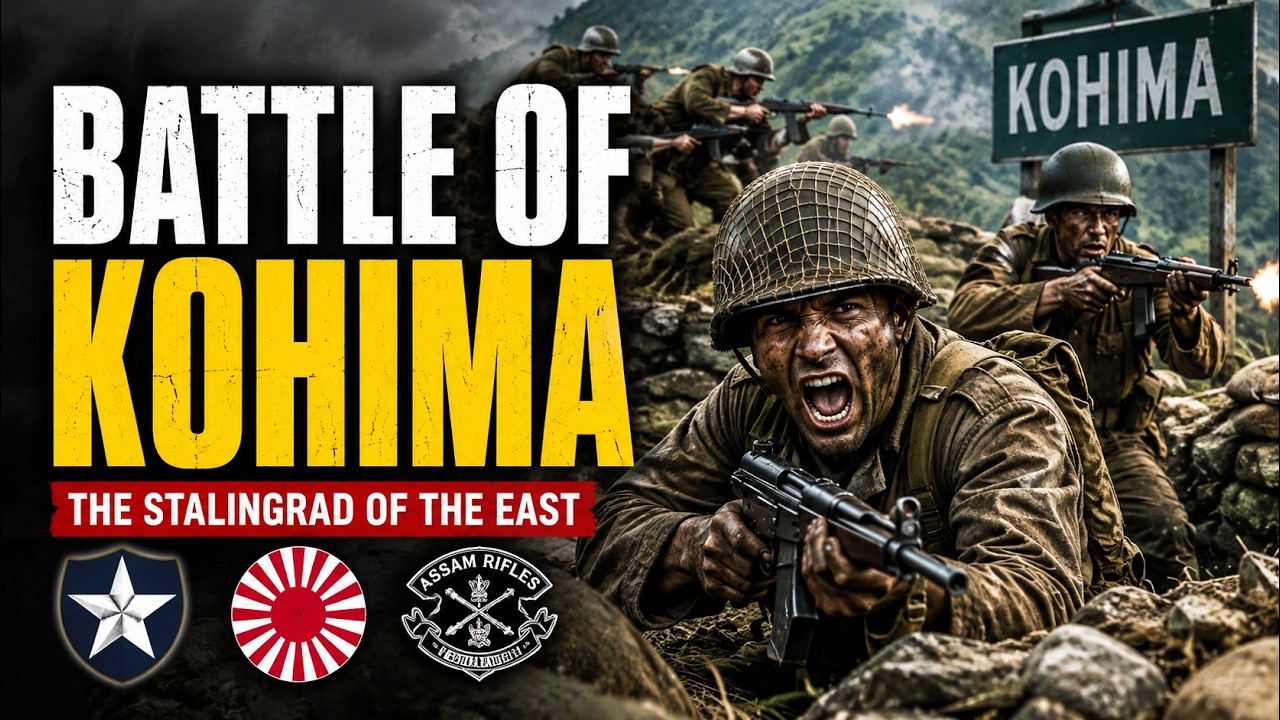
The officers had calculated the risk and found it acceptable. General Sato’s men had crossed the Chindwin River in late March, wading through water up to their shoulders, carrying rations and ammunition on their backs, the cold stealing their breath before the jungle’s heat soaked through their uniforms. Then they climbed. The Naga Hills rose steep and thick with pine, the paths reduced to ancient foot trails carved by hunters and traders, so narrow that a man could see only a few paces ahead through the vine-choked undergrowth.
They climbed for days, loaded with forty kilograms of equipment, the rain dripping from every leaf, malaria and dysentery claiming men before a single British bullet could. The tracks turned to mud. The men grew thin. By the time they crested the high ridges above Kohima in early April, they were starving.
On the ridge, the garrison had been digging. Trenches clawed out of rocky soil. Machine-gun nests positioned to create overlapping fields of fire. The men worked stripped to the waist in the humid afternoons, filling sandbags, checking sight lines through the jungle, calculating how much water they could store.
The garrison was a composite force: the 4th Royal West Kents, Indian Army units of the Assam Regiment, Nepalese Gurkhas. Around 2,000 men, a number that swelled slightly as reinforcements trickled in before the ring closed. They knew the Japanese were coming. The Naga guides had brought word.
The sound of axes on timber grew audible at night as the Japanese cut supply lines and built siege positions. By April 8th, the first Japanese elements reached the high ground north of the garrison. They did not attack the ridge directly. Instead, they moved into the surrounding heights, establishing positions on the dominant terrain features, and crucially, they cut the road that ran through the valley below, the single lifeline connecting Kohima to Imphal and India beyond.
By April 10th, the siege was complete. The Japanese had simply surrounded them and closed the door. Inside the perimeter, the silence of anticipation became the silence of a sprung trap. The ridge itself, which could be walked from end to end in thirty minutes, became the entire world for the men trapped there.
Rations were cut immediately, then cut again. The rice allowance diminished. Tins of bully beef stretched across meals for five men instead of three. Hard biscuits already like concrete were sliced thinner.
Men learned to account for every round of ammunition, for every swallow of water. The Japanese controlled the approaches to the springs, and every attempt to draw water had to be covered by fire, had to be swift, a gamble with lives. When the rains came, men held out containers and mess tins, cupping the water as it fell. When they did not, thirst became a constant gnawing presence that narrowed the mind.
Men dreamed of food. Men dreamed of water. The wounded posed their own terrible mathematics. The medical officer, a man named Gibson, worked with morphine in short supply and bandages washed and reused.
Infection was nearly as deadly as shrapnel. Wounds that might have been routinely treated became slowly darkening sentences. The smell of the aid post mingled with rain and mud and decay. And in the center of this compression of suffering sat something almost absurd: a tennis court.
Once the leisure space of British officers at the district commissioner’s bungalow, it now sat as a killing zone between two shattered strongpoints. The Japanese 58th Regiment pressed inward with a desperation born of hunger and impossible orders. The fighting compressed into yards, then feet. The tennis court changed hands multiple times.
The Gurkhas, with their curved blades, held the perimeter with a ferocity that made Japanese soldiers wary of close approaches. But the Japanese came anyway, driven by a code that made surrender unthinkable. One account records a Japanese officer standing at the far edge of the court after a particularly fierce assault, his uniform torn, blood on his shoulder. He simply watched the British officer across the devastated rectangle.
For perhaps thirty seconds, the two men looked at each other. Then the Japanese officer bowed very slightly and withdrew. Within hours, he would be back with reinforcements. But for that moment, there was a recognition: of shared exhaustion, of the terrible symmetry of their situation.
The defense of the tennis court became a point of symbolic and strategic necessity. Its boundary lines served as reference points for artillery spotters. Its loss would collapse the garrison’s central position. So men held it, counterattacked when the Japanese took it, and spent every hour between attacks shoring up sandbags and trying to get water.
The ground around the court became a landscape of shallow graves dug into the commissioner’s flower gardens. The dead were buried quickly, names marked on crude wooden crosses. By the third week of April, the garrison’s situation was desperate. No relief column could punch through for days, perhaps longer.
The only lifeline was the sky. The Royal Air Force’s 31 Squadron flew aging transport aircraft from airfields in Assam, descending to 500 or 600 feet over the ridge, dropping supplies bundled into canvas bags, sometimes with parachutes, sometimes not. Ammunition, tinned rations, medical supplies, water in jerry cans. At that altitude, a man with a rifle below could reach the aircraft.
The Japanese knew this. They had guns in the hills. Each drop became a window of acute vulnerability for the crews, and a moment of desperate hope for the men below, who lit signal fires and waved panels of cloth to mark safe ground. The pilots could see the men below, see them running to collect the packages, see them crouch as Japanese fire broke out.
Over the course of the siege, between 600 and 700 individual drops were made. Some aircraft did not return. But every parachute that bloomed carried a message beyond its cargo: someone had decided that you mattered, that you would not be abandoned. Sato’s division, meanwhile, was collapsing under the weight of its own impossible logistics.
The supply lines that had stretched across the Chindwin had never truly existed. Ammunition was counted in rounds per gun. Food became a memory. Men scraped by on a handful of rice grains, on boiled leaves, on bark stripped from trees.
Men collapsed while standing guard. Men hallucinated. The hunger narrowed the mind. Officers began to understand that victory had become impossible.
Some of them accepted this. Others, at headquarters far in the rear, did not. In the villages below, the Naga peoples were drawn into the machinery of war. Young men served as guides for the British, threading patrols through vegetation where a wrong turn meant hours of backtracking or worse.
Thousands of porters moved up and down the supply lines, carrying ammunition and food on their backs, often under fire. The Naga people who lived on the surrounding hills watched the collision of empires unfold on their own territory. Villages were burned. Families were displaced.
Their homeland became a landscape of trenches and barbed wire. Their loss was never counted. The relief column arrived after weeks of grinding combat. The 2nd British Division under Major General Grover had fought its way north from Assam, each ridge contested, each mile of road purchased with lives.
They met Japanese rear guards who fought with the bitter knowledge that giving ground meant relieving the starving garrison. The fighting was intimate and blind through the dense jungle, grenades louder in the confined space, mortar fire falling without warning. By early June, the perimeter had begun to contract. The Japanese were weakening, their supply lines stretched impossibly thin, their men growing hollow-eyed with fever and hunger.
The British, by contrast, could rotate exhausted units, could call on artillery and air support. The advantage had turned. General Sato made his choice. He had seen what his superiors in the rear could not: his men could no longer lift their rifles.
He had walked among soldiers who wept from hunger, who looked at him with a blank exhaustion that no exhortation about the emperor’s will could penetrate. He declared his intention to withdraw. Against direct orders, against the sacred culture of unquestioning obedience, he pulled his units back. It was an act of defiance that his superiors would never forgive, and an act of mercy that may have saved thousands of men from slaughter.
He began to order his division to retreat across the mountains they had crossed with such confidence weeks earlier. The retreat became a dissolution. The monsoon had transformed the hills into a nightmare of mud and disease. Men fell behind and were left.
Men died of dysentery, typhoid, and fever. Men ate bark and grass and insects. Men drowned in the swollen Chindwin. The column that had crossed the river in late March bore no resemblance to the one that recrossed it in late June.
The exact number of dead will never be known. The survivors would carry the mark of those weeks forever. After the last Japanese soldier crossed the river, the ridge fell into a peculiar quietness, not of peace, but of exhaustion so complete that even grief required stillness. The land lay scarred by 73 days of continuous bombardment and hand-to-hand combat.
The trenches filled with rain. The tennis court became a depression in the earth, already being reclaimed by grass. Burial parties began the slow work of gathering the dead. Row upon row of graves were cut into the earth.
The Commonwealth War Graves Commission formalized the cemetery, placing headstones that bore names, ranks, regiments, dates. For men whose names were never recovered, the stones read simply: “A soldier of the Second World War,” or “Known unto God. ” At the entrance, an inscription was carved, chosen with evident care. It is the voice of the dead speaking across time: “When you go home, tell them of us and say, for your tomorrow, we gave our today.
”
The words do not ask for pity. They do not demand that the world understand the strategic significance of the battle. They ask only to be held in memory. They honor the families who waited and hoped and eventually accepted the silence.
They carry the weight of sacrifice made so that others could have tomorrows. The battle was profane and terrible and random in its destructiveness. It was not beautiful. The cemetery is beautiful, ordered, maintained by workers who tend the lawns and repair the headstones.
For the families of the dead, many of whom will never see the graves of their loved ones, this maintenance offers a form of assurance across the decades: the names remain legible. The place remains marked. This place remembers. For nearly half a century, Kohima faded from the Western imagination.
The narratives of the war focused on Europe. Kohima remained a footnote in a campaign that felt peripheral to the great struggle. The rediscovery came gradually, through the communities that had been forgotten. Indian historians began to revisit the battle in the 1960s and 70s.
Western historians followed. Books appeared. Veterans began to speak. What emerged was a deeper understanding that Kohima was not secondary, but in many ways more consequential than it had been credited.
The failure of the Japanese to break through to India represented the absolute limit of their expansion. The holding of that ridge sealed the fate of the Greater East Asia Co-Prosperity Sphere. The veterans who remain, now in their late 90s, have seen their battle forgotten and then slowly remembered. Some have returned to walk the ground again.
Others did not live to see the recognition. But the rediscovery suggests that even the stories that are temporarily lost can be found again. Now the afternoon light grows thin and amber across the ridge. The shadows lengthen through the pine trees.
Decades have passed. The trenches have filled with earth. The blood has long since returned to soil. The monsoon clouds still gather in much the same way they did in that terrible summer of 1944.
The air still hangs heavy and damp. The rain still falls with the same insistent rhythm. Nothing essential has changed about the landscape. The ridge is still high.
The valleys below are still green and deep. As dusk falls more deeply, the ridge settles into silence. The birds settle into their branches. The wind dies down.
The air seems to hold its breath. In that quiet, there is something that feels almost like forgiveness. Not forgetting—forgiveness and forgetting are not the same thing. The dead of Kohima are not forgotten.
But the ridge itself has accepted what happened there. The earth accepted the blood. The stone accepted the weight of names. The wind continues to move through the pines, indifferent and eternal.
Perhaps that is what peace is at its deepest level. Not the absence of memory, but the integration of it. Not the erasure of suffering, but its placement within.