The first thing I ever had to dodge was a German fighter buzzing our street. We were walking home, my mum, my brother John, and me, when it came tearing out of nowhere. John slid underneath a gate, I scrambled in next to him, and my mum piled on top of us until the sound of the engine faded. You didn’t think anything of it.
That was just how it was. I was twelve when I decided I wanted to be part of the war. On the day the raid started over Bath, the siren went off around eleven. My father and I walked out into the street and saw the flares dropping over the hills above the city.
That was when he realized we were going to be the target. We were. After the all clear, I went out to see what had been hit. That was when one of my school friends came riding by on his bicycle, wearing a steel helmet and a gas mask.
He was a messenger boy. I decided right then that I was going to be one too. You had to be fourteen. I said I was.
I was twelve. Before any of that, though, came the day war was declared. It was September 1939. I was staying with my uncle and aunt in Birmingham, sitting in the back yard.
My family had a radio, which was still a rarity back then. All the neighbors came around to hear Mr. Chamberlain’s speech. I can still remember it as if it were yesterday.
Everything had already been prepared for war. The gas masks had been fitted years earlier. I remember being marched up with my whole class to a place where we were all given ours. I was very annoyed because I didn’t get a Mickey Mouse one.
I was a year too old. My sister was a baby during the war, and she got the huge colored one that looked like a great big thing, and my mother always complained it took up so much room. The blackout was one of the first things that changed everything. You had to have blinds and shutters on every window, because you couldn’t show a single light.
The street lighting went out, and the buses dimmed all their lights. Wardens could fine you for letting even a chink of light out of your house, for not shielding a hand torch, for not having the right headlight shield on your car. They made a big deal about wearing white in the blackout so you could be seen, but that didn’t really catch on. I remember the sirens going off all the time.
We lived in Bath, and the German planes used to pass over on their way to Bristol, so we heard the alarms constantly. Very rarely did we take cover. But then the night came when Bath itself was the target. I stood outside the shelter and looked at the city burning.
When we went up to my bedroom, we could see the flames from the window. It scared the hell out of me. You learned to tell the difference between the planes by the sound of their engines. We were in what they called Bomb Alley, where the Germans flew right over the top of us.
If I said the sky was black, I’m not exaggerating. It was black with the big bombers going over, with Spitfires darting in between them. At night, we went down to the Anderson shelter. My dad had fixed ours up as comfortably as he could.
We had cooking facilities and always a good supply of clean water, but it didn’t have a toilet. He made it deep enough and then put the steel cover on it. We took down whatever furniture we had. In our case, it was just a couple of deck chairs for our parents.
And that was it. I was put to bed at night in the air raid shelter for three years. There was no point in going in the house. At about seven in the evening, I’d be tucked in down there.
That was hard in the summer because it was still daylight, but I had to go to bed anyway because I was little. Everyone with space in their backyard was encouraged to build an Anderson shelter. The government provided them free to households earning less than £250 a year, and charged £7 for everyone else. The advertisements showed bombs falling and houses collapsing while the shelter stood intact.
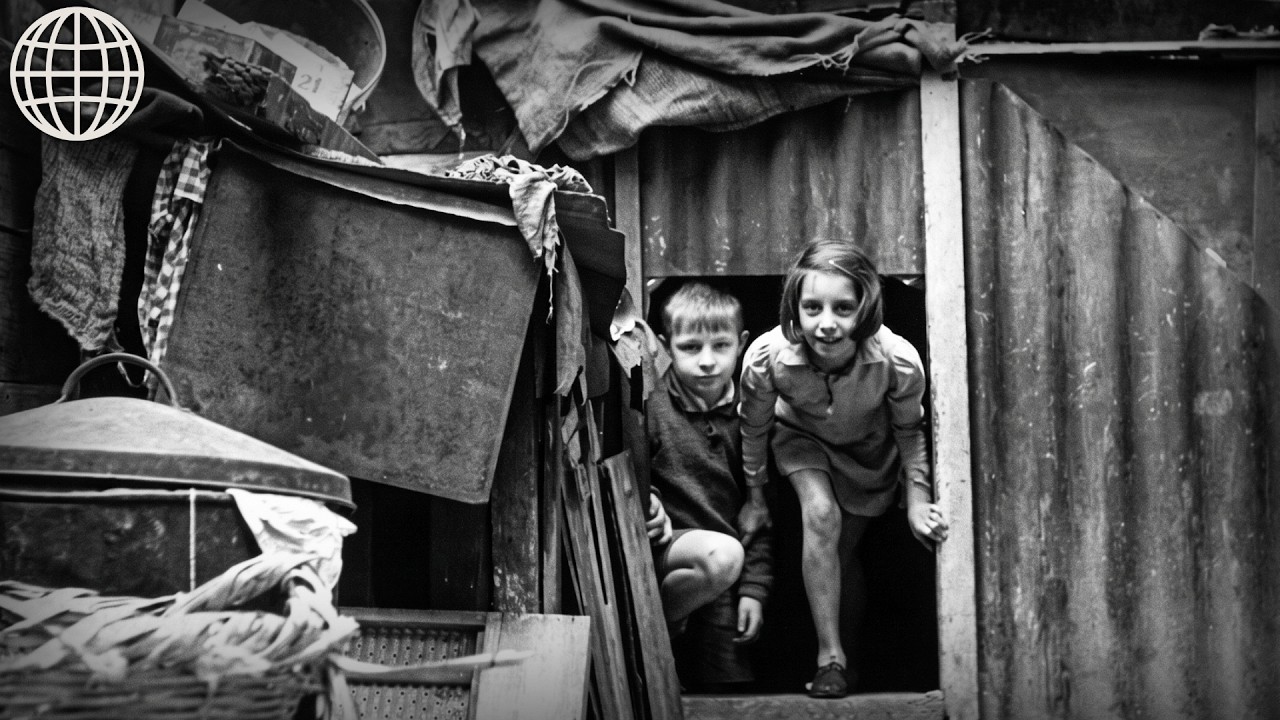
But the truth was that nobody really liked them. They were small and cramped and cold, and they let in the rain and puddled up with groundwater. As the war went on, people stopped using them. A lot of us decided that if the Germans were going to get us, we’d rather be dry and warm.
Once the Blitz started, my father bought a Morrison shelter, which was like a big steel table with wire sides to keep the stuff off. My mother, my brother, and I lived in it in the evenings, because my father was at work. We had a thermos of tea, a thermos of soup, and some sandwiches. We had the cat and the cat’s potty and our potty.
That’s where we slept. The safe places changed over time. In London, people crowded into the tube stations, sleeping on the platforms night after night. At the height of the Blitz, almost 180,000 people were down there every night.
Dances, sing-songs, and card games were part of it. But most of the time, the night was spent wondering what you’d see when you walked back up into the daylight after the all clear. The shelters were always overcrowded and had no bathrooms. There were rules about keeping quiet and staying healthy, and welfare officers tried to make the stations comfortable with canteens and first aid posts.
It was this bringing together of so many strangers that triggered one of the biggest worries of the war: careless talk. The campaign was everywhere. “Loose lips sink ships. ” There was a famous public information film about a woman who told a man she was taking a picnic to Coombe Wood, where the army had dumped a load of new mine detectors.
The result was that the Germans bombed the woods, and the whole world told her it was her fault. The government was convinced that telling lies, or even telling the truth, could kill people, and they thought the threat got worse in May 1940 when the invasion seemed imminent. But life went on. We got used to it, as people do.
We got used to lying in the gutter while a German fighter passed overhead. We got used to the warden’s whistle and the drone of the engines. We got used to the sound of bombs falling, and we became experts at judging how far away they were, whether they were close, and what sort of munitions were hitting our district. One of the strangest things was seeing the children leave.
Evacuation started in September 1939, two days before war was declared. The government urged parents to send their children out of the cities to the safety of the countryside. Pregnant women, new mothers, the elderly, and the disabled also went. The biggest image I remember is the children standing on the platforms with their suitcases clutched in their hands, gas masks hanging around their necks, and a luggage tag tied to their coats.
My own mother refused to let us be sent away officially, so we went as a family. But I still think of those mothers who put their little ones on the train, not knowing where they were going. The children would get off in the country and be inspected by the local families, picked over like cattle by strangers who had agreed to house them. That was traumatic for a lot of them.
We ended up in a little Georgian town in Berkshire called Hungerford. We lived in a house on the main street, in a shop that sold kerosene and salt. The woman who owned the house, Mrs. Glover, had something called Edwards desiccated soup, which was a little square that was meant to make soup for four people.
She made it do for eight. From that day to this, I have never liked consommé. Some children were treated terribly. Some were treated wonderfully.
I knew a boy who was taken in by a family who treated him like their own son. The father was very friendly with him, taught him to ride a bike, and took him around with him. He was very thankful for it, because it gave him a release from being in London with the bombing and all the rest. But not all children were happy.
Some couldn’t understand why the routine of their lives had been shattered by a man in a country they’d never seen. Some couldn’t deal with the strange food and the unfamiliar rules. The hosts were often very set in their ways, and the evacuees brought their city diseases with them, everything from head lice to measles. A lot of children came home almost immediately, and the government had to try again to persuade parents to send them away for a second time in 1940.
When the V1s and V2s started falling at the end of the war, I was already working as a messenger boy in London, running messages between branches of a company. I spent the last year of the war dodging the flying bombs. That was my life during the war, running across London, not knowing when one of those things was going to fall on me. I was seventeen when I joined the Royal Air Force and was stationed on a barrage balloon site in London.
We’d let the balloon up from 200 feet to 1,000 feet to stop the Germans dive bombing us. We had to climb inside the balloon to check the gas, and they’d tie a rope around your waist and pull you out if you shouted that you could smell a leak. Our first site was in the playground of a children’s school. When the wind blew, the balloon would yaw over, and there were wires all around the school.
If it yawed too much, it took the chimney pots off and the tiles off the roof, and the locals would kick up a fuss and tell us to clear off. We had incendiaries hit our house once. They smashed all the tiles on the roof and ricocheted off into the garden next door, where they started a fire. Half the American army was in the house at the time, entertaining themselves, and they jumped in with buckets of water and put it out.
It was just as well the house was being used as it was. We taped up the windows and kept buckets of water and buckets of sand handy. We had shutters on all the windows that also acted as a blackout. The biggest danger was flying glass.
Despite everything, the bombing never broke the people. By 1941, an American journalist reported that the Blitz on London was a failure. “London is no more knocked out than a man who smashes a finger is dead. ” People remained defiant and stoical, and even humorous.
When the wardens walked past, they’d call out and banter. When the bombs fell, they still went to work and stood in their queues and carried on. The war didn’t end with a grand victory at home. It ended with the sound of the last siren that never came.
The shadow was lifted, and we carried the memories with us: the mothers waving and crying on the platforms, the smell of the Anderson shelter, the thump of a bomb far away, and the certainty that you could tell the difference between a Junkers and a Dornier just by listening. Life went on. Not the same as life in times of peace, but a sort of normal life, fueled by the will to keep going. Bombs separated children from their parents and forced civilians into shelters.
The shadow of war tested resilience and morale, and people everywhere responded with a dogged, pragmatic determination until the shadow was lifted.