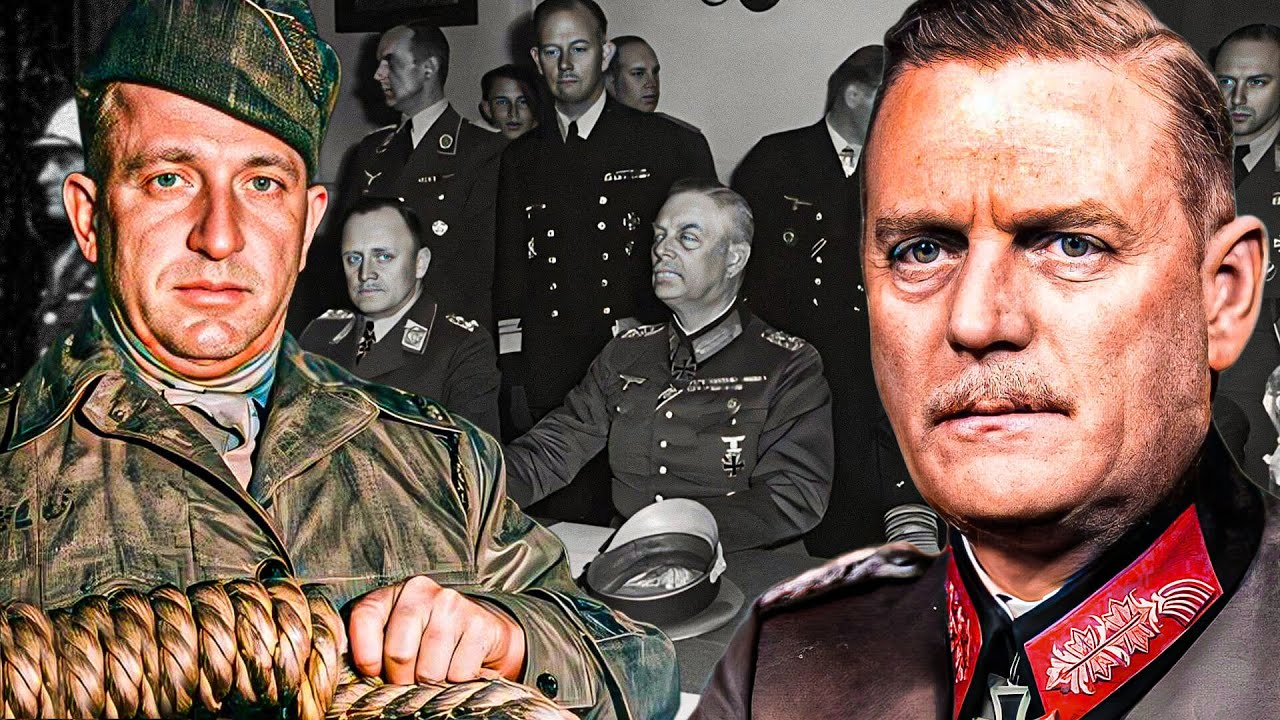


Why Wilhelm Keitel’s Nuremberg Execution Went Horribly Wrong
At Nuremberg, the Allies had spent almost a year trying to prove one enormous idea:
That civilization could answer organized barbarism with law.
Not revenge.
Not a firing squad in a ruined courtyard.
Not a bullet in the back of the head.
A trial.
Documents. Witnesses. Defense lawyers. Judges from four nations. Transcripts running to millions of words. Evidence placed carefully into the record so that no one could later claim the condemned men had simply disappeared.
And then, in the early hours of October 16, 1946, Field Marshal Wilhelm Keitel climbed thirteen wooden steps inside a prison gymnasium.
A black hood was pulled over his head.
A rope was tightened around his neck.
The trap opened beneath his polished military boots.
What was supposed to happen next was simple.
His fall was supposed to break his neck almost immediately.
Instead, according to later accounts, Keitel may have remained alive at the end of the rope for roughly twenty-four minutes.
Twenty-four minutes.
The man who had spent years signing orders that sent other people into darkness now disappeared behind a curtain while doctors waited for his heart to stop.
And the most disturbing part of the story was not that Wilhelm Keitel died.
He had been convicted on all four counts at the International Military Tribunal—conspiracy, crimes against peace, war crimes, and crimes against humanity—and sentenced to death. His responsibility for criminal military orders, forced labor, the brutal treatment of Soviet prisoners, and cooperation with mass murder had been established through documentary evidence bearing, again and again, the authority of the German High Command. (Bách Khoa Toàn Thư Holocaust)
The disturbing part was this:
After constructing the most famous war-crimes trial in history, the victors may have entrusted its final act to a hangman whose reputation was far more impressive than his actual record.
And by the time anyone realized what that could mean, Keitel was already standing on the scaffold.
Wilhelm Keitel never looked like the sort of man people imagined when they pictured a war criminal.
That was part of what made him so important at Nuremberg.
He was not a screaming street thug. He was not primarily known as an ideological propagandist. He did not arrive in court presenting himself as a wild-eyed revolutionary.
He looked like an officer.
A field marshal.
A career soldier with military posture, military habits and the vocabulary of duty.
For years, he had stood close to Adolf Hitler as chief of the Armed Forces High Command, the OKW. In photographs, Keitel appeared exactly where a man of his rank was expected to appear: beside maps, at conferences, near the Führer, surrounded by uniforms.
His great defense at Nuremberg was built around that identity.
He was a soldier.
Orders came from Hitler.
He transmitted them.
He obeyed.
Again and again, Keitel tried to create distance between the decisions of the regime and the machinery that turned those decisions into action.
But there was a problem.
The prosecution had the paperwork.
And the paperwork had his name on it.
One of the most infamous measures associated with the German High Command was the “Night and Fog” system. People accused of resistance activities in occupied territories could be removed to Germany under conditions designed to leave relatives uncertain about their fate. Keitel’s own High Command documentation spoke explicitly of creating terror by keeping families and populations in the dark. (Avalon Project)
There were other orders.
The Commando Order.
Directives affecting Soviet political commissars.
Orders connected with prisoners of war and forced labor.
Orders that stripped categories of human beings of protections that soldiers were supposed to understand better than anyone.
Keitel did not successfully prove that his signatures were forged.
He did not prove that some mysterious subordinate had been using his name.
His defense was more chilling precisely because it was so ordinary.
Hitler gave the command.
Keitel signed.
Keitel transmitted.
Someone farther down the chain carried it out.
That chain of responsibility was exactly what Nuremberg had been created to examine.
The question was no longer simply, “Who pulled the trigger?”
The question was:
Who made the killing possible?
Who authorized it?
Who converted criminal intention into official language?
Who put a seal, signature and military routing instruction on murder?
Keitel was forced to confront something that bureaucratic systems often allow powerful men to forget:
A signature can kill someone you never see.
At one point in his testimony, after being pressed about a criminal decree he had signed despite recognizing its gravity, Keitel acknowledged that by putting his name beneath it he had personally assumed a degree of responsibility. (Avalon Project)
That admission mattered.
Because his entire defense depended on turning responsibility upward.
The judges turned it back toward him.
On October 1, 1946, the tribunal delivered its sentence.
Death by hanging.
For Keitel, those final three words carried a humiliation beyond death itself.
He was a field marshal.
He wanted to die as a soldier.
Keitel and General Alfred Jodl asked to be shot rather than hanged. The request was rejected. (Simon & Schuster)
That may have been one of the most important moments of recognition in Keitel’s final days.
For years, rank had wrapped around him like armor.
Field Marshal Wilhelm Keitel.
Chief of the Armed Forces High Command.
A man who entered rooms before other men and expected them to stand.
But the tribunal was stripping the uniform of its protective meaning.
He could insist that he had been a soldier.
The judgment answered that being a soldier did not give him permission to participate in crime.
He could ask for a soldier’s death.
The answer was no.
He would go to the gallows.
Imagine the silence after that decision.
Not the dramatic silence of a movie, filled with music.
The bureaucratic silence of a closed door.
An appeal submitted.
An appeal rejected.
A prisoner returned to his cell.
A date approaching.
That was how Nuremberg worked.
The Third Reich had made disappearance, terror and arbitrary killing into instruments of state policy.
The Allies intended the opposite.
Keitel would know the charge.
He would know the evidence.
He would have counsel.
He would hear the judgment.
He would know the sentence.
And, eventually, he would know the hour.
That distinction mattered enormously.
Because the Nuremberg Trials were never meant to say only, “These men deserve punishment.”
They were meant to say something much more ambitious:
Even after the worst crimes imaginable, punishment must still pass through law.
Then came the night when that principle would face its strangest test.
Nuremberg on October 15, 1946, was a city still carrying the physical wounds of the war.
Ruined buildings stood beneath a cold sky. Wind moved through broken spaces where walls and roofs had once been. Guards watched the prison complex. Journalists waited. Military officials prepared for an operation they knew the world would remember.
Inside the prison, the condemned men ate their last meal.
TIME’s contemporary account described simple food—sausage, cold cuts, potato salad, black bread and tea—before the lights were dimmed and preparations began. (Time)
Eleven men had originally been marked for execution.
But hours before the hangings, the first great shock struck.
Hermann Göring was supposed to be first.
He never reached the gallows.
Somehow, despite months of elaborate security, Hitler’s former Reichsmarschall had managed to keep or acquire cyanide.
He bit into the poison in his cell and killed himself.
The man who had dominated much of the trial had escaped the final punishment the tribunal intended for him.
Suddenly, before a single rope had been used, the execution operation already had a failure hanging over it.
Guards had watched Göring.
His cell had been searched.
Procedures had been designed.
Yet he had beaten them.
His corpse would eventually be brought into the same gymnasium where the others died, but he had denied the executioners the moment they had prepared for him. Contemporary reporting treated the suicide as a major security embarrassment. (TIME)
That was the first twist of the night.
It would not be the last.
Because Göring’s death moved everyone else forward.
Joachim von Ribbentrop, Hitler’s former foreign minister, was now first.
Wilhelm Keitel would be second.
And waiting inside the prison gymnasium was Master Sergeant John C. Woods.
The gallows were painted black.
There were three scaffolds, with two intended for alternating use and one held as a reserve. The temporary structures stood inside a gymnasium—a place built for exercise now transformed into a chamber of execution.
Each condemned man would climb thirteen steps.
At the top, his identity would be confirmed.
He could make a final statement.
His hands would be secured.
A hood would cover his face.
A noose would be placed around his neck.
Then the trapdoor would open.
If everything had been calculated correctly, the procedure was supposed to be brutally efficient.
Hanging by a properly calculated drop was not intended to leave a person slowly suffocating.
The distance of the fall mattered.
The prisoner’s weight mattered.
The rope mattered.
The knot mattered.
Too long a drop could cause catastrophic injury.
Too short a drop could fail to break the neck.
This was not a detail.
It was the difference between an execution lasting moments and a death lasting far longer.
And that brings us to John C. Woods.
At the time, Woods carried an extraordinary reputation.
He told reporters that he had been an executioner for fifteen years and had hanged 347 people.
Three hundred and forty-seven.
It was the kind of number that suggested almost impossible experience.
A man with that record should have understood every measurement, every rope and every trapdoor.
Contemporary journalists repeated the figure.
But later historical research has challenged Woods’s story, concluding that his famous body count was heavily exaggerated and that his prewar execution experience was not what his public legend implied. (The Fifth Field)
That is the second twist.
The man who looked, on paper, like the safest possible choice may not have been the master craftsman people assumed.
And Nuremberg was not an assignment where small mistakes remained small.
Shortly after one in the morning, Joachim von Ribbentrop entered the gymnasium.
Officials and selected journalists watched.
The room was brightly lit.
The scaffold waited.
Ribbentrop climbed.
He spoke.
The hood came down.
The trap opened.
His body disappeared from view behind the boarded and curtained lower section of the scaffold.
The rope snapped tight.
Then it moved.
What happened behind that curtain became one of the most controversial details of the executions.
To the witnesses above, much of the condemned man’s final physical struggle was hidden.
The next prisoner did not wait for the first body to be removed before the machinery of execution continued.
Wilhelm Keitel was brought in.
Here was a man who had once entered military headquarters with generals waiting on him.
Now American guards escorted him toward a wooden staircase.
He wore his uniform.
His boots were polished.
Contemporary reporting described him climbing the scaffold briskly, almost like a man mounting a reviewing stand. (Time)
That image is difficult to forget.
Because if Keitel was frightened, he was determined not to give the room the satisfaction of watching him collapse.
He still had posture.
He still had the uniform.
He still had the habits of command.
But none of them had authority anymore.
At the top, he gave his last statement, referring to the millions of German soldiers who had died and saying that he now followed his sons.
Then came the final ritual.
His identity no longer mattered as rank.
His uniform no longer mattered as protection.
The man who had once carried a field marshal’s baton was positioned over a trapdoor.
The rope was fitted.
The hood covered his face.
For a brief moment, the room saw only a uniformed figure standing beneath a beam.
Then the mechanism was released.
Keitel dropped.
And something appears to have gone terribly wrong.
This is where the story becomes both darker and more complicated.
Because there are two versions of what happened.
The official machinery of the execution did its work. Keitel was eventually pronounced dead, and the sentence was carried out.
But journalists and later historians raised disturbing questions about how that death occurred.
Cecil Catling, a British reporter experienced in covering executions, argued that the gallows did not provide sufficient dropping distance. If so, the men’s necks might not have broken as intended, leaving them to die through prolonged strangulation instead.
Catling also alleged that the dimensions of the trap contributed to injuries as some prisoners fell.
The United States Army denied his account.
That disagreement matters.
It means some of the most sensational descriptions of the Nuremberg hangings should not be presented as uncontested fact.
But the controversy did not disappear.
TIME reported the accusations within days of the executions, including the claim that the drop was inadequate. (Time)
Later legal and historical writing went further, reporting that several of the condemned took many minutes to die—and that Keitel’s death was the longest and most painful of the group, at approximately twenty-four minutes. (Digital Commons)
Twenty-four minutes.
Think about what that means without turning it into spectacle.
The trapdoor opens.
Everyone expects the decisive snap of a professionally calculated hanging.
Instead there is uncertainty.
A body hangs out of sight.
The rope remains taut.
Doctors wait.
Time keeps moving.
One minute.
Five.
Ten.
Long enough for everyone in that brightly lit gymnasium to understand that this is not the quick ending the procedure was supposed to deliver.
Long enough for another condemned man to be prepared.
Long enough for the language of “efficient execution” to begin sounding grotesque.
Keitel had reached the place where his entire defense no longer mattered.
There was no Hitler above him to blame.
No subordinate below him to carry out instructions.
No staff officer waiting to receive a signed directive.
No map.
No conference table.
No argument about military necessity.
Just a rope.
And time.
But there was another bitter layer to the moment.
Keitel had spent much of Nuremberg asking the world to understand the pressures of obedience.
He had served beneath a dictator.
He had signed what the dictator ordered.
He had remained at his post.
The tribunal’s answer was devastating in its simplicity.
There are orders a human being is responsible for refusing.
There are moments when rank does not excuse action.
There are commands whose criminal nature does not disappear because they arrive on official paper.
The judges specifically rejected the idea that “superior orders” erased Keitel’s responsibility. Their judgment found nothing sufficient to mitigate his conduct in crimes committed consciously and without lawful military justification. (Avalon Project)
That was the legal reckoning.
Yet now, at the very end, a different question was emerging.
If Keitel had been denied the right to hide behind orders, could the people executing him hide behind procedure if the procedure itself was careless?
That is where this story stops being simple.
It would be easy to say he deserved whatever happened.
Many people in 1946 undoubtedly felt exactly that.
Europe was full of graves.
Millions of Jewish men, women and children had been murdered.
Soviet prisoners of war had died in enormous numbers through execution, starvation, exposure and brutal treatment.
Civilians had been deported.
Resistance members had vanished.
Slave laborers had been dragged across borders.
Families had received no explanation because uncertainty itself had been used as a weapon.
Against that landscape, sympathy for Wilhelm Keitel was understandably scarce.
But Nuremberg had not been created to demonstrate that the Allies could be crueler than the Nazis.
Its legitimacy depended on the opposite.
That was the trap hidden inside the gallows.
The worse Keitel’s crimes were, the more important it was that his punishment be controlled by law rather than rage.
Otherwise the trial risked becoming merely the most elaborate prelude to revenge in history.
And then came perhaps the strangest contrast of the entire night.
While questions would later emerge about the suffering behind those black curtains, John C. Woods appeared satisfied with his work.
Contemporary reporting quoted him boasting about the speed of completing ten executions.
Years later, TIME recalled his claim that he had “never saw a hanging go off any better.” (Time)
That statement becomes chilling when placed beside the later allegations.
Imagine the scene after the last condemned man had been pronounced dead.
The ropes had stopped moving.
The witnesses had watched ten men climb and disappear.
Göring’s body, the product of his last act of defiance, was also there.
The largest war-crimes trial the world had yet seen was over.
Not legally.
Not philosophically.
But physically.
The defendants who had been sentenced to hang were dead.
Woods viewed the assignment as a success.
But history was already beginning to ask a different question.
What if the executioner himself had been one of the weakest links in the entire process?
A trial involving judges, prosecutors, interpreters, thousands of documents, military security and international law had culminated in something as basic as rope length and trapdoor dimensions.
A few feet.
A few calculations.
A knot.
And if those calculations were wrong, then the final minutes of Nuremberg had been shaped not by some profound legal dilemma, but by human incompetence.
That is almost impossible to accept.
Which is exactly why it is so memorable.
There is an instinct, when telling this story, to turn Keitel’s suffering into poetic justice.
The man who helped institutionalize terror suffered at the end.
The bureaucrat who signed ruthless orders discovered what helplessness felt like.
The field marshal who wanted a soldier’s bullet died at the end of a rope.
It practically writes itself as revenge.
But that interpretation is too easy.
And it misses the most important point.
Wilhelm Keitel’s execution did not need to be painful to be just.
His conviction did not become more legitimate because he may have suffered.
His victims did not return because his death lasted longer.
A prolonged execution did not balance an equation.
Justice is not arithmetic.
You cannot take millions of destroyed lives, put one condemned man on the other side of the scale, add suffering and eventually declare the numbers equal.
Nothing could make them equal.
That is precisely why civilized justice needs limits.
The limits are not gifts to the guilty.
They are protections for everyone else.
They protect the judges from becoming avengers.
They protect soldiers from becoming torturers.
They protect institutions from discovering that hatred can quietly rewrite procedure.
And they protect history from the excuse every brutal regime eventually uses:
“They deserved it.”
The Nazis had used that logic repeatedly.
The prisoner deserved it.
The partisan deserved it.
The Jew deserved it.
The political enemy deserved it.
The village deserved it.
The prisoner of war deserved it.
Once a state decides that the unworthiness of the victim removes the obligation of restraint, almost any cruelty can be made to sound administrative.
Nuremberg was supposed to reject that principle.
Not inherit it.
There is another reason Keitel’s story remains so unsettling.
He represents a form of evil that is easier to recognize in hindsight than in real time.
The loud fanatic announces himself.
The bureaucrat does not.
Keitel’s power came through offices, conferences, military channels and signatures.
He could tell himself that Hitler was the real decision-maker.
A colonel could tell himself Keitel had signed.
A captain could tell himself the colonel had ordered.
A lieutenant could tell himself he was only maintaining discipline.
A soldier could tell himself he had no choice.
And at the bottom of that chain lay a dead human being.
Everyone had someone above them.
Everyone could point somewhere else.
That was the machine.
Nuremberg’s revolutionary answer was that responsibility does not vanish simply because it has been divided among many hands.
The person drafting an illegal order can be responsible.
The person signing it can be responsible.
The person transmitting it can be responsible.
The person enforcing it can be responsible.
Rank does not erase conscience.
Neither does bureaucracy.
And on October 16, 1946, that same principle should have applied to the victors.
The sentence had to be lawful.
The execution had to be competent.
The condemned man’s crimes could not lower the standard.
Otherwise “I was only carrying out the sentence” becomes disturbingly close to “I was only carrying out orders.”
That is the final reversal in this story.
The Nuremberg judgment condemned Keitel partly because responsibility survives the chain of command.
The execution of Keitel reminds us that responsibility also survives on the side administering justice.
None of this turns Wilhelm Keitel into a martyr.
That distinction matters.
He was not an innocent man caught in an unfortunate judicial machine.
The International Military Tribunal found him guilty on every count. The documentary record linked him to criminal orders and policies whose consequences were vast. The Holocaust Encyclopedia describes him as ultimately responsible for military cooperation in crimes against Jews and other civilians in the Soviet Union, the brutal treatment of Soviet prisoners of war and forced labor measures. (Bách Khoa Toàn Thư Holocaust)
His execution controversy does not erase any of that.
If anything, it makes the lesson harder.
It is easy to demand humane treatment for someone we love.
It is easy to talk about dignity when the prisoner seems sympathetic.
The principle means almost nothing until it is tested on someone hated.
Someone guilty.
Someone whose decisions helped produce suffering on a scale almost beyond comprehension.
That is when restraint becomes more than a slogan.
Wilhelm Keitel climbed those thirteen steps as a convicted war criminal.
He should have been treated as exactly that.
Not as a field marshal entitled to special honor.
Not as a victim whose crimes should be forgotten.
And not as an object on whom cruelty no longer mattered.
A condemned human being under the complete control of the state.
Nothing more.
Nothing less.
By dawn, the executions were finished.
The gymnasium fell silent.
The gallows had done their work.
The Third Reich’s leaders who once commanded armies and territories had ended as prisoners identified by name, escorted by guards and processed one at a time.
No cheering crowd was permitted inside.
No Nazi banners remained.
No military formations saluted Keitel.
No staff officers waited for his orders.
The title “Field Marshal” could not open a door.
His uniform could not stop the guards.
His polished boots could not prevent the trap from opening beneath them.
That was the public collapse of power in its most physical form.
And perhaps the most revealing moment was not the fall itself.
It was everything that had disappeared before it.
The offices.
The adjutants.
The telephones.
The maps.
The signatures.
The obedient subordinates.
A man who had once helped move millions of people through war by issuing words on paper had been reduced to one person standing alone over a square hole in a wooden platform.
For years, Keitel had lived inside a system that distributed guilt.
At the end, there was nowhere left to distribute it.
No superior order could change the verdict.
No subordinate could take his place.
The trapdoor belonged to him alone.
And yet the people operating that trapdoor still had a responsibility of their own.
That is why the disputed twenty-four minutes matter.
Not because Wilhelm Keitel deserves our pity more than his victims.
He does not.
Not because the Nuremberg judgment was somehow invalidated.
It was not.
They matter because justice reveals its character most clearly at the exact moment it has total power over the guilty.
Anyone can behave with restraint when restraint costs nothing.
The real test comes when the prisoner is hated, helpless and unable to retaliate.
That is when competence matters.
Procedure matters.
Dignity matters.
Humanity matters.
Because once justice begins taking pleasure in unnecessary suffering, something dangerous has entered the room.
And no verdict—however righteous—automatically drives it back out.
Wilhelm Keitel spent years claiming that obedience explained what he had done.
Nuremberg answered that some duties do not disappear because an authority gives an order.
His final night added one more lesson history should never forget:
The people who punish wrongdoing have duties too.
A civilization proves that it is different from the criminals it condemns not by how fiercely it can punish them, but by how firmly it refuses to become like them when nobody would object.