On the morning of 27 January 1945, Soviet soldiers of the 60th Army crossed into Oświęcim expecting another battle. Instead, they walked into the largest murder site in human history. The retreating SS had tried to erase their work. The gas chambers of Birkenau lay in rubble, blown apart by engineers.
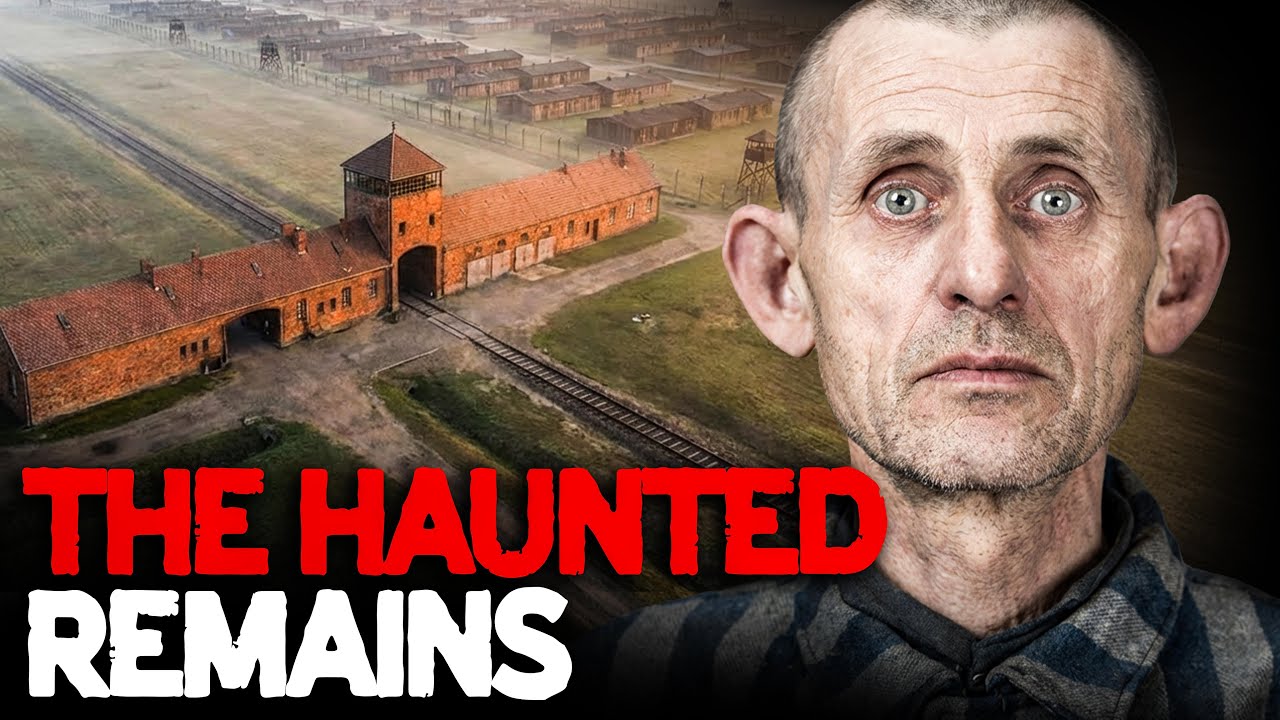
Fires still burned in the warehouses called Canada, where the possessions of over a million dead—suitcases, shoes, children’s clothing—were being consumed by flame. The guards had run out of time before they could destroy everything. The soldiers found roughly 7,000 prisoners still alive, most barely clinging to life. Six hundred corpses lay unburied.
In the storehouses that survived, investigators would later document 370,000 men’s suits, 837,000 articles of women’s clothing, and seven tons of human hair, shaved from victims and packaged for shipment to German factories. Even men hardened by years on the Eastern Front were stunned. General Vasily Petrenko later said that despite seeing death every day, he was shaken by what had been done to the inmates. Auschwitz was not a military objective.
The Red Army had stumbled upon it during their advance across Poland. They had liberated Majdanek the previous July and would find many more camps in the months ahead. But Auschwitz, by its sheer scale, was different. Between 1940 and 1945, approximately 1.
3 million people had been deported here. At least 1. 1 million were murdered, the vast majority Jews transported from across Nazi-occupied Europe. At peak capacity, the gas chambers and crematoria of Birkenau could kill and dispose of up to 6,000 people per day.
Liberation was not a moment of joy for most survivors. They were too ill, too starved, too traumatized. Many did not immediately understand that the men in Soviet uniforms represented salvation rather than another danger. Red Army hospitals treated around 4,500 survivors in the weeks that followed.
As late as June 1945, some 300 former prisoners remained because they were still too weak to be moved. Within days, Soviet authorities began investigating. Forensic teams photographed the ruins, mapped the layout, gathered surviving documents, and conducted autopsies. But the investigation also served propaganda purposes.
In early reports, Soviet writers often failed to mention Jews specifically as victims, referring instead broadly to “citizens of the Soviet Union and other countries. ” This reflected Stalin’s policy of suppressing Jewish identity within the broader narrative of Soviet suffering. The emphasis was on the defeat of fascism, not the specific extermination of Jews. The most significant reckoning came with the trial of Rudolf Höss, the longest-serving commandant of Auschwitz.
He had overseen the camp from May 1940 through November 1943, and returned briefly in 1944 to supervise the murder of Hungarian Jews. After the war, he lived under a false identity until British investigators tracked him to a farm in northern Germany in March 1946. His trial before the Polish Supreme National Tribunal began in Warsaw on 11 March 1947. Witnesses testified to gassings, torture, and systematic cruelty.
But the most chilling voice was Höss himself. In the packed courtroom, he described the extermination process with clinical precision, displaying what observers noted was a technician’s pride in efficiency. He estimated that at least 2. 5 million people had been gassed at Auschwitz, though he later revised the figure downward.
Modern historians place the total number of dead at approximately 1. 1 million. On 2 April 1947, the court sentenced him to death. Former prisoners petitioned for the execution to take place at Auschwitz itself.
The authorities agreed. On the morning of 16 April 1947, Höss walked under armed escort to a wooden gallows erected near the crematorium of Auschwitz I, just yards from the villa where he had lived with his wife and five children while overseeing mass murder. Approximately 100 witnesses watched, including former prisoners and government officials. He spoke no final words.
His body was cremated, and his ashes scattered in an undisclosed location. A second major trial, the Auschwitz Garrison Trial, followed in late 1947. Forty former SS personnel stood accused, including the second commandant, Arthur Liebehenschel. Twenty-three received death sentences; others received prison terms ranging from three years to life.
Over the following decades, additional trials were held in Poland, Germany, and elsewhere. Yet of the roughly 7,000 SS men and women who served at Auschwitz and survived the war, only a small fraction ever faced justice. Many simply melted back into German and Austrian society, their wartime service unknown even to their own families. Even as the trials proceeded, a different process had begun at the camp itself.
The question of what to do with Auschwitz arose almost immediately. Unlike most concentration camps, which were quickly dismantled or repurposed, Auschwitz presented a unique challenge. The scale of the crime, and the largely intact condition of Auschwitz I despite the destruction at Birkenau, meant the site could serve as evidence and memorial in ways other camps could not. The impulse to preserve came first from survivors themselves.
In April 1946, the Polish Ministry of Culture and Art sent a team of former prisoners to protect the site and begin organizing a museum. They were led by Tadeusz Wąsowicz, who would become the first director. These men had no training in museum work or historic preservation. They had only their own experiences and a determination that what had happened here should never be forgotten.
The formal opening of the museum took place on 14 June 1947, the seventh anniversary of the arrival of the first transport of Polish political prisoners. Tens of thousands of people attended. The ceremony began with religious services—Catholic in the courtyard of Block 11, Jewish in Block 4, Orthodox and Lutheran inside Block 11. Polish Premier Józef Cyrankiewicz, himself a former Auschwitz prisoner, addressed the crowd, as did representatives of the Central Committee of Jews in Poland.
The Polish Parliament formally established the Auschwitz-Birkenau State Museum on 2 July 1947. The legislation stated that the grounds of the former Nazi concentration camp, together with all buildings and equipment, shall be preserved for all time as a monument to the martyrdom of the Polish nation and other peoples. That language reflected the political reality of post-war Poland. Under Soviet influence, the Communist government emphasized Polish suffering and resistance while downplaying the specifically Jewish character of the Holocaust.
The museum’s early exhibitions focused on Polish political prisoners and the anti-fascist struggle, treating Jews as one category among many victims rather than as the primary targets of Nazi extermination. This approach would persist for decades and generate considerable controversy. In the early years, some structures were lost to local need. Desperate residents dismantled barracks for firewood and building materials.
The wooden barracks of Birkenau, built hastily by prisoners using poor materials, deteriorated or were taken apart. The brick buildings of Auschwitz I fared better, and the museum concentrated its early efforts there. In the 1960s, the museum underwent significant expansion. So-called national exhibitions opened in individual blocks of Auschwitz I.
Countries whose citizens had been deported to the camp were invited to create their own displays. The Soviet Union opened its exhibition in 1961, followed by Czechoslovakia, Poland, Hungary, France, Belgium, the Netherlands, and Yugoslavia. These pavilions reflected the political priorities of their respective governments. The most significant addition came in April 1967 with the unveiling of the International Monument to the Victims of Fascism at Birkenau.
The monument, designed by Italian architects Pietro and Andrea Casella, lies at the western end of the railway lines that cross Birkenau from the main gate. It consists of piled stone blocks stretching approximately 100 meters, dominated by a higher block bearing an inverted triangle resembling the badges worn by camp prisoners. Approximately 200,000 people attended the unveiling ceremony on 16 April 1967, twenty years to the day after Rudolf Höss’s execution. Twenty-three bronze plaques bearing the same inscription in different languages were set into the cobblestone platform.
The dedication referred to the victims of fascism, language that some critics noted continued to obscure the specifically Jewish character of the genocide. The monument, like the museum itself, reflected the political constraints of Cold War Poland. In 1979, Auschwitz-Birkenau was inscribed on the UNESCO World Heritage List. UNESCO stipulated that it would be the only concentration camp on the list, serving as a symbol for all similar sites.
The designation brought financial and technical assistance for preservation and signaled the site’s importance to global heritage. It also invited renewed scrutiny of how the camp’s history was being presented. The end of Communist rule in Poland in 1989 opened a new chapter. With Soviet influence removed, scholars gained freedom to re-examine how the Holocaust was commemorated at Auschwitz.
Two developments converged to reshape the site’s meaning: the genocide of European Jews became a more prominent subject of public debate, and survivors and international Jewish organizations pressed for greater recognition of Jewish victims at a site where 90 percent of those murdered had been Jews. In 1994, a new text was engraved on the International Monument at Birkenau, explicitly acknowledging that the majority of victims were Jews. The original plaques had referenced four million dead, a figure based on Soviet-era estimates derived from the theoretical capacity of the crematoria. Historians had long known this number was inflated.
The new inscription, based on more rigorous research, stated that about one and a half million men, women, and children, mainly Jews from various countries of Europe, had been murdered. This revision, while historically accurate, was painful for some who felt it diminished the scale of the crime. But it represented a commitment to historical truth over political convenience. The museum underwent significant changes in the post-communist era.
The International Auschwitz Council was created to oversee the site’s development. Collaboration with Yad Vashem brought new resources and perspectives. National exhibitions were gradually updated. The Soviet exhibition, unchanged since 1985, was eventually closed due to disputes over how to address the territorial situation of the USSR between 1939 and 1941, including the annexation of the Baltic states and Eastern Poland.
In 2005, the museum opened the International Center for Education about Auschwitz and the Holocaust. The center conducts seminars, study visits, and teacher training for tens of thousands of participants annually. Online education expanded, including web-based lessons and a podcast series. The museum became active on social media, reaching millions worldwide with content designed to combat Holocaust denial and promote historical understanding.
Preservation of the physical site presented enormous challenges. The remains of Auschwitz-Birkenau cover nearly 200 hectares, comprising over 150 buildings and approximately 300 ruins, including the remains of the gas chambers and crematoria that the SS attempted to destroy. The collections, including 100,000 personal objects belonging to victims, required specialized conservation in modern laboratories. In 2009, the Auschwitz-Birkenau Foundation was established to create a perpetual fund for the site’s long-term preservation.
Nearly forty governments, numerous cities, and private donors contributed. Germany, whose Nazi government built and operated the camp, has been a major contributor. The foundation enabled multi-year conservation programs addressing everything from deteriorating roofs to fragile documents. By the 2020s, Auschwitz had become the most visited memorial to the Holocaust in the world.
In 2019, more than 2. 3 million people visited. Attendance fell sharply during COVID-19 restrictions but recovered to 1. 68 million in 2023 and approximately 1.
83 million in 2024. The museum employs nearly 300 educators who guide visitors in nearly twenty languages. In 2007, UNESCO approved a Polish and Israeli request to change the site’s official name. The original designation, Auschwitz concentration camp, became Auschwitz-Birkenau German Nazi concentration and extermination camp, 1940-1945.
The new name emphasized both German responsibility for the site and its dual function as both concentration and extermination camp. It also responded to concerns about the increasingly common misuse of phrases like “Polish death camp” in foreign media, language that falsely suggested Polish complicity in what was entirely a German Nazi operation conducted on occupied Polish territory. The passing of time has brought new urgency to the museum’s educational mission. The survivors who could provide first-hand testimony are aging.
By the time of the 80th anniversary of liberation in January 2025, only a few dozen survivors remained, the youngest of the 7,000 who had been liberated. The museum has worked extensively to record their testimonies, collaborating with organizations like the USC Shoah Foundation to preserve oral histories for future generations. The site continues to evolve. New exhibitions have opened, including updated national pavilions and expanded coverage of victim experiences.
The sauna building at Birkenau, where new arrivals were processed, has been restored and opened to visitors. In 2024, the museum reported significant progress on a new main exhibition focused on the experiences of Auschwitz prisoners. Auschwitz today serves multiple functions simultaneously. It is a cemetery, the final resting place of over a million people whose ashes lie in the soil and ponds of Birkenau.
It is a crime scene preserved as evidence of genocide. It is a museum with exhibitions, collections, archives, and educational programs. It is a research center where historians continue to investigate the history of the camp and the fate of its victims. And it is a warning, a place where visitors confront the consequences of hatred and the dehumanization of others.
The word Auschwitz has become more than the name of a place. It has become a symbol and a synonym for the collapse of human values under ideologies of hatred. As survivors pass from the world, the authenticity of the physical site becomes ever more important. The barbed wire and guard towers, the barracks and railroad tracks, the ruins of the gas chambers, and the piles of victims’ possessions—these tangible remains speak with a power that no book or film can fully replicate.
The international community’s engagement with Auschwitz has deepened over recent decades. In 1996, Germany designated 27 January, the anniversary of liberation, as the official day for commemoration of the victims of National Socialism. Other countries followed. In 2005, the United Nations General Assembly established 27 January as International Holocaust Remembrance Day.
Major anniversary commemorations draw world leaders, survivors, and their descendants to the site. The 75th anniversary in January 2020 brought together more than 200 Auschwitz and Holocaust survivors, alongside dozens of heads of state and government. It was likely the last such gathering with so many survivors present. The 80th anniversary in January 2025 was described by organizers as the last major commemoration with surviving witnesses in significant numbers.
Museum director Piotr Cywiński has emphasized that the authentic memorial is irreplaceable, that nothing can substitute for standing where the crimes occurred. The challenges facing the memorial extend beyond physical preservation and visitor management. Rising anti-Semitism worldwide, the growth of far-right movements, and the proliferation of Holocaust denial on social media have made education more urgent. The museum has developed tools to combat denial, including online resources that allow people to report and counter false claims.
Staff monitor social media for misuse of images from the site and respond to those who distort the historical record. The town of Oświęcim itself has grappled with living in the shadow of Auschwitz. The community of approximately 40,000 people has sought to develop its identity beyond the camp, promoting its pre-war Jewish heritage and cultural attractions. Yet the presence of the memorial shapes everything.
Tourism related to Auschwitz drives much of the local economy. Hotels, restaurants, and transportation services cater to the nearly two million annual visitors. The balance between commercial development and respect for the sanctity of the site requires constant attention. Educational programming has evolved to address contemporary issues.
The museum’s International Center for Education designs programs that connect the history of Auschwitz to current challenges, including racism, xenophobia, and the rights of refugees and minorities. Teachers from around the world participate in seminars exploring how to teach about the Holocaust in ways that resonate with young people. The goal is not merely to transmit facts but to cultivate what museum leaders call moral anxiety, a discomfort with injustice that motivates action. Eighty years after liberation, Auschwitz remains a place of pilgrimage and education, of mourning and reflection.
The men and women who survived the camp fought for its preservation because they understood that the world needed to remember. The museum that now stands on the site of history’s largest murder exists because of their efforts and the support of the international community. It carries forward their testimony to generations who never knew them, a reminder that such crimes happened, that they can happen again, and that vigilance against hatred is the responsibility of all.


