In the spring of 1066, a long-haired star blazed across the skies of Europe, and terrified people everywhere took it as a sign of catastrophe. They were right. Within six months, two of the most powerful kings in the West would lie dead on the battlefield, and a third would begin his bloody rise to mastery over England. The man who would come to be known as William the Conqueror was born into a dynasty of sea raiders.
Around the year 917, a giant Norwegian outlaw named Rollo had led his Viking band up the River Seine, ravaging the countryside all the way to the gates of Paris. In desperation, the King of France gave him the title of count and a stretch of land between the River Epte and the sea. Rollo accepted Christianity, married the king’s daughter, and settled his people there. They called it the land of the Northmen—Normandy.
The Normans saw themselves as a distinct race, fierce and restless, with a love of order that could only be enforced by a strong hand. Over the next century they rebuilt their devastated towns and monasteries, and they became almost French in speech and culture. But beneath the surface, the old Norse hunger for battle and adventure still burned. The young William was born into this fierce dynasty, the illegitimate son of Duke Robert of Normandy and a woman of humble origins.
For a child of his time, illegitimacy carried little stigma, but it would haunt him for the rest of his life. When William was about six years old, his father announced he was going on a pilgrimage to Jerusalem. Before he left, he gathered his nobles and made a remarkable announcement. “I have a little bastard here who will grow, if God pleases, to be a gallant man.
I ask you, by the duty you owe me, to revere him as your lord. ”
Robert appointed a regency council and set out. He never returned. In the summer of 1035, news reached Normandy that he had died of a fever at Nicaea.
Within months, his brother the Archbishop of Rouen also died, and without his steadying hand, Normandy was plunged into bloody anarchy. One by one, the men entrusted with guarding the infant duke met violent ends. The Count of Brittany was poisoned. The young duke’s guardian and his tutor were both assassinated.
Then one night, rebels broke into the castle where William slept beside his seneschal, Osborn. Osborn was hacked to death in front of the boy. Little William, unnoticed in the frenzy, cowered hidden among the bloody sheets. It was a trauma that would shape everything he became.
As he grew toward manhood, William surrounded himself with trusted advisers and, after enormous bloodshed, reestablished peace in Normandy. He was a pragmatic, no-nonsense leader who had survived numerous assassination attempts. His generosity toward defeated enemies was noted, but so was a darker side. During the siege of Alençon, the defenders hung ox hides from their walls in mockery of his mother’s lowly trade, chanting, “Hides, hides for the tanner.
” White with rage, William stormed the outpost, then had the thirty-two survivors blinded, their hands and feet struck off, and their bodies hurled over the walls into the city as a warning. The city surrendered at once. With his position secure, William married Matilda of Flanders, a match made for political advantage. For his time, he was remarkably faithful to her, and she bore him many children, including four sons, two of whom would become kings of England.
In 1065, William was accompanied on a campaign by a distinguished foreign guest, Harold Godwinson, the most powerful nobleman in England after King Edward the Confessor. The visit carried profound implications. William later claimed that Edward had promised him the English throne, and that Harold had sworn an oath to support his claim. But the English monarchy was elective—the throne was not Edward’s to give, and Harold had no authority to make such a promise.
Whatever agreement William believed he had secured, he was bitterly disillusioned. When news reached Normandy that Edward had died on January 5, 1066, and that Harold had been crowned king, William’s rage was so terrible that none dared approach him. If he could not have the throne by assent, he would take it by force. All through the summer, Normandy prepared for invasion.
William assembled over seven hundred ships and gathered an army of Normans, Bretons, French, and Flemings, drawn by promises of land and booty. He secured the blessing of the Pope and carried the papal banner at the head of his army. His force comprised heavily armed knights, infantry, and archers—the mounted knight was the tank of the eleventh century, and William represented the future of warfare. Across the Channel, Harold’s army represented the old Viking tradition.
His men fought on foot, forming the famous shield wall and wielding the feared battle-axe. They used horses only to reach the battlefield. William was challenged by events beyond his control. In late September 1066, a powerful army under King Harald Hardrada of Norway and Harold’s own exiled brother Tostig invaded the north of England, defeated the local earls, and occupied York.
Harold, who had been waiting on the south coast for the rumored Norman invasion, was forced to march north. At Stamford Bridge on September 25, he won a total victory. Hardrada and Tostig were killed. Scarcely pausing for breath, Harold hurried south.
But the news was out. The Norman invasion had begun. Around September 27, the great Norman fleet set sail from the mouth of the Somme. Unopposed, they landed at Pevensey and established a base at Hastings.
William did not want to march on London while Harold remained undefeated. Instead, he devastated the surrounding countryside, correctly calculating that Harold would be stung into giving battle. Harold arrived back in London on October 6 with the survivors of his housecarls. He gathered what men he could and, without waiting for reinforcements from the north, marched out to confront the invader.
His army was depleted and, apart from the elite housecarls, largely made up of poorly equipped militia. Taking up a strong defensive position on Senlac Hill, he barred the road to London and waited. The Anglo-Saxons stood like a wall rooted into the ground. William would choose the tune, and they would dance to it.
On the morning of October 14, 1066, William, aged thirty-eight, faced the supreme test of his military career. He had fought in only two major pitched battles before, and his reputation as a general did not match that of his opponent. A defeat meant disaster, even if he survived. He would be discredited and prey once more to his enemies.
He addressed his commanders before the battle. “If you fight like men, you will gain victory, honor, and wealth. Otherwise, you will be covered with eternal ignominy. No road is open for retreat.
On one side, armed men and a hostile land bar your passage. On the other, the sea and more armed men oppose your flight. ”
The battle opened with a barrage of arrows from William’s archers. It made little impression.
A general assault by his infantry was met with slingshot, javelins, and small axes. The Normans then committed their cavalry, but the sloping ground and the unbroken shield wall held. Many knights and their horses were hacked down by Harold’s axemen. Then the left wing, composed largely of Bretons, broke and fled.
Panic began to spread. Some English ran forward in pursuit, and a rumor spread that William had been killed. William was equal to the moment. He pushed back his helmet, roaring with the full strength of his lungs.
“Look at me, all of you. I still live and with God’s help I will conquer. What folly has driven you to flight? If you flee, not one of you will escape death.
”
He rallied his men, aided by his half brother Odo, the mace-wielding Bishop of Bayeux, and cut down the pursuing Saxons. Then the Normans carried out the famous feigned retreats. Harold’s less disciplined troops charged down the slope in pursuit, were cut off, and wiped out. But the best of Harold’s men, including his housecarls, held their position, and the shield wall remained intact.
By midday, the battle had reached a desperate point for both sides. The English had lost their entire right wing, but the Norman line was battered as well. William had to win before sunset. He had nowhere to fall back on, and if he did not win that day, his army would face total disaster.
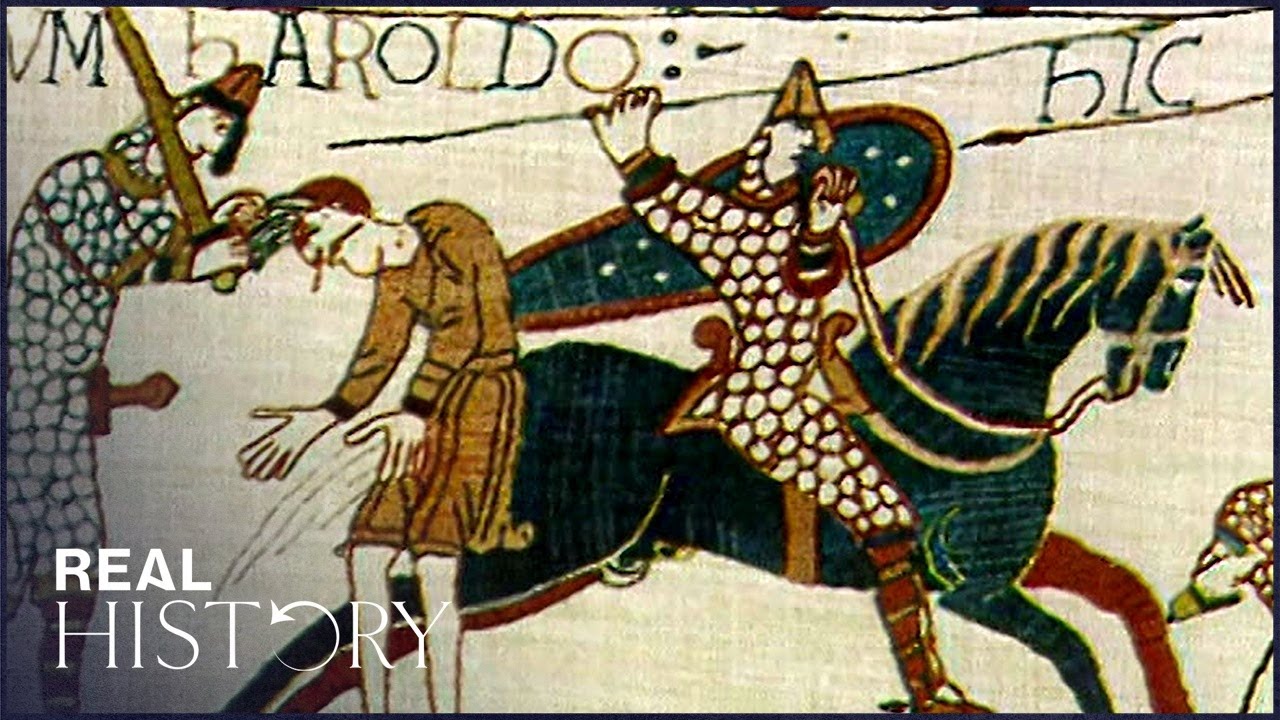
He changed his tactics. He ordered his archers to advance and fire at close range into the English line. The arrows tore gaps in the shield wall. It was probably at this point that Harold was struck down, likely by an arrow in the eye.
His brothers Gyrth and Leofwine were already dead. Without their leadership, the English command began to break down. As gaps appeared, the Norman cavalry charged through and cut down the isolated groups of Englishmen. With King Harold lying dead at the foot of his standard, William had won his greatest victory.
The question of the succession had been settled. The whole future of these islands would be irremediably changed. On Christmas Day 1066, William was crowned king of England in Westminster Abbey. It was noted that he was visibly trembling.
If so, it was one of the few times in his life he showed fear. He knew that the conquest had only just begun. At first, all was relatively civilized. William made a brief progress through the territory under his control and returned triumphantly to Normandy, taking the leading Anglo-Saxon magnates with him as political hostages.
But he could not stay away long. The Normans in England were few, perhaps no more than ten thousand, and they depended on a network of castles to overawe the conquered English. They were built often by requisitioned Saxon labor—the bitter irony of the English being forced to build the mechanisms of their own oppression. By the death of William in 1087, England was studded with castles.
The promises William had made to respect English rights and laws were quickly forgotten. Those who had fought at Hastings, and the families of the slain, had their lands confiscated or were forced to pay heavy sums in gold. William’s greed for gold was proverbial, and his Norman barons, with their rapacious Viking ancestry, found the riches of England impossible to resist. The next few years saw a flood of uprisings against Norman rule.
In January 1069, William’s new overlord in the north was surprised at Durham and slaughtered along with nine hundred Normans. Uprisings broke out across the country, and William’s hold on England seemed to hang by a thread. He responded with ferocity that has echoed down the ages. Striking first at rebels in the Midlands, he then led his troops north in a savage campaign.
A coalition formed against him—the King of Scots, a Danish fleet, the northern earls, outbreaks in Wales and the south. William’s response was short and brutal. His army entered Yorkshire, laying waste, killing and burning. Crops were gathered and systematically burnt.
Plows and instruments of agriculture were destroyed to create an artificial famine. Those who escaped the swords died of slow starvation. The chroniclers recorded that the streets and houses lay empty, and there was no one left alive to bury the dead. It has been estimated that the ravaging of the north cost the lives of between five and ten percent of the total population of England, and its effects were still visible sixty years later.
Despite the horrors, the period after the conquest saw a resurgence of religious activity. Great cathedrals were built. On the very spot where God had granted him the conquest of England, William caused a great abbey to be built. He made the English church administratively efficient, but he also made it Norman.
In every aspect of their existence, the English were subject to their foreign overlords. In 1080, the threat of renewed Danish invasion and the need to pay continental mercenaries drew attention to the lack of an accurate record of England’s wealth. At Christmas 1085, William, grown immensely fat and with a harsh commanding voice, called his council together. The result was the great survey the English wryly called the Domesday Book.
It was the most thorough land survey ever carried out, done with amazing speed. William sent his men into every shire to record how much land there was, what it was worth, and who held it. So thorough was the inquiry that there was not a single ox or cow or pig that escaped his survey. As William grew older, his relationship with his eldest son Robert deteriorated.
Robert, named as heir to the duchy of Normandy, grew impatient to take up his inheritance. William dismissed his demands. “It is not my custom to take off my clothes before I go to bed. ”
In the summer of 1086, reports reached William that Robert was plotting with King Philip of France to invade Normandy.
Though nearly sixty, immensely stout, and in failing health, William crossed to the duchy to meet the threat. At the end of July 1087, William’s troops stormed the city of Mantes and put it to the torch. Riding exultantly through the burning streets, William was either struck by a seizure in the immense heat or was thrown against the iron pommel of his saddle. He suffered a fatal internal injury.
The dying king was carried back to Rouen, where he lingered in great pain for six weeks. With typical pragmatism, he settled his affairs. He confirmed his errant son Robert in Normandy. His second son, William Rufus, was to become king of England.
On the morning of September 9, 1087, as the great bell of the Minster of Rouen tolled, the fierce old warrior breathed his last. A monk from William’s own abbey, writing two centuries later, has left an account of the conqueror’s tormented final words, which may serve as his most fitting epitaph. “I persecuted the native inhabitants of England beyond all reason. Whether nobles or commons, I cruelly oppressed them.
Many I unjustly disinherited. Innumerable multitudes, especially in the county of York, perished through me by famine and sword. I tremble when I reflect on the grievous sins which burden my conscience. I was bred to arms from my childhood, and am stained with the rivers of blood that I have shed.
”


