The first shell struck without warning. One moment HMAS *Sydney* was approaching what appeared to be a Dutch freighter in the fading Indian Ocean light, the next the freighter’s false plating was falling away and her hidden guns were firing from point-blank range. There was no time for surprise, no time for a proper battle formation. The crew of the Australian light cruiser could only react as the shells tore through their decks, and the sea around them began to boil with the impact of a war they had not seen coming.
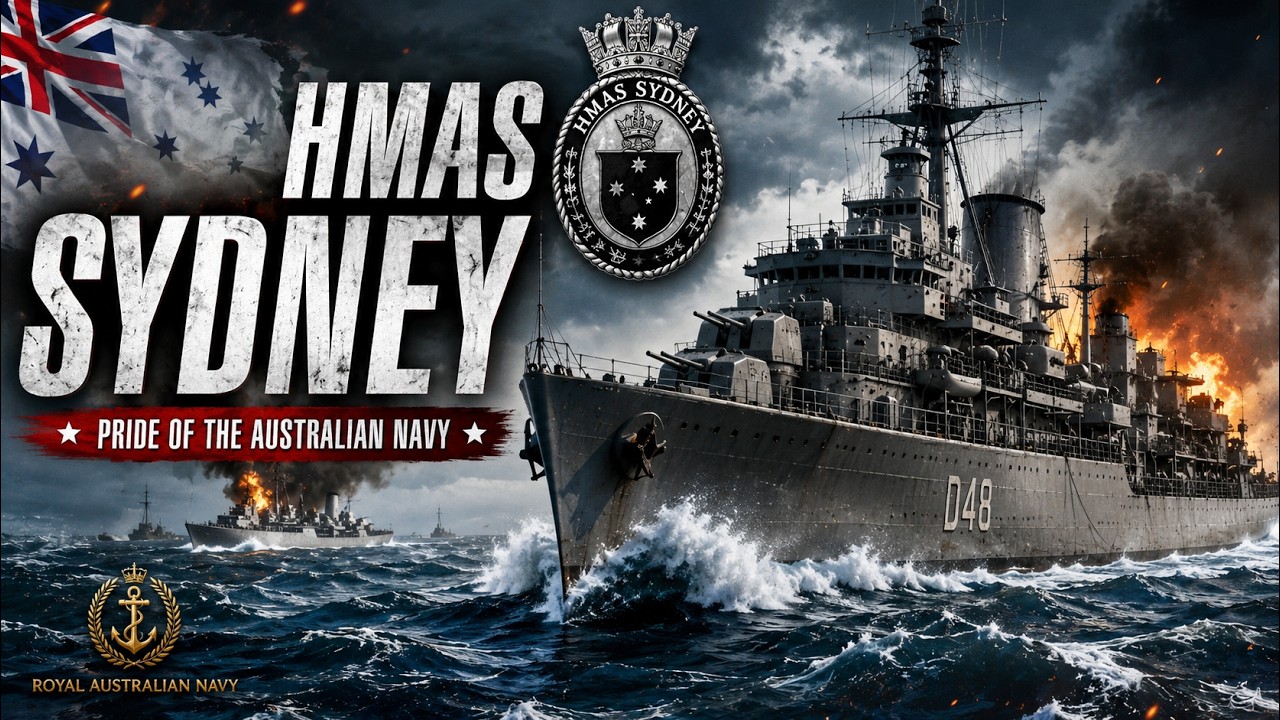
It was November 19, 1941, off the coast of Western Australia. The *Sydney*, a proud light cruiser of the Royal Australian Navy, had already made her name in the Mediterranean, sinking the Italian cruiser *Bartolomeo Colleoni*. She had returned home to patrol these waters, to protect the shipping lanes that had become increasingly dangerous. The crew of 645 men were experienced, confident, and they trusted their ship.
They had no reason to suspect that the seemingly harmless merchant vessel ahead of them was anything other than what she appeared to be. The other ship was the *Kormoran*, a German merchant raider. She had once been an ordinary freighter, but she had been surgically transformed into a weapon of war. Her guns were hidden behind innocent-looking panels, her torpedo tubes were concealed within her hull, and her crew—297 men—had been trained to maintain a perfect disguise.
She wore the identity of a Dutch vessel called the *Straat Malacca*, with false papers, false flags, and a crew that moved with the calm of merchant sailors rather than the discipline of military men. The *Kormoran* had been hunting in the Indian Ocean for months, preying on Allied shipping. She was commanded by Captain Theodor Detmers, a meticulous officer who understood that his ship’s survival depended entirely on deception. His crew knew that discovery meant death or capture.
They had become experts at living within their carefully constructed lie. When the *Sydney* first spotted the smoke on the horizon that afternoon, the encounter seemed routine. Captain Joseph Burnett ordered his ship to investigate. The unidentified vessel was moving slowly, apparently alone in the vast ocean.
As the distance closed, signals were exchanged. The *Kormoran* responded with hesitation, buying time, claiming to be the Dutch freighter she was impersonating. Something felt wrong to Burnett. The responses were evasive.
The ship’s movements were odd. He ordered the *Sydney* to close the distance further, to get close enough for visual confirmation. It was a decision of naval protocol, a commander doing what any commander would do. What he could not know was that he was sailing his ship directly into a trap.
The *Kormoran* had been waiting for this moment. As the *Sydney* approached to what became point-blank range, Captain Detmers gave the order. The false plating was dropped, the Dutch flag was torn down, and the true nature of the ship was revealed in an instant. The *Kormoran*’s guns, loaded and aimed, opened fire at a distance so close that missing was nearly impossible.
The first salvos struck the *Sydney* with devastating accuracy. The bridge was hit. Shells penetrated the hull. Fuel oil tanks ruptured, and flames began to consume the ship.
The Australian crew was caught between suspicion and verification, between the routine of an approach and the reality of combat. It was as if the world had been turned upside down in a matter of seconds. But the *Sydney* was not an easy target. Despite the shock and the damage, her crew began to return fire.
Their guns, those same guns that had claimed the *Colleoni* in the Mediterranean, began to find their targets. The *Kormoran*, for all her hidden power, was still a converted merchant vessel. Her hull was not built to withstand the punishment of a true warship’s guns. The engagement lasted roughly twenty minutes.
Both ships hammered each other with everything they had. German shells found their marks with terrible consistency, but so did Australian ones. The *Kormoran* began to take on water. Her engines faltered.
Fires broke out across her deck. The two ships, locked in their deadly embrace, were both dying. By the time the firing ceased, the outcome was clear. Neither vessel would sail away from this encounter.
The *Kormoran* was crippled beyond repair, and Captain Detmers made the decision to scuttle her. Explosive charges were set. The crew, those who had survived, prepared the lifeboats and rafts. As darkness fell, they watched their ship slip beneath the surface, sent down deliberately to deny the enemy any prize.
But the *Sydney* did not follow the same path. She did not sink near the *Kormoran*. She did not settle to the bottom where her wreckage could be easily found. Instead, burning and listing heavily, she limped off into the gathering darkness.
The men aboard the *Kormoran*’s lifeboats watched her lights disappear over the horizon. They saw her fires burn for a time, and then she was gone. What happened in the *Sydney*’s final hours remains one of the greatest mysteries of naval history. She had sent distress signals before her communications were destroyed, but whether they were received, whether anyone knew her position, remains a matter of conjecture.
She was never seen again. No lifeboats were found. No wreckage washed ashore. All 645 men aboard went down with their ship, and no one survived to tell the story of her final moments.
The *Kormoran*’s crew drifted for days before being rescued. They were taken into custody, processed, and eventually interrogated by Australian authorities. Their accounts of the battle were collected and compared, but they could not answer the question that mattered most to Australia: what had happened to the *Sydney*? They had seen her burning.
They had watched her disappear into the darkness. But they had not witnessed her sinking. That final moment belonged only to the men who went down with her. The news reached Australia slowly, then spread like a cold current.
The *Sydney*, the pride of the nation, the ship that had returned from the Mediterranean victorious, had vanished. Families waited for news that never came. There were no bodies to bury, no graves to visit. Mothers and wives held on to the thinnest strands of hope, but the ocean refused to yield its secret.
The official statements were vague, wrapped in the careful language of wartime secrecy. The public was told that a raider had been engaged and sunk, but the details of the *Sydney*’s fate remained locked away. In the years that followed, the mystery deepened. The war ended, but the questions did not.
The families of the lost demanded answers, but there were none to give. The German survivors had told their stories, but their accounts were incomplete. The wreck of the *Kormoran* had been found relatively quickly after the battle, but the *Sydney* remained hidden, somewhere out there in the vast Indian Ocean, waiting. Decades passed.
The families aged. Children grew up knowing fathers only through photographs and letters. November 19 became a date of remembrance, a day when the nation turned its attention to the lost ship and her crew. The mystery became part of Australia’s collective memory, a story with a hole in it, a narrative that ended in mid-sentence.
The technology to find the wreck did not exist for most of those years. Sonar was crude, deep-sea exploration was the stuff of science fiction, and the depths off Western Australia, where the *Sydney* had gone down, were too great for conventional salvage. It was not until the early 2000s that the tools became available to search with any serious chance of success. In 2008, an expedition was organized, combining Australian naval historians, oceanographers, and researchers.
The search area was calculated from survivor testimonies, historical records, and the physics of ocean currents. The *Kormoran* was found first, resting at a depth of around 240 meters, her hull fractured and burnt, bearing the evidence of the punishment she had received from the *Sydney*’s guns. The wreck confirmed the German accounts of the battle, but it did not reveal the fate of the Australian cruiser. The search continued.
The sonar operators swept the grid patiently, methodically, day after day. And then, on the display, a shape emerged. It was unmistakable. The wreck of HMAS *Sydney* was lying on her side at a depth of over 2,000 meters, far deeper and more distant from the *Kormoran* than anyone had calculated.
She had drifted considerably farther after the battle, burning through the night before finally succumbing to the sea. The images that came back from the deep were haunting. The *Sydney*’s hull bore the unmistakable scarring of concentrated gunfire. Her superstructure was devastated.
The gun turrets that had served her so faithfully in the Mediterranean were twisted at unnatural angles. The pattern of damage confirmed that she had been overwhelmed by point-blank bombardment. But the wreck could not answer the deeper questions. It could not tell whether her men had fought with courage or terror, whether they had known what was happening in those final terrible hours, or if the end had come so swiftly that understanding never quite arrived.
No survivors had ever come forward from the *Sydney*. There were no voices from her decks to explain the last orders or the final moments. The wreck preserved the physical evidence of what had happened, but it could not speak to the human experience of that tragedy. The men who went down with their ship rested in that darkness, and they carried their secrets with them.
The discovery of both wrecks changed something profound. It was a moment when two nations, separated by war and time, could finally look at the same evidence and begin to understand. Australian historians and German researchers began to collaborate. The wrecks themselves became a shared cemetery, a common ground at a depth where no flag could fly and no nation claimed ownership.
The scarred hulls bore witness to a moment of mutual destruction, a tragedy that had claimed lives on both sides. In the years since, remembrance has taken a gentler turn. Memorials have been built, ceremonies are held each November, and families from both Australia and Germany have found ways to honor their dead. The ocean that swallowed both ships has become a place of reconciliation, not because the enmity has fully healed, but because the wreckage has taught both nations that their men sailed into the same violence with the same fear and the same duty.
The wrecks continue to rest in the deep, slowly being covered by sediment, becoming part of the seafloor itself. They have been found, their stories partially told, but some questions remain forever unanswered. The mystery of what happened in the *Sydney*’s final hours, of what the men aboard felt as their ship burned around them, belongs to a realm beyond sonar and photography. It lives in the space between the historical record and the lived experience, a gap that perhaps no technology can ever fully bridge.
The families of the lost have learned to live with this. They know where their loved ones rest, but they cannot visit a grave two thousand meters beneath the surface. You cannot leave flowers in the abyss or speak words of goodbye where your voice cannot travel. So remembrance has become an act of imagination, a choice to keep someone present in your thoughts, to refuse their erasure even as the years accumulate and living memory fades.
The ocean holds its secrets with the patience of geological time. The wrecks of the *Kormoran* and the *Sydney* now rest in that custody, preserved in the cold, dark waters where no light reaches. They are monuments to loss, to the chaos of war, to the moment when two sets of sailors collided in darkness and both were swallowed by the sea.
They are found, but their deepest secrets remain in the depths, guarded by the same currents that carried them to their final resting place.


