Yesterday in London, the military ran an exercise in a disused part of the underground railway system, rehearsing for a Russian conventional attack on Britain. The press was full of stories about how Russian cruise missiles could strike UK targets with almost total impunity. I felt vindicated. Around the time the Ukraine war began, I had made two videos warning about this exact vulnerability.
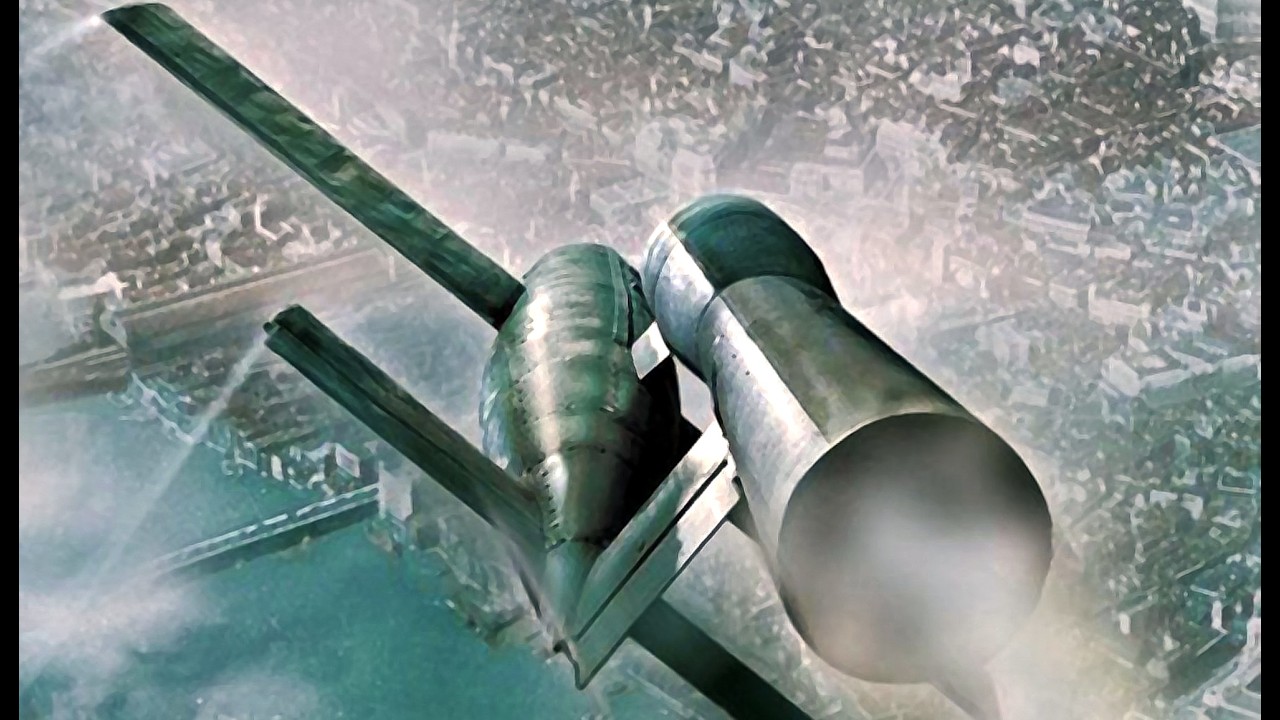
In a conventional war between NATO and Russia, cruise missiles launched from bombers outside our airspace could hit British infrastructure, power generation, and our dwindling number of operational RAF and naval bases. We would be hard-pressed to stop them. I took criticism for that at the time. Now the British military itself was practicing for the scenario, and the articles agreed with me.
The constant downsizing of the British military had left the UK dangerously exposed to precision strikes. The war with Iran underlined the point. The Iranians had shown they could fire very long-range missiles at British Indian Ocean Territory and the vital US airbase at Diego Garcia. Drone attacks had hit RAF Akrotiri in Cyprus.
The lesson was clear, and I had been saying it all along. But the current exercise in London brought something else to mind. It was the anniversary, in a sense, of an earlier threat. 82 years ago, Britain faced the first sustained cruise and ballistic missile campaigns in history: the German V1 and V2 attacks.
Now, a recent theory about a V1 site had emerged, one that tied directly into what London was rehearsing for. Cruise missiles used as delivery systems, possibly for chemical weapons. It was something the Ministry of Defense was undoubtedly worrying about again. The story began in 2017 with a historical dispute about the island of Alderney, one of the Channel Islands.
Alderney was the only British soil the Germans occupied in World War II, along with Jersey, Guernsey, and Sark. It was also the most heavily fortified and the closest to Britain. The theory was put forward by Colonel Richard Kemp, a former commander of British forces in Afghanistan, and his research partner, John Weingold. Their claim was that late in the war, the Germans had started planning a chemical weapons attack on mainland Britain from Alderney.
Alderney was different from the other islands in one crucial way. Its population had been almost entirely evacuated before the Germans arrived. There were almost no witnesses to what happened there for the next four years. Years ago, when I was still a military history author, I had become fascinated by Alderney’s dark wartime history.
I planned to write a book about the German labor camps on the island, the only place on British soil where the SS operated. The book never came together, largely because so much about Alderney in World War II was still classified in the early 2000s. Other authors eventually pieced together more of the story. All the Channel Islands were heavily fortified.
Bunkers, machine gun positions, artillery, anti-tank walls, all built by Organization Todt, often using forced labor. But Alderney was unique. It was the only place where the SS ran a concentration camp in the Channel Islands: Lager Sylt. The camp held Soviet prisoners of war, Jews, and other prisoners of the Nazis.
It was brutally run by SS Captain Maximilian List. Around 5,000 prisoners were forced to labor on the defenses. Huge numbers died from exhaustion, beatings, or hangings. The question Colonel Kemp asked was simple: why bring the SS to Alderney at all?
Why not just use Organization Todt like everywhere else in the islands? He and Weingold believed there was a more sinister reason for the SS presence than just running a camp. The island has one small town, St. Anne’s.
Just outside it, a track called Water Lane runs through a narrow valley called Le Val des Terres. A tunnel system from the war still exists there, hewn from the rock by prisoners from Lager Sylt under almost intolerable conditions and great SS brutality. Historians had always said the tunnels and rooms at Water Lane were for fuel, ammunition, or a power generator. Kemp and Weingold felt that didn’t add up.
There were two tunnel systems, one on each side of the valley. Each main tunnel was ten feet wide and nine feet high. A narrow-gauge railway line once ran along its length. The roof and sides had been lined with wood, and the remains of bitumen sheets showed the Germans had also lined the tunnel to make it completely waterproof.
That was unusual. It was a degree of fitting out that other German tunnels on the Channel Islands and in France simply didn’t have. Whatever the Germans had stored in this tunnel was delicate and valuable. It needed special protection from rock falls and dripping water.
Kemp and Weingold didn’t believe the fuel store theory. Ventilation was poor, and the dimensions were wrong. The ammunition theory was just as unlikely. The tunnels were too small and difficult to work in.
They also noticed the tunnels had an odd shape. They curved and bent. That was inefficient for German military storage, and plenty of regular German storage tunnels still existed in the Channel Islands to compare with. Whatever was kept inside sat on trolleys running along the small railway lines bolted to the floor.
Kemp and Weingold realized whatever it was would have been long and thin, and could be shunted outside when needed. They came to a conclusion: a Fieseler Fi 103, the V-1 flying bomb, with its wings detached for storage, as was standard, would fit perfectly. Armies follow handbooks when laying out facilities. The Germans did the same when setting up V1 launch positions.
Kemp and Weingold saw that outside each tunnel exit, huge embankments of excavated earth and rock had been piled up to create slopes running from the tunnel entrances to flattened areas. And the site had once held a water tank. That was strange for an ammunition store or a generator room. But at known V1 launch sites in northern France, a water tank was integral.
It allowed crews to wash down the ramp with chemicals used during the firing of the missile. Coupled with the length of the tunnels, the way the spoil had been deliberately shaped into slopes outside the exits, the high build quality, and the rails bolted to the floor, all of it pointed, according to Kemp and Weingold, to one answer. This was a V1 launch site. They calculated that each tunnel could have held 72 disassembled V1s on trolleys.
But there was a mystery. Why build a V1 site on Alderney at all? It was close to the coast, and if the British discovered it, it would be very vulnerable to attack. About a quarter of a mile inside the hill, two smaller side tunnels branched off the main tunnel in each complex.
Each was about 30 yards long and led nowhere. They were extremely well-built and completely dry. No such chambers existed at V1 sites in France. Kemp and Weingold speculated that the V1s would have been wheeled along the main tunnel.
As they passed the side passages, something could have been fitted to them. Could these very well-built side chambers have held special warheads that required special storage? In the British archives, there is a report from a Guernsey fisherman. One day during the war, he came into St.
Anne’s Harbor and witnessed Germans unloading yellow-painted barrels from a ship. Yellow is the international recognition color for chemical weapons. It was then, and it still is now. Further evidence came from survivors of the labor camp.
After the war, they recalled that the Germans on Alderney had frequent gas drills, often lasting all day. The prisoners watched their guards wearing respirators. The Germans had certainly developed and stockpiled horrifying chemical agents during the war, including the nerve gases tabun and sarin. I did my own research on the V1 missile.
I discovered the Germans did design a special chemical warfare variant, the Fi 103D1. As far as anyone knows, it never entered serial production. But the truth is, we simply don’t know whether special warheads were produced in secret, or whether the D1 variant was built in small numbers. What is well known is that Hitler was very reluctant to use such weapons, even facing defeat in the final weeks.
His objections are documented. But whatever was happening on Alderney was being run by the SS, under the direct authority of Reichsführer Heinrich Himmler, the second most powerful man in Germany, a man known for his secret operations. The practical issues also made sense. Alderney would have been a good place for such a launch site.
The closest point of mainland Britain was only about 60 miles away, well within the V1’s range of up to 150 miles. The island was almost completely empty of civilians and heavily militarized. The labor was disposable and under direct SS control. No one wanted to upset Himmler.
So why not simply launch a nerve agent attack from the regular V1 bases in northern France? Why the elaborate deception of doing it from Alderney? Several answers presented themselves. Alderney had no civilian population, so there was no indigenous resistance organization to report to London, unlike in France.
The British would never suspect such a facility on the Channel Islands. And if there was an accident with the nerve agents, it could be contained on one small island in the middle of the sea, not spread over an area crowded with German troops. Kemp and Weingold stated that two launch ramps had been built, one for each tunnel complex. One ramp lined up with the port of Plymouth.
The other lined up with Weymouth. Both ports were vital to the D-Day operation. They were crowded with warships, transports, troops, and supplies heading for Normandy. Even after the landings, they continued operating at maximum capacity for months.
The researchers suggested the nerve agent-tipped V1s were meant to be fired at these two ports to disrupt the Allied invasion effort. The V1 was not a precision weapon. It was an area bombardment missile that could generally hit within a 7-kilometer circumference of a target. That’s why it was used against London.
But if the Germans fired enough at Plymouth and Weymouth, the law of averages suggested some would get through. In London, about 20 percent of V1s successfully got through the extensive defenses of anti-aircraft guns, barrage balloons, and fighters, causing immense damage and loss of life. Most of those defenses were concentrated in southeast England. The west of England was far less defended.
V1s fired from Alderney would have faced less opposition. Weymouth was about 60 miles almost due north from Alderney. Plymouth was slightly further at about 110 miles. Both were within range of a standard V1.
The V1 flew at around 400 miles per hour. Flight time to Weymouth would have been 9 minutes. To Plymouth, 16 and a half minutes. For operations against London, launch crews could fire 10 to 15 missiles per day.
On Alderney, one battery firing over two ramps could have fired upwards of 20 to 30 missiles a day. With each tunnel holding 72 missiles, 144 in total, the Germans could have fired continuously for three days at both ports. Even a handful of successful nerve agent hits on entire cities would have been devastating. Of course, Kemp and Weingold’s work drew heavy criticism.
Trevor Davenport, author of Festung Alderney, a book about the island’s German defenses, dismissed the idea as utter nonsense. But he also admitted there are many things we do not know. It was accepted. It had always been accepted.
The island’s history was secret. Could the Germans have planned to launch nerve agent-tipped V1s at England in 1944 or 1945? Or is the evidence just not strong enough? I think the very special nature of Alderney during the war, the secret activities of the SS, and the analysis of the tunnels at Water Lane are compelling.
But until an actual German document surfaces discussing this operation, it will be very difficult to prove. I will say one thing. It would have made an absolutely fantastic plot for a Jack Higgins novel.


