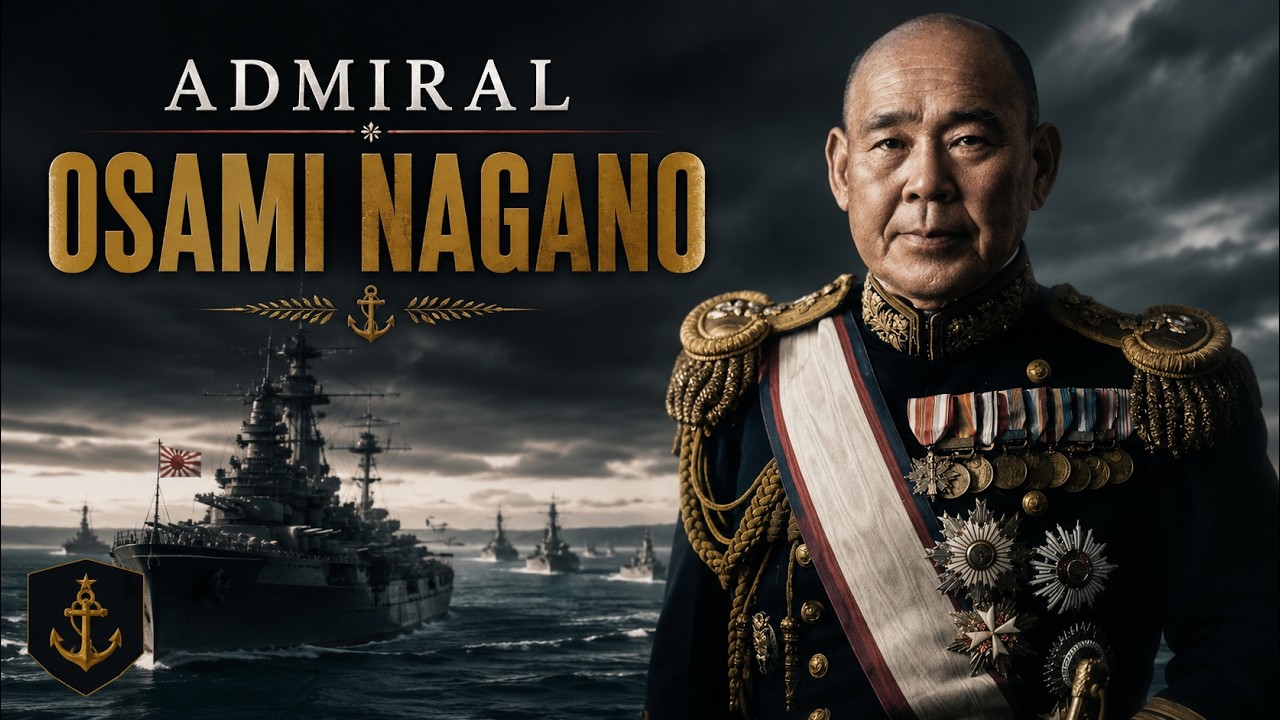
On a fog-wrapped morning in the inland sea, a naval officer stood on the deck of the battleship Yamato, waiting for news that would decide the fate of empires. The water was still, broken only by the slow movements of warships at anchor. Admiral Osami Nagano, chief of the Japanese Naval General Staff, had approved the plan. Now there was nothing left but to wait.
The first reports arrived around mid-morning. The aircraft had reached their target. The American fleet at Pearl Harbor had been caught by surprise. Significant damage had been inflicted.
Around Nagano, the operations room stirred with controlled excitement. He received the news with the composure he had cultivated over decades, absorbing it without visible emotion. He understood what others in that room did not yet grasp. He had studied American industrial capacity firsthand during his years as a naval attaché.
He had walked their dockyards, spoken with their officers, understood their resources. Japan could strike a brilliant blow. But the blow would only enrage them. The war Nagano had helped begin would not end the way his younger, more optimistic colleagues imagined.
Nagano was born in 1880 in Kochi Prefecture, a maritime region on the southern coast of Shikoku. His family belonged to the samurai class, that warrior heritage that had been officially dissolved by the Meiji government yet still carried its values of loyalty and discipline into every generation. Japan in those years was seized by a fever of modernization, determined to remake itself in the image of Western power while remaining fundamentally Japanese. His childhood was shaped by this duality.
The old world of samurai codes and ancestral values coexisted with the relentless push toward railroads, Western military advisers, and reformed schools. Nagano absorbed both currents. From his family, he learned that duty was a living expectation. From the sea that surrounded his prefecture, he learned that Japan’s future lay beyond its shores.
In the spring of 1898, at age eighteen, he entered the Imperial Japanese Naval Academy on the island of Etajima. The academy was designed not merely to train officers but to forge them. Cadets rose before dawn, submitted to relentless inspections, and learned that a thread out of place was not a minor error but a failure of character. The sea itself was both classroom and judge.
Mistakes held real consequences. A man could drown. A ship could founder. By the time Nagano graduated, he had been transformed.
He understood the mechanics of naval power, the discipline of command, and the weight of responsibility that would follow him for the rest of his life. He entered a navy that was just beginning to assert itself on the world stage. His early assignments came in the aftermath of the Russo-Japanese War. The victory at Tsushima in 1905 had demonstrated that a non-European power could defeat a major Western nation at sea.
Every senior officer carried that battle with them as a kind of lodestone. Nagano absorbed the lessons not from lectures alone but from the living oral tradition of the service. He proved himself capable, serious, methodical. He was not a firebrand who sought attention through self-promotion.
He was the sort of officer noticed for the quality of his work, his grasp of technical matters, his willingness to master details. His reputation built quietly, as such reputations do in large institutions. The navy selected him for foreign attachment, an assignment given only to the most promising officers. His journey westward carried him across waters that seemed to stretch toward infinity.
When he arrived in the United States, he entered a world of immense naval sophistication and industrial capacity. Nagano observed everything. He studied how American naval strategy prioritized certain technologies, how their officer corps approached problems of organization, how they conceived of naval warfare with capital ships as the ultimate arbiters of power. He walked their dockyards of staggering scale and spoke with officers whose careers had been shaped by entirely different historical narratives.
What he learned convinced him of America’s immense material superiority. But he also perceived what he considered rigidities in their thinking. He saw the Americans and British as powerful, yes, but perhaps not infinitely adaptable. The question formed in his mind: could a nation of Japan’s industrial constraints compete with such overwhelming resources through exceptional thinking, discipline, and sacrifice?
His foreign service extended to other postings, each adding another layer to his understanding of how the modern naval world operated. He returned to Japan as a sophisticated observer who understood both the achievements of the Western naval powers and what he saw as their vulnerabilities. This perspective would shape his strategic calculations for the rest of his career. The years after his return were marked by Japan’s growing naval ambitions and the constraints imposed upon them.
In 1921 and 1922, the Washington Naval Conference attempted to regulate the arms race that had preceded the First World War. The treaty that emerged established a ratio of 5:5:3 for the navies of Britain, America, and Japan. For Japan, this meant it could maintain only three capital ships for every five possessed by the Western powers. Nagano understood the strategic calculations that produced the treaty.
He could recite the tonnage ratios from memory. But he also understood what those numbers meant for Japan’s aspirations in the Pacific. The ratio was a formal acknowledgment that Japan occupied a secondary tier in the international naval hierarchy. In 1930, Nagano served as a delegate to the London Naval Conference.
The talks were tense almost immediately. Britain and America sought to maintain their advantage. Japan sought relief from the ratios that bound it. The conference produced an accord, but it was thin, fragile, built on the understanding that each power was already contemplating what it might do once the agreement expired.
Nagano’s role was partly to negotiate, but increasingly to observe and report back. He watched the delegations and their intransigence, their unwillingness to recognize Japan’s needs. By the early 1930s, his observation hardened into conviction. The West would never voluntarily accept Japan as anything but a subordinate power.
In 1933, Japan withdrew from the League of Nations after international criticism of its invasion of Manchuria. By 1936, Japan had formally withdrawn from the naval treaty system entirely. Nagano watched this unfold. He had been among those who believed such a moment would come.
Now it had arrived. What followed was a transformation of Japan’s naval construction. The Yamato class battleships, the largest warships ever built, emerged from this new freedom. Nagano was deeply involved in the thinking that justified such expenditures.
If Japan was to compete with American strength, it would need a fleet that could dominate East Asian waters. In 1936, Nagano was appointed Navy Minister. The appointment came at a moment of extraordinary internal stress within the Japanese establishment. The army had become the dominant voice in military affairs, pursuing an increasingly aggressive strategy in China.
The navy viewed the continental adventure with skepticism. Naval officers looked outward to the Pacific. A truly imperial Japan, they believed, would require unchallenged naval supremacy in those waters. Nagano found himself in an impossible position.
He was responsible for defending the navy’s interests against the encroachments of an increasingly dominant army. Every yen spent on battleships was a yen the army could not spend on infantry divisions. Yet he was also expected to cooperate within the larger military hierarchy. To resist too openly was to risk being branded as weak or defeatist, labels that could be professionally fatal.
He advocated for fleet expansion. He argued for technological innovations that would give Japanese forces an edge in any future conflict. But events were moving toward scenarios that even he could not fully control. In April 1941, at age sixty-one, Nagano received the appointment that would define the remainder of his life.
He became chief of the Naval General Staff, the supreme operational authority over every ship and strategic calculation the Japanese navy would undertake. The timing was not coincidental. Japan was moving toward a moment of decision. The United States had imposed oil embargoes in response to Japanese expansion into China and Indochina.
These were slowly draining the navy’s fuel reserves, the lifeblood of any modern fleet. The industrial capacity of America remained almost incomprehensibly vast. The mathematics of a long war were brutal and inescapable. Nagano knew that time was not Japan’s ally.
The longer Japan delayed, the weaker it would become relative to the United States, which was rapidly expanding its own fleet. Therefore, the reasoning went, would it not be better to strike while Japan still possessed a margin of superiority, however temporary and fragile? By the autumn of 1941, the planning for an attack on Pearl Harbor was underway. Commander Isoroku Yamamoto had proposed the audacious idea in January of that year.
A single devastating strike against the American Pacific fleet at its moorings in Hawaii. It was an enormous gamble. But Yamamoto had grown convinced that if Japan were to have any chance in a prolonged war, the blow had to be swift and shocking enough to fracture American will. Nagano listened to these debates with the patience of a man who had spent decades learning when to speak and when to absorb the arguments of others.
He understood the appeal of Yamamoto’s reasoning, the desperate logic of it. Japan’s oil reserves would dwindle if war continued. Time was not Japan’s friend. The sooner the war could be won, the better Japan’s chances of emerging intact.
Yet he also harbored doubts. He knew the risks. But by this point, the question was no longer whether war would come. The political forces within Japan had developed their own momentum.
For Nagano to have stood against the attack, he would have had to sacrifice his position, his reputation, and quite possibly his life. The purges and assassinations of previous decades had demonstrated what happened to those who stood too firmly. And so his war began. In the weeks that followed Pearl Harbor, the operational tempo of the Japanese navy shifted into something approaching euphoria.
American supply lines shattered. Japanese forces advanced through the Philippines, the Dutch East Indies, and Malaya with astonishing speed. Singapore surrendered with embarrassing swiftness. The oil and rubber of Southeast Asia fell into Japanese hands.
Nagano received reports of expansion across the Pacific that seemed almost unassailable. Yet something curious began to take root. Officers who had harbored doubts began to shift their assessments. Difficulty became merely challenging.
Unsustainability transformed through the chemistry of success into possibility. Each success opened new possibilities rather than narrow them. Nagano existed in an interesting cognitive space during this period. He had expressed doubts about the possibility of a decisive strategic outcome.
And yet he had spent his entire career in service to Japanese naval power. He had seen the navy he helped build achieve extraordinary feats. The reports flowing into his command seemed to vindicate years of planning. The morning of June 4, 1942 began like so many others.
Reports came in from the fleet operating near Midway. But throughout the day, the reports grew darker. A cruiser sunk. An aircraft carrier damaged.
Then another. By evening, the naval command knew the truth. Four fleet carriers had been lost. Four.
The core of Japan’s striking power now lay burning on the ocean floor. Nagano understood the mathematics of naval power as well as anyone alive. Japan could build more ships. But Japan could not replace the trained pilots, the maintenance crews, the irreplaceable expertise of men skilled in carrier warfare.
Midway shattered the assumption that had underpinned Japanese naval strategy. American pilots could match Japanese pilots. American intelligence could compete with Japanese planning. In the weeks that followed, the atmosphere changed.
The conversation shifted from how Japan would extend its victories to how Japan might defend what it had already taken. Nagano’s role in day-to-day decision-making began to narrow. This was not a formal demotion. He retained his title.
But younger officers, more aligned with the army’s faction politics, more willing to embrace the rhetoric of spiritual victory, began to supersede his voice. The war continued its inexorable progression. Atoll by atoll, island by island, the Americans advanced. The Japanese navy retreated into an increasingly defensive posture.
In the corridors of the naval general staff, younger men questioned whether Nagano’s methods, his caution, his reliance on traditional hierarchy, were adequate to the demands of a new kind of war. By 1944, Nagano’s authority had become largely ceremonial. The fall of Saipan in July brought American bombers within reach of the Japanese homeland. It shattered the fiction that Japan still controlled the strategic initiative.
In the political turmoil that followed, Nagano was further marginalized. In the spring of 1945, he was effectively retired from active decision-making. His responsibilities were subtly redistributed. By May of 1945, with the war in Europe concluded and American forces preparing for the final assault on the Japanese islands, Nagano had ceased to matter in the corridors of power.
One might imagine him in those final weeks, watching the operations maps from a position of reduced authority, consulting on matters largely ceremonial. The weight of it all—the miscalculations, the strategic assumptions that had proven catastrophically wrong, the young men who had died—must have accumulated in the mind of a man for whom duty and honor were fundamental structures of meaning. When the atomic weapons fell on Hiroshima and Nagasaki, when the emperor announced Japan’s surrender, Nagano was no longer in command. He was simply an aging admiral watching the apparatus of empire collapse into dust.
In September 1945, Nagano was arrested at his home. He was detained at a facility reserved for high-ranking suspected war criminals. The interrogations were thorough and exhausting. He was questioned about his role in planning Pearl Harbor, about Japanese actions in China, about his participation in strategic decisions that had led to the deaths of millions.
In 1946, the International Military Tribunal for the Far East formally began its proceedings. Nagano was indicted on charges related to aggressive war and war crimes. The trial would last nearly two years. For Nagano, much of that time was spent in detention, waiting for his turn to be called.
As 1947 began, Nagano was sixty-seven years old. The stress of war, the weight of decisions made under impossible circumstances, the shock of defeat, and now the strain of detention had accumulated within him. His health was failing. In the early months of 1947, Osami Nagano died in custody before the tribunal’s verdict could be delivered.
The machinery of justice came too slowly. Or perhaps it came at exactly the pace it was meant to, and his death was simply one more piece of the vast reckoning that followed the war. The trials continued without him. Other men stood before the tribunal.
Some were convicted and executed. Others received sentences. But Nagano never faced his final accounting. He left behind questions that may never be fully answered.
Whether he wrestled with the moral implications of what he had orchestrated. Whether he could have resisted more forcefully. Whether he should have. These linger in the space he left behind.
What remains is the imperative to remember him not as an abstraction but as a human being who faced genuine dilemmas and carried genuine burdens. A man displaced by events he helped create, watching from the margins as the consequences of decisions unfolded. A man of discipline and skill who bound himself to a cause that brought suffering to millions.
A man who, in the final accounting, died before judgment could be rendered.