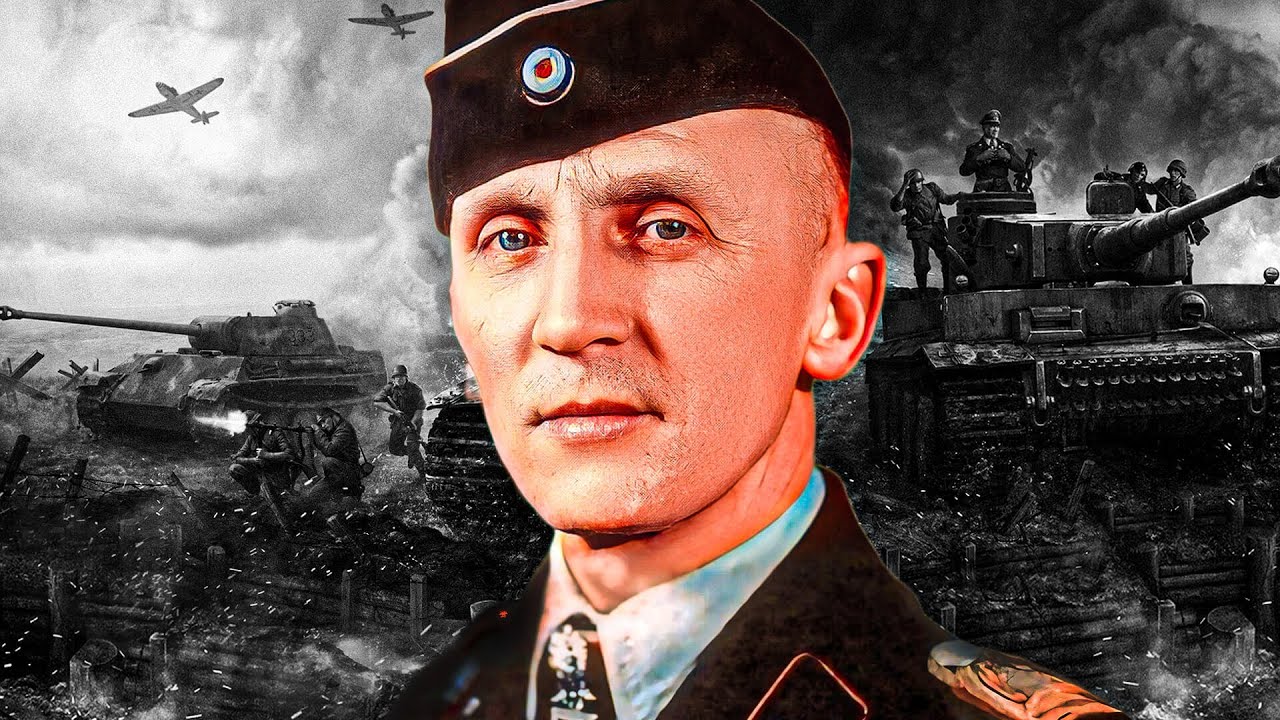
THE PANZER BARON WHO CAME BACK AS A TEACHER
Hasso von Manteuffel went from fighting American soldiers in the frozen Ardennes to standing before American cadets at West Point—and the most shocking chapter of his life happened after the war was already over.
In 1968, a German walked into the United States Military Academy at West Point to speak about fighting in deep snow.
That sentence alone does not sound extraordinary.
Until you know who the German was.
His name was Hasso von Manteuffel.
Twenty-four years earlier, American soldiers had been freezing in foxholes in the Ardennes while armored columns under his command drove through the winter darkness toward the Meuse.
Men had died trying to stop those columns.
Towns had burned.
Roads had disappeared beneath wrecked vehicles, shattered trees and snow stained black by smoke.
And now, in 1968, the same man was standing inside one of America’s most prestigious military institutions.
Not as a prisoner.
Not as a defendant.
Not as a defeated enemy being displayed as a trophy.
But as a lecturer.
The former German Panzer commander had been invited to explain what he knew.
There may be no better image for the strange second half of the twentieth century than that.
A man who had once studied how to break American lines was now being studied by Americans.
But the real story is not that Hasso von Manteuffel changed uniforms.
He never became an American officer.
He never stopped being the product of the Prussian military world that had shaped him.
And he never escaped every consequence of the decisions he made under Hitler’s Germany.
The real story is much more uncomfortable.
It is about how military brilliance can exist beside moral failure.
How yesterday’s enemy can become tomorrow’s source of knowledge.
How defeat can destroy a nation without destroying everything its soldiers learned.
And how one man who spent decades mastering the art of command eventually discovered that the most dangerous order of his career was not issued against an enemy tank.
It was issued against one of his own men.
Long before West Point, before the Panzer armies, before Hitler and before the word “blitzkrieg” terrified Europe, Hasso Eccard von Manteuffel had been born into a world that seemed designed to produce officers.
He arrived in Potsdam on January 14, 1897.
His name carried history.
His family belonged to the Prussian nobility. Discipline, service, hierarchy and military tradition were not abstract ideas in that environment. They were part of the furniture of life.
When he entered the Prussian cadet system as a boy, Europe still lived under emperors.
Cavalry officers still represented elegance and power.
Horses mattered.
Sabers mattered.
Regimental honor mattered.
The airplane existed, but few could imagine what it would soon do to warfare.
The tank did not yet matter at all.
Then Europe exploded.
In 1916, nineteen-year-old Hasso von Manteuffel became a lieutenant in the famous Zieten Hussars.
He entered military life through cavalry.
That detail would later become almost ironic.
Because the young officer trained in a tradition built around horses would spend his most famous years helping perfect a form of war built around engines.
The First World War ended with Germany defeated.
For many officers of his generation, that defeat broke something fundamental.
The Kaiser was gone.
The old order collapsed.
The German military was drastically restricted under the Treaty of Versailles.
Thousands of officers suddenly discovered that the profession around which they had built their identities no longer existed in the same form.
Manteuffel survived the institutional collapse.
And while Germany changed around him, he did something that would later define his entire career.
He adapted.
He remained a cavalryman for years. He became known as a skilled rider and competitor.
But he did not romanticize the horse to the point of ignoring the engine.
That distinction mattered.
Some officers looked at mechanization and saw machinery replacing tradition.
Manteuffel looked at mechanization and saw cavalry reborn.
Speed.
Surprise.
Flanking movement.
Initiative.
Concentration at the decisive point.
The horse could tire.
The engine could carry armor.
The old instinct could survive inside a completely new machine.
By the 1930s, Germany was rebuilding its armed forces at extraordinary speed under Adolf Hitler.
The process was tied to a dictatorship that would unleash catastrophic war, occupation and mass murder across Europe.
Manteuffel became part of the army serving that state.
That fact cannot be separated from the story simply because his tactical ability was impressive.
Yet within the military profession, another transformation was happening.
German officers were experimenting with combinations of tanks, infantry, artillery, radios and aircraft at a speed that would shock their future enemies.
Manteuffel moved into motorized forces.
The former Hussar had become a mechanized officer.
He studied movement obsessively.
He trained men to act quickly.
He believed commanders had to understand terrain from the front rather than merely from headquarters.
And he developed a reputation that would follow him for the rest of the war: he was small in physical stature, energetic, direct, and willing to appear where fighting was dangerous.
When the Second World War began, he was not yet one of Germany’s famous armored commanders.
Names such as Guderian and Rommel attracted far more attention.
Manteuffel was still climbing.
Then came the Eastern Front.
In 1941, Germany invaded the Soviet Union in the largest land campaign Europe had ever seen.
Early German advances were enormous.
They were also deceptive.
Every mile east stretched supply lines farther.
Every destroyed Soviet formation seemed to be replaced by another.
Every victory pulled German forces deeper into a country whose size began to swallow them.
Manteuffel served with the 7th Panzer Division.
It had already acquired an almost mythical reputation for speed.
On the maps, armored arrows moved eastward.
On the ground, everything was harder.
Roads dissolved.
Fuel became precious.
Machines broke.
Men slept beside engines because engines meant survival.
Then came winter.
The German advance toward Moscow reached its limit in 1941.
Manteuffel’s troops operated astonishingly close to the Soviet capital.
For an officer trained to exploit movement, it must have looked for a moment as though one more violent push might change history.
But history refused.
The Red Army did not collapse.
The temperature fell.
German equipment suffered.
Men suffered more.
The offensive that had looked unstoppable began to freeze in place.
That was one of the first great lessons Manteuffel carried forward.
Speed was powerful.
But speed without fuel was nothing.
Armor was powerful.
But armor without infantry, reconnaissance and logistics could become a steel coffin.
Plans looked clean in headquarters.
Battlefields punished cleanliness.
And the enemy always received a vote.
Those lessons would eventually make him dangerous.
Because Manteuffel was not the kind of commander who treated doctrine as scripture.
He watched what failed.
Then he changed.
By the beginning of 1943, the war had turned.
Germany was no longer simply advancing.
At Stalingrad, catastrophe had unfolded.
In North Africa, Axis forces were being compressed into Tunisia.
Allied power was growing.
Ships, aircraft, trucks, artillery, tanks and fuel were arriving in quantities Germany could increasingly struggle to match.
That was where Manteuffel received another extraordinary assignment.
Tunisia.
The force he inherited was not some perfect Panzer division waiting for a heroic commander.
It was a mixed formation assembled from different units and nationalities under increasingly desperate circumstances.
German troops.
Paratroopers.
Motorized infantry.
Italian Bersaglieri.
Improvised equipment.
Shortages everywhere.
It was the kind of formation that exposed weak leadership immediately.
Manteuffel treated it as a problem of movement.
He shifted units.
Counterattacked.
Tried to exploit moments before the Allies could consolidate.
The desert and hills became a brutal classroom.
The Americans and British had something the Germans could not wish away: growing material superiority.
Manteuffel could win local engagements.
He could surprise an opponent.
He could delay.
He could make an enemy pay heavily for ground.
But he could not manufacture fuel.
He could not manufacture strategic reserves.
He could not reverse the Mediterranean war.
That is the difference between tactics and strategy.
A brilliant commander can win a hill.
He cannot necessarily save a doomed theater.
Then the commander himself broke.
Exhaustion and illness forced Manteuffel out of Tunisia before the final Axis collapse there.
For many soldiers left behind, there would be captivity.
For him, there would be promotion.
It sounds almost absurd.
His command was approaching destruction—and his reputation was rising.
That was the first cruel paradox of Hasso von Manteuffel’s war.
The worse Germany’s strategic position became, the more valuable officers like him became.
Because Germany no longer needed commanders who could simply exploit victory.
It needed commanders who could prevent defeat from becoming immediate annihilation.
Manteuffel returned to the Eastern Front.
By August 1943, the great German offensives in the Soviet Union were largely over.
The Red Army was pushing west.
German formations that had once measured success by kilometers gained were increasingly measuring success by whether they escaped encirclement.
Manteuffel took command of the 7th Panzer Division.
Now the former cavalry officer faced a completely different problem.
Not how to chase.
How to retreat without disintegrating.
This is where mobile warfare becomes far less cinematic than people imagine.
A retreat is not simply driving backward.
A retreat means deciding which road remains open.
Which bridge must be held.
Which village must be abandoned.
Which unit has enough fuel to move.
Which unit must stay behind long enough for another to escape.
Which damaged vehicles can be recovered.
Which cannot.
And sometimes which men will be ordered to hold a position knowing the main body is already withdrawing.
Manteuffel became skilled at these ugly calculations.
He used counterattacks not necessarily to seize permanent ground, but to create time.
Strike one Soviet spearhead.
Force it to deploy.
Move another formation through the gap.
Withdraw.
Repeat.
In that kind of war, hours were territory.
A commander who bought six hours might save thousands of men.
A commander who misjudged six hours could lose a division.
His reputation grew.
Promotions followed.
Decorations followed.
Then, in early 1944, Manteuffel received command of one of Germany’s elite formations: Panzergrenadier Division Großdeutschland.
Its name alone carried enormous prestige within the German Army.
But prestige could no longer hide reality.
The Soviet Union had recovered from the disasters of 1941 and 1942.
Its armies were larger.
Its operational methods had improved.
Its tank formations could penetrate, exploit and encircle with terrifying force.
Germany was becoming the army trying to survive the kind of deep armored operations it had once imposed on everyone else.
And somewhere inside that collapsing front, an incident occurred that would remain buried beneath battlefield fame for years.
A German soldier was accused of cowardice or desertion during a crisis.
A military court considered the case.
The court did not initially impose death.
Manteuffel intervened.
The soldier was executed.
At the time, the war continued.
Fronts moved.
Cities fell.
Casualty reports multiplied.
One dead German soldier disappeared into a continent already filled with millions of dead.
Manteuffel moved on.
But history did not.
That order was waiting for him.
He simply did not know it yet.
By the summer of 1944, Germany was being crushed from both directions.
In June, the Western Allies landed in Normandy.
In the East, the Soviet Union launched Operation Bagration.
Army Group Centre was smashed.
German formations vanished from maps.
Columns of refugees and troops moved west.
The scale of the disaster was almost impossible to conceal.
Yet Hitler still imagined decisive counterstrokes.
And in September 1944, Hasso von Manteuffel was called to a level of command few officers reached.
He was promoted to General der Panzertruppe.
Then he was given the Fifth Panzer Army.
He was forty-seven.
The cavalry lieutenant of 1916 was now commanding an armored army.
The transformation seemed complete.
Except the army he inherited belonged to a state running out of time.
Germany’s cities were being bombed.
Fuel production was collapsing.
The Luftwaffe had lost control of the sky.
Replacement crews were increasingly inexperienced.
The Western Allies were on Germany’s borders.
The Red Army stood in the east.
And Hitler was planning an offensive.
Not a small counterattack.
A strategic gamble.
The Ardennes.
The same heavily wooded region through which German forces had stunned the Allies in 1940 would become the setting for one final attempt to split the British and American armies.
The objective was breathtaking.
Break through.
Cross the Meuse.
Drive toward Antwerp.
Divide the Allied coalition.
Force a political crisis.
Buy Germany time.
On paper, arrows could still reach Antwerp.
Manteuffel understood maps well enough to know arrows were cheap.
What Germany lacked was almost everything the arrows required.
Fuel.
Time.
Air superiority.
Reserves.
Reliable roads.
And surprise that would last more than a few days.
He objected to elements of the original plan.
He pushed for practical changes.
He understood something Hitler repeatedly refused to accept by late 1944:
An operational plan was not an expression of will.
It was an agreement with reality.
Reality did not care how badly Berlin wanted Antwerp.
Still, the offensive went forward.
Before dawn on December 16, 1944, artillery shattered the winter silence.
American positions erupted.
Telephone lines were cut.
Roads clogged.
Fog and low cloud temporarily reduced Allied air power.
German infantry moved first through darkness.
Then came armor.
The Battle of the Bulge had begun.
Manteuffel’s Fifth Panzer Army struck into the American lines.
The surprise was real.
Some positions collapsed.
Others fought with extraordinary stubbornness.
American commanders struggled to understand the scale of the attack.
Reports contradicted each other.
Units disappeared from communication.
Refugees and soldiers jammed roads.
German spearheads pushed west.
For a few days, the impossible seemed to be happening.
Manteuffel’s army made one of the deepest penetrations of the German offensive.
Names that had meant almost nothing before the battle—St. Vith, Bastogne, Houffalize—became symbols.
Bastogne became the most famous.
But Manteuffel’s operational problem was larger than a single town.
Every kilometer gained increased pressure on fuel.
Every delay gave the Americans time.
Every crossroads mattered.
Every bridge mattered.
He needed momentum.
The Americans needed hours.
And the Americans kept buying them.
Sometimes with tanks.
Sometimes with artillery.
Sometimes with small groups of infantry who had no idea they were delaying an entire operational timetable.
The German advance continued.
But not fast enough.
That phrase—”not fast enough”—can bury armies.
The weather cleared.
Allied aircraft returned.
American reinforcements poured toward the battlefield.
Patton’s Third Army turned north in one of the most famous operational maneuvers of the war.
German fuel reserves became critical.
Vehicles stopped.
Columns became targets.
The Fifth Panzer Army approached the Meuse but did not achieve the breakthrough Hitler had imagined.
The offensive had created terror.
It had inflicted enormous damage.
It had surprised the Allies.
But surprise was not victory.
The moment the Allies recovered, Germany’s fundamental weaknesses returned.
And now the Panzer armies were trapped inside a bulge they could not sustain.
For Manteuffel, the challenge changed again.
Advance became withdrawal.
Once more, his task was no longer to win Hitler’s war.
It was to prevent the remaining German forces from being destroyed immediately.
That was what he did best.
But here is the uncomfortable truth hidden beneath the legend of the “Panzer Baron.”
Competence can become dangerous when it serves a disastrous cause efficiently.
A commander may save his soldiers while prolonging a war that continues killing civilians and soldiers elsewhere.
A tactician may recognize that an order is militarily foolish without confronting the larger political crime surrounding the war itself.
And a man can be courageous under fire while failing a completely different test of courage.
That distinction matters because the war was approaching the moment when Manteuffel’s battlefield reputation would collide with his personal choices.
In February 1945, he received one of Nazi Germany’s highest military decorations.
The honor suggested triumph.
The map showed catastrophe.
Weeks later, Manteuffel took command of the Third Panzer Army in the east.
The Red Army was closing on Berlin.
German units were shattered.
Fuel shortages had become crippling.
Teenagers and older men were being dragged into hopeless defensive formations.
Refugees flooded westward, terrified of the advancing Soviets.
Orders from Hitler’s headquarters increasingly belonged to fantasy.
Hold.
Counterattack.
Recover lost positions.
Create armies that did not exist.
Move divisions that had no fuel.
Defend cities that could not be defended.
For an officer obsessed with practical battlefield reality, the final weeks must have been an exercise in institutional madness.
Manteuffel could see what had happened.
Germany had lost.
The only remaining question was how many people would die before everyone admitted it.
When commands came that could not realistically be carried out, he increasingly acted according to what he believed might save his army from destruction.
His forces moved west.
Like many German soldiers in 1945, they preferred surrender to the Western Allies rather than the Soviet Union.
In May, the war ended.
The Panzer armies stopped.
The radios went quiet.
The maps no longer required arrows.
Hasso von Manteuffel—baron, cavalryman, tank commander, army commander—became a prisoner.
And this is where most military legends would end.
Defeat.
Captivity.
A final photograph.
Perhaps memoirs.
Then obscurity.
But Manteuffel’s story was about to become stranger.
The Americans wanted information.
Not propaganda.
Not medals.
Knowledge.
The Allied armies had defeated Germany, but victory did not mean they believed there was nothing to learn from German officers.
Quite the opposite.
Military professionals began studying how German forces had operated.
How had armored formations been handled?
How had commanders organized mobile defense?
How had units continued functioning while retreating?
What had happened in the Ardennes?
What worked?
What failed?
Why?
Manteuffel participated in postwar historical work connected to the U.S. Army’s study of German operations.
Think about that reversal.
Only months earlier, his staff had been examining American positions looking for weaknesses.
Now Americans were examining his decisions.
The enemy commander had become a case study.
But the Cold War accelerated the transformation.
Almost immediately after the Second World War, the Soviet Union—the ally that had absorbed the greatest burden of the war against Nazi Germany—became the central military concern of the Western alliance.
Europe divided.
Germany divided.
Berlin became a pressure point.
NATO was formed.
Then an astonishing question emerged.
Should West Germany have armed forces again?
For people who had watched German troops march across Europe twice in one generation, the idea was terrifying.
But for strategists staring east, another question was equally frightening:
Could Western Europe be defended without German manpower and German territory?
Suddenly, men who had spent years thinking about fighting the Soviet Army possessed experience the West considered relevant.
Manteuffel entered politics.
He served in the Bundestag from 1953 to 1957.
He involved himself heavily in defense questions and the debate over West German rearmament.
The former Wehrmacht general was no longer commanding divisions.
He was discussing what a democratic West German defense establishment should look like.
History had turned the board over.
But then came the twist almost nobody building the legend of the brilliant Panzer commander wanted.
Because the past was not finished with him.
It arrived not in a tank.
Not in a Soviet uniform.
Not through an American investigator.
It arrived through a German court.
The case concerned that soldier from 1944.
The man whose life had disappeared beneath the statistics of the Eastern Front.
The man a military court had not originally condemned to death.
The man Manteuffel had ordered executed.
In 1959, the celebrated commander became a defendant.
Imagine the reversal in symbols.
During the war, men had stood when Manteuffel entered a command post.
His orders could move regiments.
His decisions could determine whether thousands attacked, withdrew or held.
He had spoken directly with the highest levels of the German command structure.
He had worn decorations associated with battlefield prestige.
Now the decisive voice belonged to judges.
The issue was no longer whether his order had improved discipline.
It was no longer whether the front had been collapsing.
It was no longer whether commanders in other armies might have acted harshly under similar circumstances.
The question was narrower.
Had Hasso von Manteuffel lawfully possessed the authority to turn that soldier’s sentence into death?
The court’s answer was devastating.
No.
He was convicted of manslaughter and sentenced to eighteen months in prison.
And that is the moment the mythology breaks.
Because until then, the story can be told as an almost perfect military arc.
Young Prussian cadet.
Cavalry officer.
Mechanized pioneer.
Panzer commander.
Army commander.
Defeated general whose former enemies still respected his professionalism.
Then one forgotten soldier walks back into the story from the grave.
Not literally.
Legally.
Morally.
Historically.
Suddenly the central question is no longer:
“How good was Manteuffel at war?”
It becomes:
“What does military excellence mean if command authority is used unlawfully against a powerless subordinate?”
The battlefield had rewarded decisiveness.
The courtroom demanded accountability.
The officer had spent decades being praised for acting quickly.
Now one decision would be judged precisely because he had acted beyond what the court concluded was lawful authority.
This was the moment of recognition.
Not a dramatic battlefield surrender.
No exploding tank.
No enemy general standing over him.
Just the crushing contrast between the man he had been and the position in which he now stood.
A commander who once held an army in his hands heard a civilian legal system pronounce judgment over one order given fifteen years earlier.
The medals could not answer.
The operational maps could not answer.
Bastogne could not answer.
Tunisia could not answer.
The Eastern Front could not answer.
The dead soldier’s case had survived the collapse of the Third Reich.
Manteuffel served only part of the sentence before being released, and the legal aftermath remained controversial.
Supporters argued that the extraordinary conditions of a collapsing front had to be understood.
Others insisted that precisely because war gives commanders enormous power, boundaries matter most when discipline is breaking down.
The debate never fit neatly into hero or villain.
That is what made it important.
Manteuffel was not transformed into an incompetent commander because of the conviction.
His tactical ability did not disappear.
His battlefield experience did not become imaginary.
But neither could tactical ability erase the death of the soldier.
Both truths had to exist at the same time.
And then history turned again.
Nine years after the conviction, in 1968, Hasso von Manteuffel went to West Point.
The symbolism is difficult to exaggerate.
America had not forgotten the Second World War.
Many senior officers had fought Germans personally.
Dwight Eisenhower—the Supreme Allied Commander who had overseen the defeat of Nazi Germany—was still alive.
The Battle of the Bulge was not ancient history.
Veterans were in their forties.
Widows still remembered telegrams arriving during that frozen winter.
And yet American military professionals were willing to listen to a former enemy commander.
Why?
Because professional armies study reality.
They study victories.
They study defeats.
And, perhaps most importantly, they study competent enemies.
Manteuffel could explain things few textbooks could reproduce.
What happens when snow stops movement?
How does a commander maintain tempo when roads are blocked?
How do armored formations function when fuel becomes the real center of gravity?
How does deep cold affect men, weapons and engines?
How does an army improvise under pressure?
How does a mobile force retreat without becoming a rout?
These were not ideological questions.
They were military ones.
The officer standing at West Point did not need to be morally purified for his battlefield experience to contain lessons.
That may be the most unsettling twist of all.
We often want history to organize people into simple categories.
Heroes teach us.
Villains warn us.
Victors possess wisdom.
The defeated disappear.
But real history refuses.
Sometimes the enemy knows something you need to know.
Sometimes a deeply flawed man understands a battlefield problem better than almost anyone else.
Sometimes learning from someone does not mean absolving him.
Sometimes respect for professional ability is not the same thing as approval of the cause that ability served.
The American cadets did not need to become admirers of Nazi Germany to understand what an experienced German armored commander had learned in Russia and the Ardennes.
Nor did Manteuffel’s invitation erase his conviction.
The two images belong beside each other.
Hasso von Manteuffel in a courtroom.
Hasso von Manteuffel at West Point.
One image says:
Actions remain accountable.
The other says:
Knowledge can survive conflict.
Together, they tell a much more powerful story than the easy legend of an undefeated warrior.
Because Manteuffel was defeated.
Germany was defeated.
His strategic world collapsed.
The regime his army served brought catastrophe upon Europe and Germany itself.
His political assumptions did not all survive the war.
His authority vanished.
His past returned in court.
Yet his professional knowledge still had value to people who had once been his enemies.
That is not redemption in the sentimental sense.
It is transformation through historical necessity.
By the late 1960s, yesterday’s battlefield enemies were confronting a new geopolitical reality.
West Germany had joined NATO.
American troops were stationed on German soil not as conquerors preparing another campaign against Germany, but as allies preparing to defend Western Europe alongside Germans.
Think about how violently history had reversed itself.
In December 1944, American soldiers watched for German tanks emerging from snowy forests.
A generation later, American and West German officers were planning how armored forces might fight on the same side if Soviet tanks came west.
The uniforms changed.
The alliance changed.
The maps changed.
The military problem remained.
Movement.
Terrain.
Fuel.
Initiative.
Morale.
Command.
Time.
Manteuffel had spent decades learning those realities at terrible cost.
And military institutions were willing to extract lessons from that experience.
He later appeared in historical discussions of the war and contributed to the public memory surrounding Germany’s armored campaigns.
But the image of West Point remains the most striking.
Not because it proves that former enemies should be forgiven automatically.
It proves something harder.
You can learn from a man without becoming his disciple.
You can recognize skill without erasing responsibility.
You can study the defeated without worshipping them.
You can condemn the system an officer served while still asking why his units fought effectively.
That distinction is one of the foundations of serious historical thinking.
And perhaps Manteuffel’s entire life can be understood through one transformation he began as a young officer.
He started with horses.
Then machines replaced them.
He adapted.
He began in an imperial army.
The empire disappeared.
He adapted.
He served a republic.
Then a dictatorship.
Then fought a catastrophic war.
Germany collapsed.
He adapted.
He became a prisoner.
Then a politician.
Then a convicted man.
Then, astonishingly, a guest lecturer before officers of a country his army had once tried to defeat.
Again and again, the world beneath his feet changed.
But there was one thing adaptation could never change:
The consequences of decisions already made.
That is why the soldier executed in 1944 matters just as much to Manteuffel’s story as the tanks in the Ardennes.
Without that soldier, the story becomes military mythology.
With him, the story becomes human history.
Command is intoxicating because it gives one person power over events.
But every arrow drawn on a map eventually becomes somebody’s road.
Somebody’s village.
Somebody’s burning vehicle.
Somebody’s father.
Somebody’s son.
And sometimes somebody standing alone before an execution detail because a superior decided an example had to be made.
Military history often remembers commanders in numbers.
Divisions.
Kilometers.
Tanks.
Casualties.
Days gained.
Cities defended.
But law and memory work differently.
They can reduce an entire career back down to one person.
One decision.
One life.
That may have been the most brutal lesson ever attached to Hasso von Manteuffel’s name.
Not even a general can hide forever behind the scale of war.
He died in 1978.
By then, the Europe of his childhood had vanished beyond recognition.
The Prussian monarchy was history.
The cavalry world was gone.
The Third Reich was ruins and memory.
Germany was divided between East and West.
West German soldiers served inside NATO beside Americans, British troops and others who had once fought their fathers.
Armored warfare had changed again.
Nuclear weapons hung over every serious military plan.
Helicopters crossed battlefields cavalrymen could never have imagined.
Computers were entering command systems.
But the questions Manteuffel had confronted remained familiar.
When do you move?
When do you hold?
When do you withdraw?
How much initiative should a subordinate possess?
What happens when orders from above no longer fit reality on the ground?
And above all:
Where does obedience end?
That last question is the one no tank manual can answer.
Manteuffel had once defined himself strongly through military duty and the officer’s oath.
But twentieth-century Germany demonstrated the terrifying weakness of obedience when the state issuing orders becomes criminal.
Technical competence is not a moral compass.
Professionalism is not the same as righteousness.
A brilliant tactical decision can still serve a disastrous strategy.
A courageous officer can still make an unlawful choice.
A defeated enemy can still possess useful knowledge.
A convicted man can still teach something worth hearing.
That is why the story refuses to fit comfortably inside the word “hero.”
It also refuses to fit comfortably inside the word “villain.”
Hasso von Manteuffel was something history produces far more often than either.
A complicated human being with extraordinary professional ability, enormous responsibility, serious moral limitations and a life stretched across one of the most violent transformations Europe ever experienced.
Perhaps that is why the final image matters so much.
Not the Panzer commander leaning over a map in 1944.
Not the decorated general standing before Hitler.
Not the prisoner after Germany’s surrender.
Not even the defendant hearing his sentence.
Picture instead the older man at West Point.
The enemy has crossed the Atlantic again.
This time there are no tanks behind him.
No artillery.
No army.
Only memory.
Somewhere in that room are officers preparing for wars that have not happened yet.
They do not need his ideology.
They do not need his medals.
They do not need the mythology built around German armored warfare.
They want the lessons.
What does cold do to an offensive?
What does terrain do to speed?
What happens when a plan outruns its logistics?
How does an enemy recover after surprise?
When should a commander abandon a timetable that reality has already destroyed?
Those lessons once cost lives to learn.
Now they could be transferred by words.
That may be warfare’s strangest transformation.
An enemy spends years trying to destroy you.
You defeat him.
Then, once the guns fall silent, you ask him what he learned while trying.
Not because the past has been forgiven.
Because the future has arrived.
And future soldiers cannot afford to reject useful truth simply because it comes from the wrong side of yesterday’s battlefield.
That does not mean every enemy becomes a friend.
It does not mean every crime is erased.
It does not mean military talent deserves admiration without scrutiny.
It means mature societies can do two things at once.
Judge.
And learn.
Hasso von Manteuffel experienced both.
A German court judged one of his wartime decisions.
American military professionals studied others.
Neither canceled the other.
And perhaps that is the part of his story most worth remembering today.
We live in an age that constantly asks us to reduce people to labels.
Friend.
Enemy.
Hero.
Criminal.
Winner.
Loser.
Good.
Evil.
History is less cooperative.
The person across the battlefield today may become the person whose experience prevents your mistake tomorrow.
The commander celebrated for brilliance may still have to answer for one terrible order.
The nation defeated in one generation may stand beside its former enemies in the next.
And sometimes the greatest victory after a war is not proving that your enemy knew nothing.
It is becoming secure enough to learn what he knew without forgetting what he did.
Twenty-four years separated the Ardennes from West Point.
In 1944, Hasso von Manteuffel tried to break American defenses.
In 1968, Americans gave him a room and asked him to explain warfare.
Between those two moments lay defeat, captivity, politics, rearmament, a criminal conviction and the creation of an entirely new alliance system.
That is more than the story of one Panzer general.
It is the story of what happens after enemies survive each other.
Because wars eventually end.
The uniforms are folded away.
The wreckage rusts.
The maps fade.
The men grow old.
Then another generation inherits the consequences.
Some inherit hatred.
Some inherit myths.
The fortunate ones inherit lessons.
And the wisest understand that learning from a former enemy does not require forgetting the people who suffered because of him.
That is the uncomfortable legacy of Hasso von Manteuffel.
A cavalryman who mastered tanks.
A commander who became famous while his country was losing.
A general who knew when battlefield orders no longer matched reality, yet whose own authority was later challenged over a fatal order against one of his soldiers.
A defeated enemy whose experience was eventually welcomed inside West Point.
His life offers no simple monument.
It offers a warning.
Skill without judgment is dangerous.
Obedience without conscience is more dangerous.
But refusing to learn—even from people we once fought—may guarantee that the same mistakes are purchased again with another generation’s blood.
Yesterday’s enemy does not automatically deserve forgiveness.
But yesterday’s enemy may still know something tomorrow desperately needs.
And perhaps the strongest societies are not the ones that forget their enemies.
They are the ones confident enough to judge their actions, remember their victims—and still learn every lesson the battlefield left behind.