The morning of June 19, 1944 began in the darkness of the Philippine Sea, before dawn lightened the horizon above a fleet of Japanese carriers that had sailed eastward holding the weight of an empire’s final gamble. Admiral Ozawa's mobile fleet had come this far, not in triumph, but in the grim arithmetic of desperate men. The Taiho, the flagship, was the newest and most modern vessel in the Japanese Navy, her hull still carrying the pale scars of recent construction. As the sky shifted from black to gray, her crew moved through the quiet rituals of preparation.
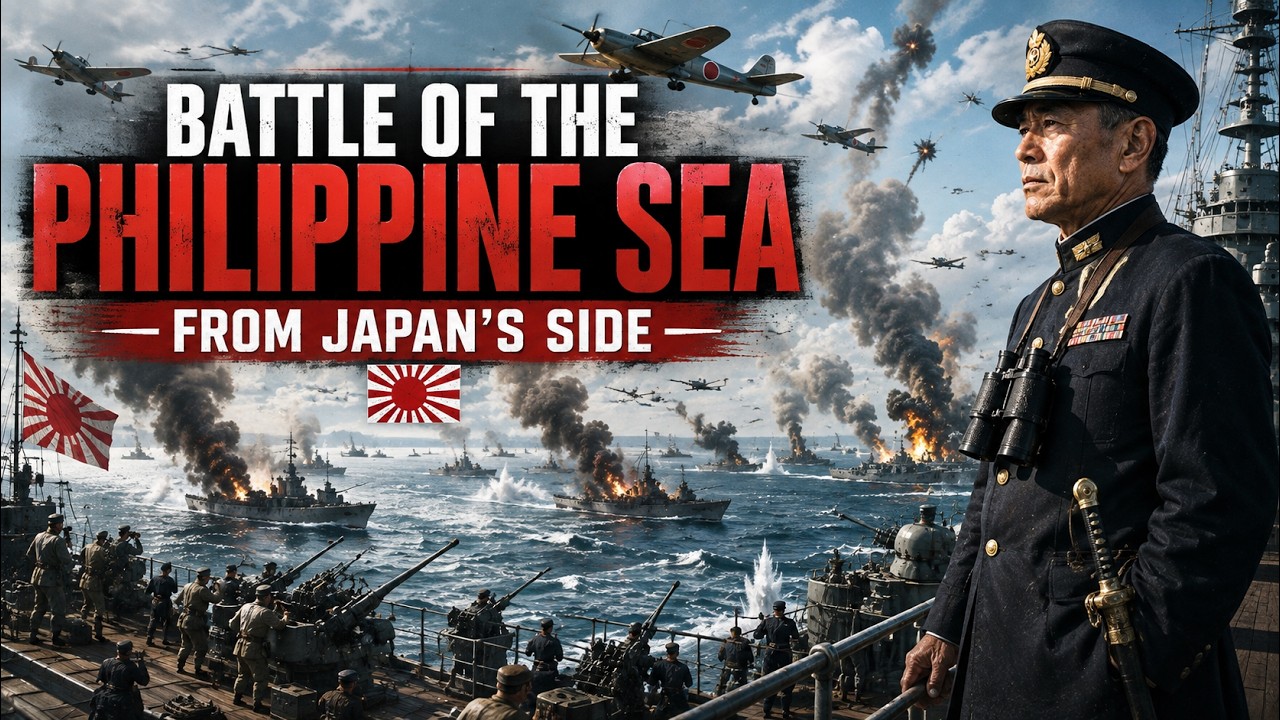
The flight deck, vast and geometric, glowed beneath work lights as the mechanics sweated over the souls of the aircraft. Zeros sat in orderly rows, their fuselages catching the electric light in ways that made them look both fragile and terrible. In the ready rooms below, the pilots waited. They had been briefed on their vectors and targetson the assumption that had governed every calculation of this operation.
That Japanese aircraft could fly farther than their American counterparts. That their superior range would allow them to strike first, strike hard, and remain out of reach of retaliation. It was an elegant, careful mathematics, a geometry of hope that had been refined through months of planning. The men who had come so far to test that theory were younger than the pilots who had once flown from these decks.
Their training had been compressed, their flight hours fewer, their faces carrying the strain of knowledge that they were the product of a system already straining to replace its losses. But courage cramped beside the mathematics of their disadvantage, they climbed the ladder to their planes and ran the engine, waiting for the signal. The signal came as patch the sun broke the horizon. The aircraft rolled forward, engines coughing into life, then roaring, then transforming into soundthat seemed to fill the sea itself.
Wave after wave lifted away fromthe carriersand turned eastward into the golden emptiness of the sky. The pilots below, the mothers, mechanics, deck crews, watched their machines rise, understanding vaguely that this mass of aluminum and fuel and human intention was flying toward the hunting ground of an enemy that possessed the numbers, the radar,and the industrial might to match them. But they did not dwell on such thoughts, because there was no room for themin the narrow space between duty and hope. The hope lasted approximately as long as it took for the American Hellcats to rise and meet them.
The Japanese aircraft flew with their range advantage, though somewhere along the 300 miles of open ocean, the geometry of their assumptions began to dissolve against the reality of American radar. The American pilots rose to meet the Japanese formations with the sun behind them, with altitude, with numbers. The first strike wave was broken almost before it could begin its attack. The Hellcats climbed faster, turned more tightly.
Japanese pilots, many of them lacking the hours in the air that their opponents took for granted, watched their friends’ planes burst into flames and tumble into the sea. Wave after wave launched fromthe carriers, and wave after wave failed to return. The sky over the Philippine Sea became a furnace of falling aircraft. By afternoon, those still alive among the navigation rooms in the Japanese fleet carried reports that spoke of hundreds of sorties flown and a handful of hits scored againstthe American ships.
The losses were not a setback. They were a catastrophe. Over 300 Japanese pilots and air crewmen had been lost. The Americans had lost less than a tenth of that number.
But the catastrophe was not confined tothe air. Below the surface of that same navy, nearer the Japanese fleet, two American submarines were moving with the patience of hunters. The Taihaho had been steaming through waters that belonged, in every practical sense, to enemies she could not detect. Commander Flucky aboard the USS Albakor had positioned his boat carefully, waiting for the moment when the great carrier’s path would bring her close enough.
When that moment arrived, a single torpedo’s ripping into the starboard side of the flagshipwood. No amount of steel or pride could save her now. The impact was violent enough to shudder thee entire hull, but on its own, should have been survivable. The captain, Mataji Morishta, decided to continue flight operations to protect the fleet’s offensive capabilityand to keep launching aircraft toward the Americans.
Damage control teams moved below decks, working with practiced calm to stem the flooding. The water entered with patient, inevitable rhythm, but pumps held back the advance. Hours passed. Themen worked without shouting, their hierarchy firm, their faith intact in their vessel and their training.
And then, deep within the ship, a decision was made that would undo everythingthe torpedo had not. Someone, in an effort to equalize pressure and slow the flooding, activated the ventilation systems. And with that air came vapors, gasoline fumes from aviation fuel tanks shattered by the initial explosion, seeping now into the superheated air of the lower compartments. The ship remained operational throughout the day, still launching and recovering aircraft, still fighting.
But the fumes gathered in the darkness, waiting like held breath. And then, as evening approached, a small spark ignited the accumulated vapor. What followed was not a bomb blast, but the ignition of everything at once, as though the ship herself had become a furnace. The explosion rolled through her stern to stem, killing instantly all who were below, and destroying her in a fraction of a second.
Within hours, the Taihaho, the mightiest carrier in the Imperial Navy, tilted her great bulk toward thee water and slipped beneath the waves, taking with her more than a thousand souls. Not far away, the submarine USS Cavala had also found her moment. The Shokaku, the carrier that had launched her planes against Pearl Harbor, the veteran of a hundred engagements, was turning in the water whenthe Cavala’s torpedoes found her mark. The impacts were deep, underneath.
The great ship, exhausted by the war alcohol and by the morning’s catastrophic air losses, and by the relentless exhaustion of three years of attrition, began taking on water from her engine rooms. Fires bloomed. Damage control teams fought with desperate professionalism, trying to seal off the flood, to put out the fires, to save her. But she was too old and too tired and too badly wounded.
As evening deepened, a series of secondary explosions ignited somewhere deep in her hull. The Shokaku, the soaring crane, sank into the darkness, taking with her another generation of irreplaceable aviators and artisans of war. The pilots above, meanwhile, were being systematically dismantled. They knew that their range advantage had not materialized as planned.
They knew that their American adversaries were being guided by something like magic, carriers that seemed to appear from nowhere with altitude and advantage. They knew. They had been told that Yamato Damashi, the unbreakable spirit of Japan, would carry them through. And they had believed it, with the fidelity of men who had grown up in a culture that honored sacrifice.
But as wave after wave dissolved into flame and smoke, enough of them began to understand a truth that no amount of spirit could overcome: that range could not compensate for radar, that courage could not compensate for training, and that in a war of attrition, numbers always have their way. Now, the sun had begun to descend toward the horizon, painting the western sky in shades of amber and crimson, when the lookouts on the surviving Japanese carriers finally reported what they had been waiting for. The American fleet had been located, approximately 150 miles distant. The hour was very late.
Darkness within hours. The surviving pilots, men already exhausted from the morning’s battles, men carrying dread of what they had witnessed, were ordered to prepare for a final strike. Ozawa, bearing the weight of the day’s losses and the accumulative catastrophe of his command, made the decision to launch. There was no other choice.
The alternative, to turn away, to allow the Americans to consolidate their beachhead on Saipan unopposed, was a kind of defeat that seemed worse than death. And so, the order went out. Aircraft were armed and fueled. And as the sun slipped lower, painting the cloud banks in shades of gold and deep red, the remaining carriers of the mobile fleet launched their aircraft into the purple sky.
The last roll of dice cast across the darkening ocean. The engagement that followed, when fledgling and exhausted Japanese aircraft met alerted American defenders above thee darkening water, was brief, brutal, and absolutely decisiveagainst the Japanese. The anti-aircraft fire rose to meet them like a wall of steel and explosive fury. Aircraft fell.
Some fell quickly, struck cleanly. Others caught fire and continued forward for a few seconds before succumbing to gravity. The pilots who survived the defensive fire and pressed home their attacks did manage to hit something. But they did not change the trajectory of the battle.
And now, as full darkness fell, a new, more terrible reckoning began. The Japanese aircraft that had survived the initial engagement faced a choice no choice at all. They could not find their way home. The distance, the darkness, the absence of navigation beacons, the ocean vast and empty beneath them.
Many flew until their fuel ran dry. Then, in those final moments, they made their choice. Some tried to crash-land into the sea. Some bail out into the black water.
Some simply flew straight into the darkness until their engines died, accepting the quiet inevitability of their fate. Thesea that night received them in great numbers
Behind them, Ozawa’s fleet was already retreating. The admiral had seen enough, had absorbed sufficient intelligence, had witnessed sufficient loss. The gamble had failed.
The order was given to reverse course, to head westward, to salvage what remained. But there was no rest nodden in that retreat. The American task force, with superior radar and night fighter capability, pursued the withdrawing Japanese ships through the darkness. Flares turned night back into a kind of terrible day.
Explosions bloomed along the horizon. Ships that had survived the main battle now found themselves wounded and sinking. The Japanese were not fleeing in panic. There was too much discipline, too much training embedded intheir bones.
But they were fleeing, and they were suffering. Attendants on thee surviving carriers watched their comrades’ vessels burn, heard the cries of men in the water, and knew with a certainty that transcended any official announcement that something fundamental had shifted. This was not the victory that had been promised. This was not even a battle that could be redeemed bysome subsequent engagement.
This was a defeat, complete and unambiguous, even if no one would speak the word aloud for some days. And as the fleet steamed westward through the night, carrying its survivors and its wounded, the water itself claimed the rest. Hundreds of sailors, many pilots, floated in the darkness, clinging to wreckage, waiting for dawn and for rescue guided them. Rescue capacity was overwhelmed by disaster.
Only a fraction of those lost would be recovered from the sea
The withdrawal continued through the hours of darkness. The surviving ships limped westward, carrying the ashes of their own hope. The carriers that remained, the pilots fewer than 50, were no longer a force capable of striking a decisive blow. They were remnants.
They were moving homeward, not in triumph or even in the hope of regrouping, butin the recognition that the battle had been lost and that what came next would be a long, grinding defense of an empire contracting toward its home islands. The Battle of the Philippine Sea was over. It would become known, with a peculiar American callousness, as the Mariana‘s Turkey Shoot. In a single day, Japan had lost 300 of its most experienced pilots, along with its two largest carriers.
The pilots who remained, those whose training had been compressed by a system starving for resources, were not capable of what the loss of those veterans demanded. The battle’s consequence lay not just in thee sunken hulls, but in the shattered doctrine thathad governed Japanese naval strategy for a generation:that superior skill, superior courage,and superior spiritual resolve could overcome superior numbersand superior industrial capacity. That assumption had been torn to shreds over the Philippine Sea. It was the moment when a navy’s fundamental belief initself died
Historians who studied this battle in the decades that followed had returned again and again to a single inescapablefact.
Japan had begun this war with one of the finest naval aviation forces in the world. The pilots who attacked Pearl Harbor were graduates of a system that demanded thousands of hours in the air, constant practice, relentless refinement. But wars of attrition do not reward skill alone. They reward numbers.
And when a pilot who had flown 500 hours fell from the sky, there was no apprentice with 500 hours waiting to take his place. There was insteada young man with perhaps 50 hours of training, climbing into the cockpit his hands trembling, his mind searching for answers that experience alone could provide. This hemorrhaging of experience had been occurring forme years, accelerating with each campaign. Guadal Canal had taken hundreds of Japan’s most experienced aviators.
The attrition at Truk, at Rabbal, in the defense of ever contracting zones of control. Each engagement had drained away veterans without the possibility of true replacement. Japan’s training pipeline, never designed to withstand such bleeding, had become a system for throwing half-trained men into the air to meet better trained men in better machines. It was a calculus thatcould only end in one way.
The Americans, by contrast, operated under asystem that seemed designed for a war of attrition. When an American pilot completed a tour, he returned home, became an instructor, carrying his knowledge forward into the next generation. American units never lost their backbone of experienced leadership. And as American industry ramped production, America introduced new pilots to the fight in numbers that match the expanding production of new aircraft.
Japan, by the time ofthe Philippine Sea, attempting to maintain a pretense of capability with a pilot corp whose average experience had plummeted catastrophically
The loss at Midway had begun this rotation of decline, but it was the Philippine Sea that completed it. After June 1944, Japanese carriers would continue to exist on the organization charts. Ships would be designated carriers. Aircraft would be assigned.
Pilots would attempt to fly. But the concept of a viable carrier task force, capable of delivering decisive force through aircraft action, had died in those three days of battle. What remained was a phantom limb, the appearance of capability without substance. In the months that followed, Japan shifted its strategic thinking, refocusing on battleship operations, experimenting with desperate new tactics.
But beneath all adjustments ran a current of resignation. The fundamental equation governing the war had shifted irrevocably away from Japan’s favor. The battle had revealed something about thee nature of industrial warfare that went beyond the specific question of Japanese naval aviation. In a conflict between nations of vastly different industrial capacity, courage and skill and spiritual resolve could delay the inevitable, but they could not prevent it, atrophy could not even make it close.
The margin of victory was so vast that it suggested almost a different category of conflict
What remains, eight decades later, is not the certainty that one side was right and the other wrong. It is a more complex understanding of how human beings conduct themselves when caught within the machinery of total war. They were not fools,yet they flew into impossible odds carrying the conviction of their culture. They were not victims of poor decisions alone, but of a global catastrophe that had been unfolding for years before any of them were born.
The ocean that claimed their ships and their bodies is indifferent, vast, patient. It has no memory, or too much memory, receiving every life and every vessel into its unbroken continuity. What cannot be recovered is the lived experience of those who were present, the precise quality of fear in a pilot’s chest as he rolled towardhis target, the particular smell of oil and smoke in a damaged compartment, the exact tenor of the last words spoken between friends before an explosion. These things dissolve into the past like salt dissolving in water.
And no historical research can ever reconstruct them with perfect fidelity. There is something restful in accepting this, in recognizing that some things are meant to be lost. That the ocean,in claiming the physical vessels and scattering the human lives, was also performinga kind of mercy, removing them beyond the reach of further suffering. The men who survived that battle carried with them memories that would fade and sharpen in cycles throughout their remaining years.
Some spokeof what they had witnessed. Others chose silence, sensing that some experiences resist translation. The ocean, which had nearly claimed them, became alsoa kind of comfort in memory, the sound of waves against ashore returning them momentarily to those days, to the salt-filled air, to the resonance of an engine room vibrating beneath their feet. And in the end, that is all history can preserve: the echo of those days, moving through the minds of those who cannot quite speak of them, and through the pages of themen who cannot quite convey them, carrying forward aslong as there are ears to hear and hearts to grieve.
It was a meeting of two societies, each operating according to its own logic andassumption, each convinced of its righteousness, each containing within itself the seeds of its own undoing. The battle happened, the ships sank, themen died or survived. The ocean holds them still.