It looked like the kind of photograph families post after a relaxed Sunday together.
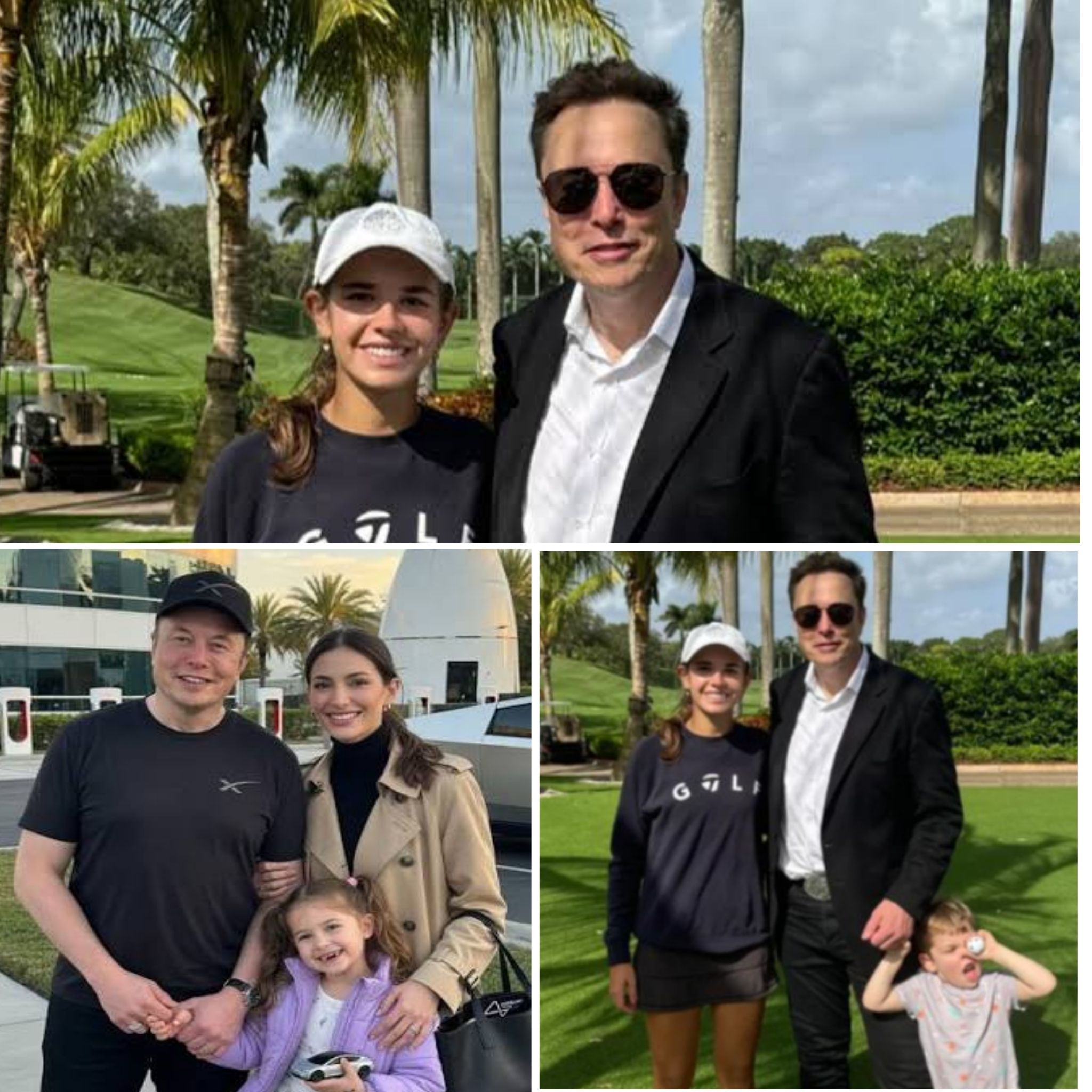
A sunny golf course. A teenage granddaughter enjoying time with her grandfather. A younger child making a face for the camera.
Then people noticed who else was standing there.
Elon Musk.
Just days after Donald Trump won the 2024 presidential election, the billionaire behind Tesla, SpaceX and X was no longer appearing only beside Trump at campaign rallies or political events.
He was showing up in the family pictures.
And Trump’s 17-year-old granddaughter, Kai, had a joke ready for the occasion.
“Elon achieving uncle status 😂.”
The caption was only four words and an emoji.
But the photograph behind it told a much bigger story.
On Sunday, November 10, 2024, Kai Trump joined her grandfather Donald Trump for a round of golf at Trump International Golf Club in West Palm Beach, Florida.
It should have been a fairly ordinary post-election family outing.
Kai, an aspiring competitive golfer who had already committed to play for the University of Miami, shared photographs and clips from the course. Her younger sister Chloe was there too.

She captioned another collection simply:
“Sundays with Grandpa.”
Trump, fresh from defeating Kamala Harris in the presidential election only days earlier, could be seen watching his granddaughter play.
But another photograph immediately attracted attention.
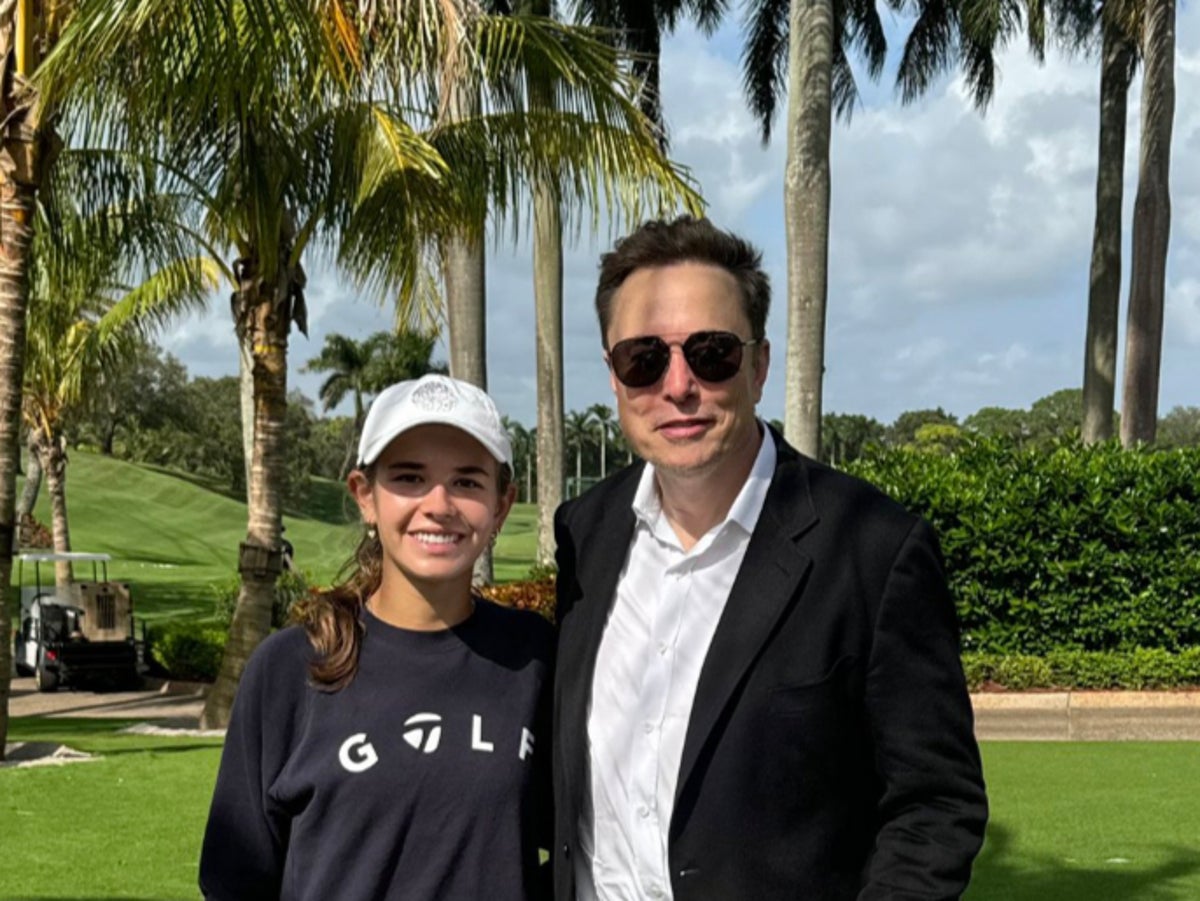
Standing beside Kai was Elon Musk.
And beside Musk was his young son, X, holding a golf ball over one eye as the camera captured the moment.
No podium.
No microphones.
No campaign banners.
Just Musk standing comfortably inside what looked like a Trump family Sunday.
Kai’s “uncle status” caption made the image even harder to ignore.
Of course, Musk had not literally become Kai Trump’s uncle.
It was a teenager’s joke.
But jokes sometimes become memorable because they capture something everyone has already begun to notice.
Musk was suddenly everywhere around Trump.
And that was what made the golf-course picture different.
A few months earlier, Musk’s relationship with Trump had primarily been discussed in political terms.
Musk had publicly endorsed Trump’s campaign. He appeared alongside him during the final stretch of the election and became one of his most prominent supporters.
On election night, Trump praised Musk during his victory speech, calling attention to SpaceX and describing the entrepreneur as a remarkable talent.
Then came the photographs.
Musk appeared around Mar-a-Lago.
His son appeared with him.
Trump was seen encouraging Musk and the boy to join a post-election photograph.
And now, less than a week after Americans had voted, Musk was on Trump’s golf course with his granddaughters.
The boundary between “political supporter” and “member of the inner circle” appeared to be disappearing extraordinarily quickly.
That was why Kai’s photograph traveled so far beyond golf fans.
Look at the image without knowing anyone’s name and there is almost nothing remarkable about it.
Kai is dressed for the course.
Musk stands beside her in dark clothing and sunglasses.
His son turns a golf ball into a tiny prop for the camera.
Palm trees and manicured grass fill the background.
It looks personal rather than political.
And that was exactly what made it politically interesting.
There are campaign supporters.
There are donors.
There are advisers.
There are people who get invited to formal events.
And then there are people who become comfortable enough around a political family that the teenage granddaughter jokingly starts calling them “uncle.”
Musk appeared to be moving through those categories at remarkable speed.
ABC News reported that Musk accompanied Trump and Kai at the West Palm Beach golf club that Sunday. Newsmax CEO Christopher Ruddy was also at the club and posted about speaking with Trump and Musk.
Meanwhile, Kai was documenting a different version of the day.
Not a policy meeting.
Not a strategy session.
Grandpa.
Golf.
Family.
And Elon.
That contrast was impossible to miss.
For Kai, the weekend had its own significance.
She had become increasingly visible during the 2024 campaign, including speaking publicly in support of her grandfather. Away from politics, she was pursuing a serious golf career and had announced months earlier that she had verbally committed to the University of Miami.
So when she went onto the course that Sunday, golf wasn’t simply something she happened to be doing with her grandfather.
It was part of her own future.
Donald Trump watched.
Kai played.
Her sister joined the family outing.
Then Musk appeared in the pictures.
Had the story ended there, “uncle status” might have remained nothing more than a funny caption attached to a celebrity encounter.
But it didn’t end there.
Because while the public was looking at family photos, something more consequential was happening behind the scenes.
Musk’s access to Trump was extending beyond golf.
CNN reported in the days after the election that Musk had been present for some of Trump’s conversations with foreign leaders and was weighing in on political personnel and other matters as the incoming administration took shape. Musk’s frequent presence around Trump became prominent enough that commentators began calling him the president-elect’s “first buddy.”
Musk embraced the nickname.
“I’m happy to be the first buddy!” he posted.
And suddenly Kai’s joke looked different.
“Uncle” wasn’t important because anyone believed Musk had become part of the Trump family tree.
It was important because a 17-year-old had casually captured, in one photograph, just how close one of the world’s richest men had moved to the center of the president-elect’s orbit.
That was the twist hiding inside an otherwise ordinary Sunday photograph.
The real story wasn’t the golf.
It was access.
Within days, that access would become even more consequential.
On November 12, Trump announced that Musk and entrepreneur Vivek Ramaswamy would lead an initiative he called the Department of Government Efficiency, or DOGE, intended to advise on reducing government spending and restructuring federal operations.
The golf outing suddenly had context.
Musk wasn’t merely a famous guest who happened to be standing nearby.
He was becoming part of Trump’s post-election governing project.
The man posing casually with the president-elect’s granddaughter on Sunday was being publicly assigned a significant advisory mission by Tuesday.
The family joke had landed just before the political announcement.
That sequence produced two very different reactions.
For Trump’s supporters, Musk’s presence could be seen as evidence that the incoming president was surrounding himself with successful business figures and people willing to challenge traditional government structures.
For critics, the same photographs raised questions about how much influence an unelected billionaire might exercise when he had such direct personal access to an incoming president.
The same picture could therefore mean completely different things depending on who was looking at it.
But almost everyone could see the same basic fact:
Musk was no longer standing at the edge of Trump world.
He was standing in the photographs.
And not just the official ones.
That distinction matters in politics.
Formal power is easy to identify.
Someone receives a title.
Someone is appointed.
Someone takes an oath.
Someone gets an office.
Informal power is harder to photograph.
It often appears first in smaller moments.
Who gets invited.
Who stays after the meeting.
Who gets called.
Who travels with whom.
Who is around when the cameras aren’t supposed to be capturing a political event at all.
And sometimes, who shows up on Sunday when the family goes golfing.
The photographs Kai shared offered a rare look at that kind of proximity.
No one needed to claim that Musk was literally family.
Kai had already made clear that “uncle” was playful.
But the humor worked precisely because his presence was becoming so noticeable.
He had supported the campaign.
He had spent election night with Trump.
He had appeared in post-election photos.
He was around Mar-a-Lago.
He was joining conversations.
Now he was golfing with the family.
And days later, he had a formal role in one of Trump’s signature government-efficiency initiatives.
One appearance can be coincidence.
A pattern is harder to dismiss.
That may explain why one of the most revealing images of that strange political week did not come from a press conference.
It came from a teenager’s social-media account.
Kai hadn’t written a lengthy analysis of political influence.
She didn’t need to.
She posted a photograph of herself beside Musk and his son.
“Elon achieving uncle status.”
That was enough.
Because behind them was the golf course.
Around them was the Trump family.
And only days earlier, the country had learned that Donald Trump was returning to the White House.
The balance of power in Washington was about to change.
New appointments would be announced.
New alliances would be tested.
People would compete for the president-elect’s attention.
And in the middle of all that maneuvering, one billionaire seemed to have skipped several stages of political courtship entirely.
He was already there.
There is also something revealing about Musk bringing his son.
The presence of children changes the atmosphere of almost any photograph.
Suddenly the image feels less like networking and more like familiarity.
X wasn’t standing stiffly for a political picture.
He was holding a golf ball over one eye.
Kai wasn’t issuing a statement about government policy.
She was teasing Musk about becoming an uncle.
That normality made the scene more striking, not less.
It showed a level of comfort that no official announcement could manufacture.
And that may be the reason the picture endured while thousands of more formal political images from that week disappeared into the news cycle.
People understand proximity instinctively.
They know the difference between someone who attends the event and someone who is still there afterward.
They know the difference between the guest on the stage and the person invited into the family photograph.
And they understand that in powerful circles, relationships sometimes become visible before titles do.
Two days after the golf outing, Musk’s growing political role was no longer just something people were inferring from photographs.
Trump had announced it.
The playful caption suddenly felt almost predictive.
Not of an actual family relationship.
Of something potentially more important in Washington:
Trust.
Access.
Influence.
And that is why the photograph mattered.
It was easy to laugh at “Uncle Elon.”
The child holding a golf ball over his eye made the moment even lighter.
But beneath the joke was a rapid change in Musk’s position.
Months earlier, he was a billionaire publicly backing a presidential candidate.
Then he was campaigning alongside him.
Then celebrating election night with him.
Then appearing with his family.
Then joining him on the golf course.
Then participating in conversations around the transition.
Then receiving a public assignment in Trump’s plans for the next administration.
The transformation happened quickly enough that a teenage golfer captured it almost accidentally.
There was no grand announcement on that Sunday.
No ceremonial handshake.
No sign saying INNER CIRCLE.
Just a photograph.
Sometimes that’s how shifts in power first become visible.
Not when someone walks onto a stage.
But when everyone else in the room—or in this case, on the golf course—already seems comfortable with the fact that they’re there.
Kai Trump called it “uncle status.”
Washington would spend the following months arguing over what to call everything that came after.
But in that moment, the message of the picture was remarkably simple: