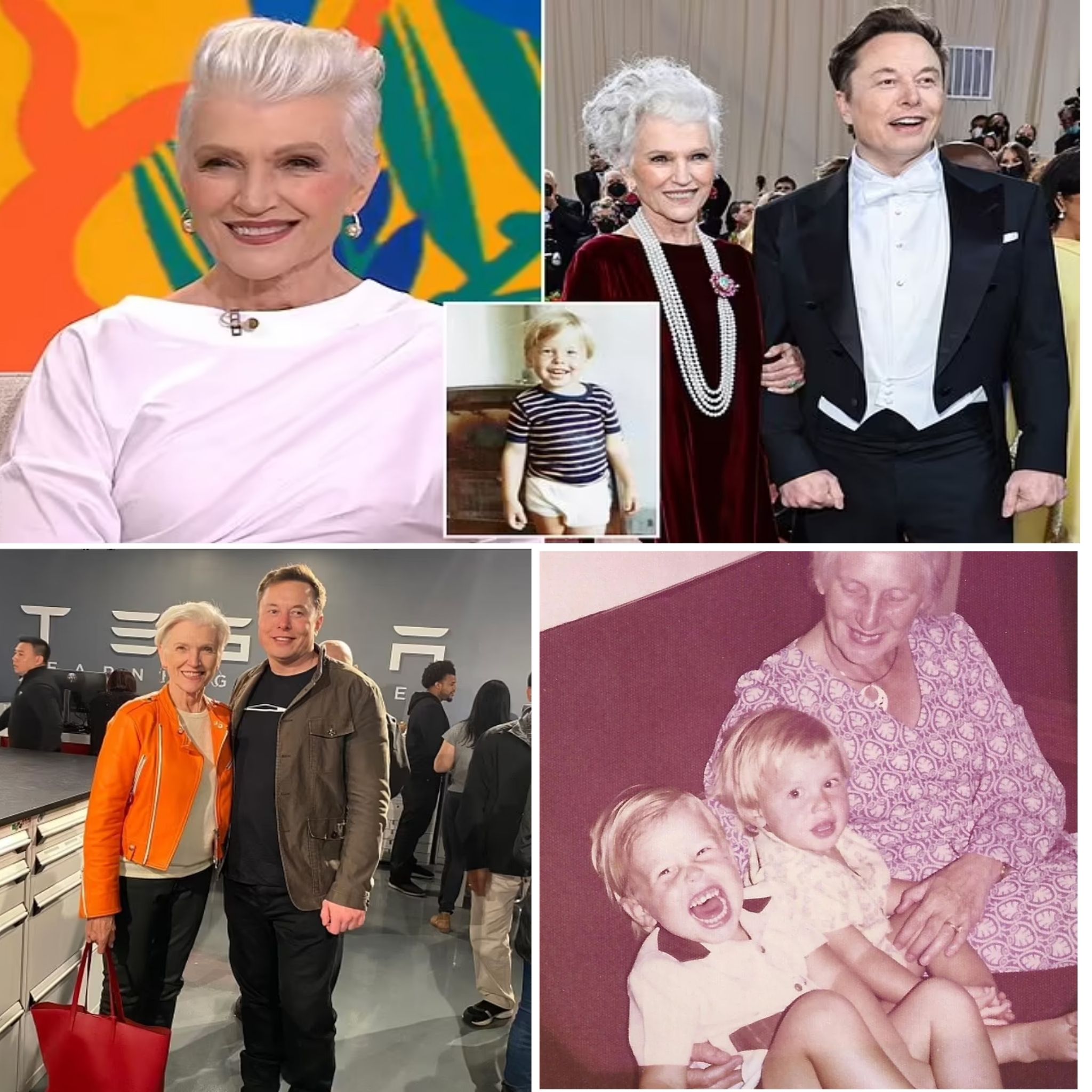
When Maye Musk sat down for a television interview in May 2022, she was asked a question almost everyone wanted answered.
Her son, Elon Musk, was attempting one of the most controversial business deals in recent memory: a proposed $44 billion purchase of Twitter.
Elon was already the man behind Tesla and SpaceX. He had built companies around electric vehicles, reusable rockets and technology projects that many people once considered unrealistic.
Now he wanted Twitter.
Surely his mother had an opinion.
Surely the woman who had known him longer than anyone else had given him some advice.
Maye Musk smiled.

Then she gave an answer that revealed far more about their relationship than perhaps anyone expected.
“He should do whatever he wants,” she said.
And then she added something extraordinary.
She had tried giving Elon business advice before.
It hadn’t gone particularly well.
“I told him not to do an electric car as well as rockets,” she admitted.
“He didn’t listen to me.”
For most parents, that might have sounded like a complaint.
For Maye, it sounded more like acceptance.
Because by then, she had learned something about her son:
When Elon Musk becomes convinced that something can be done, telling him not to do it may only be the beginning of the story.
At the time of Maye’s interview, Elon’s proposed Twitter acquisition was dominating headlines.
He had offered approximately $44 billion for the social-media platform in April 2022, but by May the deal had become increasingly complicated.
Elon publicly questioned Twitter’s estimates about the number of spam and automated accounts on the platform.
Twitter had stated in regulatory filings that false or spam accounts represented fewer than 5 percent of monetizable daily active users during the relevant period.
Elon wasn’t convinced.
He suggested the real number could be significantly higher and said the acquisition could not move forward as originally expected until the issue was clarified.
The debate became public.
Twitter executives defended their methodology.
Elon challenged it.
Investors watched.
Employees waited.
Millions of users argued over what the platform might become if the world’s richest man took control of it.
So when Maye appeared on the Today show, hosts Hoda Kotb and Jenna Bush Hager naturally wanted to know what Elon Musk’s mother thought.
Would she tell him to walk away?
Would she tell him to negotiate harder?
Would she tell him that spending $44 billion on a social-media company was madness?
Instead, Maye essentially removed herself from the decision.
Her reason was simple.
She had already learned the limits of maternal advice when dealing with Elon Musk.
Years earlier, when he pursued electric vehicles, the idea looked enormously risky.
The automobile industry destroys money with frightening efficiency.

Starting any car company is difficult.
Starting one built around a technology that, at the time, many consumers still doubted seemed even more dangerous.
Electric cars had existed in different forms for generations, but building a mass-market electric-car company capable of competing with some of the world’s largest automakers was another matter entirely.
Maye wasn’t enthusiastic.
Then there were rockets.
If electric cars sounded ambitious, privately funded spaceflight sounded almost absurd.
Rockets explode.
Launches cost fortunes.
Governments had traditionally dominated space exploration because very few private organizations had the money, infrastructure or patience required to survive repeated failure.
Again, Maye had reservations.
Solar energy was another field Elon pursued.
Again, enormous capital.
Again, uncertainty.
Again, the possibility of spectacular failure.
From a mother’s perspective, the advice made perfect sense.
Why risk everything?
Why choose industries filled with technical obstacles, established competitors and breathtaking costs?

Maye had watched her son work hard enough to build financial security.
Why gamble it?
But Elon didn’t listen.
Tesla went on to become one of the most recognizable electric-vehicle companies in the world.
SpaceX accomplished something that once sounded almost impossible for a private company: developing orbital rockets whose boosters could return to Earth and be flown again.
The industries Maye once worried about became central to her son’s identity.
By 2022, telling Elon Musk not to pursue an improbable business idea had become almost humorous.
But there was another reason Maye wasn’t completely shocked by his willingness to challenge conventional thinking.
She had seen it before almost anyone else.
Decades before Tesla.
Before SpaceX.
Before PayPal.
Before Twitter.
Before billions of dollars.
Before anyone cared what Elon Musk thought about cars, rockets, artificial intelligence or social media…
There was a shy three-year-old boy standing beside his mother.
Maye wanted to enroll him in nursery school.
The staff believed he should probably wait another year.
Maye disagreed.
She told them something that sounded ridiculous coming from the mother of a toddler.
“I have a genius son.”
The reaction was immediate.
They rolled their eyes.
To them, Elon apparently didn’t look like a child prodigy.
He was shy.
He wasn’t performing for the adults in the room.
He wasn’t walking around announcing how clever he was.
And from the outside, Maye simply looked like another proud mother convinced that her child was exceptional.
She noticed their skepticism.
But she didn’t change her mind.
Because the Elon they saw in a nursery-school setting was not the Elon she saw at home.
“He would reason with me,” Maye later explained.
And he remembered things.
A lot of things.
That was what caught her attention.
It wasn’t simply that he knew information other children didn’t.
It was the way his mind appeared to process what was happening around him.
He listened.
Stored details.
Connected ideas.
Then questioned them.
Maye was one of the few people with whom the shy little boy spoke openly, which meant she was seeing a side of him strangers easily missed.
The nursery-school staff saw silence.
His mother saw calculation.
They saw a quiet three-year-old.
She saw a mind constantly working.
The people in that room rolled their eyes when Maye used the word “genius.”
But she never forgot what she had seen.
And yet this is where the story becomes far more interesting.
Because decades later, the same mother who had been so certain about her three-year-old son’s unusual intelligence would become deeply uncertain about some of his biggest ideas.
That is the contradiction people often miss when they tell stories about successful families.
We imagine that the people closest to extraordinary entrepreneurs must have recognized every great idea immediately.
We picture supportive parents saying:
“Yes, build the rocket company.”
“Yes, challenge the automobile industry.”
“Yes, invest millions into technology everyone else doubts.”
“Yes, risk your fortune.”
But real life rarely looks like that.
Maye believed in Elon.
That didn’t mean she believed in every decision Elon made.
Those are two completely different things.
She could recognize his intelligence while still believing an idea was too dangerous.
She could love his ambition while fearing the consequences.
She could know what he was capable of and still think:
Maybe this time he has gone too far.
And she did.
She told him not to pursue some of the very businesses that would later make him globally famous.
He ignored her.
Years passed.
The electric-car company she worried about grew.
The rocket company she questioned began launching missions.
Ideas that sounded reckless slowly became companies employing thousands of people.
Then, in 2022, there she was again.
Another massive gamble.
Another enormous number.
Another project everyone was arguing about.
Twitter.
$44 billion.
Only this time, Maye Musk had changed her approach.
She wasn’t going to tell him what to do.
Not because she suddenly believed every Elon Musk idea must succeed.
And not because a mother stops worrying when her son becomes one of the richest people on Earth.
But because experience had taught her something uncomfortable:
Her judgment of risk and his judgment of possibility operated on completely different scales.
That was the real plot twist.
Maye Musk had spotted something unusual in Elon before almost anyone else did.
She recognized his mind at three years old while other adults rolled their eyes.
But even she could not predict where that mind would eventually take him.
She never expected him to become one of the richest people in the world.
She never imagined he would create or lead so many companies.
She certainly could not have known that the quiet boy she once defended at nursery school would one day become a person whose business decisions moved financial markets and triggered international debates.
And perhaps that is why her answer about Twitter was so short.
“He should do whatever he wants.”
There was no grand speech.
No motherly declaration that Elon was always right.
No claim that she had predicted Tesla, SpaceX and everything that followed.
In fact, she openly admitted the opposite.
She had been wrong before.
Not about her son’s ability.
About the limits she thought should be placed around it.
That distinction matters.
Because Maye’s story isn’t simply a mother boasting about a famous child.
It is the story of how difficult it can be to recognize potential when it appears in an unfamiliar form.
At three, Elon Musk’s potential looked like a shy child who remembered everything and reasoned with his mother.
Some adults apparently couldn’t see it.
Maye could.
Years later, his ambition looked like electric vehicles, private rockets and solar technology.
This time, even Maye struggled to see what he saw.
And yet the outcome did not turn her into someone who blindly approved of every decision.
Instead, it seems to have made her more willing to accept that some choices belonged to Elon alone.
There is something strangely human about that.
Because behind the billions, rockets and headlines was still a dynamic familiar to almost every family:
A parent saying, “I don’t think you should do this.”
A child doing it anyway.
The difference was that in this family, the argument eventually involved electric cars, reusable rockets and tens of billions of dollars.
There was another layer of irony to Maye’s appearance that morning.
At 74, she was experiencing another extraordinary chapter of her own career.
Maye Musk had spent decades working as a model and dietitian, long before her surname became associated around the world with technology companies.
In 2022, she appeared on the cover of Sports Illustrated Swimsuit, becoming the publication’s oldest cover model at the time.
So the woman being interviewed wasn’t simply “Elon Musk’s mother.”
She was still building her own career at an age when many industries quietly stop paying attention to women.
Perhaps that made her perspective even more fitting.
Maye had spent much of her own life refusing to accept other people’s assumptions about what someone could or could not do.
About age.
About careers.
About reinvention.
About when someone is supposed to stop.
And she had watched her children make unconventional choices of their own.
So when the conversation turned toward Twitter and people expected a mother to deliver a verdict on her 50-year-old son’s latest gamble, Maye declined.
She had already played that role.
She had already issued warnings.
Electric cars?
Don’t.
Rockets?
Don’t.
He went ahead anyway.
Now another enormous decision sat in front of him.
And Maye Musk understood that this time, the decision—and whatever consequences followed—belonged to Elon.
Nobody watching that 2022 interview could know exactly what would happen next.
But one image from Maye’s story was difficult to forget.
A nursery school.
A shy three-year-old.
Adults looking at his mother as though she were exaggerating.
“I have a genius son,” she told them.
Eyes rolled.
Decades later, people could debate Elon Musk’s personality, his politics, his decisions, his companies and his controversies endlessly.
But nobody was rolling their eyes because his mother thought he might someday do something unusual.
The little boy they underestimated had become impossible to ignore.
And perhaps the most revealing part of Maye Musk’s story is that believing in someone doesn’t mean predicting every decision they will make.
Sometimes belief simply means recognizing that there is more inside a person than the rest of the room can see.
Maye saw it when Elon was three.
She didn’t foresee the electric cars.
She didn’t foresee the rockets.
She didn’t foresee the billions.
And sometimes she actively told him to stop.
He kept going.
Years later, when the world asked her what Elon Musk should do next, she finally gave the only answer experience had left her with:
Let him decide for himself.
Because sometimes the person everyone is trying to protect from an impossible idea is the only person in the room who can see that it isn’t impossible yet.