The first thing Patton did after taking command in North Africa wasn’t to draw up attack plans. It was to check the supply depots. He appeared without warning at motor pools, field kitchens, and repair shops, running his fingers along truck tires and prying open ammunition crates. A driver caught skipping a maintenance check wasn’t just reprimanded—he was pulled from duty until he could prove he understood why the truck mattered.
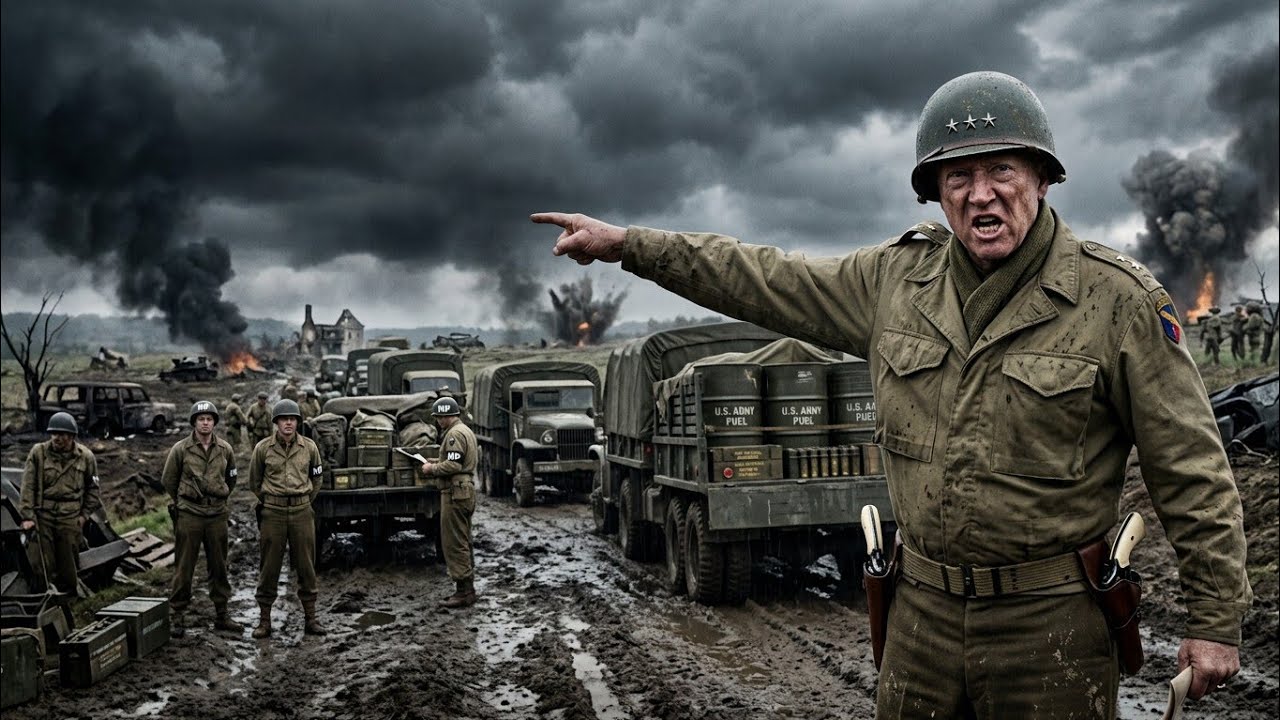
“No excuse,” Patton would say. “Fuel has to arrive. Food has to arrive. Lives depend on it.
”
Most people never thought about the supply lines. But Patton knew that victories were won long before the shooting started. Napoleon’s army starved when its logistics collapsed. In the First War, offensives stalled when ammunition couldn’t reach the front.
No matter how brave the soldiers were, an army without fuel and bullets was just a crowd waiting to be destroyed. . In the desert, that truth was brutal. Fine sand clogged engines.
Tires burst on sharp rocks. Temperatures hit 100 degrees by day and dropped below freezing at night. A single broken-down fuel truck could halt an armored column. One missing shipment of shells could leave infantry without fire support.
Patton made supply discipline his religion. Every truck had to be inspected before leaving its depot. Every driver had to know his route and report mechanical problems immediately. Every gallon of gasoline had to be tracked on paper, whether officers liked it or not.
His answer to complaints was always the same: If commanders don’t know where their supplies are, they don’t know whether their army is ready to fight. ,
.. By the summer of 1944, Patton’s Third Army was racing across France with astonishing speed. Tanks sometimes advanced more than 50 miles in a single day.
It was exactly the kind of fast-moving war he had always dreamed about. But every mile created a new crisis. A Sherman tank could burn hundreds of gallons of fuel during continuous operations. Artillery batteries needed thousands of shells.
Trucks needed spare parts. Soldiers needed food, water, medicine, and ammunition—and it all had to come from beaches still in Allied hands, hundreds of miles behind them. Convoys stretched as far as the eye could see, dust covering everything. Drivers often stayed behind the wheel for 16 or 18 hours at a time.
Mechanics worked through the night by dim lantern light to get broken trucks back on the road by sunrise. Patton demanded that supply officers think ahead—not ask what the army needed today, but what it would need three days from now. Waiting until tanks were already low on fuel meant waiting too long
,
.. But even Patton couldn’t escape reality.
By late August, the advance had become so rapid that Allied supply lines cracked. Fuel shortages turned severe. Some tank units stopped, not because Germans had defeated them, but because they simply ran out of gasoline. Patton was almost physically ill watching halted armor sitting beside the road, helpless.
He later wrote that his army could have advanced even farther if enough fuel had existed. The crisis forced massive emergency efforts. Thousands of trucks under the famous Red Ball Express carried fuel, ammunition, food, and spare parts toward the front, driving through the night with dimmed headlights, navigating crowded roads in rain, snow, and mud. Some were fired upon by German aircraft.
Yet they kept moving. Patton never underestimated their importance. He knew that every successful delivery meant tanks could keep rolling, artillery could keep firing, and infantry could keep pushing east toward Germany
,
.. But the greatest test came in December 1944, during the Battle of the Bulge.
German forces smashed through the Ardennes, catching everyone off guard. Entire roads jammed with retreating vehicles. Fuel dumps were captured. Communication lines broke down.
Thousands of American soldiers were surrounded, among them the 101st Airborne Division at Bastogne. Germans believed the trapped Americans would soon surrender
,
.. At a crowded headquarters in Verdun, freezing rain turning to snow, Supreme Allied Commander Dwight Eisenhower asked how quickly Patton could turn his Third Army north and relieve Bastogne. Most officers expected a cautious answer.
Patton replied with remarkable confidence. His army could attack within the 48 hours. Some commanders were stunned. Moving an entire field army in the middle of winter—hundreds of tanks, thousands of trucks, artillery batteries, engineers, ambulances, nearly a quarter of a million soldiers—seemed almost impossible.
But Patton had spent weeks preparing for exactly this kind of emergency. His logistics officers had already developed alternate routes, emergency fuel plans, and reserve supply schedules. Convoy commanders knew what to do if roads were blocked or bridges destroyed. Preparation turned the impossible into reality
,
..
Within days, long columns of American vehicles rolled north through snow-covered roads. Engines struggled to start in freezing temperatures. Ice covered bridges and mountain roads. Visibility dropped to only a few yards.
Yet, the convoys kept moving. Truck drivers fought exhaustion hauling fuel, ammunition, winter clothing, and food. Mechanics repaired frozen engines by hand in the bitter cold. Engineers cleared blocked roads while artillery units struggled through deep snow.
Patton constantly demanded updates: How much fuel remained? How many trucks reached the forward depot? Which roads were still open? Every report mattered.
He understood that relieving Bastogne depended not only on brave infantry and powerful tanks, but on thousands of support personnel working behind the lines
,
.. Finally, on December 26th, elements of the 4th Armored Division—part of Patton’s Third Army—reached the defenders of Bastogne. The siege was broken. For the soldiers who had endured days of freezing weather, constant shelling, and dwindling supplies, the arrival of fresh fuel, ammunition, food, and medical equipment meant survival.
It was one of the defining moments of the war
,
.. To most observers, the victory highlighted Patton’s aggressive leadership. But Patton himself knew the deeper truth. The attack succeeded because the supply system held together under extraordinary pressure.
Without disciplined logistics, those tanks would never have reached Bastogne. Without fuel, they would have stopped miles away. Without ammunition, the artillery would have fallen silent. Without food, exhausted soldiers could not have continued fighting.
For Patton, this was the ultimate proof of everything he had preached throughout the war: Winning battles required courage. Winning campaigns required logistics
,
.. Looking back after the war, historians would praise Patton for his bold tactics. But behind every famous victory stood an army of drivers, mechanics, engineers, cooks, warehouse workers, and supply officers whose work rarely appeared in headlines.
Patton understood their value better than most commanders. He demanded strict supply discipline because he knew that wars were not won by generals alone. They were won by countless ordinary soldiers who ensured that every rifle had ammunition, every tank had fuel, every hospital had medicine, and every fighting man received his next meal. In Patton’s eyes, discipline was never just polished boots.
It was creating an army that could fight, move, and endure under any condition. Because when the decisive moment arrived, victory belonged to the force whose supply lines were as strong as its soldiers
.


