Sweden was supposed to be neutral, untouched by the extremism that consumed Europe. But even here, a dark political undercurrent was growing. By the mid-1920s, the country saw the rise of its first fascist parties, voices calling for a racially pure Sweden, modeled on Mussolini’s Italy and later Hitler’s Germany. These movements were fragmented from the start.
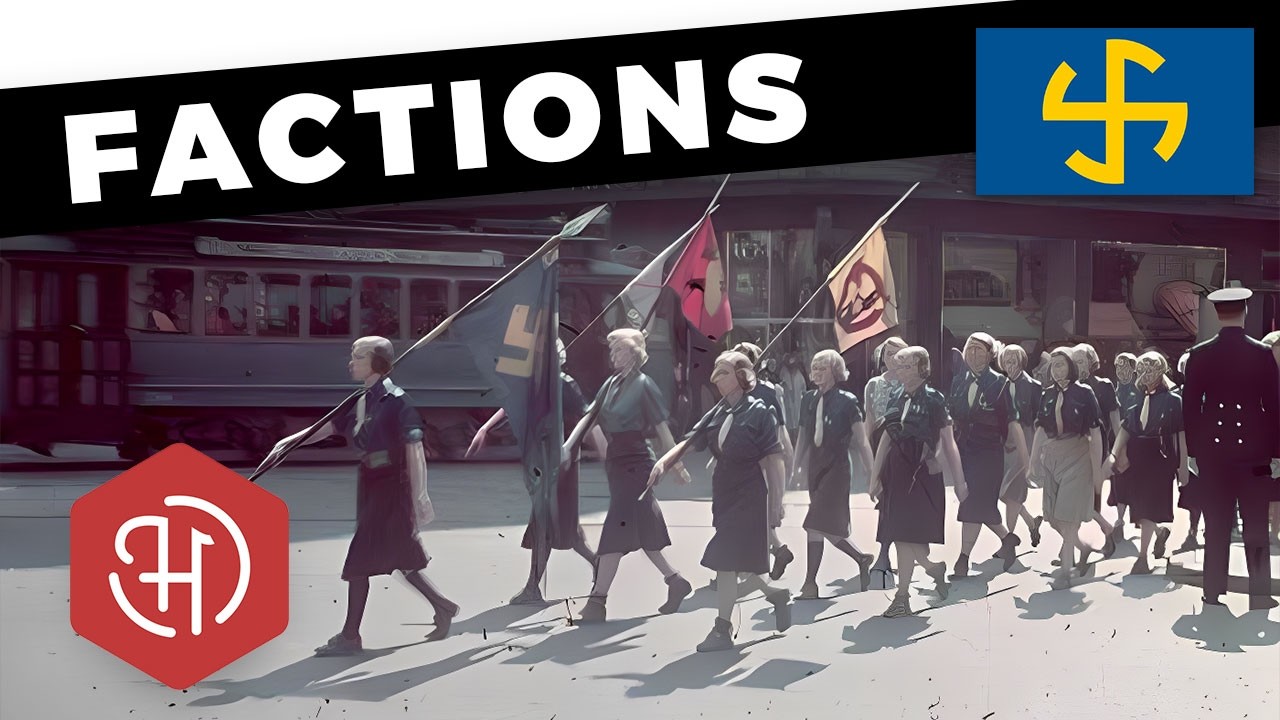
The Swedish National Socialist Party appeared in 1930 under Birger Furugård, but it was torn apart by internal rivalries. By 1933, Sven Olof Lindholm broke away to form his own National Socialist Labor Party, which leaned more toward the socialist side of national socialism. Another party, the National Socialist Bloc, backed by wealthy industrialists, also emerged that year, but it failed to gain traction. The infighting was relentless.
The parties were defined by constant splits, personal grudges, and competing visions. In the 1934 local elections, Furugård’s party won close to 17,000 votes, but by the 1936 national election, it had collapsed to just over 3,000 votes. Lindholm’s party, on the other hand, won 17,483 votes, becoming the leading fascist force in Sweden. Still, that was only 0.
7% of the total vote. Swedish fascists never won a single parliamentary seat on a national level. Despite their political failure, these groups maintained surprising organization. They had women’s auxiliaries, youth wings, uniformed militias, and even their own trade unions.
Lindholm’s party, which rebranded as the Swedish Socialist Union, toned down its imagery during World War II, dropping swastikas and changing its salute. But its ideology remained rooted in Nordic racial superiority and the desire to build a Swedish-led Nordic federation. When Germany invaded Norway in 1940, the party grew disappointed, more focused on the honor of their Nordic neighbors than on Hitler’s ambitions. They discouraged formal Swedish entry into the war but encouraged individual volunteers.
Over 1,000 Swedes fought alongside Finnish troops in the Continuation War, and several hundred more served in the German Waffen SS. There was also the Swedish National Federation, an anti-democratic and ultra-nationalist group that was even larger, boasting around 40,000 members at its peak. It broke from the Conservative Party in 1934 and briefly held three parliamentary seats, but it lost them all in 1936. After the war ended, these groups fragmented further.
Sweden was spared the horrors of occupation, but the remnants of its fascist movements persisted. One of them, the New Swedish Movement, was led by Per Engdahl, and for a time, its members included Ingvar Kamprad, the future founder of IKEA.