On the twenty-second of July, 1917, the Kingdom of Siam declared war on Germany and Austria-Hungary. For three years, this small Southeast Asian kingdom had watched the Great War from a careful distance, balancing between the British Empire to its west and French Indochina to its east. Now, surrounded by colonial powers, it made a decision that would define its place in the modern world. Siam had never been formally colonized, but that independence came at a price.
Decades of pressure from Britain and France had forced the kingdom to surrender territory and accept unequal treaties that limited its control over trade and gave foreigners special legal protections. Siam was sovereign in name, but not in the eyes of the European powers. King Vajiravudh, educated in Britain and crowned in 1910, understood this reality better than most. He had spent years modernizing his kingdom—building railways, reforming administration, hiring European advisers—all in an effort to prove that Siam was a civilized, modern state worthy of equal treatment.
His father, King Chulalongkorn, had transformed the kingdom with sweeping reforms, and Vajiravudh intended to continue that legacy. When war erupted in Europe in 1914, Siam declared neutrality. The conflict seemed distant, and the kingdom had nothing to gain from joining a massive European war. But neutrality grew harder to maintain as the fighting dragged on.
Bangkok became a battleground of diplomacy and propaganda. German ships sought refuge in Siamese waters. British and French diplomats urged Siam to support the Allies. Even within the Siamese elite, opinions were divided—some admired German military traditions, while others looked to Britain and France.
By 1917, the tide had turned. Reports of chemical weapons and attacks on civilian shipping shocked the world, and the Allies appeared increasingly likely to win. When the United States entered the war in April, framing it as a struggle for civilization and international law, Siam’s leaders saw their opportunity. Joining the Allies would mean little military risk but potentially great diplomatic rewards.
It could strengthen Siam’s claim to full sovereignty and allow the kingdom to renegotiate those humiliating treaties. And for the king, it was a way to unite the nation behind the monarchy. Siam acted quickly after the declaration. German and Austro-Hungarian citizens were arrested and interned.
German-owned businesses were seized, and German ships anchored in Siamese ports were confiscated before their crews could sabotage them. The removal of German competition benefited British commercial interests overnight, and diplomats in London welcomed the loss of German influence in the region. But then came the bigger question. How actively should Siam participate in the war?
Most small nations contributed little beyond declarations of support. Siam, however, chose a far more ambitious path: it would send troops to Europe. The idea had originated partly from French suggestions that Siam could provide volunteer ambulance units, drivers, pilots, and mechanics. Siam’s military was not equipped for large-scale trench warfare, but it had a modern aviation division and officers trained in European military methods.
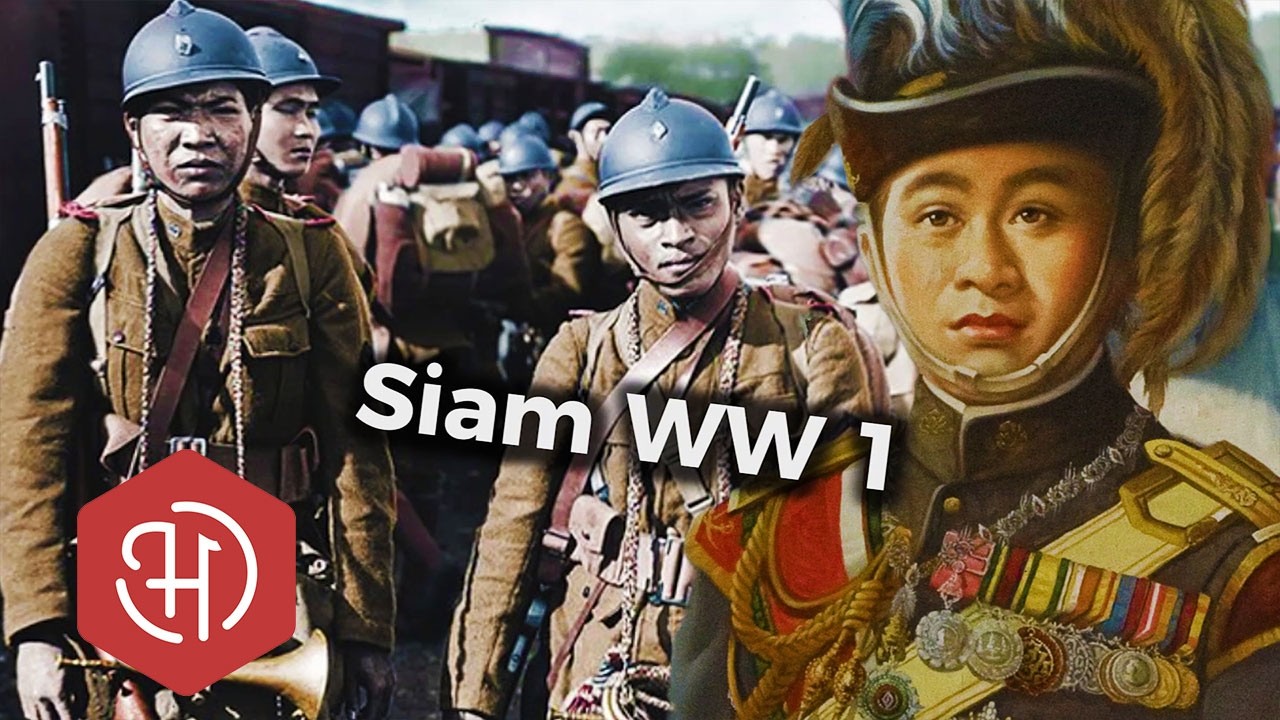
In September 1917, the government issued a call for volunteers. The stated mission was clear: support the Allied war effort, gain military experience, and uphold Siam’s national honor. The Siamese Expeditionary Forces numbered roughly 1,300 men. About 400 belonged to the Aviation Corps, while the rest formed a Motor Transport Corps of drivers, mechanics, medical personnel, and support staff.
Preparation took months—training, vaccinations, and careful transport arrangements. In January 1918, an advanced mission led by Major General Praya Bhya Yan Ridhi traveled to Europe to prepare for the main force’s arrival. He had studied military affairs in Europe and spoke fluent French, making him an ideal commander. On the twentieth of June, 1918, the main expeditionary force departed Bangkok aboard the SS Empire.
King Vajiravudh attended the send-off ceremony himself, while cheering crowds lined the Chao Phraya River to watch the soldiers leave. After stops in Singapore, Colombo, and Port Said, the troops arrived in Marseille on the thirtieth of July. The arrival was not what Siam’s leaders had hoped. French officials initially mistook the soldiers for colonial troops from French Indochina, deeply offending Siamese diplomats who wanted their kingdom recognized as an independent ally, not a colony.
And by mid-1918, thousands of American troops were arriving in France every day, overshadowing the small Siamese contingent. Once in France, the aviation corps was sent to training camps at Istres, Avord, and Pau. The transport corps trained near Lyon before moving closer to the front lines. In October 1918, the Motor Transport Corps began supplying Allied troops in the Champagne region using French military vehicles.
Though the soldiers performed their duties effectively, tensions soon developed between Siamese and French officers. Communication problems created difficulties, but the deeper issue was the condescending attitude of some French officers. French liaison officers often bypassed Siamese commanders and gave orders directly to the troops. This deeply offended the Siamese leadership, who believed their soldiers deserved the same respect as any European force.
Complaints reached Siamese diplomats in Paris and eventually the king himself. Frustration grew so severe that Siamese leaders considered withdrawing the expedition entirely. French diplomats realized the danger this posed to Franco-Siamese relations and tried to improve the situation. But before matters could be fully resolved, events changed dramatically.
On the eleventh of November, 1918, the armistice ended the fighting on the Western Front. Following the armistice, Siamese troops were assigned to the Allied occupation of Germany. The Motor Transport Corps crossed into German territory and served mainly in the Palatinate region around Neustadt. For King Vajiravudh, the moment carried enormous symbolic weight.
He later described the entry of Siamese troops into Germany as one of the proudest moments of his life. Though his soldiers had seen little direct combat, their presence inside defeated Germany allowed Siam to present itself as a victorious allied power. The Siamese troops remained in Germany until mid-1919. During that period, they participated in the Allied victory parades in Paris, London, and Brussels.
For the first time, Siamese soldiers marched alongside the armies of the great European powers under the eyes of kings, presidents, and massive crowds. An independent Asian nation stood among the victors of the First World War. The expeditionary force suffered relatively few casualties. Nineteen members died during the mission, mostly from disease—especially the influenza pandemic—or accidents, rather than enemy action.
The aviation corps returned to Siam in May 1919, and the motor corps arrived later that year. Their return was celebrated with massive public ceremonies. Bangkok held several days of parades, religious events, and official commemorations. Militarily, Siam’s contribution was small.
Politically, the impact was enormous. By sending its troops to Europe, the kingdom had proven that it was more than just another vulnerable Asian state caught between empires. It had claimed its place among the nations that mattered.


