The man who would become known as Hitler’s favorite commando lay in a hospital bed near Moscow, shrapnel embedded in his skull, his war over before it had truly begun. That wound ended his frontline service, but it opened a far more dangerous path. He was born Otto Skorzeny in Vienna in 1908, the son of a civil engineer who drilled discipline and technical thinking into him. He studied mechanical engineering and joined a nationalist student fraternity, a world of dueling and right-wing politics.
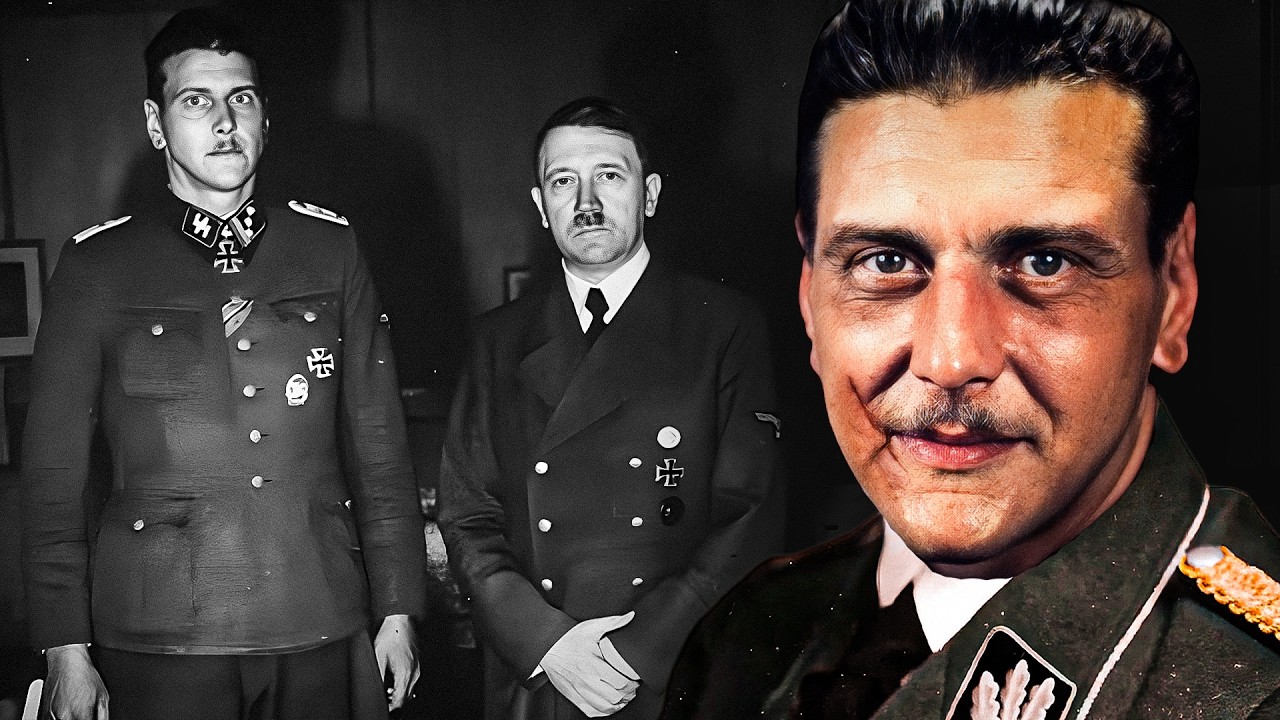
It was there he earned the long fencing scar across his left cheek that would become his signature. Austria’s politics fractured in the 1930s, and Skorzeny joined the Nazi Party in 1931, years before it was banned. When the Austrian government outlawed the Nazis in 1933, he went underground. When Germany annexed Austria in March 1938, his loyalty was rewarded.
He joined the SS, serving in the elite unit that guarded Hitler himself. He fought on the Eastern Front with the Das Reich division, and in June 1941 he took part in the invasion of the Soviet Union. The shrapnel wound near Moscow was his ticket out of the trenches. Once recovered, he was assigned to SS headquarters in Berlin, where he worked on unconventional warfare tactics.
His mix of engineering skill, frontline experience, and bold ideas caught the attention of senior officers, and eventually Hitler himself. By 1943, he was in charge of a new operations unit reporting directly to Hitler. The stage was set for his most famous mission. In the summer of 1943, Italy overthrew Mussolini and began secretly negotiating with the Allies.
To Hitler, the fall of his most vital ally was a personal humiliation. He ordered an immediate rescue. Skorzeny, now a major, was handpicked for the job. German intelligence searched for weeks, but Mussolini was constantly moved between secret locations under heavy guard.
Finally, through intercepted radio traffic, Skorzeny identified the site: the Hotel Campo Imperatore, a remote mountain resort on the Gran Sasso in central Italy, reachable only by cable car. On September 12, 1943, Skorzeny led Operation Oak. A handful of DFS 230 gliders crash-landed on the small plateau near the hotel, surprising the Italian guards. Without firing a single shot, they secured the area and reached Mussolini’s room within minutes.
“I knew my friend Adolf Hitler would not abandon me,” the former dictator reportedly said. Skorzeny personally escorted Mussolini to a waiting Fieseler Storch light aircraft that performed a hair-raising takeoff from the narrow mountaintop. The rescue was a propaganda triumph. German newsreels hailed him as a hero.
The Völkischer Beobachter called him “the most dangerous man in Europe. ”
He received the Knight’s Cross and was promoted to SS Obersturmbannführer. He became the regime’s symbol of daring loyalty. Beneath the myth, though, lay a more complex truth.
The mission was aided by Italian insiders sympathetic to Germany, and its military value was minimal. Mussolini was restored as a puppet leader, but his regime was doomed from the start. By late 1944, Germany was collapsing. Hitler, unwilling to accept defeat, planned one last counteroffensive in the Ardennes.
For that offensive, he turned once again to Skorzeny. His assignment was Operation Greif: infiltrate behind enemy lines disguised as American soldiers. Skorzeny recruited English-speaking volunteers from across the Wehrmacht and SS, building a force of roughly 2,500 men. Many spoke very poor English, or none at all, so he relied on a handful of genuine linguists.
They were organized into small teams equipped with captured American jeeps, Sherman tanks, and fake identification papers. As the offensive began on December 16, 1944, his commandos slipped through the front lines disguised as GIs. Some changed signposts, gave false orders, and cut communication lines. The rumor that German commandos were disguised as Americans spread fast.
US military police began stopping soldiers and questioning them about baseball teams, movie stars, and state capitals. General Omar Bradley himself was briefly detained after giving a wrong answer. Skorzeny’s deception achieved its psychological aim, but the military impact was limited. Worse, wearing an enemy uniform violated the Hague and Geneva Conventions, punishable by death.
When several of his men were captured, they were tried and executed by firing squad. The offensive failed by late January 1945. Skorzeny escaped capture until May, when he surrendered to US troops in Austria. In August 1947, he stood trial at Dachau, accused of war crimes for ordering his men to fight in American uniforms.
Acting as his own defense counsel, he argued that his men had only used the uniforms for infiltration, not combat. He claimed the Allies had used the same tactic. Several Allied officers, including a British commando, testified that similar methods were used by both sides. The tribunal found him not guilty.
But the acquittal didn’t bring freedom. He remained in detention under denazification procedures. Restless and fearing rearrest, he plotted his escape. In July 1948, while held at an internment camp in Darmstadt, he donned an American military uniform and simply walked out.
Sympathetic guards, or perhaps ex-SS comrades, looked the other way. Within weeks, he was gone. By early 1949, he resurfaced in Madrid under the protection of Franco’s regime, which welcomed anti-communist fugitives from across Europe. Skorzeny reinvented himself as a respectable businessman, establishing engineering and trading companies and growing wealthy through arms deals.
Behind the facade, he was building a new career. Throughout the 1950s, he became a key figure in a network that supplied former SS men to nationalist governments. He worked as a military adviser in Egypt, helping train Nasser’s army and reorganize its intelligence service. At the same time, he advised Juan Perón’s Argentina, where many ex-Nazis had fled.
Then came the strangest twist of all. In the early 1960s, Israeli intelligence launched Operation Damocles, a campaign to stop German scientists from helping Egypt build missiles. According to several accounts and later declassified files, Mossad agents made contact with Skorzeny in Madrid. They allegedly persuaded him to cooperate in exchange for having his name removed from assassination lists.
He allegedly supplied information on ex-Nazis aiding Cairo. Some accounts even suggest he personally met Mossad officers and led them to their targets. Whether fact or legend, the claim that he once worked with Israeli intelligence cemented his reputation as a man who could survive in any shadow. He also cultivated ties with West Germany’s intelligence agency and private arms networks across Europe.
His memoirs, published in 1950, portrayed him as a loyal soldier and professional strategist rather than a Nazi ideologue. The book sold well. He divided his time between Madrid and a farm near Alicante, maintaining contact with surviving SS officers. By the 1970s, declining health slowed him down.
Diagnosed with lung cancer, he underwent surgery in 1973, but he still appeared in public, boasting of the Gran Sasso rescue. On July 5, 1975, Otto Skorzeny died in Madrid at the age of 67. His body was cremated and buried in Vienna’s Döblinger Friedhof, where former SS comrades attended his funeral and gave him a final salute. He lived many lives: soldier, fugitive, spy, and myth.
His story bridges the fall of Nazi Germany and the shadow world of the Cold War, where loyalty and survival blurred into one.