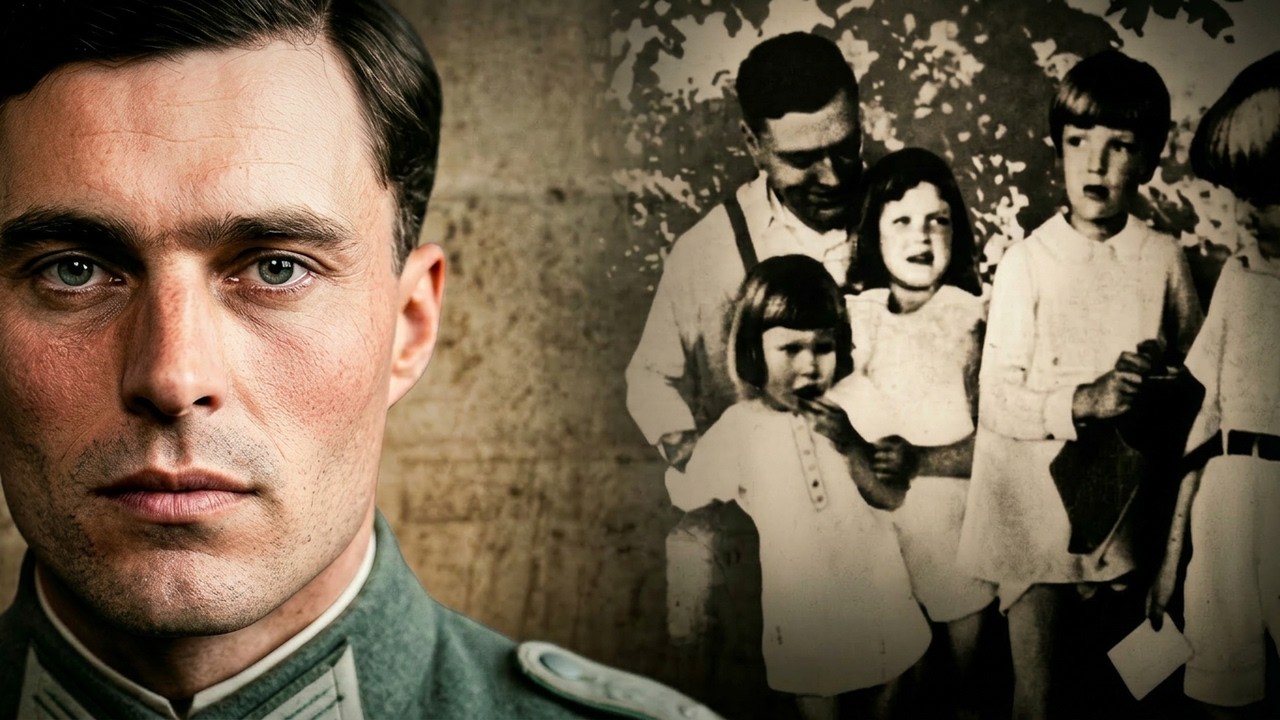
What Happened to Claus von Stauffenberg’s Family After Hitler Had Him Executed?
On January 27, 1945, while Adolf Hitler’s empire was collapsing under artillery fire, a baby girl was born inside a Nazi maternity home.
Her father had already been dead for six months.
Her mother was a prisoner.
Her brothers and sister had been taken away, given another surname, and placed in a children’s institution where the name of their own father was treated almost like a forbidden word.
And the regime responsible for all of it had made something terrifyingly clear:
Punishing Claus von Stauffenberg was not enough.
They wanted to punish his bloodline.
They wanted his children to grow up without his name.
They wanted his relatives frightened, scattered, imprisoned, interrogated and erased from public life.
They wanted the Stauffenbergs to become an example of what happened to anyone whose family dared to raise a hand against Adolf Hitler.
But the child born that January morning would eventually carry the name Stauffenberg.
So would her brothers.
One of them would later become a major general in the army of democratic West Germany.
Another would sit in parliament.
And the daughter born while her mother was a prisoner would grow up and help preserve the story the Nazis had tried to bury.
The regime had executed Claus von Stauffenberg in a courtyard.
It had hunted his relatives.
It had taken his children.
But the part Hitler could never have imagined was what happened after the firing squad stopped shooting.
Because the destruction of the Stauffenberg family was supposed to begin on July 20, 1944.
Instead, that date eventually became the reason the family name would never disappear.
By the evening of July 20, 1944, Berlin was a city vibrating with rumor.
Something extraordinary had happened hundreds of kilometers away at Hitler’s military headquarters in East Prussia.
At approximately 12:42 that afternoon, an explosion had ripped through a conference room at the Wolf’s Lair.
A bomb had been placed inside a briefcase.
The man who carried it into the room was Colonel Claus Schenk Graf von Stauffenberg.
He was 36 years old.
He had lost an eye, his right hand and two fingers from his left hand after being badly wounded in North Africa.
Yet by 1944, his most dangerous weapon was no longer something he carried on a battlefield.
It was access.
Stauffenberg had become part of the German military resistance.
The conspirators believed Germany was being led toward catastrophe.
They knew about mass murder and atrocities committed under Hitler’s rule.
They also understood something much more immediate by the summer of 1944: militarily, Germany was being crushed.
The Western Allies had landed in Normandy.
The Soviet Union was advancing from the east.
German cities were burning.
Millions were already dead.
To Stauffenberg and the men around him, removing Hitler had become both a moral act and a desperate attempt to prevent Germany’s total destruction.
So Stauffenberg carried a bomb into the room.
Then he left.
When the explosion came, he believed Hitler could not possibly have survived.
That assumption changed everything.
Stauffenberg flew back to Berlin.
Orders began moving through the military communication system.
Operation Valkyrie—the emergency plan originally designed to suppress internal unrest—was redirected by the conspirators toward a coup.
SS offices were to be isolated.
Key Nazi officials were to be arrested.
Military commanders were told that Hitler was dead and that a new government was assuming control.
For several extraordinary hours, the future of Germany appeared uncertain.
Then came the sentence that destroyed the plot:
Hitler was alive.
The heavy conference table had helped shield him.
The bomb had killed and wounded others, but the dictator survived.
And once Hitler’s voice reached the outside world, hesitation spread through the coup like poison.
Officers who might have followed the conspiracy backed away.
Orders were reversed.
Loyalties changed almost hour by hour.
Men who had been willing to move against the Nazi leadership suddenly began protecting themselves.
By midnight, Stauffenberg and several of his fellow conspirators were prisoners inside the Bendlerblock in Berlin.
There was no long judicial process.
There was no opportunity to prepare a defense.
In the early hours of July 21, Stauffenberg was taken into the courtyard.
Floodlights cut through the darkness.
A firing squad waited.
Seconds before the shots came, he reportedly cried out for the Germany he believed could still exist beyond Hitler.
Then the rifles fired.
Claus von Stauffenberg fell.
For the Nazi regime, however, his death was only the beginning.
Because Hitler did not intend to punish only the people who had planted the bomb.
He wanted their families.
The idea was called Sippenhaft.
Family liability.
It represented one of the most chilling instincts of dictatorship: the belief that guilt could run through blood.
If one member of a family committed what the regime called treason, parents could be arrested.
Brothers could be imprisoned.
Wives could be interrogated.
Children could be taken away.
The message was brutally simple.
You might be willing to die for your beliefs.
But were you willing to watch your family pay for them?
After July 20, Hitler wanted that question hanging over every German officer who might consider resistance.
The crackdown became enormous.
Investigators searched for everyone connected to the conspiracy.
Documents were seized.
Homes were searched.
Friends disappeared.
Relatives were questioned.
Hundreds of people would ultimately be executed or killed in connection with the broader resistance crackdown.
Claus’s own brother Berthold, who had participated in resistance planning, was arrested.
He would be tried before the notorious People’s Court.
There was little illusion about what that meant.
The People’s Court under Judge Roland Freisler was not a place where accused conspirators expected neutral justice.
It was theater.
Defendants were humiliated.
Freisler screamed.
The proceedings existed primarily to produce convictions and demonstrate the power of the regime.
On August 10, 1944, Berthold von Stauffenberg was executed.
Another Stauffenberg was gone.
But Hitler wanted the family punished beyond death.
And at that moment, perhaps no one was more vulnerable than Claus’s wife.
Her name was Nina.
She was 30 years old.
She had four young children.
And she was pregnant with a fifth.
Imagine what July 20 must have looked like from her side.
There was no television broadcast explaining the plot.
No instant message from Berlin.
No secure call from Claus telling her exactly what had happened.
There were fragments.
Rumors.
Radio announcements.
Names whispered carefully.
And then the terrible understanding that her husband had attempted to kill Hitler.
Nina knew Claus had become deeply opposed to the regime.
She knew he was involved in dangerous circles.
But the mechanics and timing of a conspiracy this sensitive could not simply be discussed around a family dinner table.
Secrecy was survival.
For everyone.
Then suddenly secrecy became impossible.
Her husband’s name was everywhere.
Claus von Stauffenberg was no longer simply an army colonel, a father, a husband.
To the Nazi state, he was the face of betrayal.
And his children were now the children of the man who had tried to kill Hitler.
Berthold, the oldest, was ten.
Heimeran was eight.
Franz Ludwig was six.
Valerie was three.
They were old enough to understand that something terrible had happened.
But too young to understand the machinery now moving toward them.
Their father was dead.
Before they could even process what that meant, their mother was taken from them.
The children were removed.
And then came one of the most psychologically brutal details of the entire punishment.
Their surname was changed.
They were no longer to be Stauffenbergs.
They became Meister.
A different name.
A safer name for the regime.
A name meant to sever children from the identity Hitler wanted destroyed.
For adults, a surname can be paperwork.
For a child, it is part of the answer to the simplest question in the world:
Who are you?
The four children were taken to a children’s home at Bad Sachsa.
There they lived among other children whose parents had been swept up after the July 20 conspiracy.
Different families.
The same punishment.
Their parents had challenged Hitler.
So the children were made to disappear behind altered identities.
They were instructed to use their new names.
The Stauffenberg children became the Meister children.
And somewhere else in Nazi custody, their pregnant mother had no certainty about when—or even whether—she would see them again.
That uncertainty may have been the worst weapon of all.
Nina was not accused of carrying the bomb.
She had not stood inside Hitler’s conference room.
She had not issued Valkyrie orders in Berlin.
But that was precisely the point of Sippenhaft.
Individual guilt did not matter.
Blood did.
Marriage did.
Kinship did.
She was Claus von Stauffenberg’s wife.
That alone was enough.
The family network was pulled apart.
Relatives were arrested and moved through prisons and camps.
The Nazi security system hoped interrogation might uncover additional conspirators.
But there was another goal that went beyond intelligence.
Fear.
If officers in the Wehrmacht saw what was happening to Stauffenberg’s wife and children, they might think twice before attempting another July 20.
The dead could no longer be threatened.
Their families could.
And Hitler was furious enough to make that lesson public.
Meanwhile, the children had entered a strange suspended world.
They did not know where their mother was.
They did not know when the war would end.
They did not know what would happen if Germany won.
And they certainly did not know what their father’s name would mean after the war.
Today, Claus von Stauffenberg is widely associated with resistance against Hitler.
In July 1944, the situation was radically different.
German propaganda described the conspirators as traitors.
For children, that difference mattered.
Their father had disappeared into a historical argument they were too young to understand.
Was he a criminal?
A traitor?
A soldier?
A murderer?
A hero?
A man who had abandoned them?
A man who had tried to save Germany?
Those questions would follow the Stauffenberg children for decades.
But first they had to survive childhood under a regime that considered their surname dangerous.
And then, in the middle of that nightmare, came another complication.
Nina’s pregnancy was advancing.
By January 1945, Nazi Germany was collapsing.
The situation had transformed dramatically in just six months.
When Claus entered the Wolf’s Lair in July 1944, Hitler still controlled enormous territory.
Now Soviet forces were tearing through the east.
Refugees poured westward in columns.
Rail networks were disrupted.
Bombing raids had reduced entire urban districts to ruins.
The government was still arresting enemies.
Still issuing orders.
Still executing prisoners.
But the regime’s geographical world was shrinking by the week.
Nina was moved into a Nazi maternity facility.
She was separated from her four older children.
Her husband was dead.
Her brother-in-law had been executed.
Other relatives were prisoners.
Her mother was also caught in the machinery of collective punishment.
Outside, Germany was falling apart.
And on January 27, 1945, Nina gave birth.
A girl.
She was named Konstanze.
It is difficult to imagine a stranger inheritance.
Konstanze entered the world as the daughter of a dead conspirator, born while her mother was being held by the dictatorship her father had tried to overthrow.
She never saw Claus.
He never held her.
He never knew whether the child Nina was carrying would be a boy or a girl.
The father was a memory before the daughter took her first breath.
And yet the date of her birth carried an almost unbelievable historical coincidence.
January 27, 1945, was also the day Soviet troops liberated Auschwitz.
Hundreds of kilometers away, one of Nazi Germany’s most infamous killing centers was being opened to the outside world.
The scale of the regime’s crimes was becoming impossible to hide.
On the very same day, the daughter of the man who had tried to kill Hitler was beginning her life under Nazi custody.
The regime wanted to make the Stauffenbergs disappear.
Instead, a new Stauffenberg had just been born.
But survival was far from guaranteed.
Only days after Konstanze’s birth, another blow struck the family.
Nina’s mother, Anna, died while in detention.
Now Nina had lost her husband.
Her children were scattered away from her.
Her mother was dead.
Her newborn daughter depended entirely on her.
And the country around them had become a moving battlefield.
This was no longer the organized Germany of uniforms, timetables and rigid bureaucracy.
By early 1945, evacuation routes changed constantly.
Trains were bombed.
Roads were crowded with soldiers and refugees.
Officials sometimes received orders that were obsolete before they could carry them out.
Prisoners were moved because advancing Allied armies threatened to overrun camps.
Some transfers became death marches.
Some guards abandoned their posts.
Others became more brutal as defeat approached.
For families under Sippenhaft, this collapse created a terrifying paradox.
The destruction of Nazi Germany was their only real hope.
But the destruction also made every day more unpredictable.
A stable dictatorship could imprison you.
A collapsing dictatorship might kill you simply because no one knew what else to do with you.
Nina and her newborn were moved again.
At one point she traveled while ill with the infant.
The system that had once seemed terrifyingly efficient was beginning to fracture around them.
Orders became confused.
Authority blurred.
And that breakdown created the first opening.
Because there comes a moment in the life of every dictatorship when people begin to notice that an order no longer has the same force it once did.
A guard looks over his shoulder.
A bureaucrat hesitates.
A prisoner refuses.
A commander wonders whether the government giving instructions will even exist next week.
That moment was approaching for Nina.
In April 1945, Hitler’s empire was only weeks from extinction.
Berlin was about to become a battlefield.
The Americans and British were driving through western Germany.
The Soviets were closing in from the east.
Among the prisoners being moved south were relatives of the July 20 conspirators.
The Nazis had once dreamed of making these families permanent hostages.
Now guards struggled simply to decide where to put them.
Nina, traveling with baby Konstanze, eventually found herself in a situation almost unimaginable months earlier.
The authority controlling her had become uncertain.
Her escort did not appear to have clear instructions.
The woman who had once been imprisoned because her husband had nearly changed history now faced a regime too disorganized to determine her destination.
And Nina did something deceptively simple.
She refused to continue.
No bomb.
No gun.
No secret code.
She stopped.
The power relationship had changed.
Only slightly.
But enough.
Her guard ultimately allowed her to remain behind.
The dictatorship that had once sent the Gestapo after an entire family was now losing the ability to control one exhausted mother carrying a baby.
That may have been the first real sign that the Stauffenbergs were going to outlive Hitler.
But Nina still did not have her other children.
And the children still did not have Nina.
The war had not yet delivered its final twist.
At Bad Sachsa, the four older Stauffenberg children had spent months under the name Meister.
They were not alone.
Other children from resistance families had been placed there too.
Some were too young to fully grasp why they had been taken.
Some undoubtedly wondered whether their parents were alive.
The adults around them knew more than the children did—and sometimes that knowledge made the silence worse.
Because the truth was horrifying.
For many July 20 families, there would be no father returning.
No uncle.
No brother.
No husband.
The Nazi state had executed conspirators with extraordinary speed.
In some cases, families would spend months not knowing exactly when or how a relative had died.
The children of the plotters were living in a world built on absence.
Then the front moved closer.
The regime began to crumble.
Guards and officials who once represented permanent authority suddenly represented a government with days left to live.
By May 1945, Hitler was dead.
Berlin had fallen.
Germany surrendered.
The Third Reich—the state that had promised to last a thousand years—had survived twelve.
And the strange identities imposed on the Stauffenberg children became meaningless almost overnight.
The Meister children could become Stauffenbergs again.
But this was not a fairy tale.
The doors did not simply open on May 8 and reveal an intact family waiting on the other side.
Germany was physically shattered.
Communication was chaotic.
Millions of people were displaced.
Roads, railways and cities had been destroyed.
Families searched for one another through rumor, handwritten lists and Red Cross notices.
Some people traveled hundreds of kilometers without knowing whether the person they were trying to find was alive.
For the Stauffenbergs, victory over Hitler did not erase what Hitler had done.
Claus was still dead.
Berthold was still dead.
Nina’s mother was still dead.
The children had still been separated from their mother and forced to live under another name.
There was no undoing July 20.
There was only the question of what came next.
Eventually, Nina and her children were reunited.
They gathered again at Lautlingen, the Stauffenberg family home.
Five children.
One mother.
No father.
Konstanze, the baby born in captivity, met brothers and a sister who had spent the last months of the war as “Meisters.”
It would have been easy to imagine that this was the ending.
It wasn’t.
Because the most extraordinary part of the Stauffenberg story did not happen during the war.
It happened after Germany began rebuilding itself.
In 1945, the name Stauffenberg was complicated.
That fact is often forgotten.
Historical reputations look neat in retrospect.
Real time is messier.
Many Germans had supported Hitler.
Others had accommodated themselves to the regime.
Some had resisted quietly.
A much smaller number had actively tried to overthrow it.
After the war, people had to confront uncomfortable questions.
If the July 20 conspirators had been right, what did that say about everyone who had obeyed until the end?
If Stauffenberg was a patriot, what did patriotism mean?
Had he acted too late?
Had he acted for moral reasons?
Military reasons?
Both?
Had the conspirators understood the full scale of Nazi crimes?
Had they been democrats in the modern sense?
Germany argued over these questions for decades.
The Stauffenberg children grew up inside that argument.
Their father was not simply their father anymore.
He belonged to history.
Every anniversary brought speeches.
Books.
Arguments.
Judgments.
Strangers developed opinions about a man whose children had barely had the chance to know him.
That burden fell especially heavily on Berthold, the eldest.
He had been ten when his father was executed.
Old enough to remember him.
Old enough to remember being taken away.
Old enough to remember losing the Stauffenberg name.
And then Berthold made a career choice that almost seems designed by history for maximum irony.
He became a soldier.
Think about what that meant.
The Nazi regime had executed his father as a traitor to the German state.
Hitler’s government had arrested the family.
The children had been stripped of their surname.
And yet when West Germany created a new democratic military after the war, Claus von Stauffenberg’s eldest son joined it.
Berthold entered the Bundeswehr in 1956.
Not Hitler’s Wehrmacht.
Not an army built around personal obedience to a dictator.
A military belonging to the Federal Republic of Germany.
The distinction was enormous.
Postwar West Germany had to solve a frightening problem.
How do you build an army in a country where the last army had served a criminal dictatorship?
How do you teach obedience without teaching blind obedience?
How do you create disciplined soldiers who still understand that conscience matters?
Those questions made the story of July 20 increasingly important.
The conspirators had broken their oath to Hitler.
Under Nazi logic, that made them traitors.
Under the emerging logic of democratic Germany, their refusal to obey criminal authority could be understood as something else:
Moral courage.
The child punished because of that act now wore a German uniform.
Berthold’s career lasted decades.
He rose through the ranks.
Eventually, he became a major general.
By the time he retired in 1994, he had served the Bundeswehr for approximately 38 years.
There is a detail here that feels almost too perfect for fiction.
The Nazis had tried to erase the name Stauffenberg from a ten-year-old boy.
Half a century later, that boy retired as one of the most senior officers in Germany’s democratic army.
The uniform had returned.
The surname had returned.
But the Germany attached to them had changed.
That alone would have been an extraordinary ending.
Then came Franz Ludwig.
Franz Ludwig was six when his father died.
Like his siblings, he had been renamed Meister.
A regime built on absolute political power had tried to punish him for the political actions of a parent.
So what did he do when he grew up?
He entered politics.
Franz Ludwig became a lawyer and a politician with the Christian Social Union.
In 1972, he entered the Bundestag, West Germany’s federal parliament.
Think about the image.
A little boy whom the Nazi state had once treated as the child of a traitor was now sitting inside the elected legislature of a democratic Germany.
No Gestapo.
No Führer principle.
No collective family punishment.
Votes.
Committees.
Debate.
Opposition.
Law.
Later, Franz Ludwig served in the European Parliament.
The symbolism grew even larger.
His father’s generation had watched Europe destroy itself through dictatorship and war.
His son’s generation helped build institutions designed to bind European countries together through politics instead of conquest.
Again, history seemed to be answering Hitler directly.
The dictator had punished the Stauffenberg children because their father rejected Nazi rule.
One became a general in a democratic army.
Another became a legislator in a democratic parliament.
And the child Hitler’s system never expected to matter—the baby born in captivity—would carry the story into another generation.
Konstanze grew up knowing that her entire existence was connected to one of the most famous failed assassinations in history.
Her father died before she was born.
Everything she knew about him had to come through other people.
Her mother.
Her siblings.
Relatives.
Letters.
Documents.
Stories.
Silences.
That last category matters.
Families who live through political terror do not always talk openly about it.
Sometimes silence becomes a survival habit.
During dictatorship, speaking is dangerous.
After dictatorship, speaking can still be painful.
Children learn which questions make adults stare into the distance.
They learn which names change the mood of a room.
They learn that history is not always something printed in textbooks.
Sometimes history is why there is an empty chair at the table.
For Konstanze, Claus was permanently absent.
But Nina was present.
And Nina’s story was extraordinary in its own right.
For decades, Claus dominated public memory.
The bomb.
The briefcase.
The Wolf’s Lair.
The race back to Berlin.
Operation Valkyrie.
The firing squad.
Those events are dramatic and cinematic.
But the wife left behind had lived through a different kind of resistance story.
Nina survived arrest while pregnant.
She endured separation from four children.
She gave birth in Nazi custody.
She moved through collapsing Germany with a newborn baby.
She lived with the consequences of a decision her husband had known might kill him.
Then she raised five children in a country forced to reconstruct not only its cities but its moral identity.
Konstanze eventually wrote about her mother.
In doing so, she shifted the camera.
Away from the conference room.
Away from the bomb.
Away from Hitler.
Toward the family.
That shift changes the July 20 story.
Because assassination attempts are usually told through the men who plan them.
But political violence does not stop with the conspirator.
It reaches wives who receive knocks on doors.
Children who are given false names.
Parents who disappear into camps.
Babies born behind institutional walls.
Families forced to live with consequences long after the headlines end.
And once you see the Stauffenberg story through that lens, the failed assassination suddenly looks very different.
The bomb failed to kill Hitler.
But Hitler also failed to accomplish what came next.
He failed to destroy the family.
There is another uncomfortable layer to the story.
Claus von Stauffenberg was not a simple, flawless hero.
Human beings rarely are.
His political views evolved.
Like many conservative German officers of his background, his relationship with National Socialism was complicated, especially in the regime’s earlier years.
Historians continue to debate motives, political goals and the ideas held by various members of the July 20 resistance.
Some conspirators were traditional conservatives.
Some wanted constitutional government.
Some wanted monarchy.
Some were driven by military catastrophe.
Some were appalled by Nazi crimes.
Motivations overlapped.
They changed over time.
That complexity matters because turning Stauffenberg into a perfect movie character would actually make his decision less important.
Perfect heroes are easy to admire.
Real people are harder.
Claus belonged to Germany’s military elite.
He served in Hitler’s war.
Then he reached a point where obedience became impossible.
By 1944, he was willing to risk everything.
And “everything” turned out not to be a figure of speech.
He lost his life.
His brother lost his life.
His wife lost her freedom.
His children lost their names.
His extended family lost its safety.
That is the cost hidden inside the phrase “he tried to kill Hitler.”
And there was no guarantee history would vindicate him.
On July 20, he did not know Germany would become democratic.
He did not know memorials would someday honor resistance.
He did not know soldiers would study the moral meaning of refusing illegal orders.
He did not know his son would become a general.
He did not know another son would enter parliament.
He did not even know the daughter Nina was carrying would survive.
He acted without seeing the ending.
That is what made the risk real.
Now imagine Hitler during those final months.
He had survived the bomb.
At first, that survival seemed like victory.
Nazi propaganda presented it almost as proof that destiny protected him.
He continued the war.
He ordered reprisals.
He watched film and photographs of conspirators being humiliated.
He demanded punishment.
The families of plotters became targets.
And for a short time, the regime succeeded.
Claus was dead.
Berthold was dead.
Nina was imprisoned.
The children had become Meister.
The Stauffenberg name had been removed from them.
From Hitler’s perspective, perhaps that looked like complete domination.
Then time began turning against him.
Six months after the assassination attempt, Soviet troops stood on German soil in overwhelming strength.
The Western Allies had crossed into the Reich.
German cities were ruins.
Fuel was disappearing.
Young boys and old men were being pushed into desperate defensive units.
Refugees covered the roads.
And inside a maternity facility, Nina gave birth to another Stauffenberg.
Three months later, Hitler was underground in Berlin.
The man whose government had tried to erase the Stauffenberg family was now living inside a bunker while Soviet shells struck the capital above him.
On April 30, 1945, Adolf Hitler killed himself.
Konstanze von Stauffenberg was three months old.
That contrast may be the sharpest twist in the entire story.
The dictator survived Claus’s bomb by luck and circumstance.
Claus died believing the coup had failed.
Technically, it had.
But less than a year later, Hitler was dead, the Nazi state was gone, and Claus’s newborn daughter was alive.
History had not moved on the schedule the conspirators wanted.
But it had moved.
Decades passed.
Germany changed.
The ruins disappeared.
A new generation was born.
Then another.
The name Stauffenberg began appearing in places the Nazis could never have anticipated.
Military academies.
Parliamentary records.
Commemorations.
Books.
Documentaries.
Schools.
Memorial ceremonies.
Every July 20, Germany returned to the question of resistance.
What does a citizen owe the state?
What does a soldier owe an order?
When does obedience become complicity?
When does disobedience become duty?
These were not abstract questions for the Stauffenberg children.
Their family had paid for one answer.
Berthold, the former child prisoner, spent much of his life connected to Germany’s armed forces.
Franz Ludwig, another former “Meister,” spent years connected to democratic political institutions.
Konstanze preserved the experience of the mother who had carried the family through the aftermath.
Their lives did not erase the trauma.
Nothing could.
Valerie, one of the four children taken after July 20, died young in 1966.
The family knew personal loss long after the war.
And public attention carried its own weight.
Being the child of a famous resistance figure does not mean inheriting only honor.
It means inheriting expectations.
Questions.
Arguments.
People telling you what your father meant.
People asking whether you agree.
People using his name for political purposes.
People judging decisions made before you were old enough to understand them.
There was no clean escape from July 20.
But there was something the Nazi state had specifically tried to prevent:
Continuity.
The children grew up.
They had careers.
They formed families.
They spoke under their real name.
The surname survived.
And that is why the story of Sippenhaft is so revealing.
Collective punishment is based on a fantasy of total control.
The dictator does not merely want obedience from you.
He wants control over the future.
He wants to decide what your children will remember.
He wants to determine whether your name will be spoken with pride or shame.
He wants fear to travel from one generation into the next.
Hitler’s regime attempted exactly that after July 20.
It could execute Claus.
It could execute Berthold.
It could imprison Nina.
It could arrest relatives.
It could separate children.
It could type “Meister” onto paperwork where “Stauffenberg” should have been.
For several months, it could even force those children to answer to that name.
But there was one thing the dictatorship could not control.
What Germany would remember after the dictatorship itself was gone.
That is where the final reversal happened.
Because the identity Hitler tried to erase became part of Germany’s national memory.
The officer Hitler called a traitor became one of the most recognizable symbols of German military resistance.
The children whom the Nazis renamed eventually reclaimed the name.
The son of the executed conspirator became a general.
Another son became a parliamentarian.
The daughter born in captivity became an author and keeper of family memory.
And Nina—who had every reason to disappear into private grief—lived long enough to see a Germany radically different from the one that had taken her husband and imprisoned her family.
Not perfect.
Not free from argument.
But democratic.
There is a photograph-like scene worth imagining at the end of all this.
Not because we know it happened exactly this way, but because history gives us all the pieces.
Picture a government ceremony decades after the war.
German officers stand in uniform.
Flags move slightly in the wind.
Speakers mention July 20, 1944.
Young soldiers listen to the story of officers who concluded that loyalty to Germany could require resistance to Germany’s dictator.
Somewhere among the names is Stauffenberg.
Now consider what the Nazis wanted that name to mean in 1944.
Disgrace.
Treason.
Contamination.
A warning.
A surname so dangerous that even children were not allowed to keep it.
Then look at what happened.
The Nazi flags disappeared.
The Nazi uniforms disappeared.
The People’s Court disappeared.
The Gestapo disappeared.
The Führer disappeared.
The regime that issued the order disappeared.
But the name remained.
Stauffenberg.
That was the part Hitler could not execute.
And perhaps the most powerful proof of that fact was not a statue, a military building or an anniversary speech.
It was a child.
A girl born on January 27, 1945.
Konstanze.
When she arrived, Nazi Germany still officially existed.
Her mother was still caught inside its system of punishment.
Her father had been dead since before she was born.
Her siblings were living under another surname.
Everything about her circumstances suggested that the regime had won.
But regimes often misunderstand what victory means.
They confuse control with permanence.
They mistake fear for loyalty.
They assume that because people obey today, history will obey tomorrow.
It rarely does.
Three months after Konstanze’s birth, Hitler was dead.
Four months after her birth, Nazi Germany surrendered.
The children came home.
The false name disappeared.
The real one returned.
And then the family did something dictatorships fear more than dramatic revenge.
They continued living.
There was no army of Stauffenbergs marching toward Berlin.
No spectacular act of vengeance.
No final confrontation with the men who had arrested them.
Most of those responsible vanished into death, prison, anonymity or the confusion of postwar Germany.
The family’s revenge—if that word can even be used—was quieter.
Berthold put on the uniform of a democratic Germany.
Franz Ludwig entered democratic politics.
Konstanze wrote.
The family remembered.
They survived long enough for the meaning of July 20 to change around them.
The boy forced to forget his surname lived long enough to see that surname honored by German soldiers.
The family described as traitorous lived long enough to see the dictatorship itself universally condemned.
The father shot in a courtyard did not return.
That tragedy never changed.
But the verdict surrounding his death did.
And perhaps that is why the Stauffenberg family story remains more powerful than the assassination attempt by itself.
Because the bomb exploded once.
The consequences lasted generations.
The explosion tells us what Claus von Stauffenberg was willing to risk.
What happened to Nina and the children tells us what that risk actually cost.
And what happened after 1945 tells us something even more important:
Power can control people for a time.
It can confiscate property.
It can lock doors.
It can change names on official documents.
It can arrest mothers.
It can frighten children.
It can execute fathers before sunrise.
But power has a weakness.
It cannot guarantee how the future will remember it.
Hitler had Claus von Stauffenberg killed because Stauffenberg tried to change Germany’s future.
Then Hitler went after his family because he wanted to control their future too.
He failed at both.
Not in the way Claus had planned.
Not on July 20.
Not immediately.
But unmistakably.
The thousand-year Reich disappeared before Konstanze von Stauffenberg learned to walk.
The name the Nazis tried to erase survived for generations.
And the children Hitler wanted branded as the descendants of a traitor grew up in a Germany where their father’s refusal to obey him became part of the country’s definition of courage.
That may be history’s coldest answer to a dictator:
You can kill a man, imprison his wife, steal his children’s names and terrorize an entire family—but if the idea they stood for survives you, then history has already decided who really lost.