On the night Adolf Eichmann was hanged, the Israeli authorities made sure there would be no grave.
No monument.
No patch of earth where admirers could gather.
Shortly after midnight between May 31 and June 1, 1962, the former SS officer was executed at Ramla Prison. His body was cremated. His ashes were carried out to sea and scattered beyond Israel’s territorial waters.
It was meant to be an ending.
But hundreds of miles away, four sons were still carrying his name.
And for them, the story was only beginning.
One would publicly defend his father and repeat grotesque claims minimizing the crimes of the Holocaust.
Another would become associated with a neo-Nazi circle so dangerous that Argentine police discovered weapons, explosives, swastika flags and a list of Jewish people apparently marked for attack.
A third would retreat almost completely from public view.
And the youngest—the boy who had barely understood why his father suddenly disappeared—would eventually become a respected archaeologist, publicly reject Adolf Eichmann’s ideology, accept that his father deserved to be brought to justice, and one day sit face-to-face with one of the Israeli agents responsible for capturing him.
Four brothers.
One surname.
Four radically different answers to the same impossible question:
What do you do when history hands you the name Eichmann?
The answer began on a dark road outside Buenos Aires two years before the execution.
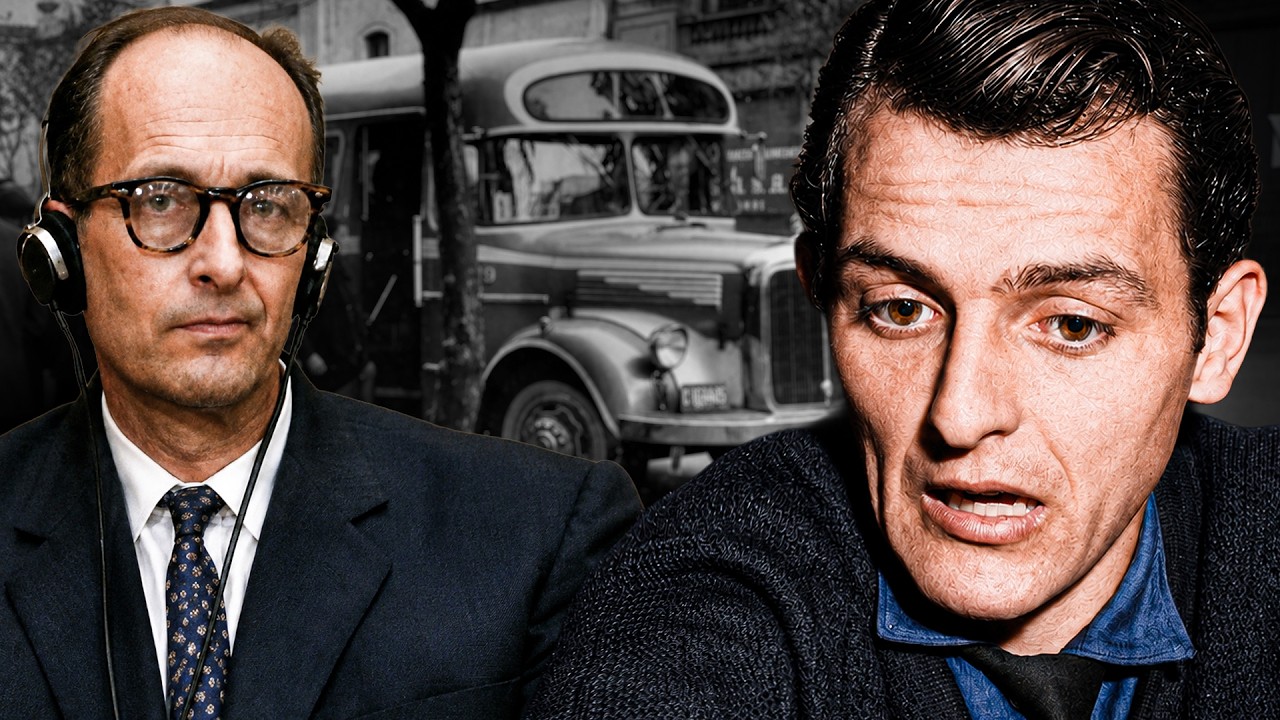
On May 11, 1960, a middle-aged Mercedes-Benz employee stepped off a bus and began walking toward his modest home in San Fernando.
To his neighbors, he was Ricardo Klement.
Quiet.
Ordinary.
Forgettable.
That was exactly how he wanted it.
But the men waiting nearby knew who he really was.
One of them, Israeli agent Peter Malkin, approached.
Within seconds, the man was on the ground.
He struggled.
The agents forced him into a waiting vehicle, covered him and drove away.
The stranger called Ricardo Klement had spent years constructing another life in Argentina.
But inside a secret safe house, that life collapsed.
His captors confronted him with the identity he had tried to bury.
Adolf Eichmann.
SS officer.
One of the principal organizers of the deportation machinery that sent European Jews toward ghettos, killing sites and extermination camps.
In 1944 alone, Eichmann and his staff played a central role in the deportation of approximately 440,000 Hungarian Jews, most of them to Auschwitz. After Germany’s defeat, he escaped Allied custody, ultimately reached Argentina and lived under an assumed identity while maintaining contacts within circles of former Nazis.
For years, he had survived.
Then, in a matter of seconds, he disappeared.
His family had no idea exactly what had happened.
Imagine the house that evening.
The chair that remained empty.
The routine interrupted.
A father who should have returned from work simply did not come home.
For the younger children, particularly Ricardo, there was no geopolitical explanation.
No discussion of war crimes tribunals.
No explanation of intelligence operations or the Holocaust.
There was simply an absence.
But for the older sons, the truth was different.
They knew the name their father had hidden.
They knew the world was hunting Adolf Eichmann.
And they understood that the disappearance of Ricardo Klement probably meant that Adolf Eichmann had finally been found.
Eleven days after his seizure, Eichmann was secretly flown to Israel. Prime Minister David Ben-Gurion announced to the Knesset that the man accused of playing a major role in the Nazi destruction of European Jewry was in Israeli custody and would stand trial.
The news detonated around the world.
For Holocaust survivors, Eichmann’s capture represented something many had almost stopped expecting: accountability.
For Argentina, it triggered a diplomatic crisis over Israel’s violation of Argentine sovereignty.
For the Eichmann family, however, it meant something more personal.
Their father was no longer hiding behind a false name.
And neither were they.
The trial began in Jerusalem in 1961.
Eichmann sat behind bulletproof glass while survivors described deportations, ghettos, selections, shootings, camps and families that vanished into the machinery of genocide.
The proceedings were broadcast internationally.
Millions watched.
The quiet man in the glass booth tried to present himself as something smaller than the crimes surrounding him.
A functionary.
A subordinate.
A man following orders.
But the documentary record told a far more damning story.
Before his capture, while living in Argentina, Eichmann had participated in lengthy recorded conversations with former SS officer and pro-Nazi journalist Willem Sassen. Those conversations complicated the image of the passive bureaucrat Eichmann later projected at trial; he spoke openly about his role and retained virulent antisemitic views.
That distinction mattered.
Because the image Eichmann’s sons inherited depended partly on which version of their father they were willing to believe.
The obedient official?
Or the ideologically committed participant?
The court reached its answer.
In December 1961, Adolf Eichmann was found guilty of crimes against the Jewish people, crimes against humanity, war crimes and other offenses.
He was sentenced to death.
His appeals failed.
Then came the night of the execution.
At the prison, Eichmann was led toward the gallows.
Outside, his sons could do nothing.
At midnight, the sentence was carried out.
Israel then cremated his body and scattered the ashes at sea beyond its territorial waters. The deliberate absence of a grave prevented the creation of a physical shrine.
One life was over.
But the Eichmann name had now become permanent.
And that is where the four brothers’ paths began to split.
The oldest son, Klaus, did not respond to his father’s downfall by distancing himself.
He defended him.
Before the execution, while the trial was still attracting international attention, Klaus appeared in the media arguing that the accusations against Adolf Eichmann were propaganda.
The claims he promoted were not simply expressions of a son struggling to believe that his father was guilty.
They ventured into Holocaust denial and antisemitic conspiracy.
In a 1961 interview reported decades later, Klaus dismissed the war-crimes case against his father and repeated conspiracy theories suggesting that Jews themselves bore responsibility for Jewish deaths.
It was an extraordinary transformation of victim and perpetrator.
The evidence being presented in Jerusalem was overwhelming.
Survivors were testifying publicly.
Documents existed.
The Nazi bureaucracy had recorded its own actions.
Yet Klaus chose defense.
Not silence.
Defense.
There is an uncomfortable psychological trap in families built around powerful fathers.
If the father is guilty, then the entire mythology of the household collapses.
The stories told at dinner become lies.
The moral authority of the parent disappears.
Childhood itself becomes unreliable.
For some children, confronting that collapse becomes necessary.
For others, preserving the parent becomes more important than preserving reality.
Klaus chose preservation.
And after the death sentence, his anger reportedly hardened rather than softened.
According to later accounts, he publicly protested the verdict and remained attached to his father’s innocence.
He eventually moved to Germany and lived for decades under the same name that had already become synonymous with one of the most infamous Nazi perpetrators.
He died in 2015 after suffering from Alzheimer’s disease, according to reporting based on relatives and people close to the family.
But Klaus was not the brother whose post-execution path became most alarming.
That was Horst.
If Klaus fought with words, the circle surrounding Horst crossed toward something darker.
Three years after Eichmann’s execution, Argentine police were investigating armed neo-Nazis outside Buenos Aires.
What they found sounded less like political nostalgia than preparation.
Police discovered a hidden base connected to a neo-Nazi group.
Inside were weapons.
Explosives.
Swastika flags.
Nazi propaganda.
And, according to contemporary reporting, a list containing the names or details of prominent Argentine Jews apparently marked for attack.
Authorities also found a photograph of Horst Eichmann.
He was wearing a Nazi uniform.
Police began looking for him.
The discovery became more disturbing as investigators examined the group.
Officials said there were indications that its members wanted to avenge Adolf Eichmann’s execution.
Reports at the time described plans for violence against Jewish targets, and police believed members of the network were preparing terrorist acts.
The group had even exchanged gunfire with police before escaping into the darkness.
Now the story had twisted into something few could have predicted when Adolf Eichmann disappeared from the roadside in 1960.
The father had been captured for participating in a regime built on racial hatred.
Years later, one of his sons was appearing in connection with a movement organized around the same symbols.
Horst did not merely inherit his father’s surname.
By multiple later accounts, he inherited—or adopted—much of his ideological worldview.
Carmen Bretín Lindemann, who had a long relationship with Horst and had a child with him, later described him as deeply committed to Nazism.
She recalled Nazi symbols in the home and said Horst continued believing his father had done nothing wrong.
Her description reveals something crucial about the Eichmann household after 1962.
The execution did not automatically destroy Adolf Eichmann’s influence.
For some of his children, death may have preserved it.
A dead father cannot be questioned.
He cannot revise his story.
He cannot accidentally contradict the mythology created around him.
He can become whatever his survivors need him to be.
Victim.
Martyr.
Misunderstood soldier.
Wrongly accused father.
And once that narrative hardens, evidence becomes the enemy.
According to Lindemann, Horst’s attachment to his father was so fundamental that accepting Adolf Eichmann’s guilt would have shattered the structure through which he understood his own life.
That may explain the intensity.
But it does not excuse it.
The people placed in danger by neo-Nazi groups in Argentina were not symbols in someone else’s family trauma.
They were human beings.
Some were Holocaust survivors.
Others were members of families that had already fled Europe once.
They had crossed an ocean hoping distance might protect them from the ideology that had murdered millions.
Then, in Argentina, swastikas appeared again.
Weapons appeared again.
Lists of Jewish names appeared again.
And attached to that frightening world was the surname Eichmann.
Horst eventually lived a much quieter life than the headlines of the 1960s might have suggested.
He died in Argentina in 2015 at approximately seventy-five years old, reportedly from bowel cancer.
But according to the woman who knew him intimately, his loyalty to his father’s worldview never underwent the public reversal that would later define his youngest brother.
Then there was Dieter.
The third son is perhaps the strangest figure precisely because he refused to become one.
No public ideological campaign comparable to Klaus.
No widely documented neo-Nazi notoriety comparable to Horst.
No dramatic repudiation comparable to Ricardo.
Instead, silence.
Dieter reportedly worked in construction, divided parts of his life between Germany and Argentina, later owned rental properties and eventually retired in Buenos Aires.
Journalists looking for answers discovered a man who apparently had little interest in publicly discussing the most famous thing about his family.
For decades, he avoided interviews.
That silence created its own mystery.
What did he believe?
What had his father told him?
Had the trial changed anything?
Did the testimonies from survivors penetrate the family’s private version of events?
Did he ever confront Klaus or Horst?
Did he disagree with Ricardo?
The public record gives few satisfying answers.
People close to the family later claimed Dieter continued to believe his father had been innocent.
But Dieter himself largely refused to participate in the spectacle.
He did not construct a public identity around answering for Adolf Eichmann.
And perhaps that is why his story feels so different.
Klaus fought history.
Horst appeared to reenact its ideology.
Dieter tried to disappear behind ordinary life.
Then came Ricardo.
The youngest son.
And the greatest reversal.
Ricardo Francisco Eichmann was born in Buenos Aires in 1955.
He was only five when Israeli agents captured his father.
For a small child, the world did not divide neatly into Nazis, Mossad agents, prosecutors and survivors.
There was simply a father.
And then there wasn’t.
After the capture and trial, Ricardo eventually returned to Germany with his mother.
But Vera Eichmann did not sit her young son down and explain the enormity of what Adolf Eichmann had done.
According to Ricardo’s later recollections, much remained unspoken.
He knew his father was gone.
He eventually knew he was dead.
But he did not immediately understand how his father had died or why millions of people around the world knew his name.
His mother reportedly kept newspaper clippings hidden beneath a sofa.
Think about that image.
The history of one of the twentieth century’s most notorious criminals literally concealed under furniture while his youngest child grew up in the same house.
Ricardo said that as a boy he believed his father had essentially disappeared from his life.
The adults around him offered no complete explanation.
So he did what children eventually do when adults refuse to answer.
He began finding answers himself.
As he entered adolescence, Ricardo read.
And the man he discovered in books was not the father preserved in family memory.
He was Adolf Eichmann.
Historical figure.
SS officer.
Organizer.
Deportation specialist.
Defendant.
Convicted war criminal.
The deeper Ricardo investigated, the less room there was for comforting mythology.
He learned what the Holocaust was.
He learned what his father had helped do.
He learned what happened in Jerusalem.
And eventually he learned the truth of the execution.
This was the moment when the youngest Eichmann faced the decision his brothers had already answered in their own ways.
Blood or truth?
Family loyalty or moral judgment?
Defend the father?
Ignore the father?
Become the father?
Or separate yourself from him?
Ricardo chose separation.
But there was a twist.
He refused to change his surname.
For someone carrying perhaps one of the most toxic family names in modern European history, changing it would have been understandable.
A new surname could have prevented questions.
It could have protected his children.
It could have allowed him to enter a university classroom without students wondering whether “Eichmann” meant that Eichmann.
But Ricardo decided hiding the name would not erase the reality.
Changing letters on a passport could not change his father.
He would carry the surname.
Just not the ideology.
He studied archaeology.
Not politics.
Not apologetics.
Archaeology.
A discipline built around excavating buried evidence.
Layer by layer.
Object by object.
Fragments placed into context until a picture of the past emerges.
The irony is difficult to miss.
His father had spent years trying to disappear into a false identity.
The son built a career around uncovering what the past had left behind.
Ricardo specialized in Near Eastern archaeology and eventually became a professor at the University of Tübingen.
He later served for years as a senior figure in the German Archaeological Institute’s Orient Department.
He became known professionally not as an ideological heir to Adolf Eichmann, but as a scholar.
For decades, he rarely discussed his father publicly.
Then, in the mid-1990s, the silence broke.
Ricardo Eichmann gave interviews.
And suddenly the world heard something it had never heard from his older brothers.
Rejection.
He said he felt no resentment toward Israel for bringing his father to justice.
He rejected the idea that Adolf Eichmann could escape responsibility simply by saying he was following orders.
He described the burden of carrying the family history.
And he made clear that he belonged to a completely different moral worldview from his father.
In one interview, he said that if Nazis ever returned to power in Germany, he would prepare suitcases for his own children and leave.
That statement carried enormous weight because of the name attached to it.
The son of Adolf Eichmann was imagining himself fleeing Nazis.
History had turned upside down.
But the most extraordinary encounter was still ahead.
In 1995, Ricardo traveled to a hotel near London’s Heathrow Airport.
Waiting there was an Israeli man connected directly to the night Ricardo’s childhood ended.
Zvi Aharoni.
Aharoni had been one of the intelligence operatives centrally involved in identifying and capturing Adolf Eichmann in Argentina.
Thirty-five years earlier, men like Aharoni had watched the Eichmann home.
Studied the family’s routines.
Confirmed the identity of the supposedly ordinary Mercedes employee.
Helped close the trap.
To five-year-old Ricardo, they had been the invisible force that made his father vanish.
Now the child was forty.
The agent was older too.
And the son voluntarily walked into a room to meet him.
There was no gun.
No safe house.
No false passport.
No Ricardo Klement.
Only Ricardo Eichmann and one of the men who had helped end Adolf Eichmann’s escape.
The emotional logic of the meeting seemed obvious.
This should have been confrontation.
The son of the captured man facing the captor.
A lifetime of unanswered questions compressed into one room.
But Ricardo did something that completely reversed the expected script.
He shook Aharoni’s hand.
Later, he described the meeting as deeply emotional.
But he said he was not angry.
Adolf Eichmann, he explained, deserved to be brought to justice for what he had done.
Ricardo personally opposed capital punishment, but he understood why Israel had imposed it in his father’s case at that historical moment.
That handshake may be the most important scene in the entire story.
Because it did not erase anything.
It did not forgive Adolf Eichmann.
It did not erase the Holocaust.
It did not transform the son into a representative for his father’s victims.
And it certainly did not mean the burden of the name vanished.
Something far more difficult happened.
Ricardo separated biological inheritance from moral inheritance.
He acknowledged that the man taken from his childhood home had been his father.
And he acknowledged that the men who took him were bringing a war criminal to trial.
Both things could be true at once.
That is where his path diverged most dramatically from Klaus and Horst.
To defend Adolf Eichmann, Klaus had to attack the truth.
To preserve Adolf Eichmann’s ideological world, Horst appears to have embraced much of what that world represented.
Ricardo did the opposite.
He allowed evidence to destroy the comforting version of his father.
That decision came at a price.
Imagine introducing yourself professionally.
“Eichmann.”
A pause.
A second look.
The inevitable question.
Any ordinary person can inherit debt, property, facial features or family traditions.
Ricardo inherited recognition.
Before strangers knew anything about him, they knew something about his father.
He could publish academic work.
Lead archaeological research.
Build a family.
Teach students.
Spend decades creating a professional identity.
And one word could still collapse the distance between his adult life and a prison execution in 1962.
Eichmann.
Ricardo once described his family history using the image of a multistage rocket: the father had fallen away, while the rest of the family continued moving.
It was an unusual metaphor.
Cold.
Mechanical.
Almost scientific.
Perhaps intentionally so.
Because there is no emotionally clean vocabulary for being the son of Adolf Eichmann.
How do you mourn the father without mourning the criminal?
How do you acknowledge childhood affection without transforming it into moral defense?
How do you carry a family name without turning it into either a badge or a prison?
Ricardo’s answer seemed to be that Adolf Eichmann belonged to history.
Not to mythology.
Not to family excuses.
History.
And history requires evidence.
That same evidence had been waiting for his brothers too.
This is what makes the fate of Eichmann’s sons more disturbing than a simple story about “good son versus bad sons.”
All four men emerged from the same family.
They shared the same father.
They experienced the same catastrophe of exposure.
They watched the name Eichmann move from secrecy in Argentina to worldwide condemnation.
Yet they did not become the same men.
Klaus had been old enough to absorb much more of his father’s worldview before the capture.
Horst had also grown up closer to Adolf Eichmann during the years when the family knew far more about his past.
Dieter retreated from scrutiny.
Ricardo, the youngest, experienced his father partly as an absence—and then reconstructed the truth through history rather than memory.
That difference mattered.
Memory says:
He was my father.
Evidence asks:
What did he do?
Memory says:
He loved his family.
Evidence asks:
Whose families did he help destroy?
Memory says:
He told us he was innocent.
Evidence asks:
What do the documents show?
That conflict is larger than the Eichmann family.
It appears after dictatorships.
After genocides.
After wars.
After political violence.
Children grow up surrounded by stories adults tell to protect themselves.
Some accept those stories forever.
Some refuse to ask questions.
Some become defenders of the family myth.
And some open the box hidden under the sofa.
That was Ricardo’s real rebellion.
Not changing his name.
Not giving dramatic speeches.
Not spending his life publicly attacking his brothers.
He looked.
He read.
He accepted what the evidence showed.
And once he understood, he refused to inherit his father’s moral universe.
There was another cruel irony.
Adolf Eichmann had spent his career helping turn human beings into administrative categories.
Transport numbers.
Train schedules.
Quotas.
Destinations.
He helped organize deportation through bureaucracy so immense crimes could be executed with routines, paperwork and timetables.
After the war, he tried to reduce himself too.
Not Eichmann.
Klement.
Not SS officer.
Worker.
Not architect of deportations.
Ordinary father.
Then the trial put the individual back behind the paperwork.
A face.
A name.
A defendant.
And decades later, his youngest son would make another individual choice.
He would not claim responsibility for crimes he had never committed.
But neither would he pretend those crimes had not happened.
That distinction matters.
Children do not inherit guilt genetically.
But they do inherit stories.
They inherit explanations.
Silences.
Photographs.
Political beliefs whispered around tables.
Resentments.
Enemies they have never met.
Victimhood narratives.
Names.
And eventually, when they become adults, they decide which of those inheritances to keep.
Klaus kept defending.
Horst remained bound to the ideology.
Dieter kept largely silent.
Ricardo confronted the past.
The four brothers became four different examples of what can happen when family loyalty collides with historical truth.
And perhaps that is the final plot twist.
For years, the world focused on the extraordinary operation that captured Adolf Eichmann.
The surveillance.
The bus stop.
The agents waiting in darkness.
The struggle beside the road.
The safe house.
The secret flight.
The glass booth in Jerusalem.
The verdict.
The gallows.
Those moments became history.
Movies were made.
Books were written.
Intelligence officers became famous.
But Adolf Eichmann’s most intimate legacy could not be contained inside the courtroom.
It walked out through his children.
One son fought to protect the myth.
Another moved dangerously close to continuing its hatred.
One withdrew.
And the youngest eventually sat across from a man who had helped capture his father—and offered his hand instead of revenge.
No intelligence service could have planned that ending.
No court could have ordered it.
It was a choice.
Decades after Adolf Eichmann’s ashes vanished into the sea, his surname remained on the earth.
But it no longer meant exactly one thing.
Ricardo Eichmann could never choose his father.
He could never choose the history attached to his birth certificate.
He could never make strangers forget what Adolf Eichmann had done.
What he could choose was what happened after he learned the truth.
And perhaps that is the most unsettling lesson of the Eichmann family.
The past does not control everyone in the same way.
Evidence can be rejected.
Silence can be chosen.
Hatred can be inherited and protected.
But inheritance is not destiny.
A name can be handed down.
An ideology must still be accepted.
And sometimes the most powerful rejection of a father’s legacy is not to erase his name—but to carry it into the world while refusing to become anything he believed you should be.