



HOW HITLER’S GENERALS ENDED UP IN NATO — AND WHY THE WEST DECIDED IT NEEDED THEM
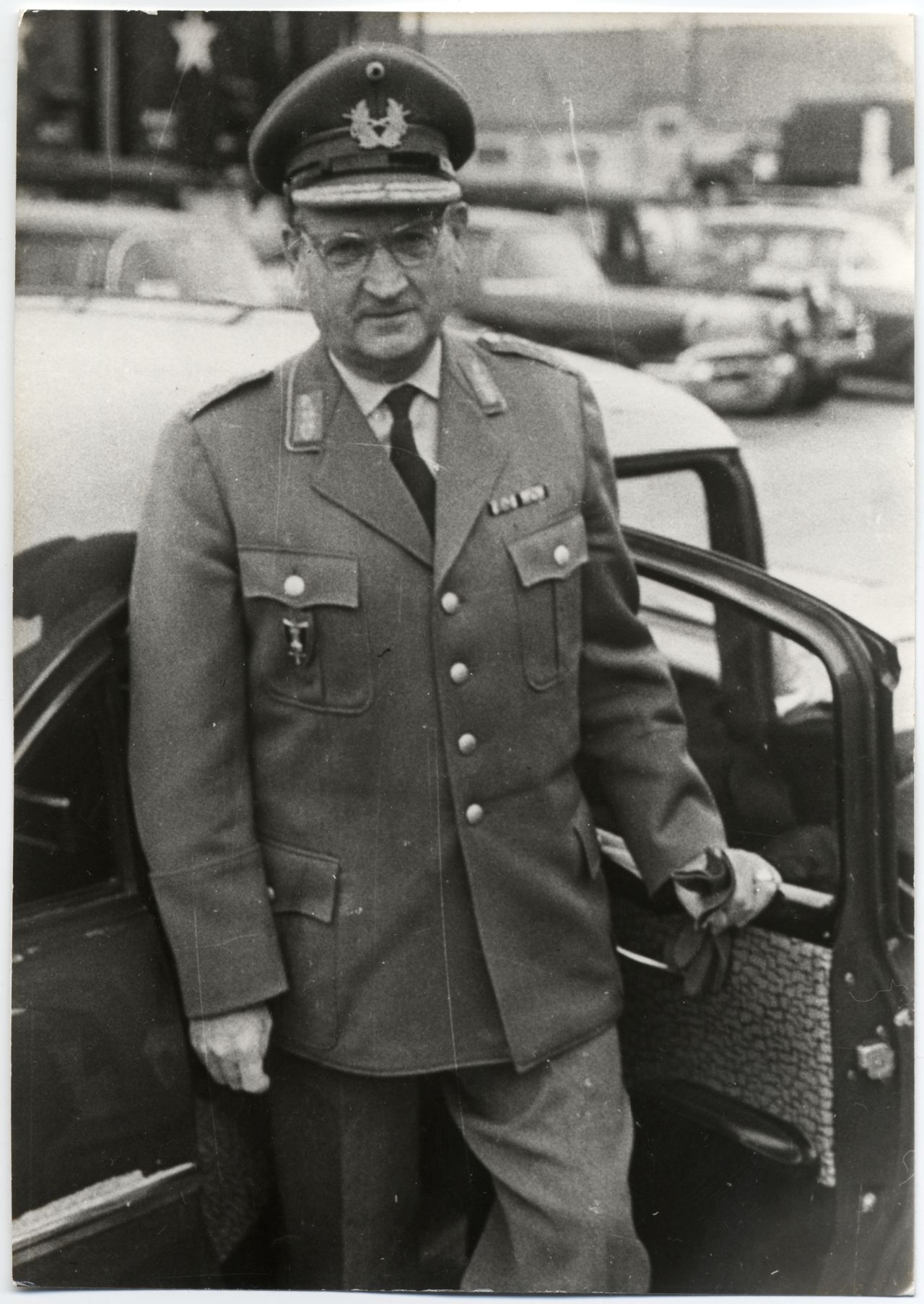
In 1961, one of the most important military offices in the Western alliance belonged to a German general named Adolf Heusinger.
His headquarters were in Washington.
His job placed him near the center of NATO’s strategic planning against the Soviet Union.
Seventeen years earlier, Heusinger had been standing only a few feet from Adolf Hitler when Colonel Claus von Stauffenberg’s bomb exploded inside the Wolf’s Lair.
He had spent years in the Operations Department of the German Army High Command. For a brief period in 1944, he had even served as acting Chief of the Army General Staff. He had helped manage the military machine that carried Hitler’s war across Europe.
Now he was helping plan the defense of the Western democracies.
And Heusinger was not an isolated case.
Hans Speidel, another former Wehrmacht general, had served as Erwin Rommel’s chief of staff in occupied France before becoming connected to the military resistance against Hitler. The Gestapo arrested him in 1944.
Thirteen years later, Speidel became commander of NATO’s Allied Land Forces in Central Europe.
Then there was Friedrich Foertsch.
His transformation was even harder to believe.
Foertsch had been a senior staff officer on the Eastern Front. After the war, a Soviet military court sentenced him to twenty-five years in prison on war-crimes charges.
He returned to Germany in October 1955.
By January 1956, he was back in uniform.
Within several years, he was working at NATO headquarters.
And in 1961, he became the highest-ranking professional soldier in West Germany.
This was not a secret conspiracy discovered decades later.
It happened openly.
Western governments approved it. NATO worked with these men. West Germany promoted them. American, British and French officers sat across conference tables from men who, barely a decade earlier, had belonged to the armed forces they had fought from Normandy to the Rhine.
The phrase “Hitler’s generals in NATO” is provocative, and it can also be misleading if understood too simply. NATO was not recruiting Nazi political leaders because it suddenly admired Nazism. Some of the officers who returned had opposed Hitler; others had complicated or deeply controversial wartime records. The new Bundeswehr was placed under democratic institutions and was explicitly intended not to become a resurrection of the Wehrmacht.
But the central fact remains extraordinary.
The Cold War had changed the value of the men themselves.
In 1945, they were members of a defeated enemy army.
By the 1950s, some of them had become military assets the West believed it could not afford to waste.
And the road from one reality to the other began much sooner than most people imagine.
On May 8, 1945, Nazi Germany ceased to exist as a military power.
Its cities were shattered.
Its territory was occupied.
Its armed forces were dissolved.
Millions of German soldiers were prisoners. Senior commanders were being interrogated, investigated and, in some cases, prosecuted. The victorious powers were committed to demilitarization and denazification.
After two world wars, the idea of rebuilding a German army seemed almost obscene.
France had been invaded by Germany three times within living memory.
The Netherlands had been occupied.
Belgium had been occupied.
Poland had been devastated.
The Soviet Union had lost human beings on a scale almost impossible to comprehend.
Nobody in 1945 needed to be reminded what a powerful German military could do.
The solution therefore appeared obvious:
Germany would not be allowed to become a major military power again.
Then the map began to change.
The Soviet Union consolidated control over Eastern Europe.
Communist governments emerged across the region.
Czechoslovakia fell under communist rule in 1948.
That same year, the Soviets blockaded the Western sectors of Berlin, forcing the Western Allies to sustain the city through the Berlin Airlift.
In 1949, Germany itself formally split into two states.
In the west stood the Federal Republic of Germany.
In the east stood the Soviet-backed German Democratic Republic.
Between them ran more than a political boundary.
It was becoming the front line of a new global confrontation.
Then, in June 1950, North Korean forces crossed the 38th parallel and invaded South Korea.
To people looking at Europe from Washington, London, Paris and Bonn, Korea was not simply an Asian war.
It was a nightmare scenario.
If a communist army could launch a massive conventional invasion on one divided peninsula, what prevented something similar from happening in divided Germany?
Suddenly military planners began counting.
How many Soviet and Warsaw-aligned forces could potentially be mobilized?
How much territory would NATO have to defend?
How many Western divisions were actually available?
And where exactly would the battle take place if Soviet forces moved west?
The answer to the last question was unavoidable.
Germany.
That created an almost impossible strategic contradiction.
The Western powers feared a rearmed Germany.
But they were beginning to fear an undefended Germany even more.
A British government message from September 1950 captured the change with startling clarity. British military planners saw “no visible way” to produce the forces required for Western defense “without German assistance.” Yet Britain was still unwilling simply to recreate a German national army. (Lịch Sử Bộ Ngoại Giao)
That sentence represented one of the great reversals of the postwar era.
Five years earlier, German military power had been the problem.
Now German military power was beginning to look like part of the solution.
And there was another problem.
You could manufacture rifles.
You could order tanks.
You could build barracks.
You could recruit eighteen-year-olds.
But you could not manufacture experienced generals in a factory.
If West Germany was going to create armed forces rapidly, somebody had to know how to organize divisions, coordinate artillery, manage logistics, plan mobilization, operate staff systems and command large formations.
Most of the Germans who possessed that knowledge had learned it in one institution.
The Wehrmacht.
That was the trap.
To build something new, West Germany needed men from something it desperately wanted to leave behind.
The first major step was taken somewhere almost designed to avoid public attention.
In October 1950, a group of former German officers traveled to Himmerod Abbey, a secluded monastery in the Eifel.
There were fifteen former Wehrmacht officers in the central expert group.
The meeting was held in secrecy.
West Germany was not yet fully sovereign. It had no legal national armed forces. Openly discussing a new German army remained politically explosive.
Inside the abbey, however, men who only five years earlier had worn Wehrmacht uniforms began designing the military future of democratic West Germany.
Among the leading figures were Hans Speidel and Adolf Heusinger.
The Federal Archives describes the Himmerod gathering as foundational to the future Bundeswehr. The officers considered organization, training, command structure and strategy. They proposed twelve army divisions and developed a concept of forward defense intended to stop an attack as far east as possible rather than abandoning large areas of West German territory. (Bundesarchiv)
Consider the transformation contained in that room.
These men were not being asked merely to explain how Hitler had lost the previous war.
They were being asked how the West might fight the next one.
And one of the men helping lead those discussions had recently survived Hitler’s prisons.
Hans Speidel’s wartime story was already filled with contradictions.
He was no outsider to the German military system. He had served in France and on the Eastern Front. In April 1944 he became chief of staff to Field Marshal Erwin Rommel’s Army Group B, the command responsible for defending Western Europe against the Allied invasion.
But Speidel had also developed links to military opponents of Hitler.
He attempted to bring Rommel toward the anti-Hitler resistance. According to the German Resistance Memorial Center, Speidel knew of preparations for the military coup, although he was not told the precise date of Stauffenberg’s assassination attempt.
After the bomb exploded on July 20, 1944, the conspiracy collapsed.
The Nazi state began hunting the participants.
Executions followed.
Interrogations spread through the officer corps.
On September 7, Speidel was arrested.
He spent the final months of the Third Reich moving through detention, with his survival becoming increasingly uncertain as the regime destroyed many of its internal enemies. In the final days of the war, he was hidden from pursuing Gestapo personnel shortly before French troops reached the area. (GDW Berlin)
When Germany surrendered, Speidel was therefore something unusual.
He was a former Wehrmacht general who could present both professional military credentials and a record of opposition to Hitler.
That combination would become extraordinarily valuable.
After the war he returned to academic and historical work.
Then the Cold War opened another door.
By 1950 he was advising Chancellor Konrad Adenauer on security matters. He participated in planning for a West German defense contribution. He became deeply involved in negotiations surrounding European defense.
Then, on November 12, 1955, Speidel and Heusinger received appointments as lieutenant generals in the new Bundeswehr.
The date carried symbolic weight.
It was the 200th anniversary of the birth of Prussian military reformer Gerhard von Scharnhorst, a figure associated with reforming an army after catastrophic defeat.
But the symbolism could not conceal the practical reality.
The new army had almost no experienced professional leadership that had not come through the old one.
Official Bundeswehr historical research states that roughly 40,000 former Wehrmacht officers and NCOs eventually formed the trained cadre of the new armed forces. Senior candidates were subjected to personnel screening, and the government attempted to exclude those considered politically or morally unsuitable. (ZMS Bundeswehr)
This is where the story becomes more complicated than the easy version.
The Bundeswehr was not simply the Wehrmacht with different badges.
Its architects also tried to create a fundamentally different relationship between soldier, government and society.
The Himmerod discussions helped develop ideas that evolved into Innere Führung—“internal leadership”—and the ideal of the Staatsbürger in Uniform, the “citizen in uniform.”
A German soldier in the new republic was supposed to remain a citizen with individual responsibility, grounded in constitutional democracy rather than unconditional obedience to a Führer.
The Bundeswehr would ultimately answer to democratic civilian institutions.
That distinction mattered enormously.
But it created a historical paradox that could not be erased by a new constitution.
The men teaching the new democratic army how to operate had often learned their profession in the army of a dictatorship.
And NATO needed them quickly.
West Germany officially joined the Atlantic Alliance on May 6, 1955.
It became NATO’s fifteenth member.
Only ten years had passed since German surrender.
NATO itself later described West Germany’s accession as a major step in its postwar rehabilitation. Within two years, the first West German division could be assigned to the Alliance, and over the following decade the Bundeswehr became a crucial component of NATO’s defense in Central Europe. (NATO)
The geographical logic was ruthless.
If there were a conventional Soviet attack, West Germany could not remain a passive buffer.
It would be the battlefield.
That meant German soldiers could not simply guard warehouses behind American and British units.
They would have to fight.
They would have to command.
They would have to participate in NATO planning.
And the more seriously the West took the Soviet threat, the more valuable experienced German officers became.
Hans Speidel’s rise demonstrated just how far that logic could go.
In 1957, twelve years after Nazi Germany’s collapse, Speidel was appointed commander of NATO’s Allied Land Forces in Central Europe, based at Fontainebleau in France.
France.
The country Germany had invaded in 1940.
The country where Speidel himself had served in the German occupation apparatus and later under Rommel.
The country whose soldiers had helped liberate him at the end of the war.
Now a German general was holding a major NATO command on French soil, responsible for forces belonging to the multinational alliance that had emerged from Germany’s former enemies.
Speidel remained in the position until 1963. Official German historical records credit him with helping integrate the Bundeswehr smoothly into NATO. (Hdg)
If the story ended there, it would already be one of the Cold War’s strangest reversals.
It did not.
Because Adolf Heusinger’s journey was even more uncomfortable.
Heusinger had been far closer to the operational center of Hitler’s war.
Beginning before the Second World War, he worked in the Army General Staff’s Operations Department. By 1940, he was its chief.
This meant that while German armies invaded, occupied and fought across Europe, Heusinger worked where operational decisions were translated into orders and movements.
His later defenders emphasized that professional military service was not the same thing as ideological commitment to Nazism.
His critics pointed to the impossibility of occupying such a position without proximity to the criminal warfare of the regime, particularly in the Soviet Union.
Modern German biographical research notes that Heusinger knew about mass crimes in the war in the East and that his Operations Department had responsibilities connected to anti-partisan warfare. American postwar files also recorded questions about his role in transmitting criminal orders, although U.S. authorities did not prosecute him. (Deutsche Biographie)
Then came July 20, 1944.
Stauffenberg entered a military briefing at Hitler’s Wolf’s Lair carrying a bomb.
Heusinger was there.
When the device detonated, Heusinger was wounded.
The assassination failed.
Hitler survived.
The Gestapo investigation soon reached Heusinger.
He knew several conspirators and had knowledge of anti-Hitler sentiment. He was arrested and questioned, but investigators could not establish sufficient evidence to convict him of participation in the assassination plot.
He survived.
Many others did not.
That single explosion became one of the most extraordinary intersections in his life.
In 1944, Heusinger stood beside Hitler when a German officer tried to kill him.
In 1961, Heusinger would stand near the top of the military hierarchy created to defend Western Europe against the Soviet Union.
Between those two scenes lay only seventeen years.
After Germany’s defeat, Heusinger spent time under Allied control and appeared as a witness in postwar proceedings. He later worked on military historical studies and had connections with the intelligence organization built around former German general Reinhard Gehlen.
Then he joined the West German rearmament effort.
He was at Himmerod.
He became one of the crucial military planners working with Adenauer’s government.
In 1957, he was appointed the first Inspector General of the Bundeswehr—the senior professional military position in West Germany.
Four years later, he moved higher into the Atlantic structure.
From 1961 to 1964, Heusinger chaired NATO’s Military Committee structure, becoming the first German to occupy that position. NATO’s own historical record lists him in the chairmanship beginning in 1961, with the organizational arrangement evolving in 1963. (NATO)
Think about what that meant for people who still remembered the war not as history, but as yesterday.
A Polish survivor.
A French veteran.
A British family that had endured the Blitz.
A Soviet citizen who had watched entire communities destroyed.
A Jewish survivor who had escaped Nazi Europe.
They could open a newspaper and see German generals again wearing uniforms.
Not in a defeated prisoner column.
Not behind a courtroom dock.
Inside the command institutions of the West.
The political explanation was clear.
The emotional explanation was much harder.
And then came the twist that exposed the entire contradiction in public.
In December 1961, the Soviet Union formally demanded that the United States arrest Heusinger and hand him over for trial as a war criminal.
Heusinger was then serving in Washington.
Moscow accused him of responsibility for crimes committed during the war in the Soviet territories.
The Western reaction was immediate.
West German and NATO officials rejected the accusations. The U.S. State Department described the Soviet action as crude propaganda intended to divide the alliance at a moment of severe Cold War tension. Contemporary reporting recorded both the Soviet demand and Washington’s refusal to accept its premise. (Historic Oregon Newspapers)
The situation was almost surreal.
The Soviet Union—the country whose armies had fought Wehrmacht forces all the way to Berlin—was demanding that America arrest a former German general.
America—the country that had declared war on Nazi Germany in 1941—was now protecting that general as a senior NATO official.
And Heusinger’s task was to help the alliance prepare for a possible war against the Soviet Union.
Within sixteen years, the lines on the map had rotated almost completely.
But even that was not the most startling career resurrection.
That belonged to Friedrich Foertsch.
Foertsch had served in senior staff positions on the Eastern Front, including with the German 18th Army and later Army Group Courland.
When the war ended, Soviet forces captured him.
He did not go home in 1945.
He remained a prisoner for years.
Then, on June 29, 1950, a Soviet military court sentenced him to twenty-five years’ imprisonment on war-crimes charges.
The accusations concerned responsibility connected to destruction in Soviet cities and historical sites. Western accounts later treated aspects of Soviet war-crimes prosecutions with skepticism because of the political and judicial conditions under which they operated, so Foertsch’s conviction cannot simply be equated with a conviction before an independent modern Western court.
But the sentence itself was real.
Twenty-five years.
Had he served it, Foertsch could have remained imprisoned into the 1970s.
Instead, the Cold War changed his life.
In 1955, Chancellor Adenauer traveled to Moscow.
One of the central issues surrounding the visit was the return of Germans still held by the Soviet Union.
Foertsch was released in October.
He had spent roughly a decade in Soviet captivity.
He came home to a Germany transformed beyond recognition.
Hitler was dead.
The Reich was gone.
Germany was divided.
West Germany was a member of NATO.
And the country had just begun creating an army again.
Foertsch did not remain a civilian for long.
On January 1, 1956—less than three months after his release—he entered the Bundeswehr as a major general.
Less than three months.
A man who had started autumn 1955 as a Soviet prisoner serving a twenty-five-year sentence entered the new West German military establishment before winter had fully passed.
By 1959, Foertsch was assigned to SHAPE, NATO’s Supreme Headquarters Allied Powers Europe, as deputy chief of staff for plans and policy.
Then came April 1961.
Heusinger left the position of Inspector General of the Bundeswehr to take his NATO role.
Who replaced him?
Friedrich Foertsch.
The former Soviet prisoner.
The former Wehrmacht lieutenant general.
The man a Soviet military court had sentenced to twenty-five years for alleged war crimes.
He became West Germany’s top uniformed professional soldier. Contemporary reporting noted both his NATO planning experience and his Soviet sentence when his promotion was announced. German Federal Archives records confirm his service at SHAPE from 1959 to 1961 and as Inspector General from 1961 through 1963. (Le Monde.fr)
This was the point where pragmatism became almost indistinguishable from historical whiplash.
Speidel: Gestapo prisoner to NATO commander.
Heusinger: Hitler’s operational staff to Bundeswehr chief to NATO leadership.
Foertsch: Soviet war-crimes prisoner to NATO planner to Bundeswehr chief.
And they were not operating on the margins.
They were helping construct the central military architecture of West Germany’s place in the Western alliance.
The expertise NATO wanted was not abstract.
Former German officers had spent years studying and fighting the Red Army.
They understood the geography of Central and Eastern Europe.
They understood large-scale armored warfare.
They understood operational planning, logistics, artillery coordination and the enormous difficulties involved in moving entire armies across the European continent.
German air-war veterans also possessed experience in air defense, fighter control and command systems that suddenly mattered in an era when Western planners feared Soviet bombers and, eventually, nuclear attack.
For the new Bundeswehr, this experience solved an immediate problem.
A democratic state could create new political principles overnight.
It could not create decades of military experience overnight.
So West Germany attempted something enormously risky.
It reused expertise while trying to break the political culture in which much of that expertise had developed.
The screening system was supposed to help.
Senior former Wehrmacht officers seeking positions were examined by a personnel committee. Bundeswehr research emphasizes that officials were aware from the beginning that Nazi-era backgrounds presented a serious problem. (ZMS Bundeswehr)
But no screening process could erase the larger contradiction.
The same biographies could contain resistance and service.
Professionalism and complicity.
Personal courage and institutional obedience.
Men could despise Hitler and still spend years helping his armies function.
They could become enemies of the Nazi leadership late in the war without having opposed the regime from the beginning.
They could later serve a democracy without making every question about their earlier conduct disappear.
That is why the story cannot honestly be reduced to either of two slogans.
It is inaccurate to say that NATO simply became filled with “Nazis” and continued Hitler’s project under another name.
West Germany after 1949 was a constitutional democracy integrated into Western institutions. The Bundeswehr developed structures intended to prevent the kind of unconditional military obedience that had contributed to catastrophe. Its soldiers served a parliamentary state, not a Führer dictatorship.
But the opposite comforting story—that the new German armed forces were created cleanly from scratch by people untouched by the Wehrmacht—is equally false.
They could not have been.
The available professional military class had been shaped by the German armed forces that came before.
The numbers alone make that obvious.
Tens of thousands of former Wehrmacht officers and NCOs became part of the Bundeswehr’s early cadre.
Some had uncontroversial records.
Some had resisted Hitler.
Some carried serious questions with them.
Some had served in commands connected to a war of annihilation.
The urgency of the Cold War did not resolve those differences.
It made Western governments more willing to live with them.
And this is perhaps the deepest twist of all.
The rehabilitation of German military power was not caused by anyone suddenly forgetting what Germany had done.
The people making these decisions remembered perfectly well.
Adenauer remembered.
The French remembered.
The British remembered.
The Americans remembered.
The Soviets certainly remembered.
The calculation changed anyway.
In 1945, the dominant fear was Germany.
By 1950, the dominant fear was the Soviet Union.
Once that happened, almost every political equation in Europe shifted.
West German sovereignty became valuable.
West German factories became valuable.
West German territory became strategically indispensable.
West German soldiers became necessary.
And therefore West German officers became necessary too.
The former enemy had become the front line.
The irony became complete only days after West Germany formally entered NATO.
On May 14, 1955, the Soviet Union and its Eastern European allies created the Warsaw Pact.
Germany was now divided between two opposing military systems.
West German soldiers prepared to fight alongside Americans, British, French, Dutch and Belgians.
East German soldiers prepared to fight alongside Soviets, Poles, Czechoslovaks and others.
Less than fifteen years after German armies had invaded much of Europe, German soldiers on both sides were being trained for the possibility of shooting at other Germans in a war between nuclear superpowers.
That was the Europe the Second World War had produced.
And the former Wehrmacht generals sitting inside NATO planning rooms understood something younger officers did not.
They had already seen what happened when modern mechanized armies collided across those exact landscapes.
The West wanted that knowledge.
It was willing to pay a moral and political price for it.
By the 1960s, the Bundeswehr had grown into one of NATO’s most important conventional forces. NATO itself later described it as becoming a backbone of Alliance defense in Europe within the decade after West Germany joined. (NATO)
The men at Himmerod had helped create what had once seemed unimaginable.
Germany was armed again.
Its divisions were integrated into Western defense.
Its generals sat beside the generals of nations they had once fought.
A German officer could command multinational NATO forces.
Another could chair NATO’s senior military committee.
Another could leave Soviet imprisonment and, within six years, become the Bundeswehr’s Inspector General.
Nothing about this required a secret cabal.
It required something more ordinary, and therefore more unsettling.
Governments decided that security mattered more than consistency.
The Cold War rewarded usefulness.
It rewarded information.
It rewarded experience.
And few Europeans possessed more experience of large-scale war against the Soviet military than the surviving officers of the Wehrmacht.
For Speidel, involvement in the anti-Hitler resistance helped make his rehabilitation easier to defend.
For Heusinger, the questions were harder. His knowledge of the military opposition to Hitler existed beside a long career at the operational center of the German Army.
For Foertsch, the Soviet conviction remained a reminder of how differently East and West could interpret the same man.
Moscow saw evidence that fascist militarism had simply been restored under an American umbrella.
Bonn saw professional officers serving a new democratic state.
Washington saw experienced commanders for an alliance facing a potentially overwhelming strategic challenge.
All three perspectives were shaped by politics.
None made the past disappear.
And that is the part of the story that matters most.
We like historical eras to end cleanly.
A dictatorship falls.
The villains are punished.
The uniforms are burned.
A new generation begins.
Real history rarely cooperates.
Institutions collapse faster than expertise disappears.
Political enemies change faster than human careers end.
The officer studying Soviet armored formations in 1943 could still understand Soviet armored formations in 1953.
The staff officer who knew European rail networks under Hitler did not lose that knowledge when Hitler died.
The general who had once studied how to defeat the Western Allies could be asked, ten years later, how to defend them.
That does not automatically constitute redemption.
It constitutes reuse.
And reuse is morally more uncomfortable because it does not require anyone to declare the past innocent.
It only requires them to declare the present more urgent.
Speidel’s NATO uniform did not erase his years in the Wehrmacht.
His resistance connections did not turn the Wehrmacht into a democratic institution.
Heusinger’s NATO chairmanship did not answer every question about what he had known or transmitted during the war.
Foertsch’s Bundeswehr command did not make his Soviet conviction vanish from the record.
Their new jobs changed their political function.
They did not rewrite their biographies.
Yet for years, parts of the Western public preferred a simpler narrative of the Wehrmacht as a fundamentally professional army separated from Nazi criminality. Modern historical scholarship has dismantled much of that comforting picture, showing that the Wehrmacht was deeply involved in the regime’s criminal war, especially in Eastern Europe.
That makes the early Cold War personnel decisions look more complicated today than they often appeared to Western planners at the time.
Those planners were looking east.
They saw Soviet divisions.
They saw Berlin under pressure.
They saw a divided Germany.
They saw nuclear weapons entering military strategy.
They feared that another war might begin before a new generation of commanders could be trained.
So they reached backward.
They took men produced by one European catastrophe and asked them to prevent another.
That was the bargain.
It helped build an effective West German contribution to NATO.
It anchored West Germany inside a democratic Western alliance rather than allowing independent German rearmament outside it.
It also contributed to a period in which difficult questions about individual wartime responsibility could be subordinated to Cold War necessity.
Both things can be true at once.
That is why the photographs from the period remain so startling.
A German general shakes hands outside NATO headquarters.
Another sits beside American officials.
Uniforms are neat.
Flags hang behind them.
Nobody looking only at the photograph would necessarily guess that scarcely more than a decade separated that meeting from cities in ruins, prisoner-of-war camps, Hitler’s command conferences and the Eastern Front.
But the men knew.
The governments knew.
The Soviets knew.
Everyone knew.
They simply had a new enemy.
And in the nuclear age, yesterday’s enemy had become too useful to leave on the sidelines.
That is the uncomfortable truth behind the story of Hitler’s former generals and NATO.
It was not mass absolution.
It was not proof that the Second World War had suddenly been forgotten.
And it was not simply continuity between Nazi Germany and democratic West Germany.
It was something colder.
A strategic bargain made under pressure, in which military knowledge became political currency and the moral boundaries of 1945 were renegotiated by the fears of 1950.
Within one decade, men who had planned Germany’s war were helping plan Germany’s defense.
Men who had fought the Western Allies were commanding alongside them.
A man once hunted by the Gestapo could become a NATO commander.
A man standing beside Hitler when a bomb exploded could later chair NATO’s military leadership.
A man sentenced to twenty-five years by a Soviet court could return from prison and become West Germany’s highest-ranking soldier six years later.
History did not forgive these men in 1955.
The Cold War simply decided it needed them.


